Showing posts with label Paris in July. Show all posts

Wednesday, 5 August 2020

A Little Paris in July in the Kitchen

To finish off another wonderful year of Paris in July with Tamara @Thyme For Tea, I'm going to tempt you with a few of the Parisian style means I enjoyed through July.

My favourite local cafe is called Cafe d'Yvoire. They specialise in French cakes, desserts and meals. Mostly I just enjoy my morning coffee with my latest read on my days off work. But this year has been different. Covid-19 has changed many things and one of the big things has been the pressure on small businesses to stay viable during lockdowns and social distancing restrictions. 

During the height of lockdown, I continued to get my morning coffee as a takeaway, purchased through the window. For family lockdown Saturday night dinners, I would also take home various desserts for us to try. I fell in love with the salted caramel cheesecake (below), while Mr Books is a traditional lemon meringue tart man, and B19 was happy with anything chocolate-y.

Once we were allowed to dine in again, I found myself still eating the desserts, this time with my morning coffee and book! I had to increase the distance of my morning walk to justify the change!


I may have also treated myself to their magnificent Croque Madame once or twice during July as well!


It wasn't all just eating out and takeaway though.

For Mother's Day the boys gave me a book set called Art of French Cuisine. I will need more time and patience to tackle the sweet book, but the savoury book gave me lots to work with. 

With some roast beef one night, I made the Gratin Dauphinois with Haricots verts aux tomates cerises. The Gratin in particular was a HUGE hit.


A couple of weeks later I tried Julia Child's Suprêmes de Volaille aux Champignons from her Mastering the Art of French Cooking Volume One. 

The rich, creamy sauce was a little too much for B19, but I fell in love big time. So much so, I'm going to include a version of the recipe below. I highly recommend it.

Trying to follow one of Julia child's recipes can be a trying experience. She liked to skip back and forth between the master recipe and the one you're trying to actually cook! Finding an online version that has been collated and tidied up is much easier to use. This is one of those, with my little tweeks.

Ingredients:
  • 2 suprêmes - chicken breasts (I cut the chicken into quarters & adjusted cooking time slightly to allow for the smaller pieces, I didn't want to have to eat a whole chicken breast on my own.)
  • 1 teaspoon fresh lemon juice
  • pinch of white pepper
  • 5 Tablespoons butter
  • 120 grams white mushrooms, sliced
  • 2 Tablespoons shallots, diced
  • ⅛ teaspoon salt
  • Sauce:
  • ¼ cup chicken of beef stock
  • ¼ cup dry vermouth
  • 1 cup of whipping cream
  • salt/pepper to taste
  • 2 tablespoons fresh parsley, chopped
Instructions:
  • Rub the chicken breasts with drops of lemon juice and season with salt & white pepper.
  • Heat the butter in a heavy, oven-proof casserole until it is foaming.
  • Stir in the minced shallots and saute for a minute - do not wait to brown.
  • Stir in the mushrooms and saute lightly for 1-2 minutes - do not wait to brown.
  • Sprinkle with salt.
  • Quickly flip the chicken breasts in the butter mixture. 
  • Cover and cook over medium high heat for 8-10 minutes.
  • After that time, flip chicken breasts and cook on opposite side for another 8-10 minutes until chicken temperature reaches at least 165 degrees.
  • Remove the chicken to a warm plate (leave mushrooms/onions in the pot) and cover while making the sauce.
  • To make sauce, pour the chicken/beef stock and vermouth in with the cooking butter and mushrooms/onions.
  • Over medium high heat, boil down quickly until liquid is syrupy.
  • Stir in cream and boil down again over medium high heat until cream has thickened slightly. 
  • Off heat, taste for seasoning, and add drops of lemon juice to taste.
  • Pour the sauce over the chicken, sprinkle with parsley and serve immediately.


Bon appetit!

Monday, 3 August 2020

Maigret and the Killer | Georges Simenon #ParisinJuly


A big part of the reason I love reading Maigret's so much is the glimpse into life in Paris in the middle of the 20th century. Maigret and the Killer opens with Mrs Maigret and her man, dining out with friends discussing the merits of the Madame Pardon's 'unparalleled boeuf bourguignon...filling, yet refined', provincial cookery that was 'born of necessity', whilst finishing off the meal with the obligatory 'coffee and calvados'.

This is the 70th book in the series and the year is 1969. The setting is Quai d'Anjou - the home of the young man killed in the first chapter. His parents are the wealthy owners of a cosmetic company. A stroll around the Quai d'Anjou is definitely on the cards if I ever return to Paris in real life!


As always, time with Maigret is easy. He may be getting stressed out by the details of the crime, but all the reader has to do is simply sit back and enjoy the ride. It's a pleasure watching how Maigret works to solve the case. It's a joy to walk the streets of Paris with him and I never get tired of watching him eat. Whether its a golden tench baked in the oven, or 'rilletes made locally, coq au vin blanc and, after goat's cheese, rum babas' washed down with a little after dinner cognac, Maigret looks forward to each and every meal.

And I look forward to each and every Maigret.

Facts: 
  • This Penguin edition was published 2019.
  • Originally titled Maigret et le tueur. 
  • Translated by Shaun Whiteside.

Book 6 of 20 Books of Summer Winter

Friday, 31 July 2020

An Indiscreet Journey | Katherine Mansfield #ShortStory


An Indiscreet Journey was a short story written in 1915 by Katherine Mansfield but published posthumously in the 1924 collection, Something Childish and other stories by her husband John Middleton Murry. Initially it reads like a fairly straight forward story about a woman on a train journey to visit her aunt and uncle in the middle of the French war zone during WWI. Except she's not really visiting her aunt and uncle, she's meeting up her with her lover, a soldier. A very brief internet research also reveals this short story is based on the actual visit of Mansfield to her lover Carco in February 1915.

John Middleton Murry introduced Mansfield and Carco back in 1913. Murry and Mansfield were not married at until 1918, but their on again/off again bohemian relationship had begun in 1911. The affair between Carco and Mansfield seems to have run over the winter of 1914/1915.

With this story, we can see Mansfield exploring the idea of documenting the war as a social historian, as someone who is living through the thing she is describing. She shows us wounded soldiers, checkpoints and a mother reading a letter from her soldier son. She talks about gassing, firing lines, travel documents and curfews.

Mansfield leaves a lot unsaid here. The clandestine nature of the visit is alluded to but not directly approached. Most of the story is about the journey, not the actual purpose of the visit. The danger and tension of the war acts as a cover for the danger and tension of a secret assignation with a lover.

It turns out that the letter in the story, from the aunt, Julie Boiffard, inviting her to visit, is based on the real letter from Carco to Mansfield, that is now held in the Alexander Turnbull Library in Wellington, New Zealand. The fake nature of this letter explains, why the niece in the story keeps forgetting the surname of her aunt and uncle. 'Again I read the unfamiliar letter in the familiar handwriting.'

One of the curiosities that caught my eye was the 'ordinary little woman' sitting in the same carriage as as our narrator. 'She wore a black velvet toque, with an incredibly surprised looking seagull camped on the very top of it. Its round eyes, fixed on me so enquiringly, were almost too much to bear. I had a dreadful impulse to shoo it away.' 

I imagined something like this in my mind's eye:


However, it more likely resembled the image below. 

Birds and feathers were a feature on hats at this time, with many cartoons sending up this particular fashion by suggesting the addition of kittens and puppies. Mansfield seems to be tapping into this humorous vein to make fun of her own distress or guilt at her secret rendezvous, imagining that all eyes were on her and that everyone knew what she was up to.


Francis Carco depicted Mansfield as a magpie, a purloiner of gems from the lives and characters of those around her, who was incapable of putting a word on paper without having personally witnessed or experienced the sentiments it expressed. For all the distortion of his caricature, there is an element of truth in his notion that she was a writer who fed off her surroundings to an exceptional extent.1 If she didn't 'prey' off life, as Carco put it, she was certainly deeply 'rooted' in it.
Parkin-Gounelas Ruth. (1991) Katherine Mansfield: Far, Far Nearer. In: Fictions of the Female Self

I'm not particular surprised that Carco was dismissive of Mansfield's writing style. The two stories that feature him in some way are not very flattering. In fact Je ne parle pas Francois (1918) shows us a very unattractive, unlikable man indeed.

In An Indiscreet Journey we see a man who seems to get off on the secretive details of the tryst - the dash in a cab, through the streets where 'policemen are as thick as violets' to the door of the aunt and uncle, before being quickly bundled inside and shut up in the white room. He drops the suitcase and paper, she tosses her passport in the air and he catches it. End scene. 

Their time spent in the unnamed town is filled with visits to the local cafe for lunch and dinner every day, where they have a special table, that she has decorated with a little vase of violets. The final scene is the woman sitting at the table on her, imagining the passing years, watching the passing parade on the other tables...until her lover and his friend arrive. At the end we see the two men, quite drunk, discussing the merits and differences between the English whiskey and the French mirabelle as they eat their way through a little charcuterie platter.

Mansfield wrote to Virginia Woolf in 1919, "What the writer does is not so much to solve the question but to put the question. There must be the question put. That seems to me a very nice dividing line between the true & the false writer".

So what is the question being asked here?
Is it, once again, the difference between the English and the French.
Who do you trust?
Escape and freedom versus fear and guilt?

The joy of these stories is that we will never really know.
The delight is in the interpretation for each and every reader.

Part of the joy for me, is the researching, as I dig deeper into Mansfield's short life. Getting to know this fascinating woman has certainly been a highlight of my 2020 reading life so far.

Facts:
  • From 20 – 22 February 2015, the town of Gray, near Dijon in France, hosted a weekend of celebrations, to commemorate the centenary of the visit by Katherine Mansfield to Gray in order to see Francis Carco.

My other Katherine Mansfield posts:
#ParisinJuly

Wednesday, 22 July 2020

Je ne Parle pas Français | Katherine Mansfield #ShortStory


Je ne Parle pas Français, or I Do Not Speak French was written in early 1918 and published in Bliss and other stories (1920).

There is a rather long and complicated story about the publication of this particular short story. It started life as a pamphlet published by Heron Press, which was run by John Middleton Murry (Katherine's husband at the time) and his brother, Richard Arthur Murry. They produced only 100 copies of the story in this format. The press was situated in the home of Murry and Mansfield in Hampstead Heath. Of the 100 copies, 20 were damaged. From the 80 left over, about 60 were sent out to reviewers in early 1920.

Anthony Alpers (The Life of Katherine Mansfield |1980) writes that "this little private-press edition in which it first appeared is very rare... Few know the story in its intended form." 

The December 1920 Constable publication of Bliss and other stories, contains an edited version of Je ne Parle pas Français. Apparently the end of the story in the original is rather different. 

The Norton Critical Edition edited by Vincent O’Sullivan (2006) contains the unedited version. The highlighted text below reveals the original story.
One day when I was standing at the door, watching her go (the African laundress who worked for his family when he was 10 yrs old), she turned round and beckoned to me, nodding and smiling in a strange secret way. I never thought of not following. She took me into a little outhouse at the end of the passage, caught me up in her arms and began kissing me. Ah, those kisses! Especially those kisses inside my ears that nearly deafened me. 
"And then with a soft growl she tore open her bodice and put me to her. When she set me down she took from her pocket a little round fried cake cover with sugar and I reeled along the passage back to our door.
My reaction:
  • Wow! That's a HUGE reveal!
  • The edited version left me wondering why this memory was so significant to Raoul.
  • Did the lack of attention from his parents, make the affection from the laundress significant?
  • But instead, we have a situation of power and sexual abuse of an older woman over a young boy.

Raoul never yet made the first advances to any woman:
"Curious, isn’t it? Why should I be able to have any woman I want? I don’t look at all like a maiden’s dream . . . ."
My reaction:
  • By this point of the short story, I was convinced that Raoul was gay. 
  • The extra sentence would seem to suggestion that perhaps he was bisexual.

Towards the end of the story Raoul says goodnight to a prostitute:
Not until I was half-way down the boulevard did it come over me—the full force of it. Why, they were suffering . . . those two . . . really suffering. I have seen two people suffer as I don’t suppose I ever shall again. . . . And . . . . ‘Goodnight, my little cat,’ said I, impudently, to the fattish old prostitute picking her way home through the slush . . . . I didn’t give her time to reply.
My reaction:
  • One of the few times in this story where we see Raoul thinking about others.
  • The extra sentence reminds us that he inhabits a fairly squalid part of Paris, despite his higher aspirations.
And so on and so on until some dirty gallant comes up to my table and sits opposite and begins to grimace and yap. Until I hear myself saying: ‘But I’ve got the little girl for you, mon vieux. So little . . . so tiny. And a virgin.’ I kiss the tips of my fingers—‘A virgin’—and lay them upon my heart.
My reaction:
  • Without the 'virgin', this paragraph reads like a boast.
  • With the 'virgin' it makes Raoul sound like a pimp!

The story’s original ending continues on from the 1920 censored text:
I must go. I must go. I reach down my coat and hat. Madame knows me. ‘You haven’t dined yet?’ she smiles. ‘Not, not yet, Madame. I’d rather like to dine with her. Even to sleep with her afterwards. Would she be pale like that all over? But no. She’d have large moles. They go with that kind of skin. And I can’t bear them. They remind me somehow, disgustingly, of mushrooms.
My reaction:
  • The edited end, just ends.
  • A man in a cafe, thinking about his next meal.
  • The original reasserts the sexual nature that infuses the whole story.
  • As well as reinforcing Raoul's ambivalence about the female body.
Francis Carco 1923

Raoul is apparently based on Mansfield's lover Francis Carco, a man with whom she had a brief affair with in 1915. Alpers claims that Mansfield is referring to Carco's cynical attitude towards love and sex via Raoul. 

Her story An Indiscreet Journey (1915) is also based on her journey through the war zone to spend four nights with Carco in Eastern France. 

I wonder if Mansfield was writing a homage to Carco's style of writing or did she think that Carco was gay but didn't know it, bisexual or was this her dig at a failed lover? Either way, Raoul is about as camp as you get in 1918 literature. And a not very pleasant fellow. I suspect the affair did not end well (I hope to know more when the bio about Mansfield that I've ordered finally arrives).

Raoul's penchant for stylish clothes, his flamboyant mannerisms, delusions of grandeur, cutting remarks, and his love/lust infatuation with Dick, the Englishman are all textbook versions of Havelock Ellis' sexual inversion theory, that was prevalent at the time.
My name is Raoul Duquette. I am twenty-six years old and Parisian, a true Parisian. About my family - it really doesn’t matter. I have no family; I don’t want any. I never think about my childhood. I've forgotten it.

Raoul was a gigolo, a dandy, crass, conceited, superficial and sexually ambiguous. He was an unreliable narrator with huge gaps in his story. The whole time I was reading this story, I had a Carly Simon earworm of 'You're So Vain' playing in the background. Raoul loved being front and centre and seemed to be playing to an imaginary audience the whole time. At the same time he was a social outcast, with no family that he will speak of, hanging out in seedy bars and cafes, pretending to be something he isn't, or just hoping that acting the part will make him so.
If a person looks the part, he must be that part.

He pretends to take us into his confidence, but we can never really trust him. He ends up revealing more than he thinks, although we're still left in the dark about pretty much everything. Perhaps this is how Mansfield felt after her brief affair with Carco?

There were a number of themes explored from the use of public and private spaces, the English vs the French and life as a stage (a homage to Shakespeare perhaps?). Metaphors abound with dogs, cats and a mouse, suitcases (to be unpacked) and mirrors (that reflect the surface not the substance).
‘But after all it was you who whistled to me, you who asked me to come! What a spectacle I’ve cut wagging my tail and leaping round you, only to be left like this while the boat sails off in its slow, dreamy way . . . Curse these English! No, this is too insolent altogether. Who do you imagine I am? A little paid guide to the night pleasures of Paris? . . . No, monsieur. I am a young writer, very serious, and extremely interested in modern English literature. And I have been insulted – insulted.’

Ultimately, Raoul is not very likeable.

He's selfish and mean and judgemental. 
He's careless and thoughtless. 
One feels pity for him and fears that he will never find the love and happiness he is so desperately searching for. He may speak French fluently, but he does not know the language of love. And maybe never will.


My other Katherine Mansfield posts:

Monday, 20 July 2020

The Parisian | Isabella Hammad


My journey with The Parisian has been a labour of love. I started reading it the week before Australia went pear-shaped with Covid-19 back in March. I was really enjoying it, but it's a thoughtful read and I struggled to give this book the attention it deserved during those early, weird weeks of Covid confusion. 

For a month or so, I needed books for comfort instead. Then when I started back at work, new releases got in the way as I struggled to manage my time efficiently. 

Last week I decided it was time to finish it. 

During the reading break, I'd forgotten just how lovely is the writing and how absorbing is Midhat's story. It's hard to believe this historically rich, self-assured novel is a debut.

I learnt so much about the end of the Ottoman Empire and the Levant area circa WWI - WWII. The reference to Paris is slight, in that the story begins with a young Midhat moving to France in October 1914, at the beginning of WWI, to train to be a doctor. His time in Paris is not very long in the scheme of his whole life, but it was an informative few years for him. On his return to his home town, Nablus, he affects a Parisian air, wearing the latest Parisian fashion and discussing the latest Parisian books, art and philosophy. 

Midhat is loosely based on Hammad's own great-grandfather, Midhat. A man whose family teased him and joked about his Parisian ways for the remainder of his life. These are the stories that Hammad grew up listening to. Her grandmother, Ghada (who features briefly as a young girl towards the end of the book) was the main source of these stories about this gentle, sensitive man who happened to live his life during extremely turbulent and 'interesting times'.

From the first page, Hammad shows us Midhat's fascination with all things French. Meeting another Arab (who has been to France before) on board the ship taking him to Marseille, he observes,
He wore a pale blue three-piece suit, and an indigo tie with a silver tiepin in the shape of a bird. A cane of some dark unpainted wood leaned against the table.

He then went on to warn/shock/entice Midhat about the women of France 'they are treated like queens', the alcohol and religion, 'you should know that missionaries are always different from the natives. The religion is less strong in France.'

Part One is about Midhat's time in Montpellier, training to be doctor from the home of Docteur Molineu. He has a daughter, Jeanette who fascinates and confounds Midhat from the start. He feels his outsider status and constantly struggles with how different life is in France, to his home. Confusion and faux pas' abound. From this distance he remembers the significant events from his childhood.

Midhat is a daydreamer, a romantic soul, so naturally he falls in love with Jeanette. A major misunderstanding leads him to run away to Paris. Regret sets in.

Part Two begins with Midhat living in Paris.
He took his first look at Paris - the cluttered pavements, the zinc roofs, the faceless rush....The people seemed less to walk down the street than hurtle; he heard the cry of a seagull and the earth muttered beneath his feet as though somewhere below water was churning.
Politics, philosophy and wartime gaiety take up his time, as he completes his training. 
Sometimes after dinner Midhat would go out with Faruq to bars and cabarets. As the city moved from her mood of wartime grief to one of revelry, Parisian nightlife began to thrive on the electric atmosphere of the home front. Ration-dimmed streetlights greyed the boulevards but cinemas and theatres still packed out nightly and even stayed open during the zeppelin attacks. Under the sustained pressure of war, the people of Paris behaved as though they had approached the end of the world.
Paris in half-mourning | Ralph Burton |1915


Hammad only gives us a few chapters about this significant, informative time in his life, before returning Midhat to Nablus.

The memories of regret and nostalgia around Jeannette, Montpellier and Paris inform every decision he makes there after. A hidden letter changes everything.

Political events and family expectations inform his career choice, his eventual marriage and friendships. 

Part Three shows the growing unrest in Palestine at this time, which seems to pass Midhat by as he lives on his Parisian memories. Yet his inner turmoil often reflects the outer madness taking hold of his homeland.

Back in Nablus, Midhat finds that he is once again an outsider, struggling to belong in his home town as he constantly longs for another place, another love.

Hammad has created an incredibly immersive story about a fascinating period in history, told from a Palestinian point of view. Hammad has chosen to use a fairly traditional, classic style of storytelling which suits this time period perfectly. She claims Virginia Woolf and Henry James as influences on her writing, especially James' ability with dialogue and how he reveals the things unsaid. 

The Parisian is a book worthy of your time. It rewards, delights and informs the reader, in much the same way that a careful read of Dickens or Zola does. I'm very curious to see what Hammad might do next.
  • Winner of the Creative Award at Palestine Book Awards 2019.
  • Shortlisted for the 2020 Sir Walter Scott Prize for Historical Fiction.
Book 5 of 20 Books of Summer Winter

Sunday, 5 July 2020

Book Stop #2


Book Stop is an occasional meme that allows me to travel and indulge in a good bookshop browse, during these strange, strange times when we cannot travel outside our home state, let alone the country. I plan to combine my bookish instincts with my itchy feet and explore the world via bookshops.

I have a number of bookstores on my to-visit wish list, if I am ever in that country, state or neighbourhood. This is the perfect time to share some of them and my reasons for wanting to visit (beside the obvious reason, of course!)

This edition of Book Stop will also be combined with Paris In July as we head off to Shakespeare & Company, 37 rue de la Bûcherie, 75005 Paris.


In July 1991 I spent three days in Paris. Nowhere near long enough, I'm sure you will all agree. 

We arrived late afternoon and went straight to one of the camping grounds that ring outer Paris. The plan was to set up camp and drive into Paris at sunset so that our first view of Paris proper would be at night, all lit up with the lights that make it so magical. We boarded a Seine River cruise and ooh-ed and ahh-ed at the lights as we glided past all those famous sites I'd only ever read about until that time.

The rest of the evening was spent wandering around the Left Bank, trying to work out how to order and pay for pastries.

Paris was my very first experience in a foreign speaking country. I was 23 and travelling alone within a group. I was rather overwhelmed by the whole thing. So much of my time in Paris is a blur. My photos and a few brief notes in my journal are the only record I have. 

I know I climbed all the stairs up the Eiffel Tower. The lines for the lift were long, even first thing in the morning, and I was young and fit. So climb I did!

1991 was the middle of the Gulf War and we were told that the city wasn't as full as usual with tourists as the war was keeping the American tourists at home. (I had already enjoyed the benefits of this in London during the past 5 months. I was nannying and tripping around the country on the weekends. The weekends I stayed in London, I was able to access last minute tickets for all the West End shows by lining up half an hour before the start. Every show had oodles of returned tickets thanks to the no-show of American tourists. I saw some amazing productions at a great price. No-one likes to perform to a half empty room!)

I still experienced Paris as being busy with bustling, hustling crowds, but apparently, most years it was worse!

The other problem with 1991 travelling, was the smoke haze from the fires in the Gulf. At the top of the Eiffel Tower our view was greatly impaired by the haze. The haze followed us all around Europe that summer.

I also remember climbing all the steps up the belfry of Notre Dame Cathedral in the stifling heat. I tasted escargot for the first (and last) time. I loved buying little cheese snacks at the corner convenience stores. I went through the Musée d-Orsay, walked up the Champs-Élysées and did a dash around the Louvre. But generally, I wandered the streets in a bit of giddy daze. I promised myself that one day I would return, and take my time. I would stay in one of the nicer apartments (not a tent), I would have more money and be a more confident traveller.

When I returned home to Australia four months later, I started a travel wishlist. Whenever I watched a tv program, or read an article, or a book, I would note down places of interest that I wanted to see for myself.

One such note was for the Shakespeare and Company bookstore.


Describe by many as controlled chaos, a place for dreamers and poets, the Shakespeare and Company has a well-known history and an enviable list of famous patrons.

There’s Hemingway, flexing his fists from the boxing ring, stopping by to pick up a book. James Joyce never arrives before noon and usually needs to borrow money. The big woman with the white poodle is Gertrude Stein. By the stove, beautiful and tired, Djuna Barnes is talking about her novel Nightwood to T. S. Eliot.

Scott Fitzgerald likes to sit and read on the stoop in the sun, and Sylvia Beach has made up her mind to publish Ulysses, because no one else will.

Started by Sylvia Beach in 1919 and now run by George Whitman and his daughter, Sylvia, Shakespeare and Company has changed owners, address and been forced to close due to war and more recently Covid-19. It is now part of Parisian folklore and a must-see for many book-loving travellers.

I, for one, (if international travel ever resumes, and we can return to Europe without quarantining for two weeks), will make Shakespeare and Company my first port of call.

In the meantime, I will endeavour to read one of the many books written about this iconic bookshop.
  • Shakespeare and Company, Paris: A History of the Rag & Bone Shop | Krista Halverson
  • Shakespeare and Company | Sylvia Beach
  • Sylvia Beach & The Lost Generation – The History Of Lit Paris In The 20′s & 30′s | Noel Riley Fitch
  • Time Was Soft There | Jeremy Mercer
  • Sylvia's Bookshop: The Story of Paris's Beloved Bookstore and Its Founder (As Told by the Bookstore Itself!) | Robert Burleigh & illustrated by Katy Wu 
  • Down and Out in Paris | The Guardian | 7th March 2009 | Jeanette Winterson


Wednesday, 1 July 2020

Claris The Chicest Mouse in Paris | Megan Hess #PictureBook


Every time I see these very chic, very elegant picture books, I want to say Cla-reece. I have an acquaintance called Cla-reece. However to read these stories, I have to make a huge mental effort to say 'Paris-Claris' in my head a few times to find the rhyme.

I've been saving this post for today, the very first day of July, to help me get Paris in July off to most graceful, glamorous start possible! If you're not sure what I'm talking about (where have you been darling?) then pop over to Tamara's Thyme for Tea blog to check out the coins et recoins.

2020 is the tenth anniversary of Paris in July. To celebrate this year's theme of élégance, I've invited Claris and Megan Hess to the party. Hess is an international fashion illustration with an expanding range of fashion design picture-books-for-adults on her catwalk, including one all about Coco Chanel, (which may explain my unexpected fascination in such girly, frilly books to those who know my ongoing intrigue with Coco). Other books include Paris Through a Fashion Eye, The Dress, Iconic and Elegance.


Claris The Chicest Mouse in Paris, Hess' first picture book for children, was published in August 2018. From the gorgeous end papers littered with pink dresses and pink & gold bling you know that this foray into the world of fashion will be as girly-girl and frilly as you can get!

I always experience a weird conflict when I read these books. My younger self was a tomboy with a capital T. From about age 8, I hated wearing dresses or anything resembling pink. It has taken marriage and a family of boys to help me embrace pretty clothes and the colour pink. As I read these picture books I move between eye rolling tomboy exasperation to gushing girly awww's as I make my way through all the intense, non-stop cuteness that defines and decorates each page.

Claris is a Vanity Fair reading, éclair eating country mouse who dreams of the big city and fashion and frills. She also ‘longed for an elegant friend of her own.’ A chance meeting with two stylish frogs, ‘one in a beret’,and she is whisked her away in a hot air balloon and on her way to Paris!

However, Paris and dreams come true, not easy. 

Claris has to find herself a new maison in which to live, only to find herself at the mercy of snotty, snitchy daughter and a grey cat! Instead of allowing fear to rule her life, Claris takes a chance, a big risk, in fact, to save the grey cat...from the snotty daughter and sartorial disaster!

Naturally Claris and Monsieur Montage become fast and best friends. He helps Claris with discarded dolls house furniture so she can furnish her new apartment in the attic. And he gathers together all the old doll's clothes rejected by the snooty daughter. Claris gets to work, turning them into works of art for herself and her friend. Her motto is ‘you should always be brave and help someone in need.’

Some of the rhymes are not as elegant as the illustrations, which makes reading this book aloud a bit de trop. But I suspect you're turning the pages in this book for the fashion and bling, the charm and the colour, and for the glimpses of Paris life, not the rhyme.


Claris and the Fashion Show Fiasco was published in 2019. The end papers are adorned with yellow dresses and pink & yellow bling. 

It is now springtime in Paris and life is tres belle. This is the season of the fashion show! 

A mishap at the breakfast table means that Claris' family leave without their fashion show invite. Claris, with the help of Monsieur Montage, is determined to save the day. Together, they embark on an adventurous, stylish and iconic journey across Paris on their way to the Chanel show. 

The adventure comes with a map and includes the reappearance of the two stylish frogs from book one. We also meet more animal friends, all enthralled by fashion week in Paris.

Once again, adventure, bravery and friendship are the dominant themes, while kindness, chic and savoir faire are the main flavours.


Claris, Bonjour Riviera is Hess' latest worked published earlier this year. This time our end papers feature blue dresses and blue themed fashion bling. 

Summer has arrived in Paris and the très chic thing to do is holiday on the Riviera, at the Hotel du Cap, no less! The two stylish frogs, plus all the other animal friends from the fashion show, arrive in the hot air balloon for a ‘fabulous soiree.’

Naturally, Claris finds an adventure and another opportunity to practice being brave and helpful. This time she rescues a song bird whose wing gets stuck in a thorn. Valerie from Antibes is a bit of a diva, but spectaculaire nonetheless.

Teamwork and bravery is it's own reward of course, but Claris also enjoys the excitement of a new friendship and the pleasures of brie and camembert!

Each book features a fashion spread with six images of Claris dressed in Chanel, Dior, Hermes, Pucci etc. This is where Hess excels. Her love and enthusiasm for the fashion world spills over into every design for Claris.

The final page of each book reveals Hess in one of the dresses she loves so much, surrounded by her illustrations.


I hope you agree, that this has been a truly elegant, truly Parisienne way to begin our #ParisinJuly 2020 tour. 

Bonne nuit and bonne lecture!

Monday, 23 December 2019

2020 | Here We Come!

Photo by Jamie Street on Unsplash

Sometimes in this blogging life, the words just won't come.

I have several posts on the back burner waiting for inspiration, time and for the right words to appear. In the meantime, I will fill the gaps with housekeeping posts and lists.

Once upon a time, I used to join in a ridiculous amount of reading challenges.
I'd read books with colours in the titles, from every country around the world, or all the counties in England! I read by numbers, by lottery, in large groups and small. I filled out bingo cards and joined reading challenges to decrease my TBR pile, my classics pile, my Aussie author pile and my award winning books pile.

They were all fun at the time, even as I knew I had no chance whatsoever, in following through and completing them.

Over my decade of blogging, I've finally learnt what works for me and what doesn't.

Even though all those other challenges were fun, a great way of meeting other bloggers and working through my TBR pile, they ultimately made me feel guilty, obligated and bogged down by the end of the year.

I've learnt that I love:
  • a readalong. 
  • a slow read.
  • historical fiction and classics.
  • Australian lit, Japanese lit and award winning books.
  • memoirs, history and travel books.
  • cook books and my kids books.
  • rereading.

Which brings me nicely to my 2020 plans.

I will start the year with Sheila's First Book of the Year photo challenge which will include a picture of me with my next classic for Nick's slow read chapter-a-day readalong, War and Peace.


Together we've read, Les Miserables (very successfully), Don Quixote (less successfully - I bailed halfway through), The Count of Monte Cristo (another big success) and now we have War and Peace to look forward to.

This will be a reread for me.

I first read W&P in the Antipodean summer of 2001. I had just bought my first home and I spent all of the January school holidays either ploughing my way through W&P, painting, gardening or decorating my new home.

My edition was a 1942/1970 Sandstone Publishing one, translated and abridged (yikes! how did that slip by me at the time?) by Princess Alexandra Kropotkin. I raced through the 696 pages, skim reading a lot of it. I can now barely remember a thing.

Between now and January 1st, I will hunt out an edition that has the 361 chapters, as recommended by Nick, and a better translation. The Princess AK and I did not gel at all last time round.
Your recommendations for translations are greatly appreciated.
#warandpeacereadalong

I will then read a Gen III AWW book for Bill in the middle of January. I haven't decided which one yet, but no doubt it will be one of my slimmer options! Maybe The Pea Pickers by Eve Langley, The Dye House by Mena Calthorpe or one of my Thea Astley's.

January is also the beginning of three months of reading Japanese Literature with Meredith.


I have so many options to chose from, I'm not sure where to even start! But I've been craving Murakami recently, so I may go there and I also a number of new releases that I wouldn't mind getting to whilst they are still new!

In February I will complete my own slow read readalong of Moby-Dick.
Now that I have (finally) learnt how to schedule tweets, I feel that the next readalong I host will feature a consistent quote tweeting strategy.

Whatever book I choose for my next hosted readalong, won't be until the second half of the year. Why, I hear you ask?
The reason why should become abundantly clear as you keep scrolling down!


March through to mid April is a One Hundred Years of Solitude Readalong with Ruth and Silvia.

For the life of me I cannot remember if it's this Marquez that I've read or Love in the Time of Cholera. I guess I will find out on the 6th March!

April, of course, is always saved for Fanda and her marvellous Zoladdiction month. I'm reading my way through the Rougon-Macquart series chronologically.

In 2020 I'm due to read the fourth book, La Conquête de Plassans.


July's reading commitment is for Lisa's Indigenous Literature Week early in the month. I plan to read one from my TBR pile and a new release.

However July is also Paris in July with Tamara, when I love to pull out a Maigret or two and maybe a Balzac.

I finish the year with my very own AusReadingMonth in November.

I do enjoy reading non-stop Aussie books for a month, but I find the blogging schedule exhausting. After talking with Meredith, I've been wondering if a more relaxed three month reading challenge would be easier on me, and also easier for people joining in all around the world.

What are your thoughts on an AusReadingSeason from September through to the end of November?

Naturally, new and unexpected reading opportunities will come up throughout the year.

I may try to use Rachel's History Reading Challenge to read The Anarchy: The Relentless Rise of the East India Company by William Dalrymple. A specific challenge may the only way to get through this chunkster in a timely fashion.


Rachel is also hosting a Wolf Hall Trilogy Readalong for those of us wanting to reread Hilary Mantel's Wolf Hall and Bring Up the Bodies before the final book, The Mirror and the Light is published in March.

I'm very, very tempted, except that my dance card is already pretty full for January and February!

Erica has created a Reading Classic Books Challenge for 2020.

  • Reading War and Peace will give me a classic over 500 pages and a book in translation. 
  • The Zola will be a classic that takes place in a country other than where you live.
  • My Gen III AWW book will count as a classic written by a woman. 
  • And no doubt my 2020 CC Spins will help me fill out a few more slots on her list.

Finally, my real life book group.
Our Jan/Feb read will be Marcus Zusak's Bridge of Clay and our March read is Where the Crawdads Sing by Delia Owens.

It's just as well I don't really join in reading challenges anymore!!

Tuesday, 30 July 2019

Mirka & Georges: A Culinary Affair by Lesley Harding & Kendrah Morgan

Mirka & Georges: A Culinary Affair is a beautiful book and hard to define. Is it an art book? Is it a biography? Or is it a recipe book? I guess the subtitle that Harding & Morgan chose gives us a clue to their intentions - that food is the central idea around which the book hinges.


Food, not just because of it's ability to sustain and fill an empty stomach, but the social aspect of food, preparing, sharing, bringing family and friends around a table to eat together, to talk, laugh and philosophise!

Upon arrival in Melbourne in 1951, the Mora's couldn't find a proper cup of coffee or a restaurant that stayed open past 8.30pm. However, it didn't take them long to search out pockets of like-minded people and small European wholesalers as they gathered them into their new home and studio on Collins St.

Mirka's iconic artwork also features throughout the book. Lovely full page spreads of her work as well as collages wrapped around each of the recipes included in the book. I had planned on cooking a couple of the recipes for Paris in July - Blanquette de Veau or Truite Aux Amandes appealed in particular as being good winter dishes, but a hectic work schedule and a nasty head cold has got in the way of my good intentions this year.


However, Mirka and Georges is not just about the art and the food. Harding and Morgan have written an engaging, personal account of both Mirka and Georges' childhoods in France, their subsequent meeting and marriage after WWII and eventual emigration to Australia.

The early pages of the book are littered with childhood photos as the threat of WWII loomed. Mirka's family were arrested and detained in the 1942 Velodrome d'Hiver round up, but managed to escape transportation thanks to a letter claiming they were 'indispensable to the war effort.' Friends then procured false papers and a safe house for them.

Georges was a German of Polish descent born in Leipzig. His parents were wealthy modern art collectors, however after witnessing the book burning in Berlin in 1933, his parents encouraged him to leave for Paris. During the war he was interned briefly as an 'enemy alien' before joining a Jewish unit in the French Foreign Legion posted to North Africa. Later he joined the Jewish humanitarian group Euvre de Secours aux Enfants that helped Jewish orphans whose parents had disappeared throughout the war.

They were a passionate, creative and gregarious couple. Their wartime experiences made them embrace the opportunities of peacetime with open arms. Living life deeply, passionately, artistically. Seeking freedom and fun and doing it all with a great deal of European flair and finesse.

They soon found their niche in Melbourne as friendships with Sunday and John Reed, Charles Blackman, Joy Hester and Arthur Boyd blossomed.

We follow the Mora's various ventures into cafes, restaurants and exhibitions as their young family grows up. The book follows them all the way to the break up of Mirka and Georges around 1970.


I knew very little about the Mora's lives before this book but what I found between the pages of this lovely book, has only intrigued me more. I only wish I'd ever had the chance to eat in one of their restaurants!

Book 16 of 20 Books of Summer Winter
Sydney 15℃
Dublin 18℃

Sunday, 28 July 2019

The Best Short Stories by Guy de Maupassant

Guy de Maupassant (1850-1893) wrote nearly 300 short stories during his life. They were uneven at times yet distinct in style. Full of irony, deception, narrative drama, arguments & quarrels. De Maupassant was also a naturalist with a tendency to lean towards the bleaker side of real life. The Guardian says that he considered life to be "brutal, incoherent, disjointed, full of inexplicable, illogical and contradictory disasters".

The Best Short Stories (first published in 1997 by Wordsworth Editions) contains 17 such examples. My 2011 reprint is rounded out with a rather dry Introduction by Cedric Watts, who informs us that Maupassant's tales 'dealt predominantly with the provincial bourgeoisie, urban employees and civil servants.'


For the past three years, I've been reading a handful of these stories at a time to coincide with Paris in July. This year, I decided it was time to be finished with them. Not because I haven't been enjoying them, but three years is long enough for a book to by taking up space on my bedside table.

I wanted to take my time with each story and not rush from one to the next. I've made that mistake in the past with short story anthologies, and as a result I have no recollection of many of them. I decided to make brief notes on each story. I also gathered together some points about the short story format to help me with my notes. I've now learnt about anecdotal stories, fables, frame stories, sketches and vignettes. Plus the various permutations of the,

  1. epical short story - realistic, withholding part of the narrative for a revelation with a decisive ending and universal insight.
  2. lyrical - open ended stories with a central recurring image or symbol.
  3. artifice - a literary conceit using metaphoric devices and incongruity.

Furthermore, I discovered the scathing Works of Guy de Maupassant by Leo Tolstoy* published in 1894. Tolstoy, the master of the backhanded compliment, declared
I could not help but see, in spite of the indecent and insignificant subject of the story, that the author possessed what is called talent.

2019:


  • Madame Husson's 'Rosier' (1888) is a classic frame story whereby our weary train traveller, Aubertin finds himself stranded in Gisors, until he suddenly remembers an old school chum, now Dr Marambot, who is practising in Gisors. Over dinner, Marambot relates another 'amusing story' to Aubertin about why the 'proud people of Gisors' call all drunkards Madame Husson's 'Rosier'.
Both men feel superior to the other, one with city vs country airs and the other with his comfortable life, wealth and status. I also loved the little nod to Jane Austen when the good doctor says, 'A little town, in fact, is like a large one. The incidents and amusements are less varied, but one makes more of them; one has fewer acquaintances, but one meets them more frequently.' I could hear Mrs Bennet's strident tone complaining/boasting to Mr Darcy throughout this piece!
The morality tale that follows suggests that these country acquaintances are ridiculous and even dangerous, in their self-importance and that virtue is a fallacy.

  • That Pig of a Morin (1882) is another frame story about morality and virtue. In, what could only be described as a #metoo moment these days, a beautiful young woman is accosted by a strange man (Morin) on a train. He sees her smiling beauty as an invitation to try it on. Fortunately the guards believe her and Morin is arrested.
Two local men, taking pity on Morin, visit the young woman's guardian to try and sort the matter before it goes to court. They are invited to stay the night. The young woman is reasonable but unflinching and replies to the suggestion that Morin's act was excusable given how beautiful she was, with a resounding, 'between the desire and the act...there is room for respect.'
However, she then allows herself to be seduced by the handsome young man under her guardian's roof later that night. They both enjoy a night of tender passion, that has no dastardly consequence or repercussions, as the end note shows us. From this we can learn that educated, handsome, charming men can have their way with beautiful women if only they approach matters in the right way!

  • Useless Beauty (1890) is my kind of short story. Punchy, with great psychological twists and turns and two characters that feel real. It's also an incredible modern story, with hints of domestic abuse, emotional blackmail and 'secret, unknowable troubles.' 
She said, "You loved your children as victories....They were victories over me, over my youth, over my beauty, over my charms, over the compliments which were paid me and over those that were whispered around me without being paid to me personally."
He said, "But you belong to me; I am your master - your master - I can exact from you what I like and when I like - and I have the law on my side."
My favourite in this collection so far.

  • The Olive Orchard, Le Champ d'Oliviers (1890) is another strong contender for favourite due to its disturbing build up of tension. One could almost see a Hitchcock movie unfolding in front of one's eyes as our sturdy, active abbé is confronted by his past in the form of a desperate, dangerous young man claiming to be his son.
I find these longer form vignettes the most satisfying. Maupassant takes the time to build up the characters, divulge background information, then surprise us with a twist, a revelation or a shock ending. I'm never quite sure what his universal meaning is or which direction his moral compass was pointing to though. Tolstoy judged that he had no"knowledge of the difference between good and evil, he loved and represented what it was not right to love and represent, and did not love and did not represent what he ought to have loved and represented." Which may be a bit harsh. And probably reflects Tolstoy's discomfort with Maupassant's lack of religious feeling more than anything else.
Moral ambiguity is another modern story telling trait that Maupassant was showing off, which is fine, I don't need need to have all my stories tied up with a neat bow. But I do like my short stories to have a sense of the ending, or an emotional truth that the reader can connect to or empathise with. This is one of the stories where Maupassant gets the mix of nuance, complexity and "the contradictions of life"* just right.

  • A Deal aka A Sale, À vendre (1885)
This is where I do agree with Tolstoy wholehearted. Maupassant's depiction of peasant life is one dimensional and without sympathy.
The insufficient comprehension of the lives and interests of the working classes, and the representation of the men from those classes in the form of half-animals, which are moved only by sensuality, malice, and greed, forms one of the chief and most important defects of the majority of the modern French authors, among them Maupassant.
This mean spirited anecdote, about a man selling his wife to his neighbour, is meant to be amusing. It's not. Holding up those less fortunate and less educated than you to ridicule only demeans you.
 
  • Love: being pages from a sportsman's notebook This is Maupassant giving us the gift of his attention. Beautiful passages describing the marshes and the intense cold felt on a youthful hunting expedition, reveal his ability to write a nature story with heart.
"the water of marshes, in which their throbs all the unknown life of birds, beasts and fishes. A marsh is a world of its own upon this earth of ours, a different world, with its own habits, its fixed populations, and its people who come and go, its voices, its sounds, and, essentially, its mystery."
"It was freezing hard enough to split stones." 
 
  • Two Little Soldiers (1885) is another brief tale of love. Two homesick soldiers find a rural retreat that reminds them of home. From the privacy of their retreat they have the pleasure every Sunday of watching a lovely young milkmaid walk by them to milk her cow. Eventually they strike up a shy friendship with her until one of the soldiers, slightly bolder than the other, meets up with her on separate occasions. When the other soldier find out he is "unmanned...motionless, bewildered and grieving...He wanted to weep, to run away, to hide somewhere, never to be seen again."
Repressed emotions, jealousy, unrequited love - three of Maupassant's signature themes.

  • Happiness (1884) is the final story in this collection and once again returns to the theme of love wrapped up as a frame story. I've decided I'm not a big fan of the frame story. I find them too contrived. The relevance or connection between the original, or the set up, and the framed story is often tenuous at best, but in this rather tender tale, it works better than most. The transition between a dinner party in a villa overlooking the Mediterranean where everyone is discussing love, to suddenly seeing Corsica looming up on the horizon "no longer hidden by the sea-mists" is smooth. Which then reminds one of the gentleman of "an admirable example of constant love, of love which was quite marvellously happy" set in Corsica.

I've enjoyed my slow, leisurely read of this short story collection. It has allowed me to read with purpose and to commit each one to my memory far more than any other short story collection I've ever read before. I find that just looking at the titles of the ones I read two years ago (below) is enough to bring much of the detail of the story to mind. Given how much has happened to me in that time, and how many other stories have crossed my path, that level of recall is quite miraculous.

I cannot say that I will always read short stories with such considered appreciation, but this has shown me that by doing so, I can gain a far deeper understanding of the author's style and technique. And that my reading experience can be richer and longer lasting than the few short pages of writing first suggests.

2018:


2017:

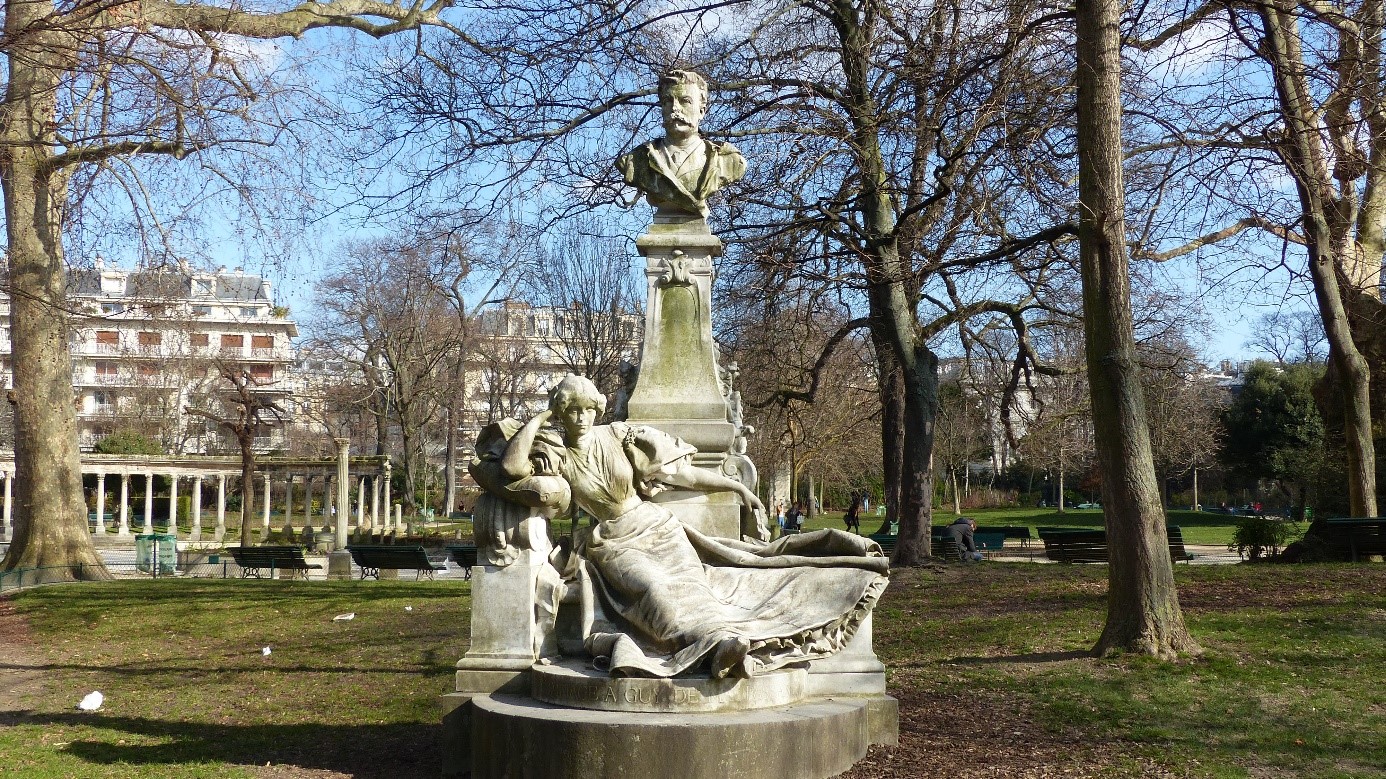
Monument to Guy de Maupassant in Parc Monceau.

Book 15 #20 Books of Summer Winter
Sydney 19℃
Dublin 23℃

Friday, 26 July 2019

Maigret and the Ghost #62 by Georges Simenon

Reading a Maigret or two during Paris in July has now become one of those things that I look forward to with a great deal of anticipation each year. Because of this though, I now associate Maigret with dreary, winter nights and rainy days (although not so much of the rain this year). My last two Maigret's, which were both set in Paris in high summer, had me all turned upside down and seasonally confused.

Fortunately Maigret and the Ghost takes us back to winter in Paris, and it feels like the seasons (if not the months) are back in sync for now.


This was mid-November and it had rained all day. Maigret hadn't left the stiflingly hot atmosphere of his office since eight o'clock the previous morning. Before crossing the courtyard, he turned up the collar of his overcoat.

I classify these crime stories as cosy, simply because even though people die we don't then have detailed forensic information or grisly crime scenes raked over by specialists using all sorts of forensic jargon. This type of gory story seems to dominate many of the modern crime stories, which is why I don't read (or watch) them. It's not my thing.

The Maigret's are pure detective story. The books are about the man, more than the crime. He is our hero that we come to admire, if not love, with each book. We get to know his techniques and his moods. The pleasure in reading comes from watching Maigret untangle the clues. His psychological methods and intuition become familiar and reliable.

In this case, we see Maigret, weary after coming off an all-nighter solving another unrelated crime, suddenly being informed of a shooting incident involving an inspector from a neighbouring precinct. Maigret quickly realises that his colleague was onto something big and that time is of the essence to stop another major criminal act from taking place. Art smuggling, forgeries, kidnapping and blackmail are the crimes with missing witnesses, nosy neighbours and deceptive suspects the spanners in the works.

It may be a little weird to say a crime novel was a lot of fun, but when Simenon gets it right, watching Maigret piece it all together is such a joy. This is one of the Maigret's where Simenon gets out of the way and lets Maigret do all the work instead.

Highly recommended.

Series:
  • 1. The Strange Case of Peter the Lett, The Case of Peter the Lett, Maigret and the Enigmatic Lett (1931)
  • 2. The Crime at Lock 14, Maigret Meets a Milord, Lock 14 (1931)
  • 3. The Death of Monsieur Gallet, Maigret Stonewalled (1931)
  • 4. The Crime of Inspector Maigret, Maigret and the Hundred Gibbets (1931)
  • 5. A Battle of Nerves, Maigret's War of Nerves, A Man's Head (1931)
  • 6. A Face for a Clue, Maigret and the Concarneau Murders, Maigret and the Yellow Dog, The Yellow Dog (1931)
  • 7. The Crossroad Murders, Maigret at the Crossroads (1931)
  • 8. A Crime in Holland, Maigret in Holland (1931)
  • 9. The Sailor's Rendezvous (1931)
  • 10. At the "Gai Moulin", Maigret at the "Gai Moulin" (1931)
  • 11. Guinguette by the Seine, Maigret and the Tavern by the Seine, The Bar on the Seine (1931)
  • 12. The Shadow in the Courtyard, Maigret Mystified (1932)
  • 13. Maigret and the Countess, The Saint-Fiacre Affair, Maigret Goes Home, Maigret on Home Ground (1932)
  • 14. The Flemish Shop, Maigret and the Flemish Shop (1932)
  • 15. Death of a Harbo(u)r Master, Maigret and the Death of a Harbor Master (1932)
  • 16. The Madman of Bergerac (1932)
  • 17. Liberty Bar, Maigret on the Riviera (1932)
  • 18. The Lock at Charenton (1933)
  • 19. Maigret Returns (1934)
  • 20. Maigret and the Hotel Majestic (1942)
  • 21. Maigret in Exile (1942)
  • 22. Maigret and the Spinster (1942)
  • 23. To Any Lengths, Signe Picpus, Maigret and the Fortuneteller (1944)
  • 24. Maigret and the Toy Village (1944)
  • 25. Maigret's Rival, Inspector Cadaver (1944)
  • 26. Maigret in Retirement (1947)
  • 27. Maigret in New York, Inspector Maigret in New York's Underworld, Maigret in New York's Underworld (1947)
  • 28. A Summer Holiday, No Vacation for Maigret, Maigret on Holiday (1948)
  • 29. Maigret's Dead Man, Maigret's Special Murder (1948)
  • 30. Maigret's First Case (1949)
  • 31. My Friend Maigret, The Methods of Maigret (1949)
  • 32. Maigret at the Coroner's (1949)
  • 33. Maigret and the Old Lady (1950)
  • 34. Madame Maigret's Own Case, Madame Maigret's Friend, The Friend of Madame Maigret (1950)
  • 35. Maigret's Memoirs (1951)
  • 36. Maigret and the Strangled Stripper, Maigret in Montmartre, Inspector Maigret and the Strangled Stripper (1951)
  • 37. Maigret Takes a Room, Maigret Rents a Room (1951)
  • 38. Inspector Maigret and the Burglar's Wife, Maigret and the Burglar's Wife (1951)
  • 39. Inspector Maigret and the Killers, Maigret and the Gangsters (1952)
  • 40. Maigret's Revolver (1952)
  • 41. Maigret and the Man on the Boulevard, Maigret and the Man on the Bench (1953)
  • 42. Maigret Afraid (1953)
  • 43. Maigret's Mistake (1953)
  • 44. Maigret Goes to School (1954)
  • 45. Inspector Maigret and the Dead Girl, Maigret and the Young Girl (1954)
  • 46. Maigret and the Minister, Maigret and the Calame Report (1955)
  • 47. Maigret and the Headless Corpse (1955)
  • 48. Maigret Sets a Trap (1955)
  • 49. Maigret's Failure (1956)
  • 50. Maigret's Little Joke, None of Maigret's Business (1957)
  • 51. Maigret and the Millionaires (1958)
  • 52. Maigret Has Scruples (1958)
  • 53. Maigret and the Reluctant Witnesses (1959)
  • 54. Maigret Has Doubts (1959)
  • 55. Maigret in Court (1960)
  • 56. Maigret in Society (1960)
  • 57. Maigret and the Lazy Burglar (1961)
  • 58. Maigret and the Black Sheep (1962)
  • 59. Maigret and the Saturday Caller (1962)
  • 60. Maigret and the Dosser, Maigret and the Bum (1963)
  • 61. Maigret Loses His Temper, Maigret's Anger (1963)
  • 62. Maigret and the Ghost, Maigret and the Apparition (1964)
  • 63. Maigret on the Defensive (1964)
  • 64. The Patience of Maigret, Maigret Bides His Time (1965)
  • 65. Maigret and the Nahour Case (1967)
  • 66. Maigret's Pickpocket (1967)
  • 67. Maigret Takes the Waters, Maigret in Vichy (1968)
  • 68. Maigret Hesitates (1968)
  • 69. Maigret's Boyhood Friend (1968)
  • 70. Maigret and the Killer (1969)
  • 71. Maigret and the Wine Merchant (1970)
  • 72. Maigret and the Madwoman (1970)
  • 73. Maigret and the Loner (1971)
  • 74. Maigret and the Flea, Maigret and the Informer (1971)
  • 75. Maigret and Monsieur Charles (1972)
  • A Maigret Christmas
Book 14 of 20 Books of Summer Winter
Sydney 19℃
Dublin 23℃