- Shortlisted Costa Book Awards 2018
This Reading Life
Wednesday, 23 December 2020
The Salt Path | Raynor Winn #UKNonFiction
Monday, 21 December 2020
How We Live Now: Scenes from the Pandemic | Bill Hayes
It’s a little like losing your life while still being alive, this experience.
Behind me a small line had formed....A family was looking for books for their kids to read. I felt like I was in a metaphorical breadline - a breadline for feeding the brain and the soul.
When you look out & see the empty streets & sidewalks & shuttered shops, a friend tells me, see it as solidarity - everyone doing their best to keep themselves & everyone else healthy....Even so, I can’t deny how sad & disorientating the absence of life in these once busy streets seems.It's only a small volume. A slim slice of life as we are living it now, by someone who has a tender eye for detail, for the unusual and the routine. Hayes is a thoughtful man who reflects on how is feeling throughout this time as well as documenting the impact on some of those around him.
In the enforced solitude and silence, you can sometimes hear yourself replaying moments in your life, things said or not said, done or not done, love expressed or not expressed, all the gratitude you’ve ever received, all the gratitude you’ve ever felt.He captured some of the feelings and moods that I also experienced during our Sydney lockdown. The moments of anxiety as well as the odd moments of peace - being able to listen to an individual bird sing, watching a skateboarder roll down an empty street from his apartment window...
Because I’ve worked at home for years now, the mandate to stay home and work from home is, I imagine, a little easier for someone like me. I’m also a loner and an introvert (except when it comes to strangers), which helps too.
Even so, there are times when I feel spooked - not scared but spooked.However, what I found most endearing or comforting as I read How We Live Now, was the sense of solidarity that we are all in this together, and the reminder to live our lives now. Our collective here and now may not be the one we planned for or expected, but this is what we have right now.
Because what IS is what matters most. What was will only make you blue in New York.
This is our life. We are living it. And that's all we have ever been able to do - to live in the world we are in.
Wishing that things were 'normal' or talking about when things go back to 'normal', will only lead us to despair. This is our normal now. We're living it. Whatever happens afterwards, will be different to what went before. This experience will change us all, in big ways and in small. We don't know what or how yet, but change is one of the few things guaranteed in life. Covid-19 has simply been a real in-your-face reminder that this is so. If we fight against it, we can become bitter and disappointed. However, if we accept it, and let go of our desire to control everything (one of the hardest lessons I've certainly had to learn as an adult) we can learn to roll with the punches and find some grace in just being, here, now.
And like Hayes, I am curious to see what's on the other side.
I am climbing the walls here. But I also know I am among the most fortunate: I have a roof over my head, food in my fridge, and my health to be thankful for. So, if this is how we have to live - with masks and gloves and almost no human contact for several more months - then so be it, this is how we have to live. I just want to see what's on the other side of this f***ing mountain.
- The Plague | Albert Camus
- How We Live Now | Bill Hayes (non-fiction Covid-19)
- The Stand | Stephen King
- Moloka'i | Alan Brennert (Leprosy)
- All Fall Down | Sally Nicholls (The Black Death) YA
- Hamnet | Maggie O'Farrell (The Plague)
- Oryx and Crake | Margaret Atwood
- Year of Wonders | Geraldine Brooks (Great Plague of London)
- The Pull of the Stars | Emma Donoghue (Spanish Flu)
- A Journal of the Plague Year | Daniel Defoe (Great Plague of London)
- Intimations | Zadie Smith (non-fiction Covid-19)
My Current Plague Reads:
- A Distant Mirror: The Calamitous 14th Century | Barbara Tuchman (non-fiction The Black Death)
- How We Live Now | Bill Hayes
Up Next:
- Pale Horse, Pale Rider | Katherine Anne Porter (Spanish Flu)
- The Decameron Project: 29 Stories from the Pandemic | The New York Times (Covid-19)
Friday, 27 November 2020
Writers on Writers: Josephine Rowe on Beverley Farmer #AWW
Writers on Writers
In the Writers on Writers series, leading authors reflect on an Australian writer who has inspired and influenced them. Provocative and crisp, these books start a fresh conversation between past and present, shed new light on the craft of writing, and introduce some intriguing and talented authors and their work.
Published by Black Inc. in association with the University of Melbourne and State Library Victoria.
Josephine Rowe on Beverley Farmer was my first foray into the Writers on Writers series. It was a very literary affair. A non-fiction novella if you like (and I do, which means this can also be part of Novellas in November!)
I confess that I did not know very much about Farmer prior to reading this book, and I'm not sure I know a whole lot more now. But I suspect, she was that kind of person. Very private. Extremely shy. But I am curious to know more.
"This far, and no further. A familiar refrain of Farmer's throughout her writing life."
As Rowe explains, 'her characters are outsiders, foreigners, fringe dwellers. Expats and exiles, those returning home after long absences...' much like Farmer (and Rowe) themselves. It certainly seemed that part of Rowe's fascination for Farmer, was for what Farmer's life and work could tell her about herself as well.
every encounter with a text is influenced by the circumstances in which we read.
Across Farmer's works there has always been an attraction to those beings who occupy two worlds...Once one has lived elsewhere, lived differently, it doesn't matter whether she stays to forge a new life or turns back towards the old, or moves on once again; there will always be the shadow, the after-image, of the life not lived.
Our relationship with the past and those who populate it is constantly shifting, as is our awareness of the ways in which it has shaped us....In returning to our first stories, those most deeply etched, are we seeking the comfort of...the familiar arrangements and foretokenings a means of retelling the story ourselves so that we might reconcile ourselves to an ending?
Facts:
- Beverley Farmer - born in Melbourne 7 February 1941
- Died 16 April 2018
- Short story anthologies:
- Snake (1982)
- Milk (1983)
- Home Time (1985)
- Collected Stories (1987)
- This Water: Five Tales (2017)
- Alone (1980)
- The Seal Woman (1992)
- The House in the Light (1995)
- A Body of Water: A Year's Notebook (1990)
- The Bone House (2005)
- A Body of Water has just been republished by Giramondo Publishing.
- 1984 – NSW Premier's Literary Awards, Christina Stead Prize for Fiction for Milk
- 1996 – Miles Franklin Award shortlist for The House in the Light
- 2009 – Patrick White Award
- 2018 – The Stella Prize longlist for This Water
- Stan Grant on Thomas Keneally due May 2021.
![]() |
Wednesday, 18 November 2020
Non-Fiction November - Week Three
Week 3: (Nov. 16 to 20) – Be The Expert/Ask the Expert/Become the Expert (Rennie of What’s Nonfiction): Three ways to join in this week! You can either share 3 or more books on a single topic that you have read and can recommend (be the expert), you can put the call out for good nonfiction on a specific topic that you have been dying to read (ask the expert), or you can create your own list of books on a topic that you’d like to read (become the expert).
1. Prehistoric epidemic: Circa 3000 B.C.
2. Plague of Athens: 430 B.C.
3. Antonine Plague: A.D. 165-180
4. Plague of Cyprian: A.D. 250-271
5. Plague of Justinian: A.D. 541-542
6. The Black Death: 1346-1353
7. Cocoliztli epidemic: 1545-1548
8. American Plagues: 16th century
9. Great Plague of London: 1665-1666
10. Great Plague of Marseille: 1720-1723
11. Russian Plague: 1770-1772
12. Philadelphia yellow fever epidemic: 1793
13. Flu pandemic: 1889-1890
14. American polio epidemic: 1916 - 1956
15. Spanish Flu: 1918-1920
16. Asian Flu: 1957-1958
17. AIDS pandemic and epidemic: 1981-present day
18. H1N1 Swine Flu pandemic: 2009-2010
19. West African Ebola epidemic: 2014-2016
20. Zika Virus epidemic: 2015-present day
- The Plague | Albert Camus
- The Stand | Stephen King
- Moloka'i | Alan Brennert (Leprosy)
- All Fall Down | Sally Nicholls (The Black Death) YA
- Hamnet | Maggie O'Farrell (The Plague)
- Oryx and Crake | Margaret Atwood
- Year of Wonders | Geraldine Brooks (Great Plague of London)
- The Pull of the Stars | Emma Donoghue (Spanish Flu)
- A Journal of the Plague Year | Daniel Defoe (Great Plague of London)
- Intimations | Zadie Smith (non-fiction Covid-19)
My Current Plague Reads:
- A Distant Mirror: The Calamitous 14th Century | Barbara Tuchman (non-fiction The Black Death)
Up Next:
- Pale Horse, Pale Rider | Katherine Anne Porter (Spanish Flu)
Plague/Pandemic Fiction Books On My Radar:
- Station Eleven | Emily St John Mandel
- Blindness | José Saramago
- The Last Man | Mary Shelley
- Nemesis | Philip Roth (Polio)
- Love in the Time of Cholera | Gabriel Garcia Marquez
- The Years of Rice and Salt | Kim Stanley Robinson
- The Dog Stars | Peter Heller
- The Pest House | Jim Crace
- The Children’s Hospital | Chris Adrian
- Severance | Ling Ma
- Fever 1793 | Laurie Halse Anderson (Philadelphia Yellow Fever Epidemic)
- The White Plague | Frank Herbert
- The Passage | Justin Cronin
- Company of Liars | Karen Maitland (The Black Death)
- The Decameron | Giovanni Boccaccio (The Black Death)
- The Decameron Project 2021 | (Covid-19)
- The End of October | Lawrence Wright
- The Ghost Map: The Story of London's Most Terrifying Epidemic—and How It Changed Science, Cities, and the Modern World | Steven Johnson (Cholera pandemic 1846–1860 - obviously not bad enough to make the top 20 list above!)
- Black Death | Philip Ziegler (The Black Death)
My 2017 Holocaust Be the Expert post is here.
My 2018 Napoleon & the French Revolution Become the Expert post is here.
Tuesday, 3 November 2020
Non-Fiction November - Week One
Week 1: (Nov. 2 to Nov. 6) – Your Year in Nonfiction (Leann of Shelf Aware)
- Take a look back at your year of nonfiction and reflect on the following questions – What was your favourite nonfiction read of the year? Do you have a particular topic you’ve been attracted to more this year? What nonfiction book have you recommended the most? What are you hoping to get out of participating in Nonfiction November?
- Intimations: Six Essays (Covid/lockdown related essays by Zadie Smith)
- The Fire This Time (a brilliant collection of BLM essays & poems)
- Humankind: A Hopeful History (easy to read AND hopeful!)
- Truganini (the tragic story of the 'last' Aboriginal woman in Tasmania)
- Fathoms: The World in a Whale (a writers response to the distressing sight of whales beaching themselves on her local beach in Australia)
- The Cloudspotter's Guide (if you've ever wondered what that cloud above you is called, wonder no more!)
- 7 Steps to Get Your Child Reading (a great guide for parents to get excited about reading with their kids with Australian links)
- 488 Rules For Life (an Australian comedienne's take on how best to live our lives!!)
- Talking to My Daughter About the Economy (I thought a bit of dad-splaining would help me understand the economy, but it didn't)
- Sand Talk (an Indigenous perspective on how to make sense of this world we live in)
- A Month in Siena (a glorious, thoughtful month in the life of Matar as he ponders art from the Sienese school and his father's death)
- Ten Doors Down (a touching memoir about adoption)
- The Adventures of Alexander von Humboldt (a disappointing graphic novel version of one of my favourite all-time non-fiction titles, The Invention of Nature)
Monday, 26 October 2020
Intimations: Six Essays | Zadie Smith #NonFiction
It stares you in the face. No role is so well suited to philosophy as the one you happen to be in right now.
My vocabulary is adequate for writing notes and keeping journals but absolutely useless for an active moral life.
1. Talking to yourself can be useful.2. And writing means being overheard.
- Walking is what got me through our lockdown in NSW. It was autumn, the weather was glorious, and I walked for hours through parks, and past gardens in their final flush of flowering. I took solace in the changing of the leaves and the shortening of the days, even in a built up inner city suburb. Splashes of geraniums and chrysanthemums would catch my eye and lift my spirits. The sun would sparkle on the harbour and reflect in the glassed sky scrapers across the bay, along with the blue skies and clouds.
writing is control...writing is all resistance...to write is to swim in an ocean of hypocrisies.
- I was surprised by how quickly and easily I submitted to the changing circumstances. My control, my creativity found expression in photography. I captured the autumnal changes and posted them on instagram. I didn't need my tulips to be peonies. For me, any flower would do!
- Curiously, I don't. There was absolutely nothing wrong with my old life; I loved most of it, most of the time. But even back then, pre-Covid, life changed and evolved. Things shifted. Good things happened; bad things happened. And we moved onto the next thing. This is the next thing. It's a bit bigger and more drastic than is usual, but it's what we do. Life changes and we can never go back. There is only a constantly changing now.
Death absolute is the truth of our existence as a whole, of course, but America has rarely been philosophically inclined to consider existence as a whole....
- Every time I read something about the American health system, I am so grateful to live in a country that has basic free health cover for all of it's citizens.
war transforms its participants. What was once necessary appears inessential.
- I've realised I don't need to go out as often as I did. I'm an introvert and staying home, quietly, is pretty easy for me. But I do miss art galleries. It's not necessary for me to go shopping or go out every night. I don't need hustle and bustle or endless stimulation. But I do need beauty. And I need my local community. I need to know we will have cafes and restaurants and local businesses going forward. I now only shop local; no online megastores for me.
- Once I got over the distraction of lockdown and all the Covid news, I rediscovered reading. I've always read, but now, I'm reading more than ever. Creating little projects for ourselves is a good thing. We do need to keep busy; it can keep the demons at bay. And if it's something you also love to do, or it helps those you love, then bonus! Bake bread, solve a puzzle, create a potted herb garden, clean out your cupboards, paint the deck. Yes, it's busy work. Yes, it's something we do, because most of us really have 'no idea what life is for', so surely it's better to being doing something, than glumly doing nothing. The older I get, the more I realise there is no meaning of life. Life is simply what we make of it.
- I acknowledge all the good fortune that I have experienced during Covid so far. All my family are still working. Some now work from home or have reduced hours, but they're all still working. For those with reduced hours, our government JobKeeper program has buffered any pain. Our lockdown (in NSW) was brief and moderate. Our social lives are curtailed and I miss hugging close friends (I don't miss the cheek kissing or hand shaking though). I only know one person who has had the virus, although most people I know have been tested once or twice. Our state government seems to have nailed contact tracing. Any outbreaks are quickly contained. We feel safe but quiet. The restrictions we live under now are occasionally irksome but not onerous. I am fortunate.
- I liked how this helped Smith to focus on her local community, and how different people are coping with Covid and lockdown. Covid has also concentrated my gaze onto the local. I'm doing all my grocery shopping locally, I eat takeaway from our local restaurants. I could have coffee at home, but I'm getting it from a rotating set of local baristas on my walk to work instead. I'm not the only one. Many of those new to working from home, are taking their laptops to local cafes for the company. We've lost a few businesses, but they were struggling before Covid. I see more people reading books, in cafes, in the parks, and in the doctor's surgery.
- It's not easy for the young. B20 is home more than out. And when out, he and his friends cannot dance, sing or walk around. They must sit in a pub, at a designated table. They are usually home again by 1pm. B20 is mostly philosophical. It's all he knows. They have social media to keep in touch. At least he isn't heading off to war, like many previous generations of young men his age. It could be worse.
That my physical and moral cowardice have never really been tested, until now.
Previous Plague/Pandemic Reads:
- The Plague | Albert Camus
- The Stand | Stephen King
- Oryx and Crake | Margaret Atwood
- Year of Wonders | Geraldine Brooks
- The Pull of the Stars | Emma Donoghue
- A Journal of the Plague Year | Daniel Defoe
- Intimations | Zadie Smith (non-fiction)
Current Plague Reads:
- A Distant Mirror: The Calamitous 14th Century | Barbara Tuchman (non-fiction)
- Pale Horse, Pale Rider | Katherine Anne Porter
Plague/Pandemic Books On My Radar:
- Station Eleven | Emily St John Mandel
- Blindness | José Saramago
- The Last Man | Mary Shelley
- The Ghost Map: The Story of London's Most Terrifying Epidemic—and How It Changed Science, Cities, and the Modern World | Steven Johnson (non-fiction)
- Nemesis | Philip Roth
- Love in the Time of Cholera | Gabriel Garcia Marquez
- The Years of Rice and Salt | Kim Stanley Robinson
- The Dog Stars | Peter Heller
- The Children’s Hospital | Chris Adrian
- Severance | Ling Ma
- The White Plague | Frank Herbert
- The Passage | Justin Cronin
Friday, 23 October 2020
The Cloudspotter's Guide | Gavin Pretor-Pinney #NonFiction
Non-fiction reads are usually a labour of love for me. I start them in a fit of passion and enthusiasm, that then waxes and wanes with my mood, time and other interests.
I've always been a bit of an amateur cloudspotter.
My interest started when I was about 10. I was required to do a project on the cloud types for school. At the time, I had an uncle who worked for the water board. One of his daily duties was to check the meteorological equipment. He provided me with sheets of information about clouds. I've always loved sorting and classifying stuff, so my 10 yr old self was amazed, then impressed that someone, or multiple someone's, had watched the clouds for so long that there was now a whole system of precise classification and labelling for me to learn.
Pretor-Pinney has created a lovely looking book for those of us devoted to gazing at the skies. The book aims to provide the facts about 'all the delightful and eccentric characters in the cloud family' for the general reader. He has included poems and charts and pictures in a glorious 'celebration of the carefree, aimless and endlessly life-affirming pastime of cloudspotting.'
There is a cloudspotter's Manifesto and lovely wood engravings gracing the first page of each chapter by Bill Sanderson. Myths, legends, religious beliefs and stories about clouds are littered throughout the facts and figures.
I learnt a lot too.
- For instance, there's the incredible story of Lt-Col William Rankin, a pilot who had to eject from his plane at a height of 47 000 ft, to only get stuck with his parachute and light-weight summer clothes, in the violent, swirling updrafts of a cumulonimbus storm cloud for 40 mins. He was battered by hailstones at -50℃, deafened by thunderclaps and almost struck by lightning. He managed to survive the decompression, the fall and the storm without any broken bones, with only some bruising and frostbite.
- Lightning heats the air around it instantaneously to 27 000℃!
- There is no difference between sheet and fork lightning. All lightning is fork lightning; sheet lightning is simply lightning hiding behind the clouds and illuminating said cloud from behind.
- The main way to classify lightning is by where the bolt goes. To the ground or in-cloud are the most common possibilities, but there's also cloud-to-cloud lightning and cloud-to-air.
- The main difference between fog and mist is that if you can see less than 1km through, it's fog - between 1-2km's, it's mist. They are both earth-bound stratus clouds.
- You can also have advection fog (sea fog), radiation fog, steam fog (Arctic sea smoke), upslope fog, valley fog, freezing fog and ice fog.
![]() |
| Cumulonimbus |
- When the sun is low on the horizon, the high clouds will be bright white, the middle clouds golden and the lowest clouds will be red.
- Rainbows are not the only 'optical delights' - there are double bows, cloudbows, fogbows and a glory, which can appear around the head of a cloudspotter's shadow.
- Contrails are man-made clouds. Scientists are studying the environmental impact of contrails. After 9/11 and the three day no flights period, they realised that contrails 'reduced ground temperatures during the day and raised them at night.' Which made me wonder what might be happening to our skies and temperatures now that flights have been drastically reduced during Covid. Turns out that the scientists are asking this question too.
- And Morning Glory! Not a cocktail or a pretty flower, but an amazing cloud formation almost guaranteed to be seen near Burketown, NT between the end of Sept and Feb...in the morning. A favourite with glider pilots who like to surf the warm currents.
Thursday, 17 September 2020
The Fire This Time | Jesmyn Ward #NonFiction
- The Fire This Times opens with a poem by Jericho Brown, The Tradition.
- It's a sonnet that beautifully and brutally compares flowers, blooms and earth to black lives. In just 14 lines, he alludes to the tradition of slavery, the desire for belonging and the current loss of black lives. The poem finishes with three names - John Crawford. Eric Garner. Mike Brown.
- John Crawford III was a 22 yr old man, shot and killed in a Walmart in Beavercreek, Ohio, on the 5th August 2014.
- Eric Garner was killed on the 17th July 2014 in Staten Island after being placed in a choke hold by police.
- Mike Brown Jr was an 18 yr old young man shot by police on the 9th August 2014 in Ferguson, Missouri.
- Brown is the 2020 Pulitzer Prize winning poet and this poem can be found in his latest collection also called The Tradition.
- I was so impressed by this poem, I've ordered Brown's anthology in at work.
- Introduction by Jesmyn Ward.
- Begins with the shooting death of 17 yr old Trayvon Martin on the 26th February 2012 in Sanford, Florida.
- Also Tamir Rice a 12 yr old boy shot & killed by police on the 22nd November 2014 in Cleveland, Ohio.
- Mike Brown (see above)
- Sandra Bland was found hanged on the 13th July, 2015, after 3 days in gaol for a traffic infringement in Waller County, Texas. Her death was declared a suicide.
- Emmett Till was a 14 yr old boy lynched in Mississippi in 1955. His body was found floating in the Tallahatchie River three days after he went missing. According to wikipedia,
The brutality of his murder and the fact that his killers were acquitted drew attention to the long history of violent persecution of African Americans in the United States. Till posthumously became an icon of the civil rights movement.- She turned to the writing of James Baldwin for 'kinship in this struggle'.
- He told her that she was 'worthy of love...worth something in this world...[and]...a human being.'
- His book The Fire Next Time inspired the title of this book.
- Which led her to seek out other writers, thinkers, and voices from her generation. Only three of the submitted pieces referenced the future.
- 'It confirmed how inextricably interwoven the past is in the present, how heavily the past bears on the future.'
- PART I - LEGACY
- Homegoing, AD by Kima Jones
- A hybrid poem that begins with a prose section about a family funeral and ends with a free form verse about outrunning the 'gators.
- Jones is the founder of the Jack Jones Literary Arts whose mission is to 'provide publicity services and support for writers who are unafraid. We work diligently to announce book projects to audiences who seek literary art that is unorthodox, underappreciated, and unparalleled.'
- The Weight by Rachel Kaadzi Ghansah
- Ghansah won the 2018 Pulitzer Prize for Feature Writing.
- She is know for her writing about James Baldwin and his historic home in the South of France, including this piece that discusses her first visit to his home.
'If I knew anything about being black in America it was that nothing was guaranteed, you couldn't count on a thing, and all that was certain for most of us was a black death....a black death was a slow death, the accumulation of insults, injuries, neglect, second-rate health care, high blood pressure and stress, no time for self-care, no time to sigh, and in the end, the inevitable, the erasing of memory.'- Lonely in America by Wendy S. Walters
- 'I resist thinking about slavery because I want to avoid the overwhelming feeling that comes from trying to conceive of the terror, violence and indignity of it.'
- New-to-me word - cathexis - 'the concentration of mental energy on one particular person, idea, or object (especially to an unhealthy degree).'
- Discussion about slavery in the northern states, especially New Hampshire.
- Black Heritage Trail, Portsmouth.
- Where Do We Go From Here? by Isabel Wilkerson
- 'We seem to be in a continuing feedback loop of repeating a past that our country has yet to address.'
- After the end of slavery, came the Reconstruction.
- Then the reversal of black advancement - the Nadir. I had heard of the Jim Crow laws but not the Nadir (1890 - 1940).
- 'Six million African Americans fled that caste system, seeking asylum in the rest of the country during what would become the Great Migration. Denied the ballot, they voted with their bodies.'
- In the north they met with 'redlining, overpolicing, hyper-segregation, the seeds of the disparity we see today.'
- Wilkerson was the first African American woman to win a Pulitzer Prize in Journalism Feature Writing in 1994.
- The Dear Pledges of our Love: A Defense of Phillis Wheatley's Husband by Honoree Fanonne Jeffers
- Phillis Wheatley - poet (1753-84)
- The Age of Phillis published March 2020 by Wesleyan University Press - 'imagines the life and times of Wheatley: her childhood in the Gambia, West Africa, her life with her white American owners, her friendship with Obour Tanner, and her marriage to the enigmatic John Peters.'
- White Rage by Carol Anderson
- 'white rage carries an aura of respectability and has access to the courts, police, legislatures, and governors.'
- for every 'African American advancement, there's a reaction, a backlash.'
- As an outsider, I'm astounded every time I read how easy it is to manipulate the US electoral system - against African Americans, against women, against the poor and disenfranchised. Our system is not perfect, but we make it easy for everyone to vote. Whether you choose to use that right is up to you. It's a right and a responsibility.
- Cracking the Code by Jesmyn Ward
- on the difficulty faced by most African Americans when creating their family tree.
- and on the unsettling & discomforting information that genetic DNA testing can provide.
- is identity genetics, heritage, personal history, or how others perceive you?
- PART II - RECKONING
- Queries of Unrest by Clint Smith (poem)
- modelled after the work of poet Hanif Willis-Abdurraqib
- Maybe, maybe, maybe...
- Maybe I'm scared of writing another poem/that makes people roll their eyes/and say, "another black poem."
- Blacker Than Thou by Kevin Young
- the issue of blackface, 'passing' and reverse-passing.
- I did not know that Thomas Jefferson had a black mistress, Sally Hemings, who gave him six children.
- Young is the poetry editor for the New Yorker.
- Da Art of Storytellin' (A Prequel) by Kiese Laymon
- 'voices aren't discovered fully formed, they are built and shaped.'
- storytelling via hip hop and rap.
- Read - Octavia Butler | Kindred
- Black and Blue by Garnette Cadogan
- the art of walking and the difference between walking the streets of Kingston, Jamaica, New Orleans and NYC.
- 'I could be invisible in Jamaica in a way I can't be invisible in the United States.'
- 'walking is an act of faith...we see, we listen, we speak, and we trust...I strolled into my better self...'
- 'walking while black restricts the experience of walking...it forces me to be in a constant relationship with others...' Understood. It's the same for most women when walking alone.
- The Condition of Black Life is One of Mourning by Claudia Rankine
- the beginning of the Black Lives Matter movement - 'an attempt to keep mourning an open dynamic in our culture because black lives exist in a state of precariousness.'
- Just Us: An American Conversation published September 2020 by Graywolf Press.
- Know Your Rights! by Emily Raboteau
- how to talk to your children about protecting themselves from the police.
- 'this mural struck me as an act of love for the people who would pass it by.'
- Raboteau spotted her first social justice mural and went searching for the others (below).

- Composite Pops by Mitchell S. Jackson
- the importance of father figures to kids, especially boys.
- a lovely homage to the men who mentored him throughout his life.
- PART III - JUBILEE
- Theories of Time and Space by Natasha Trethewey
- US Poet Laureate 2012 & 2013 .
- Pulitzer Prize winner for poetry 2007.
- This Far: Notes on Love and Revolution by Daniel Jose Older
- 'unraveling all the creation myths this country has always held most sacred.'
- Message to my Daughters by Edwidge Danticat
- African Americans as internal and external refugees
- 'You think that your pain and your heartbreak are unprecedented in the history of the world, but then you read.' James Baldwin
- Tragically, Jesmyn Ward's 33 yr old husband died in January this year after they all contracted what they thought was the flu. She writes about her grief in a recent Vanity Fair article, On Witness and Respair.
- Respair - OED: noun and verb, meaning the return of hope after a period of despair—only citation for this dates back to 1425. Sadly, it has now fallen out of use.
Thursday, 13 August 2020
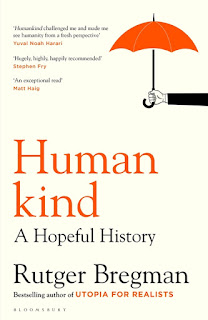
Humankind: A Hopeful History | Rutger Bregman #NonFiction
Infectious diseases like measles, small pox, tuberculosis, syphilis, malaria, cholera & plague were all unheard of until we traded our nomadic lifestyle for farming. So where did they come from? From our new domesticated pets - or more specifically, their microbes.
I was saddened when he noted later on that "education has become something to endure." The truth of this has been brought home to me constantly over the past decade as the boys finished their school years. They have no inspirational stories to tell about their school days, like Mr Books and I both do. They have plenty of tales about what they got up to with their friends during the breaks, but nothing about what they learnt. All they ever wanted to know was what they would need to pass their exams to get them out of there. How did education become such a dull, routine thing?
Bregman finished with his very own 10 rules to live by (everyone seems to be doing it lately!)
- when in doubt assume the best
- think in win-win scenarios
- ask more questions
- temper your empathy, train your compassion
- try to understand the other, even if you don't understand where they're coming from
- love you own as others love their own
- avoid the news
- don't punch Nazis
- come out of the closet: don't be ashamed to do good
- be realistic
- Translated by Elizabeth Manton and Erica Moore.
- Bregman was born the year I finished my Diploma of Education (1988).
- Author of Utopia for Realists: How We Can Build the Ideal World (2016).
Tuesday, 23 June 2020
7 Steps to Get Your Child Reading | Louise Park #NonFiction
The reality is that the one-on-one sharing of quality literature has to come from the child's family, extended family and out-of-school environment.
the most important stuff I've learned I think I've learned from novels. It has to do with empathy. It has to do with being comfortable with the notion that the world is complicated and full of greys, but, there's still truth to be found, and that you have to strive for that, and work for that. And the notion that it's possible to connect with someone else even though they're different from you.
Saturday, 16 May 2020
The Illustrated Golden Bough | Sir James George Fraser #Readalong
Books like mine, merely speculation, will be superseded sooner or later (the sooner the better for the sake of truth) by better induction based on fuller knowledge."His critics were not only upset by the inclusion of the Christian story, but one Edmund Leach, "one of the most impatient critics of Frazer's overblown prose and literary embellishment of his sources for dramatic effect" said that,
Frazer used his ethnographic evidence, which he culled from here, there and everywhere, to illustrate propositions which he had arrived at in advance by a priori reasoning, but, to a degree which is often quite startling, whenever the evidence did not fit he simply altered the evidence!
- I should have read the Intro by Robert Temple before publishing this post.
- He posits a kinder way of viewing Frazer's work than did Leach.
- Temple clarifies Frazer's anthropological position as an interest in taboos and totemism.
- He believes that Frazer took 'the grand view' surveying 'world history as a whole'.
- Temple saw Frazer's ability to 'change his hypothesis if he saw it to be inadequate' as one of two 'exemplary characteristics.' The other being his 'disregard for excessive specialisation'.
- He concluded with, 'Frazer was essentially a nineteenth-century thinker, and approaches to social anthropology have changed....some of his views are no longer compatible with current thinking. However (his work) remains a vital part of cultural history. It is a unique archive and work of literature, and Frazer's splendid prose style is a pleasure to read.'
- A far more generous appraisal of The Golden Bough and Frazer, I'm sure you will agree.