Showing posts with label Recipe. Show all posts

Wednesday, 5 August 2020

A Little Paris in July in the Kitchen

To finish off another wonderful year of Paris in July with Tamara @Thyme For Tea, I'm going to tempt you with a few of the Parisian style means I enjoyed through July.

My favourite local cafe is called Cafe d'Yvoire. They specialise in French cakes, desserts and meals. Mostly I just enjoy my morning coffee with my latest read on my days off work. But this year has been different. Covid-19 has changed many things and one of the big things has been the pressure on small businesses to stay viable during lockdowns and social distancing restrictions. 

During the height of lockdown, I continued to get my morning coffee as a takeaway, purchased through the window. For family lockdown Saturday night dinners, I would also take home various desserts for us to try. I fell in love with the salted caramel cheesecake (below), while Mr Books is a traditional lemon meringue tart man, and B19 was happy with anything chocolate-y.

Once we were allowed to dine in again, I found myself still eating the desserts, this time with my morning coffee and book! I had to increase the distance of my morning walk to justify the change!


I may have also treated myself to their magnificent Croque Madame once or twice during July as well!


It wasn't all just eating out and takeaway though.

For Mother's Day the boys gave me a book set called Art of French Cuisine. I will need more time and patience to tackle the sweet book, but the savoury book gave me lots to work with. 

With some roast beef one night, I made the Gratin Dauphinois with Haricots verts aux tomates cerises. The Gratin in particular was a HUGE hit.


A couple of weeks later I tried Julia Child's Suprêmes de Volaille aux Champignons from her Mastering the Art of French Cooking Volume One

The rich, creamy sauce was a little too much for B19, but I fell in love big time. So much so, I'm going to include a version of the recipe below. I highly recommend it.

Trying to follow one of Julia child's recipes can be a trying experience. She liked to skip back and forth between the master recipe and the one you're trying to actually cook! Finding an online version that has been collated and tidied up is much easier to use. This is one of those, with my little tweeks.

Ingredients:
  • suprêmes - chicken breasts (I cut the chicken into quarters & adjusted cooking time slightly to allow for the smaller pieces, I didn't want to have to eat a whole chicken breast on my own.)
  • 1 teaspoon fresh lemon juice
  • pinch of white pepper
  • 5 Tablespoons butter
  • 120 grams white mushrooms, sliced
  • 2 Tablespoons shallots, diced
  • ⅛ teaspoon salt
  • Sauce:
  • ¼ cup chicken of beef stock
  • ¼ cup dry vermouth
  • 1 cup of whipping cream
  • salt/pepper to taste
  • 2 tablespoons fresh parsley, chopped
Instructions:
  • Rub the chicken breasts with drops of lemon juice and season with salt & white pepper.
  • Heat the butter in a heavy, oven-proof casserole until it is foaming.
  • Stir in the minced shallots and saute for a minute - do not wait to brown.
  • Stir in the mushrooms and saute lightly for 1-2 minutes - do not wait to brown.
  • Sprinkle with salt.
  • Quickly flip the chicken breasts in the butter mixture. 
  • Cover and cook over medium high heat for 8-10 minutes.
  • After that time, flip chicken breasts and cook on opposite side for another 8-10 minutes until chicken temperature reaches at least 165 degrees.
  • Remove the chicken to a warm plate (leave mushrooms/onions in the pot) and cover while making the sauce.
  • To make sauce, pour the chicken/beef stock and vermouth in with the cooking butter and mushrooms/onions.
  • Over medium high heat, boil down quickly until liquid is syrupy.
  • Stir in cream and boil down again over medium high heat until cream has thickened slightly. 
  • Off heat, taste for seasoning, and add drops of lemon juice to taste.
  • Pour the sauce over the chicken, sprinkle with parsley and serve immediately.


Bon appetit!

Saturday, 3 August 2019

The Widows of Malabar Hill by Sujata Massey

The Widows of Malabar Hill by Sujata Massey is exactly the type of cosy crime I enjoy reading on a cold, rainy wintery weekend.

Much like the UK series about Maisie Dobbs and the Australian series by Kerry Greenwood about Phryne Fisher, Massey has created the Indian version of these smart, pioneering 1920's women who have the ability to be in the right place at the right time to solve crimes.


Sujata was born in England to parents from India and Germany. She now lives in the US, which may explain why I often felt that the Indian nature of the story was technically correct and well researched, but didn't always feel authentic. I spent most of the book feeling like a tourist, on the outside looking in. I will be curious to hear how one of my fellow book clubbers felt about this though, as she actually grew up living on Malabar Hill in the 1960's.

At times, I had a few quibbles with the 'show don't tell' aspect of Massey's writing and I didn't always feel like I was in 1920's India. Sometimes the dialogue felt awkward and stilted as well. It may have been an accurate reflection of the self-conscious, uneasy tensions that exist when two different classes try to communicate but I'm not sure that's where the problem lay.

However, I cannot deny, that as an easy to read, cosy crime story, The Widows of Malabar Hill was a winner. It has a likeable protagonist in Perveen Mistry and an exotic setting. Being based on versions of a true story gives the book another tick in its favour.

Mistry's backstory was interesting, but at times felt contrived. Perhaps it was all the 'telling' going on rather than showing, revealing and letting the reader get there themselves. Certainly the reader doesn't have to do anything other than just read, Massey does all the work. Despite all the descriptions, I have no residual visual image of the characters or the place. The historical element also felt rather loose. I had to keep reminding myself it was meant to be the 1920's.

I obviously had some technical issues with the writing, but ultimately I enjoyed the story and will probably read the sequel The Satapur Moonstone at some point. You may be surprised to hear that, after all the issues I had with this book, but sometimes a book is just for reading. And sometimes a book leaves you with enough of a warm glow, to make a dreary wintery weekend a little brighter.

Favourite or Forget: I suspect this will fade from my memory fairly quickly.

Food:

My edition comes with a few recipes (of meals eaten throughout the book) at the back. I'm keen to try the Malabar Spinach and Eggs one day.

Preparation Time: 20 minutes
Cooking Time: 10 minutes
Serves: 2 as breakfast or 4 as part of a dinner
Difficulty: Easy

Here’s a moderately spicy recipe that is a Parsi classic. Malabar spinach, also known as water spinach or poisaag, can be found at Asian grocers and farmer’s markets. Large leaf spinach or swiss chard is a good substitute. You’ll need a wide frying pan with a lid to prepare this dish.

Ingredients:
  • 2 tablespoons canola, safflower or sunflower oil
  • 1/2 cup chopped onion
  • 4 curry leaves (optional)
  • 2 teaspoons grated fresh ginger
  • 1 minced garlic clove
  • 5 diced Roma tomatoes, or one large tomato
  • 3 tablespoons chopped fresh coriander
  • 1/2 teaspoon turmeric
  • 1/4 teaspoon chilli powder
  • 1 bunch of Malabar spinach, or substitute greens
  • salt to taste
  • 4 eggs

Method:
  1. Heat oil in a wide, deep skillet over medium-low heat. Add onion and optional curry leaves and sauté until onion is translucent.
  2. Add the ginger, garlic, tomatoes, coriander, turmeric, and chilli powder. After the tomatoes are broken down, about two minutes, add the spinach and a few tablespoons of water. Cover with lid and cook for 5 to 7 minutes over low heat, until the spinach is soft. Add salt to taste.
  3. Use a large spoon to make 4 depressions in the soft cooked greens. Break an egg over each of these depressions.
  4. Cover the pan again. If the lid has a curve on its underside, invert the lid and pour a couple of teaspoons of water into the curve. This addition of water heightens the steaming effect as the eggs poach under the lid. Remember to keep the temperature very low.
  5. Peek at the eggs after 3 minutes, and if they are almost set, serve.
Two nights later:
I made an Aussie version of Malabar Spinach and Eggs using bok choy and broccolini. It was perfect for one of our 800 Fast day meals. It was also delicious and the spice mix was great for warming us up on a cold winter's evening.


Facts:

17/20 Books of Summer Winter
Sydney 21℃

Tuesday, 30 July 2019

Mirka & Georges: A Culinary Affair by Lesley Harding & Kendrah Morgan

Mirka & Georges: A Culinary Affair is a beautiful book and hard to define. Is it an art book? Is it a biography? Or is it a recipe book? I guess the subtitle that Harding & Morgan chose gives us a clue to their intentions - that food is the central idea around which the book hinges.


Food, not just because of it's ability to sustain and fill an empty stomach, but the social aspect of food, preparing, sharing, bringing family and friends around a table to eat together, to talk, laugh and philosophise!

Upon arrival in Melbourne in 1951, the Mora's couldn't find a proper cup of coffee or a restaurant that stayed open past 8.30pm. However, it didn't take them long to search out pockets of like-minded people and small European wholesalers as they gathered them into their new home and studio on Collins St.

Mirka's iconic artwork also features throughout the book. Lovely full page spreads of her work as well as collages wrapped around each of the recipes included in the book. I had planned on cooking a couple of the recipes for Paris in July - Blanquette de Veau or Truite Aux Amandes appealed in particular as being good winter dishes, but a hectic work schedule and a nasty head cold has got in the way of my good intentions this year.


However, Mirka and Georges is not just about the art and the food. Harding and Morgan have written an engaging, personal account of both Mirka and Georges' childhoods in France, their subsequent meeting and marriage after WWII and eventual emigration to Australia.

The early pages of the book are littered with childhood photos as the threat of WWII loomed. Mirka's family were arrested and detained in the 1942 Velodrome d'Hiver round up, but managed to escape transportation thanks to a letter claiming they were 'indispensable to the war effort.' Friends then procured false papers and a safe house for them.

Georges was a German of Polish descent born in Leipzig. His parents were wealthy modern art collectors, however after witnessing the book burning in Berlin in 1933, his parents encouraged him to leave for Paris. During the war he was interned briefly as an 'enemy alien' before joining a Jewish unit in the French Foreign Legion posted to North Africa. Later he joined the Jewish humanitarian group Euvre de Secours aux Enfants that helped Jewish orphans whose parents had disappeared throughout the war.

They were a passionate, creative and gregarious couple. Their wartime experiences made them embrace the opportunities of peacetime with open arms. Living life deeply, passionately, artistically. Seeking freedom and fun and doing it all with a great deal of European flair and finesse.

They soon found their niche in Melbourne as friendships with Sunday and John Reed, Charles Blackman, Joy Hester and Arthur Boyd blossomed.

We follow the Mora's various ventures into cafes, restaurants and exhibitions as their young family grows up. The book follows them all the way to the break up of Mirka and Georges around 1970.


I knew very little about the Mora's lives before this book but what I found between the pages of this lovely book, has only intrigued me more. I only wish I'd ever had the chance to eat in one of their restaurants!

Book 16 of 20 Books of Summer Winter
Sydney 15℃
Dublin 18℃

Tuesday, 17 October 2017

My Top Ten Foodie Books

The Broke and the Bookish host a weekly meme called Top Ten Tuesday.
Each week they nominate a topic to encourage those of us who love a good list to get all listy.
This week it's all about food.


My Top Ten Foodie Books 


I've been on a healthy food journey for most of my life.

Trying to find the balance between eating well and satisfying my sweet tooth has been a lifelong challenge. Combined with my environmental concerns about production, pesticides and waste, I have spent a lot of time researching, reading and trying to put into practice a sustainable way of living my life.

1.
The two books that got me started on my food journey were gardening books purchased in the same year.
I was 24 years of age and had just moved into my own (permanent, non-uni) townhouse and I couldn't wait to start my own little herb garden.
These two books inspired me to move beyond the usual herbs as well as attempt to have a pesticide free garden (Companion Planting by Richard Bird).
What Herb is That? by John & Rosemary Hemphill also gave me recipe suggestions for how to use all those delicious herbs I was now growing.


2.
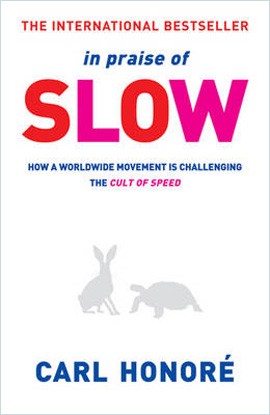
A decade later I stumbled upon In Praise of Slow by Carl Honore.
Ten years into my professional career, life was hectic and I was feeling a little out of a control.
The title of this book screamed at me to buy it NOW!
In Praise of Slow helped me to get back in touch with seasonal living and helped me to rediscover the joy of growing and preparing fresh, homegrown foods.


3.
A chance find in a second-hand bookshop, took me down the next path to eating well consistently.
Changing Habits, Changing Lives by Cyndi O'Meara really did change my life - slowly but surely - just as O'Meara said it would.


4.
It wouldn't be a foodie book post without a book by Michael Pollan!
When I 'discovered' him in 2012, I was more than ready to hear what he had to say.
I started with Food Rules: An Eater's Manual.
Everything he said made sense and seemed practical.
It was quick and easy to read as well!


5.
In Defence of Food by Michael Pollan was read in preparation for Pollan's visit to Australia in 2012.
Sadly, I don't remember very much about this book (& my post doesn't enlighten me either!)
A reread may be on the cards.


6.
Love and Hunger by Charlotte Wood was recommended to me by good friend & fellow blogger, Girl Booker.
Charlotte Wood (as in the author of the dystopian novel The Natural Way of Things) is also a foodie.
This part memoir/part ode to comfort food/part joy in the sharing of meals together was just what I needed as I settled into my new role as wife and step-mum.


7.
The Omnivore's Dilemma by Michael Pollan took a while to read as it was my swim-bag book.
Curiously every time I think about this book, I smell chlorine!
The slow read gave me plenty of time to absorb and reflect on all of Pollan's thought-provoking points.


8.
I still feel a little dubious about I Quit Sugar by Sarah Wilson, but it encouraged me (& Mr Books) to cut sugar out of our coffee and it changed my breakfast routine, so for that reason alone it deserves to be mentioned here.
I still make a toasted muesli based loosely on Wilson's granola recipe.
But I refuse to give up fruit or dried fruit completely.


9.
Given my desire to practice a more mindful and slow approach to food, The Fast Diet by Michael Mosley and Mimi Spence may not seem like a logical choice.
But we were a perfect match from page one.
The 5:2 diet is one that suits my lifestyle and the science seemed reasonable too.


10.
To finish up my top ten, I'm heading back into the realm of food fiction.
The best foodie novel I've ever read goes to Like Water For Chocolate by Laura Esquivel.
Recipes that promote love and good will and end with amazing sex...what's not to like?


What's your favourite foodie read?

Previous post - #AusReadingMonth Q&A
How much do you know about Australia?

Saturday, 17 August 2013

A Glass or Two of Negus

I finished rereading Mansfield Park for Austen in August just before dinner.

I'm not ready to write my post yet, but ever since Wondrous Words Wednesday (see below), I've been tempted by the idea of negus.

I felt that the fitting way to celebrate the end of MP was with a glass of negus!

A google search revealed that it was basically a mulled wine enjoyed at Georgian balls and dinner parties.

The Jane Austen Centre says "Negus, a beverage made of wine, hot water, lemon juice, sugar, and nutmeg was created by by colonel Francis Negus in the early 18th century. Though Col. Negus died in 1737, his namesake drink remained a popular fortifier on cold evenings. During the early Regency it was practically expected, along with White Soup at balls."

Wikipedia also gave me this ... "Negus is referred to in Jane Eyre by Charlotte Brontë, when Jane drinks it on arrival at Thornfield Hall; in Wuthering Heights by Emily Brontë, when Catherine is given it at Thrushcross Grange by the Lintons; in Jane Austen's Mansfield Park; in Charles Dickens' A Christmas Carol during the party at Fezziwig's, in David Copperfield, Dombey and Son, The Pickwick Papers and Bleak House; and in Harriette Wilson's Memoirs.

Anthony Trollope in The Small House at Allington portrays the rustic Earl de Guest's violent disgust at the thought of the drink.

Negus makes a number of appearances as a tonic in The Forsyte Saga by John Galsworthy, in Patrick O'Brian's Aubrey-Maturin novels, and Boswell refers to it repeatedly in his London Journal.

It is said to be added to a white soup in P.D. James' Death Comes to Pemberley.

In A Death in the Small Hours by Charles Finch, the character Frederick Ponsonby claims that a glass of hot negus "settles the stomach wonderfully."

In W.M. Thackeray's Vanity Fair, Ensign Stubble "never took his eyes off her except when the negus came in".

The recipe calls for port or muscat or something similar.

I couldn't come at the idea of adding sugar to a drink that was so sweet already, so I left it out.

The Recipe:
One part port
Half part boiling water
sugar
slice of lemon
nutmeg
(I also added a dash of ground cloves & cinnamon to give it a little extra zing).

We found a 20 year old unopened bottle of Frontignac at the back of the cupboard. With fingers crossed we blended the ingredients.

And?

It was delicious.

Even sceptical Mr Books enjoyed his glass of negus.

It was the perfect thing for a cold wintry night.

I'm also linking this post to Jenny Matlock's Alphabe-Thursday meme.