Showing posts with label Slow Movement. Show all posts

Monday, 27 July 2020

The Future Library Project


I learnt something new this weekend.

Whilst listening to a podcast with David Mitchell about his latest book, Utopia Avenue, he was asked about a not-yet-published book, called From Me Flows What You Call Time. It turns out this is a book he was invited to write by artist Katie Paterson for her Future Library Project (Framtidsbiblioteket).

Paterson, is a Scottish born artist well-known for her monumental projects that 'consider our place on earth in the context of geological time and change.' Her work includes broadcasting the sound of a glacier melting (2007-2008), mapping all the dead stars (2009), sending a recast meteorite back into space (2012-2014), and creating a cosmic colour wheel that captures all the colours of the universe throughout its existence (2019).

The Future Library is an artwork 100 years in the making, in Oslo, Norway. It's a 'living, breathing, organic artwork, unfolding over one hundred years.'

In May 2014, Paterson planted 1000 Norwegian spruce trees in Nordmarka, a forested area north of Oslo. It's a protected green space cared for by foresters within the Agency of Urban Environment. Hikers are encouraged to walk through the forest.

The city of Oslo has guaranteed it's support for this project during the entire 100 years via the Future Library Trust as part of their Slow Space Curatorial Vision for Oslo Harbour.

However, the artwork is not simply about growing and nurturing an urban forest. Between 2014 and 2114, 100 popular writers will be invited to submit an original manuscript to the archive. The manuscript will not be printed and published until 2114.

In 2114, the manuscripts will printed in limited edition anthologies using paper made from the 1000 Norwegian spruce planted by Paterson.

The manuscripts will be stored in a specially designed Silent Room in the New Deichman Library. The room will be panelled with wood from the forest and will display the names and the titles of each artist's work.
Year by year, the writers' words forming invisible chapters in the trees whose narratives will be reconstituted a century later.

During spring of every year, a special ceremony will take place where the author hands over their work to the project. It is a ritual designed to be repeated for the next 100 years. It begins with a walk into the forest with the author, who then gives a reading. The handover ceremony ends at the library, where the author participates in an 'in-conversation' event.

Due to Covid-19, this year's handover ceremony with Karl Ove Knausgård, the first Norwegian to be invited to write for the project, has been delayed until the 5th of September.

So far the project has works by the following authors.

2014 – Margaret Atwood, Scribbler Moon, submitted 27 May 2015.
2015 – David Mitchell, From Me Flows What You Call Time, submitted 28 May 2016
2016 – Sjón, As My Brow Brushes On The Tunics Of Angels or The Drop Tower, the Roller Coaster, the Whirling Cups and other Instruments of Worship from the Post-Industrial Age, submitted 2 June 2017
2017 – Elif Shafak, The Last Taboo, submitted 2 June 2018
2018 – Han Kang, Dear Son, My Beloved, submitted 25 May 2019
2019 – Karl Ove Knausgård

I'm disappointed that I will never get to read these stories. 

However, I do embrace the hope that this project embodies. That human beings will still be around in 100 years time, in a world still populated with forests of trees. And that these future human beings will still value reading and art.
The mandate is to compassionately sustain the artwork for its 100-year duration. The foresters have a big part to play, they tend to the trees. It’s my dream project because it’s got every aspect of what I like – the collaboration with authors, foresters and librarians. And it operates on slower time. It’s not this rush to make something for a deadline. It’s really nice to let something organically evolve. I couldn’t ask for anything more.

Saturday, 1 September 2018

Les Mis Chapter-a-Day Readalong Update

Life has been a bit crazy again this year, and lots of my good intentions for this blogging life have been curtailed, postponed or in a state of constant catch-up. But the one thing that has kept me going, albeit in fits and starts, is my chapter-a-day read of Les Miserables with Nick and friends from @One Catholic Life.


My last Les Mis check in post was way, way back in early April, which is when my chapter-a-day approach took it's first battering.

We had a three week trip to Japan planned. I didn't want to take a chunkster in my luggage, I also prefer to read books set in the country I'm travelling in at the time, so Les Mis was never going to work for a trip to Japan. I decided to read ahead before leaving.

Over two nights I read about 25 chapters. It was exciting, I felt that the pace picked up and the story was getting very interesting again as we got to back the main action of the story (and away from one of Hugo's very lengthy diversions). I loved seeing Valjean and Cosette settling into a more peaceful life in Vol 3, Book 5, getting to know each other and feel safe. Their life was frugal and inconspicuous.

The night time chase scene through the back streets of Paris in Book 6 was one of the high points in the story so far. So much tension, fear and suspense. It was easy to race through these chapters as I couldn't wait to see what happened next, and how or if, Valjean was going to escape the clutches of Javert once again.

But I did wonder at the time, how they might have been read differently and understood differently, if I had read them one at a time, slowly and thoughtfully.

Book 6 spent time LOTS of time discussing religion and one particular institution, the Petit-Picpus convent. I was glad to NOT be reading these chapters whilst on holiday. I found them dry and rather tedious, but knew that in the usual Hugo style, they were leading us slowly but surely to a point.


I did discover that there was no real Petit-Picpus convent thanks to this post at Carpe Horas and that there is a Les Mis fan community called Abaissé where some kind soul had posted a modern day photographic journey that showed the route of the Javert-Valjean chase. Lily Blackmore also has several Les Mis photo posts of her time in Paris in search of Les Mis connections. 

The love for this book runs deep and strong.

Book 7 in my Penguin edition of Les Mis, is treated as an afterthought by the translator, Norman Denny, and popped into the back of the book as Appendix A. A part of me can see why. Book 7 is another Hugo digression. This time into the nature of history, religion and faith. An interesting footnote into the mind and beliefs of the author, that reflected the times he lived through, but certainly not designed to make the reader feel like they can't wait to read the next chapter!

Since returning from Japan I have found it difficult to get back into a good routine.

June was a flurry of visits and weekends away. July saw the entire family sick with a nasty winter cold one after the other. And August was all about exams, as B18 studied for his final in-school exams.

I read Les Mis in fits and bursts throughout this time. Mostly it became a weekend thing where I would read all seven chapters in one hit. But I felt rather disconnected from the story and the readalong the entire time.

Last week I decided to reassert control over my Les Mis journey.

It was time to savour Hugo's work a chapter-a-day once again. With Vol 4, Book 3 I returned to reading this epic story little by little, one day at a time. Each night, before bed, I read my chapter. I'm trying to read each one carefully and thoughtfully.

And it has been a delight.

I have rediscovered the thrill I had at the beginning of the year.

The art of slow reading is not an easy path to follow, but I'm glad to be back on track. I can feel some of the year's stresses melting away, I'm feeling more connected and centred, my brain feels like it's working smarter and I've rediscovered the joy of reading (Les Mis).

As John Miedema, author of Slow Reading (2009) said,
If you want the deep experience of a book, if you want to internalise it, to mix an author's ideas with your own and make it a more personal experience, you have to read it slowly.

My hard-won tips for getting the most out of slow reading (Les Mis) are:
  • Pick a time of the day that works best for you AND stick to it.
  • Leave ALL devices in another room.
  • Do a brief meditation or breathing exercise to calm your mind & focus your attention.
  • Underline words or phrases that move you, that you don't know or want to research further.
  • Read some chapters or sections aloud.
  • Pause, consider, ponder, reflect.
  • Be kind to yourself. There will be times when Slow Reading isn't possible. Don't beat yourself up if you're going through one of those times. Wait it out. You'll know when you're ready to Slow Read again. And you'll love & appreciate it even more when you return to it.

The Battle of Waterloo the Victor Hugo Way
Finally Facing My Waterloo
Birthday Check In
Week 2 Catch Up
Translations
Week 1 First Impressions
#lesmisreadalong

Tuesday, 17 October 2017

My Top Ten Foodie Books

The Broke and the Bookish host a weekly meme called Top Ten Tuesday.
Each week they nominate a topic to encourage those of us who love a good list to get all listy.
This week it's all about food.


My Top Ten Foodie Books 


I've been on a healthy food journey for most of my life.

Trying to find the balance between eating well and satisfying my sweet tooth has been a lifelong challenge. Combined with my environmental concerns about production, pesticides and waste, I have spent a lot of time researching, reading and trying to put into practice a sustainable way of living my life.

1.
The two books that got me started on my food journey were gardening books purchased in the same year.
I was 24 years of age and had just moved into my own (permanent, non-uni) townhouse and I couldn't wait to start my own little herb garden.
These two books inspired me to move beyond the usual herbs as well as attempt to have a pesticide free garden (Companion Planting by Richard Bird).
What Herb is That? by John & Rosemary Hemphill also gave me recipe suggestions for how to use all those delicious herbs I was now growing.


2.
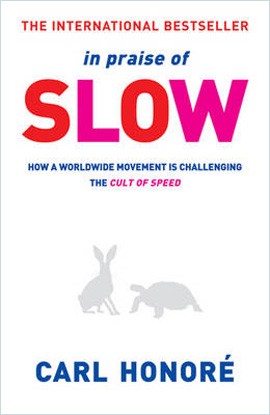
A decade later I stumbled upon In Praise of Slow by Carl Honore.
Ten years into my professional career, life was hectic and I was feeling a little out of a control.
The title of this book screamed at me to buy it NOW!
In Praise of Slow helped me to get back in touch with seasonal living and helped me to rediscover the joy of growing and preparing fresh, homegrown foods.


3.
A chance find in a second-hand bookshop, took me down the next path to eating well consistently.
Changing Habits, Changing Lives by Cyndi O'Meara really did change my life - slowly but surely - just as O'Meara said it would.


4.
It wouldn't be a foodie book post without a book by Michael Pollan!
When I 'discovered' him in 2012, I was more than ready to hear what he had to say.
I started with Food Rules: An Eater's Manual.
Everything he said made sense and seemed practical.
It was quick and easy to read as well!


5.
In Defence of Food by Michael Pollan was read in preparation for Pollan's visit to Australia in 2012.
Sadly, I don't remember very much about this book (& my post doesn't enlighten me either!)
A reread may be on the cards.


6.
Love and Hunger by Charlotte Wood was recommended to me by good friend & fellow blogger, Girl Booker.
Charlotte Wood (as in the author of the dystopian novel The Natural Way of Things) is also a foodie.
This part memoir/part ode to comfort food/part joy in the sharing of meals together was just what I needed as I settled into my new role as wife and step-mum.


7.
The Omnivore's Dilemma by Michael Pollan took a while to read as it was my swim-bag book.
Curiously every time I think about this book, I smell chlorine!
The slow read gave me plenty of time to absorb and reflect on all of Pollan's thought-provoking points.


8.
I still feel a little dubious about I Quit Sugar by Sarah Wilson, but it encouraged me (& Mr Books) to cut sugar out of our coffee and it changed my breakfast routine, so for that reason alone it deserves to be mentioned here.
I still make a toasted muesli based loosely on Wilson's granola recipe.
But I refuse to give up fruit or dried fruit completely.


9.
Given my desire to practice a more mindful and slow approach to food, The Fast Diet by Michael Mosley and Mimi Spence may not seem like a logical choice.
But we were a perfect match from page one.
The 5:2 diet is one that suits my lifestyle and the science seemed reasonable too.


10.
To finish up my top ten, I'm heading back into the realm of food fiction.
The best foodie novel I've ever read goes to Like Water For Chocolate by Laura Esquivel.
Recipes that promote love and good will and end with amazing sex...what's not to like?


What's your favourite foodie read?

Previous post - #AusReadingMonth Q&A
How much do you know about Australia?

Thursday, 29 June 2017

Solitude: In Pursuit of a Singular Life in a Crowded World by Michael Harris

As someone who understands and knows solitude pretty extensively I was instantly attracted to this title.

Feeling that my solitude and busy times are currently out of whack also made this seem like the right book at the right time.


But I'm not sure that Solitude by Michael Harris is really about solitude.

It was more of an exploration of our modern, connected, tech-obsessed society. He discusses what that looks like, how it happened and it's impact on our daily lives and on our long-term health. Harris wonders if social media has made us 'socially obese', like teenagers who need to be needed and loved. And he talks about the addictive nature of 'sharing'.

The technology becomes a salve, a way to calm our worries about fitting in or belonging.

Harris started off with the first line from an Emily Dickinson poem. I was curious enough to find the whole.


Part Five: The Single Hound

XVIII


THERE is another Loneliness
That many die without,
Not want or friend occasions it,
Or circumstances or lot.

But nature sometimes, sometimes thought,
And whoso it befall
Is richer than could be divulged
By mortal numeral.

Emily Dickinson


As someone who has an abundance of the nature and the thoughts that Dickinson referred to, this poem gave me great hopes for finding within the pages of this book, the richer stuff of 'true solitude' (as opposed to the 'failed solitude' of loneliness).

It was not to be, but Solitude did plant the seed I needed to rediscover it for myself.

There must be an art to it....A certain practice, or alchemy, that turns loneliness into solitude, blank days into blank canvases.

But, of course, as we all probably know anyway, these things have to be worked out for yourself, in your own way, usually from hard-won experience, determination and hard work.

Daydreaming our days away is a thing of the past.

Our phones and other devices suck up all of our spare time, our leisure time and much of our working time as well.

However good old fashioned daydreaming had it's purpose. Being on our own, with unfettered time and nothing to do, forced us into self-governance. It gave us those eureka moments and acted as a form of self-therapy.

The truth is that most of our daydreams are not particularly noble or important or fruitful (phew! perhaps I'm doing it properly after all!) An annoying truth about daydreaming is that it takes practice to get good at it.

Solitude also allowed us to be free and independent thinkers - more sure of our thoughts and less likely to be swayed by popular opinion.

The choices we now make online 'become less independent and more manipulated'. We begin to believe that the technology knows us better than we know ourselves. Our world becomes confined to what our known data thinks we would like to have more of. We stop being exposed to new, different and unusual things. We stop thinking for ourselves. We accept the decisions that come at us 'through our screens and accept them as our own'. Until, without realising it,

you become trapped inside an algorithmically defined notion of your own taste....you wont be exposed to things you don't know, things you haven't loved yet. Personal growth becomes stunted.

Thanks to our technology we now never get lost. There is no longer any wandering around trying to find our way and stumbling on something unexpected. Google maps are causing our 'wayfinding skills to atrophy.' We have stopped paying attention to the details of the world around us as we let our phones guide us to our destination. It is no longer the journey, and the stuff we learn and see and experience along the way, that is important. It's the getting there.

Harris then moved onto the art of reading and writing and how these technologies changed our world. 'Each technology drops its own lens over your eyes' - the printing age and the era of screens have both affected the way we tell stories. We believe in,

the fragile idea that your life is a cohesive story....the idea that you are a hero of some story...(however)...Real life feels more like a Tumblr feed than a novel. Real life is random, overpowering, and scarcely knowable as it scrolls past our bewildered, blinking eyes.

This tied in with memory and how technology has changed our ability to remember. Our memories change every time we remember them. They're reassessed to reflect our subsequent knowledge and experiences. So how does this process change when all our memories are documented on social media? And not left to the vagaries of time and revisionism?

So what did I get out of Solitude?

I realised that part of my blogging blues stems from an over-active, over-stimulated mind. I need to find calm, peace and joy. I need to slow down. I need to spend more time in nature and less time on my devices.

I might try the Japanese idea of forest bathing.


Ultimately, it's our choice to nurture our solitude or to allow it to be depleted.

I choose to calm down, slow down and find my centre again.

Friday, 31 March 2017

Rockhopping by Trace Balla

Rockhopping is Trace Balla's follow up book to Rivertime with Clancy and Uncle Egg once again getting ready to head off an eco-adventure.

I love these books a lot.

I love their gentle pace and laid back attitudes.

I love their environmental credentials and back to nature ethos.

I love their attention to details.

I love their emphasis on problem solving, responsibility and being capable.

I love their zen-like, go with the flow, be in the moment philosophy.

But most of all I love how these books remind us that we are all a part of nature. Our natural environment is affected by our interactions with it whether we live in the city or the country.

As Balla says in the Teacher's Notes produced by her publisher, Allen & Unwin,
When you stop trying to get anywhere and just be, a whole world of wonder can open up to you. And when you stop going with a plan and follow the flow, you may find a world of unexpected opportunities revealing themselves to you. The more you look the more you find out. It’s also about realising we are part of the natural world, rather than separate to it, and that we are not alone, but surrounded by other life. Themes of growing up and realising what we are capable of are also explored.


Rockhopping is also respectful to the indigenous tribes of The Grampians (Gariwerd) in Victoria. Balla uses traditional names and common names for places as well as referring to aspects of Aboriginal culture throughout the book.

Commonsense, logic and thorough preparation are also applauded. There is a page of items that Clancy and Egg collected before they went off on their adventure. Practical handy survival tips are interwoven into the story at various points.


Balla adds an historical perspective to one of the sections. Day five shows a timeline with Clancy and Uncle Egg discussing the value of a good walking stick on a big bushwalk. The timeline then shows the same stick being used by a logger, a goldminer, a Chinese market gardener, a squatter and a Jardwadjali woman to dig.

Several trips to the region were integrated into ongoing discussions with local indigenous elders which helped Balla ensure that the local knowledge was authentic and up to date.

Balla received lots of support from local elders. She said in an interview on Reading Time that,
Milipiri Elder Wanta Jampijimpa has given me encouragement to keep doing these stories, that he says are about ‘reading country” and giving hope. Renowned environmental educator David Suzuki has also given me encouragement about my books inspiring kids to be in nature. These two elders encouragement points to passing on wisdom that we often lose sight of in our modern, often urban culture.
Rockhopping has been shortlisted for this years CBCA Younger Readers award.

Monday, 26 December 2016

2017 plans and projects...

The past year or so I have avoided joining in any year long reading challenges. Although I love their sense of community and fellowship, by the end of the year, I find that keeping up with where I'm at and what I need to do next just becomes burdensome.

My plan for 2016 was to only join in one-off events (like First Book of the Year, Dewey's 24hr readthon or the Classics Club Spin), flexible join-in-when-you-can memes (like Top Ten Tuesday or 6 Degrees of Separation) and spontaneous readalongs.

I even created my own flexible once a month-ish meme - Brona's Salon - with it's aim of gathering like-minded bookish people together to discuss their latest read and to have a good old bookish gossip.

Challenges were out; chats were in!

And I loved it.

I enjoyed reading and blogging and chatting about books all year.
My ability to join in waxed and waned (as I knew it would) but it never worried me. I knew my reading or blogging mojo would return before too long.

My plan for 2017, therefore, will be more of the same.

I'm on the lookout for one-off or irregular, flexible memes and readalongs.
(Anyone looking for a challenge or twenty to join in can visit Novel Challenge or Toady for lots of great ideas. They're both constantly adding new challenges and readalongs, so check back regularly for updates.)

I was delighted to discover that Becky @Becky's Book Reviews is planning on hosting a Share-A-Tea challenge in 2017. A 'challenge' all about enjoying a lovely cup of tea whilst reading your book and sharing it.


Which books count towards the challenge? Any book that you primarily read while drinking tea. Not every single page needs to have been read while drinking tea. (I'm not that strict!!!) But this challenge is all about celebrating SLOWING DOWN and SAVOURING the moments. 
How many books? Is there a set minimum? This challenge is about QUALITY and not quantity. It's not about reading fifty books or even twelve books. This is an anti-rush reading challenge. Enjoy where you are in a book, and, engage fully in it. Live in the book. 
This challenge has a focus on SHARING.

I have been a hoping-to-get-into-the-game-sideline-supporter of the Slow Movement for quite some time now. The idea of a challenge that savours the process with no minimums required sounds perfect!

My most likely approach to this challenge will be pictorial via instagram, twitter and litsy (Brona) #ShareATea2017.


First Book of the Year hosted by Sheila @BookJourney is a lovely world-wide meme that features book bloggers with the book they're reading on New Year's Day. Sign up and fill out the form to join in. It's not too late to jump on board.

2016 Book of the Year collage featuring me on the beach with my NY book!


The only other plan/wish/hope for 2017 is to tackle my TBR pile.

Thanks to Adam @Roofbeam Reader I will hopefully read (or reread) a few of the classics on my TBR pile (my post for his Classics Book A Month Club is here) and Bev @My Reader's Block has kindly let me join her Mount TBR Reading Challenge with a smaller, more do-able peak - Australia's own Mt Kosciosko with just 6 books.


Another one that has caught my eye thanks to it's long term, freewheeling nature is The World From My Armchair challenge devised by Paul @Halfman Halfbook.


I have no intention of reading a travel book from every single country in the world, but I know I will inevitably read some and this might help me keep track.


The Deal Me In 7.0 Short Story Challenge is also tempting. 

I read a lot of short story collections throughout each year - fiction and non-fiction and never know whether to review them as one collection or review each one individually. Given that I sometimes fail to read the whole collection, this challenge might help to keep me focused on the individual stories I do actually read. 

Jay has several variations on this challenge if a short story a week seems like too big an ask. 


In my younger days I was a rather keen euchre player, so the 32 card euchre pack appeals to me (FYI: most Australians play euchre using the cards 7 up and score to 11, using one 5 and one 6 playing card to keep track). 


Naturally (as I'm the editor for the History, Memoir, Biography page) I will also be reading plenty of Australian Women Writers in 2017.
The 2017 sign up post is here.


Given that I smashed my AWW reading challenge during 2016 with 44 books completed and reviewed (and a 45th on my current reading pile), I think I will need my very own customised reading level for 2017!

To clarify this figure - one of the books was mostly read in 2015, but finished in January in 2016 and 16 of the books were picture books or junior fiction and 4 books were YA/teen.

For 2017 I plan to read 40+ AWW books to achieve MY BRILLIANT CAREER!


For someone who is not joining in any challenges in 2017, I think that should be enough, don't you?