Showing posts with label Exploration. Show all posts

Monday, 12 September 2016

To the Bright Edge of the World by Eowyn Ivey

One of my dear friends, Girl Booker, has been gushing about Eowyn Ivey's The Snow Child ever since it was first published in 2012.

It sounded wonderful and I have no idea why I haven't made the time to read it, but there it is, I haven't.

And now, here we are, with Ivey's second book to hand and The Snow Child is still sitting guiltily on my TBR pile.

In an attempt to alleviate the guilt I felt towards Girl Booker and Ivey, I made sure that To The Bright Edge of the World made it to the top of my TBR pile as soon as possible.

To The Bright Edge of the World is a fascinating blend of fact and fiction. The first person letter and journal format provided a delightful sense of confusion, or perhaps wonderment, between what was real and what was made-up.

This was a deliberate device on Ivey's behalf.

Ivey has said in an earlier interview with Writers and Books, when she was still calling the book by it's working title of Shadows of the Wolverine that,

Although it is based on real places here in Alaska, I invented the Wolverine River for The Snow Child because I wanted the freedom to play with the geography, and I decided to return there with my newest novel. Shadows, however, is set nearly 40 years earlier, in 1885, and is inspired by a true-life military expedition that traversed Alaska. In my telling, Lt. Col. Forrester ventures up the Wolverine River with a sergeant and private to explore the heart of the territory. As they travel deeper into the country, they encounter the mythology described by the land’s indigenous people. It is also the story of Sophie Forrester, the colonel’s pregnant wife, who waits for his return at Fort Vancouver. She is wrestling with her conscience and trying to find the courage to tell her husband about her past, but she is also on the cusp of making an inspiring discovery.
I’m telling the novel through journals, letters, and other documents. Some of my favorite parts to write in The Snow Child were the letters between Ada and Mabel, so I am having a lot of fun with this new project.
I confess that I was actually a little disappointed to discover that not only was the spunky Sophie Forrester not real, but neither was the Wolverine River, which Ivey had brought to life so vividly throughout her story.

Which also meant, that the wonderful black and white map that adorned the cover of my ARC was not an accurate map but a fictional one.


Colonel Forrester's character is based on the real life Henry Tureman Allen who led an expedition through Alaska in 1885. He explored the Copper, Tanana and Koyukuk Rivers with only two other men, Robertson & Fickett. At an Indian village, Taral, they met up with prospector John Bremner, who joined them on their journey, along with another prospector Peder Johnson. Several places and landmarks in Alaska are named after these men.

There are some wonderful elements woven into this story.

The old Indian with a black hat and lame leg, who liked to sleep in trees and who reappeared at odd times throughout the story. Sophie's struggle with loneliness and grief in an isolated Army barracks. The very private, independent Indian woman, Nat'aaggi, who travelled with Forrester's group for a while. And the gentle, increasingly personal correspondence between modern day Walt and Josh as they discussed the well preserved letters and journals left by the Forrester's.

Ivey also used her characters to discuss some of the bigger environmental and cultural issues at play.

The photographs included at different points were interesting (especially the Alaskan landscapes), but a few also confused me as they jarred against the lovely blur of fact and fiction that Ivey was creating with her words.

To The Bright Edge of the World is a fascinating piece of historical fiction interwoven with a few strands of the mysterious and mythical.

The letter and journal device worked really well, except for the last little bit, where I really wanted to see the reunion between Sophie and Allen. However I was happy enough to leave it to my imagination in the end, which is no doubt what Ivey intended all along.

Jane @Beyond Eden Rock's review that inspired me to read this book next is here.

P.S. In honour of my #HLOTRreadalong2017, I thought you might like to know that Eowyn Ivey was named after the character in Lord of the Rings (as played by the luminous Miranda Otto in the movies).

Saturday, 28 November 2015

The Reef: A Passionate History by Iain McCalman

The Reef: A Passionate History does exactly as its cover promises - it delivers 12 'extraordinary tales' about Australia's Great Barrier Reef.

The only thing it missed to my mind, was a thirteenth chapter where McCalman included some of the local Indigenous tribes stories about the reef. There must be Dreamtime stories, rock paintings and oral traditions that could have been unearthed for such a chapter.

The majority of Indigenous stories in this book about life on the reef only existed through the lens of the white explorers and settlers - they only appeared as helpers or hindrances to the white exploration and discovery process.

Sadly perhaps, this is all that is available to the modern researcher. Whatever the reason, the Aboriginal perspective was missed.

The reefs story begins with Captain Cook's 'discovery' and end in modern times with Charlie Vernon, Chief Marine Scientist who has predicted an imminent 'reef apocalypse'. The book is full of fascinating snippets about the history, geography, biology, geology, politics, sociology, psychology, ecology and environmental aspects of the reef.

However, the truly disturbing chapter is the last one that highlights Vernon's findings on coral bleaching. He observed his first patch of coral bleaching in the early 80's, quickly followed by the first global mass bleaching event on 1981-82. The next major mass bleaching occurred in 1997-98 and an even worse one occurred in 2001-02. As it turns out,
reef-growing corals, which seemed peculiarly susceptible to increases in heat and light, were alerting scientists to climatic changes....
These damaged corals are capable of regeneration if water temperature returns to normal and water quality remains good, but the frequency and intensity of bleaching outbreaks is now such that the percentage of reef loss from coral deaths will increase dramatically....
[Reefs] are complex data banks that record evidence of environmental changes from millions of years ago up to the present. Imprinted in fossil typography are the stories of the mass-extinction events of the geological past, including their likely causes. These archives tell us that four out of the five previous mass extinctions of coral reefs on our planet were linked to the carbon cycle. They were caused by changes to the ocean's chemistry brought about by absorption of carbon dioxide and methane, through a process of 'acidification'.
Today's culprits are the same gases - carbon dioxide and methane - though their increased presence is not due to massive meteor strikes of volcanic eruptions that caused earlier catastrophes....
Already the oceans...have reached a third of their capacity to soak them up and balance them chemically. Stealthily, the oceans of the world have begun the process that scientists call 'commitment', which in this case refers to the 'unstoppable inevitability' of acidification that presages destruction long before it is clearly visible.

Sorry for the long quote, but I knew I couldn't trust myself to paraphrase all of that as precisely as McCalman did.

It has had a profound impact on me.

By 2050, the coral reefs could be melting into the waters like a 'giant antacid tablet' heralding an unstoppable 'succession of ecosystem disasters'. The point of no return is close at hand and the only real hope we have is that some of the key micro-organisms like plankton, algae and polyps evolve fast enough to become resilient to this new threat to their environment (and ours) or that the pattern of mass extinction doesn't follow that of the previous five.

It is a tragedy to think that this beautiful area of the world could disappear forever (or at least for enough lifetimes to make it seem like forever). And it is impossible to imagine what other changes this loss will incur.

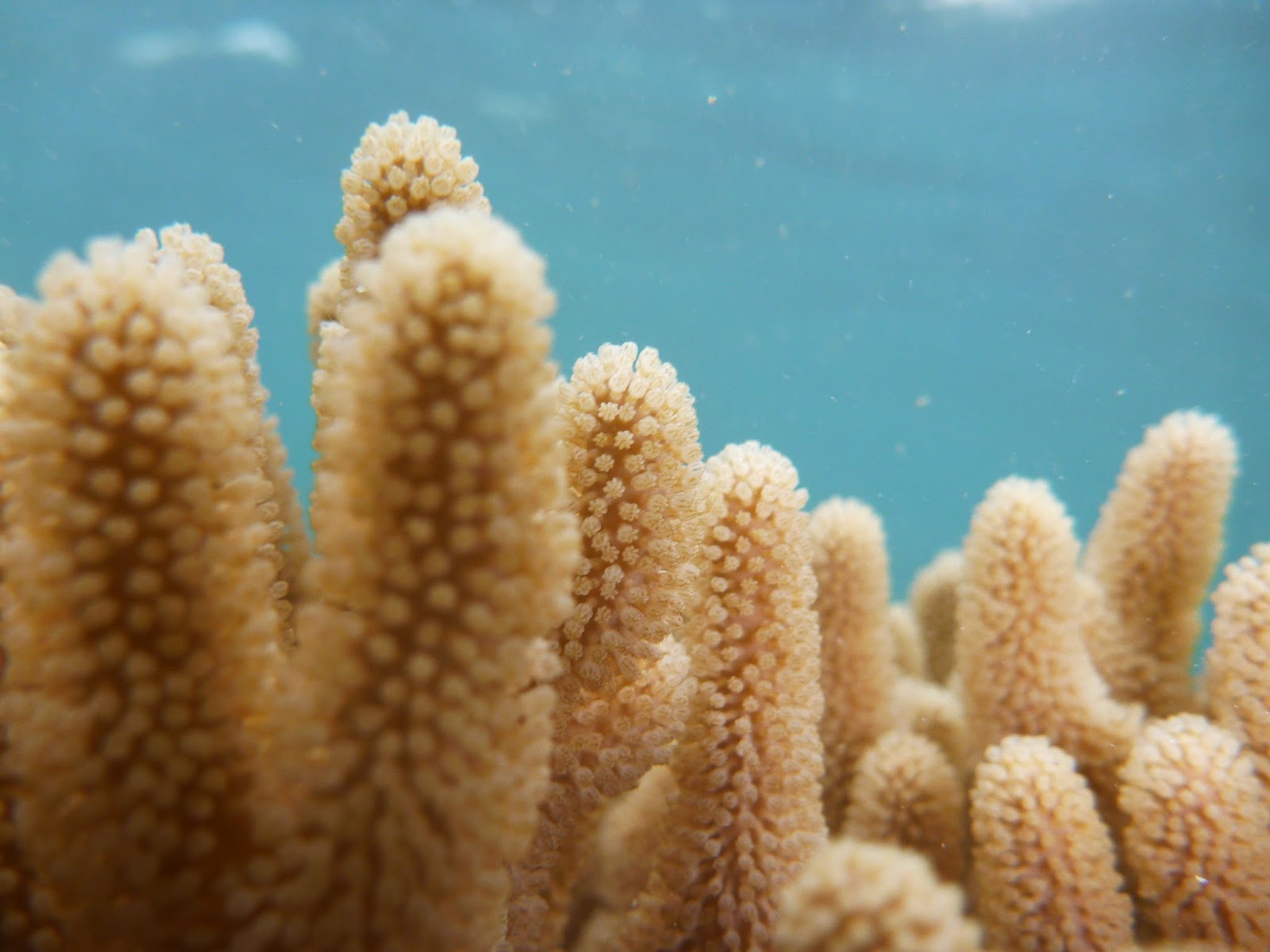
We visited the area around the Low Isles 18 months ago, not long after a cyclone had battered the coral. Our youngest had control of the hired underwater camera; he took some beautiful photos despite the obvious damage all around us.


This post is part of #AusReadingMonth and #NonFicNov

Saturday, 21 March 2015

An Armadillo in Paris by Julie Kraulis

My first thought when I saw this picture book at work was 'Louise!' (from A Strong Belief in Wicker) because An Armadillo in Paris would tickle her Francophile fancy in all the right spots!

Elegant black and white illustrations grace each page & the covers. They are simple, clean drawings enhanced by splashes of water colour.

Young Arlo the armadillo likes to explore - he comes from a long line of nine-banded explorers. His grandfather, Augustin, left him a trail of clues with which to explore Paris for the first time. His aim is to find the Iron Lady.

So with "a twitch that only stops when adventure begins..." Arlo sets off!

He takes in all the usual Parisian sites as his follows his grandfather's clues around the city.
We also learn some facts about the Iron Lady at each stop.

Arlo particularly enjoys the stops that allow him to munch on croissants & try macarons!

The final double page spread revealing the identity of the Iron Lady is followed by a page of facts and figures for those who want to know more.

Julie Kraulis is Canadian and has a website full of her lovely illustrations & art work here. She also has an earlier picture book called, Whimsy's Heavy Things, for me to track down :-)

This post is part of Dreaming of France with Paulita.

Tuesday, 12 August 2014

Ice Wind Rock by Peter Gouldthorpe

Ice, Wind, Rock: Douglas Mawson in the Antarctic has been shortlisted for this year's CBCA Eve Pownall information book award.                                                                                                                                                                                                                                                                                                                                     This picture book is based on the true story of Mawson's journey to Antarctica in 1908 & 1911. Full of derring-do, adventure & discovery, this is a story of heroism & determination.                                                                                                                                                                                                                                                     The illustrations are wonderful - so clear and vivid - you can almost feel the desperate cold as you turn each page! It also includes a fold out map and timeline at the back.                                                                                                                                                                                                                                                                         Ice, Wind, Rock is perfect for early readers or to share in your primary school classroom. This book covers Australian history, exploration, science & environmental issues.