Showing posts with label QLD. Show all posts

Tuesday, 10 November 2020

Stone Sky Gold Mountain | Mirandi Riwoe #AWW


I wasn't sure what to expect when I started Stone Sky Gold Mountain by Mirandi Riwoe. A gold rush story set on the Palmer River in Queensland (an area I did not realise even had a gold rush!) through the eyes of Chinese settlers, sounded intriguing. However, I struggle with blokey books about blokey men doing blokey stuff in the wild - which gold rush/pioneer books can often be - so I tempered my intrigue.

In a number of interviews, Riwoe mentions that she writes of things that move her. 

Naturally, they end up moving her readers too. In fact, her characters get under your skin and become a part of your daily life. You feel like you have inhabited their world. You think about them between reading sessions. You fear for their safety and sanity. You feel their pain and trepidation. You feel their disconnection and isolation. 

Far North Queensland becomes a character too. You could feel the heat, the humidity, the dust and dirt, the unrelenting nature of nature.

During Riwoe's research for this novel, she discovered that Cooktown and the Palmer River area, during the goldrush era, actually had a population that was significantly more Chinese than Anglo. Yet our settler narrative only ever talks about white people exploring and moving into the area. This was the trigger for her story.
The initial inspiration for my work is probably to do with what is of personal interest to me – being Eurasian, I like to write of those who are culturally hybridized or marginalized, and I also like to write of women and feminist issues. AsiaLink: University of Melbourne

From there it was only natural to weave in a story about a brother and a sister fleeing poverty in China, to find their fortunes in the goldrush of Australia. The sister could not safely stay on the goldfields as a woman, so she disguised herself as a boy. The only other women in Maytown were prostitutes or the wives of merchants. (Incidentally, Maytown is also the setting for Thea Astley's story It's Raining in Mango).

Some of the scenes are tough to read, especially the treatment of the Indigenous population by both the whites and the Chinese characters. The women don't always fair much better. The pecking order is clearly described and belies our belief that Australia is a classless society. The British and Chinese early settlers, all brought their own prejudices to bear on their new country; prejudices we are still trying to live down.

Many of the Chinese came to Australia with the sole intention of plundering the gold, making their fortune, then returning home as soon as possible. Getting to know Australia, or fitting in, was not part of the plan. When making a fortune didn't pan out as expected, staying in Australia became caught up in a sense of failure and exile. Australia was not a welcoming place, neither did it feel like home. That sense of disconnect and alienation became a daily lived experience. The isolation could send you mad or into the seedy rooms of the local opium den. The Australian landscape and society never lived up to their memories of China. Yet, as one of the characters made their way home again at the end, they realised how much personal freedom they were giving up by doing so.

Henry Handel Richardson's The Fortunes of Richard Mahony, was in the back of mind as I read Riwoe's goldrush story. Both stories reveal the harshness of this way of life, the sense of discrimination and displacement, the degradation of character and environment, regardless of your country of origin. The dream of striking it rich and the sense of adventure that started such a journey, inevitably ended in heartache and madness. The gold fields were an unforgiving place, full of broken dreams.

Stone Sky Gold Mountain first came to my attention when it was shortlisted for the Queensland Literary Award earlier in the year. I'm glad I tracked it down. It was a fascinating peek into another point of view of early Australia colonialism complete with ghosts, hardship and lawlessness. The violence and injustice was tempered by the tenderness of friendship in unexpected places. Riwoe is an elegant storyteller and she takes you on an unforgettable journey. 


Epigraphs:
  • To search for gold was like trying to catch the moon at the bottom of the sea. Taam Sze Pui
    • Taam Sze Pui (or Tom See Poy) was a Chinese Australian shopkeeper in Innisfail, Queensland. He spent five (unsuccessful) years panning for gold on the Palmer River goldfields, before working in market gardens and banana plantations, eventually setting up a shop in 1883.
    • I wish to inform you that they are only strangers in this land themselves. Many of them have only been here a few moons, and none for more than one of two generations. Jan Chin from a letter to his father in Shanghai, The SMH, 1858

    Opening Line:
    • Ying dreams of her little brother, Lai Cheng.

    Facts:
    • Winner 2020 Queensland Literary Award – Fiction Book Award
    • Winner of the inaugural ARA Historical Novel Prize 2020.
    #AusReadingMonth 2020

    Thursday, 17 January 2019

    Boy Swallows Universe by Trent Dalton

    I suspect I'm going to be the lone dissenting voice when it comes to Boy Swallows Universe by Trent Dalton.

    This is a debut Australian novel garnering a HUGE amount of attention and rave reviews. In the lead up to our Christmas rush at work last year, this is the book many, many locals were asking for. Customers were returning to tell us how much they ADORED the book and every second book club, including mine, seemed to pick it for their summer holiday read.


    I was thrilled that I was going to have a good excuse to make time for this book and I couldn't wait to get stuck into it.

    To start with what I loved:

    • The cover - just gorgeous, vibrant and psychedelic. The blue wren makes sense once you start reading. For an in depth look into how cover designers settle on the finished design read this fascinating piece from the Australian Book Design Association. They interviewed Darren Holt and Claire Ward, the Australian and UK designers for Boy Swallows Universe (as well as other designers for other books).
    • The writing - Dalton took my breath away. I was completely and utterly WOWED.
    • The protagonist, Eli Bell is a wonderful narrator. His voice is believable, charming and unique.
    • The introduction of ex-con Slim Halliday as Eli's babysitter added a quirky touch.
    • I loved the themes - a young boy looking for a 'good man' to love and model his life on, brotherly love, redemption and protection, a young boys fierce need for mother love.
    • Early on I also began to suspect that this book was also heavily embedded in real life events.
    • Slim Halliday was a real criminal who did his time in Boggo Road Gaol.
    • How much else was real?
    However around the 50 page mark, the underbelly criminal stuff started to take centre stage. Drugs, drug running and drug lords took over the story. Because I now suspected that this was based on a true story (I hadn't googled at this point) I made myself keep reading even though, every single extra sordid drug reference and act turned me off more and more and more. 

    I've always believed that if someone actually had to LIVE through something ghastly, the very least I can do from my safe, white, middle class home, is read about it with understanding and compassion and a huge dose of gratefulness for my very ordinary upbringing.

    True crime is not my usual genre, but I have been known to be fascinated by the occasional story. We watched the second season of Underbelly that starred Matthew Newton which was centred around the murder of Donald Mackay in Griffith in 1977, but I haven't been able to watch any of the other seasons. I also haven't got into Breaking Bad, The Sopranos or Orange is the New Black.

    However, with Boy Swallows Universe, I got to a point, about 100 pages in, where the amazing writing and the affection I felt for the two brothers, wasn't enough to sustain me through the relentless criminal activity. 

    I admire Dalton for finding such an incredible way to process the trauma from his childhood. There is so much love for this story 'out there', that I'm sure it will pop up in most of the Australian book awards this year. It deserves it too. The praise being heaped on it, is valid, but the content is just not my thing. There are so many books, about topics that I have way more interest in, waiting for me to read them, that I don't want to give too much time to one of those that just fails to fit the bill...for me.

    Boy Swallows Universe has just been shortlisted for the Indie Debut Fiction Book Awards.

    I've labelled this with the Did Not Finish tag, but it was more a case of skim reading the last three quarters of the book before slowing down to read the last chapter properly.

    March update: I gave this to Mr Books to read because I suspected that he would love it. He did.
    He felt the criminal activity was within context and didn't dominate the story. For him, the story of the boys, the search for goodness and what makes a person 'good' and the power of redemption were powerful, moving themes.
    He was surprised I couldn't finish it, even though he has had years of watching me hide behind pillows and my hands in violent movies! (We're rewatching Game of Thrones in preparation for the final season. Because I know what's coming, I'm spending even more time behind the pillows than I did with the first viewing, when many of the violent/cruel scenes caught me by surprise. I also know to leave the room whenever Bolton walks on screen).

    Facts:


    • Longlisted for the 2020 International Dublin Literary Award.
    • Winner 2019 ABIA Book of the Year Award | Literary Fiction Book of the Year
    • Winner 2019 Indie Book Award
    • Winner 2019 UTS Glenda Adams Award for New Writing | NSW Premier's Literary Awards
    • Winner 2019 People's Choice Award | NSW Premier's Literary Awards
    • Winner 2019 ABIA Matt Richell Award for New Writer of the Year
    • Longlisted for the 2019 Miles Franklin Literary Award
    • Shortlisted for the 2019 Colin Roderick Award

    Saturday, 25 November 2017

    The Commandant by Jessica Anderson

    The Commandant came recommended to me in a roundabout fashion. Earlier on in the year, I attended an 'Honouring the Author' event at the State Library, NSW. The author in question was Jessica Anderson.


    Anderson won the Miles Franklin Prize twice (in 1978 & 1980), but not for The Commandant.
    By the end of the honouring event, though, I was convinced that The Commandant was the book for me to start my Jessica Anderson journey with (and not one of her two more contemporary award winning books). Historical fiction based on real life events and people will always win me over.

    The Commandant is based on Captain Patrick Logan, the man in charge of the Moreton Bay convict settlement on the present day site of Brisbane.

    Moreton Bay Settlement 1835
    He was a cruel task master, feared by all the convicts.
    But the story is told mostly from the point of view of his young (fictional) sister-in-law, Frances, recently arrived from Ireland.

    In some ways, this story could be seen as a simple drawing room story about two sisters, but of course, the outside world intrudes regularly on their domestic dramas. There is a strong message about the role of women in the early years of colonisation and how they coped with the isolation, the lack of modern amenities and the constant fear of the unknown. Frances is told by one of the other women,
    'Whatever course you take,' she said, half-shutting her eyes, 'no doubt in ten years or so you will arrive at the state of the most of us - simply of making do with what one has. Surprisingly enough -' she opened surprised eyes - 'it is an art in which one may progress. I thought I knew all about making do with what one had, but now I find I can do more with it than I dreamed.'


    Anderson's deceptively straightforward plot also hides many viewpoints and tensions.

    We see the doubt and confusion that the soldiers and their wives feel about Logan's actions. The young doctors, who have to tend the battered backs of the recently whipped convicts, have another story to tell. The threat of a highly publicised court case in Sydney to deal with the rumours of Logan's cruelty bubble away underneath the surface, only to rear up every time a ship arrives with mail. The menace of the convicts, who far outnumber the soldiers, is felt throughout the story. How the convicts view the settlers and how they, in turn, view the convicts is a tension that Anderson plays with deftly. 


    Underlying all this, though, is another viewpoint. The local Aboriginal population are spoken of and seen fleetingly by our main characters. They know they are being watched, rumours and myths are rampant. Yet the reader can also see this little settlement, barely clinging onto the land around the Brisbane River, through the eyes of the Aboriginals, wondering who on earth where these strange people with their stone walls and inappropriate clothing and guns. 

    Image source

    Even further away, are the Sydney based journalists and intelligentsia who are driving social change and asking questions about reform, mercy and justice for the convicts. Frances represents this new world order while her brother-in-law represents the old world order of duty, a firm hand and punishment. Logan is understandably confused and even, hurt, by the possibility of change. Anderson portrays his loneliness and brooding behaviour in a sympathetic light, thanks to the tender, loving concern he evokes in his young wife (a woman with a lisp not unlike the one that Anderson, herself battled with all her life).

    It is not just Logan's right to rule that is called into question here. Anderson also leads us to see how tenuous and uncertain these early settlements actually were. A so-called civilisation perched on the edge of wilderness, halfway round the world, for the spurious idea of containing the poor and dispossessed of England, was always going to be fraught with danger. Most of the poor and dispossessed ended up on the wrong side of the law as a result of the Industrial Revolution. So many of the convicts were shipped off to Australia for one single offence, often stealing food or clothes. The colony of Australia became the dumping ground for a problem the English didn't want to face. Instead of dealing with the problem of a growing divide between the haves and have-nots at home, they shipped as many of the have-nots off to the other side of the world to basically fend for themselves.

    Image source

    Anderson's story brings to vivid life this period of history. There are fabulous, meaty characters, shifting points of view and a pervading sense of mercy. Logan's demise is deliberately left as confused and murky as the official reports of the time. Anderson doesn't try to give us the answers that weren't available to her characters at the time.

    The story ends, as it began, with Frances on board a ship, musing about her fate. The innocence and conviction of her beginning has been tempered by experience and sympathy.

    I'm so grateful to Text Publishing for bringing such tremendous Australian stories back into print. I hope they never go out of print again.

    #AusReadingMonth
    #Australian Women Writers challenge

    Thursday, 5 October 2017

    My #AusReadingMonth Possibilities

    As many of you know, my TBR pile is out of control. A bigly number of those books are by Australian authors (I feel safe using bigly now that 1. we know that Trump actually said big league and 2. that bigly is a real work, although archaic and rarely used.)

    I thought I'd list some of them, focusing on the state, territory or town that each is predominantly set in, to help our overseas #AusReadingMonth participants.


    Since I haven't read any of these books yet, I'm using their blurbs and goodreads reviews to help me work out where they're set. If anyone would like to correct me, please feel free to let me know in the comments below.

    Aunts Up the Cross by Robin Dalton (memoir) - Kings Cross, Sydney, NSW
    The Ladies of Missalonghi by Colleen McCullough (historical fiction) - The Blue Mountains, NSW
    The Dyehouse by Mena Calthorpe (fiction/classic) - Sydney, NSW
    Mirror Sydney by Vanessa Berry (non-fiction) - NSW
    The Timeless Land by Elenor Dark (fiction/classic) - NSW
    Watershed by Fabienne Bayet-Charlton (fiction) - NSW, I think.
    True North by Brenda Niall (biography) - NSW (& elsewhere)
    Home by Larissa Behrendt (fiction) - NSW
    1788 by Watkin Tench (history/memoir) - NSW

    Everyman's Rules of Scientific Living by Carrie Tiffany (fiction) - VIC
    The Pea-Pickers by Eve Langley (fiction/classic) - VIC
    Sisters by Ada Cambridge (fiction/classic) - VIC
    The Danger Game by Kalinda Ashton (fiction) - Melbourne, VIC
    The First Book of Samuel by Ursula Dubosarsky (historical fiction)- Melbourne, VIC
    Conditions of Faith by Alex Miller (fiction/memoir) - Melbourne, VIC predominantly

    A Child's Book of True Crime by Chloe Hooper (historical fiction) - TAS

    The Commandant by Jessica Anderson (historical fiction/classic) - QLD
    It's Raining in Mango by Thea Astley (fiction) - QLD
    The Slow Natives by Thea Astley (fiction) - QLD
    The White Earth by Andrew McGahan (fiction) - QLD
    Omega Park by Amy Barker (fiction) - QLD
    Journey to the Stone Country by Alex Miller (fiction) - QLD

    A Dangerous Language by Sulari Gentill (historical fiction/crime)- ACT predominantly

    Shallows by Tim Winton (fiction) - WA
    Benang by Kim Scott (memoir/fiction) - WA
    Coonardoo by Katharine Susannah Prichard (fiction) - WA
    My Place by Sally Morgan (memoir) - WA

    Island Home by Tim Winton (memoir/essays) - FREE - it covers various areas of Australia, although being Winton it will probably be predominantly WA based.
    Maurice Guest by Henry Handle Richardson (fiction/classic) - FREE - an Australian writer with an overseas setting.
    My Love Must Wait by Ernestine Hill (historical fiction/classic) - FREE - a fictional story about Matthew Flinders
    Cabin Fever by Elizabeth Jolley (fiction) - FREE - an Australian writer with an overseas setting.
    The Swan Book by Alexis Wright (fiction) - FREE - futuristic novel set in Australia
    The Rose Grower by Michelle de Kretser (historical fiction) - FREE - an Australian writer with an overseas setting.
    Dancing with Strangers by Inga Clendinnen (history) - FREE - all of Australia.
    The Bush by Don Watson (non-fiction) - FREE - all of Australia.


    As you can see, I actually need a year-long AusReading event to come close to reading all these books! Can you recommend any of these books? Which one should I tackle first?

    My Top Ten all-time favourite Australian books.

    Saturday, 28 November 2015

    The Reef: A Passionate History by Iain McCalman

    The Reef: A Passionate History does exactly as its cover promises - it delivers 12 'extraordinary tales' about Australia's Great Barrier Reef.

    The only thing it missed to my mind, was a thirteenth chapter where McCalman included some of the local Indigenous tribes stories about the reef. There must be Dreamtime stories, rock paintings and oral traditions that could have been unearthed for such a chapter.

    The majority of Indigenous stories in this book about life on the reef only existed through the lens of the white explorers and settlers - they only appeared as helpers or hindrances to the white exploration and discovery process.

    Sadly perhaps, this is all that is available to the modern researcher. Whatever the reason, the Aboriginal perspective was missed.

    The reefs story begins with Captain Cook's 'discovery' and end in modern times with Charlie Vernon, Chief Marine Scientist who has predicted an imminent 'reef apocalypse'. The book is full of fascinating snippets about the history, geography, biology, geology, politics, sociology, psychology, ecology and environmental aspects of the reef.

    However, the truly disturbing chapter is the last one that highlights Vernon's findings on coral bleaching. He observed his first patch of coral bleaching in the early 80's, quickly followed by the first global mass bleaching event on 1981-82. The next major mass bleaching occurred in 1997-98 and an even worse one occurred in 2001-02. As it turns out,
    reef-growing corals, which seemed peculiarly susceptible to increases in heat and light, were alerting scientists to climatic changes....
    These damaged corals are capable of regeneration if water temperature returns to normal and water quality remains good, but the frequency and intensity of bleaching outbreaks is now such that the percentage of reef loss from coral deaths will increase dramatically....
    [Reefs] are complex data banks that record evidence of environmental changes from millions of years ago up to the present. Imprinted in fossil typography are the stories of the mass-extinction events of the geological past, including their likely causes. These archives tell us that four out of the five previous mass extinctions of coral reefs on our planet were linked to the carbon cycle. They were caused by changes to the ocean's chemistry brought about by absorption of carbon dioxide and methane, through a process of 'acidification'.
    Today's culprits are the same gases - carbon dioxide and methane - though their increased presence is not due to massive meteor strikes of volcanic eruptions that caused earlier catastrophes....
    Already the oceans...have reached a third of their capacity to soak them up and balance them chemically. Stealthily, the oceans of the world have begun the process that scientists call 'commitment', which in this case refers to the 'unstoppable inevitability' of acidification that presages destruction long before it is clearly visible.

    Sorry for the long quote, but I knew I couldn't trust myself to paraphrase all of that as precisely as McCalman did.

    It has had a profound impact on me.

    By 2050, the coral reefs could be melting into the waters like a 'giant antacid tablet' heralding an unstoppable 'succession of ecosystem disasters'. The point of no return is close at hand and the only real hope we have is that some of the key micro-organisms like plankton, algae and polyps evolve fast enough to become resilient to this new threat to their environment (and ours) or that the pattern of mass extinction doesn't follow that of the previous five.

    It is a tragedy to think that this beautiful area of the world could disappear forever (or at least for enough lifetimes to make it seem like forever). And it is impossible to imagine what other changes this loss will incur.

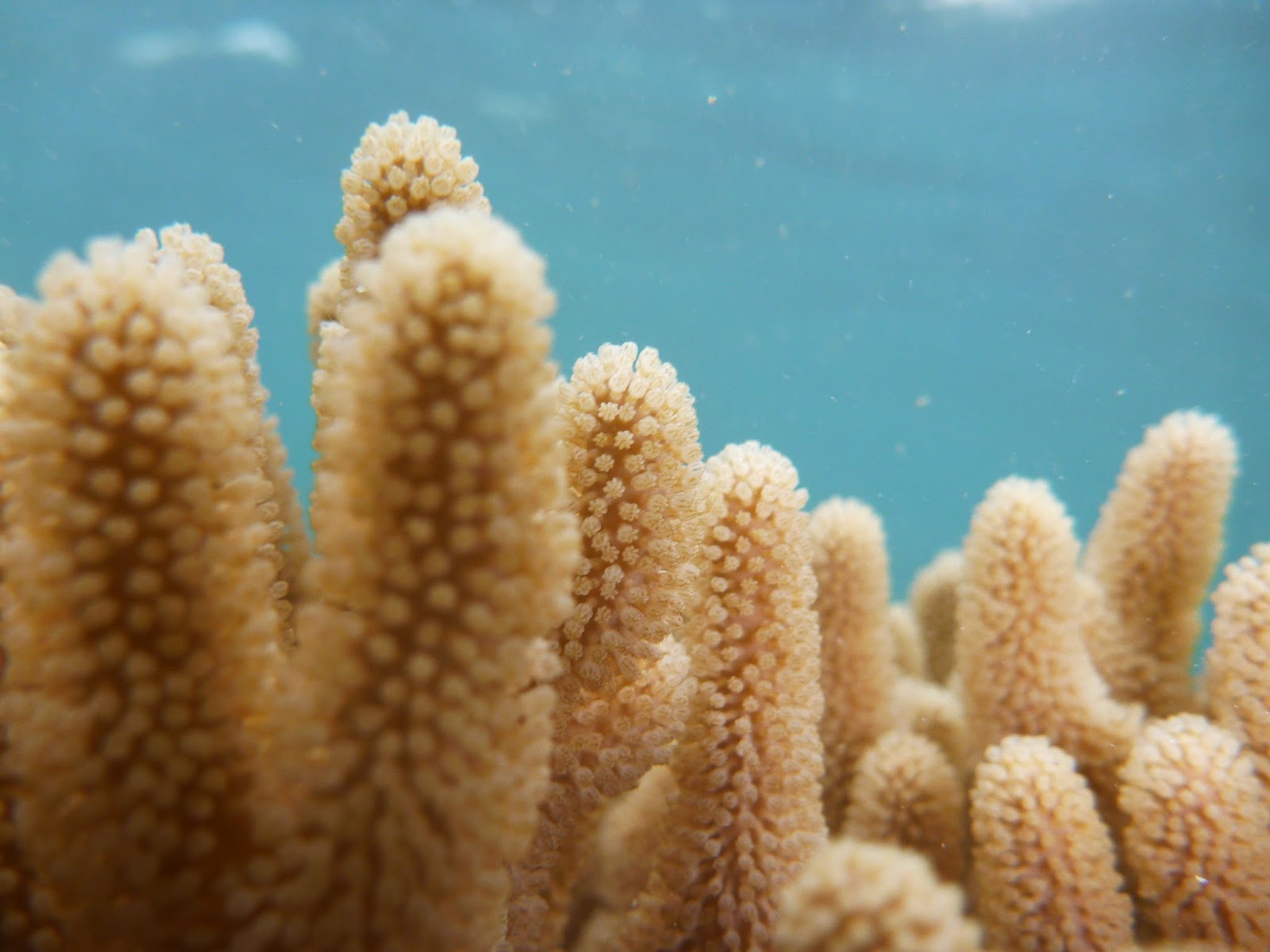
    We visited the area around the Low Isles 18 months ago, not long after a cyclone had battered the coral. Our youngest had control of the hired underwater camera; he took some beautiful photos despite the obvious damage all around us.


    This post is part of #AusReadingMonth and #NonFicNov