Showing posts with label Netherlands. Show all posts

Thursday, 13 August 2020

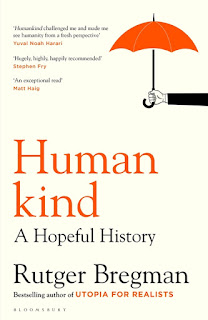
Humankind: A Hopeful History | Rutger Bregman #NonFiction


Humankind: A Hopeful History is more than just a popular science book that hits the right note during this unsettling time in our human history. For starters, Bregman uses a LOT more footnotes than one usually finds in a popular science book. He has obviously spent a lot of time researching, questioning and thinking about his topic - that we are in fact, when push comes to shove, mostly a species of decent and kind beings.

Humankind is a book designed to explore the best and most hopeful aspects of human nature. According to Bregman this is one of the things that we all share in common, regardless of race, culture, and religion. Yes, there are some sociopaths out there, but they are a very specific and aberrant group. They are not the norm. 

I understand there have been some concerns about cultural appropriation of stories surrounding this book and I understand where those concerns come from. But that's not what this book is about. It's about the kindness we all share as human beings, and our ability to pull together in tough times. It's the things that unite us, not divide us. Although, Bregman does spend some time, later in the book, discussing why it is that some of the divides have come into being. It turns out the Age of Enlightenment was not so enlightening after all!

He discusses war, slavery, the Holocaust, sexism, racism, xenophobia and catastrophes within the context of his premise. He dissects the role that media, news and the internet have on exposing the exceptional, the unusual and the shocking as opposed to the usual, the everyday and the normal. The aim of the news and information as we now know it, is to grab your attention and shock, not to enlighten.

He exposes the fallacy and myths surrounding The Lord of the Flies theory, the selfish gene, the reality of battles and warfare "interviewing veterans of WWII, they found that more than half had never killed anybody", the mystery of Easter Island, the 1971 Stanford University Prison study, the Robbers Cave experiment, the 1961 Stanley Milgram shock experiment, the bystander effect and terrorism.

Reading Humankind, as I did, during the early stages of the Covid-19 lockdown, I was struck by this particular thought:
Infectious diseases like measles, small pox, tuberculosis, syphilis, malaria, cholera & plague were all unheard of until we traded our nomadic lifestyle for farming. So where did they come from? From our new domesticated pets - or more specifically, their microbes.


I was saddened when he noted later on that "education has become something to endure." The truth of this has been brought home to me constantly over the past decade as the boys finished their school years. They have no inspirational stories to tell about their school days, like Mr Books and I both do. They have plenty of tales about what they got up to with their friends during the breaks, but nothing about what they learnt. All they ever wanted to know was what they would need to pass their exams to get them out of there. How did education become such a dull, routine thing?

Bregman finished with his very own 10 rules to live by (everyone seems to be doing it lately!)

  • when in doubt assume the best
  • think in win-win scenarios
  • ask more questions
  • temper your empathy, train your compassion
  • try to understand the other, even if you don't understand where they're coming from
  • love you own as others love their own
  • avoid the news
  • don't punch Nazis
  • come out of the closet: don't be ashamed to do good
  • be realistic

I found Humankind to be an interesting read, especially the debunking of the deeply flawed human psychology studies from the 60's and 70's, the very same ones I learnt about at uni thirty years ago, which were held up to be self-evident truths at the time. However I did grow rather weary of Bregman's tone by the end. His determination to be hopeful began to seem like one of the self-fulling, Pygmalion Effects that he wrote about! 

Bregman offers a hopeful antidote to our current pandemic and political situations. It's always nice to be reminded that most people are decent folk doing the best they can. In fact, there are way more kind people on the planet, than not. And that's a good thing.

Facts:
  • Translated by Elizabeth Manton and Erica Moore.
  • Bregman was born the year I finished my Diploma of Education (1988).
  • Author of Utopia for Realists: How We Can Build the Ideal World (2016).

Book 7 of 20 Books of Summer Winter

Wednesday, 12 December 2018

Australian Junior Fiction Catch Up

The run into Christmas and the silly season, leaves me tired, frazzled and depleted most years. This year I'm attempting a calmer, kinder approach. As a first line of defence I started interspersing junior fiction reads amongst my regular reads several weeks ago. I've been saving all the interesting looking ones for months now, so that I would have something 'just right' for this time.

Great junior fiction is the perfect antidote for the general madness and mayhem of the silly season. It's (usually) light and easy to read, sometimes interspersed with delightful illustrations and (usually) full of wonderful language. And almost all writers for younger people feel duty bound to end with hope. Bad and sad things may happen to their characters along the way, but there is always hope and wonder and love.

The Slightly Alarming Tale of the Whispering Wars by Jaclyn Moriarty is book 2 in her newly named Kingdoms and Empires series. The name of the series didn't make an appearance on the first book, so I was curious to see what this might mean for book 2 and any future books.


I loved Book 1 The Extremely Inconvenient Adventures of Bronte Mettlestone by Jaclyn Moriarty and had very high hopes for this one, so I was a little disconcerted to read the first few chapters with no Bronte in sight.

What was going on?
Where were we?
And who were all these new people?

The first couple of pages of this generously illustrated book show us maps of the various kingdoms within this world. Some of these names were familiar from Book 1, but other than the whispering element, nothing else seemed familiar.

TSATOTWW begins in the little town of Spindrift where we meet two groups of kids - one group from the orphanage, the other from an expensive, exclusive boarding school. A friendly sporting rivalry between the two schools quickly blows up when one of the children suddenly disappears. The Whisperers have kidnapped another child.

A tentative alliance is formed, a plan of rescue is hatched and Bronte makes an unexpected reappearance. Mystery, adventure and a little bit of magic is the name of the game.

I love this series for mature 9+ readers a lot and I hope that Moriarty has many more books planned for the Kingdoms and Empires. Due to the different time frame and setting in this book, it could be read as a stand-alone story, but you'll want to go back to see how Bronte came into the story in the first place. It was a savvy move by Moriarty to expand the horizons and history of this series to include the entire kingdom and I look forward to seeing where and when we end up next.

Inheritance by Carole Wilkinson is for slightly older readers - more 11+ through into the early teen years. It's a fabulous time slip story set in country Victoria.


Nic has been left by her dad at her Grandad's old homestead property while he goes off with his band to play the cruise ship circuit. With no wi-fi, no friends and loads of attitude, Nic starts exploring the big old home one room at a time. Eventually she discovers a locked room with no key in sight.

A fortuitous toe-stub whilst swimming in the dam and an old letter in a copy of Pride and Prejudice changes everything. Nic discovers dark secrets about her family history that have carry-over effects onto today's local history and her own family story.

Wilkinson weaves in indigenous issues, women's rights and early settler history into this engaging yet thought-provoking time travel story.

The Adventures of Catvinkle by Elliot Perlman is now top of my delightful dog story pile. Officially this is a book about a cat - the secret loving, baby shoe dancing, flying cat, Catvinkle, but it is also just as much about her new found friend (shhh! don't tell anyone that a cat and a dog are friends!) Ula the dalmatian.


Set in Amsterdam, Perlman (you may know him from his adult books, especially Seven Types of Ambiguity and The Street Sweeper) has turned the bedtime stories he used to tell his kids into a charming animal story for us all to relish.

There are LOTS of things to adore about this book, but the most endearing are the voices of Catvinkle and Ula. Perlman has got inside the heads of these two animals and they speak and act just as I imagine a cat and dog of these types would speak and act if they could!

The thing these three fabulous books share is complexity. The authors do not talk down to their young readers, they use interesting language, create nuanced, believable characters and they take you on a journey that is utterly compelling.

And then there is The Bad Guys Episode 8: Superbad by Aaron Blabey.

Personally, I'm getting pretty tired of their antics by now, but they continue to entertain and get 5-7 yrs old excited about reading, so I'm not going to complain too much.


After an excursion into outer space, then back in time to the dinosaurs, we are firmly back in the present with our world being taken over by the evil Mr Marmalade and his evil alien forces. And it wouldn't be the modern world without a female team of warriors to assist our bumbling bad guys.

In Superbad we learn that Agent Fox is actually part of a much larger, well organised group called The International League of Heroes. Her colleagues include Agent Kitty Kat, Agent Hogwild, Agent Doom, and Agent Shortfuse. They all have special talents and skills and they mean business. They help the Bad Guys learn control of their new super powers...until Marmalade turns up and throws everything into chaos...again!

Six Bad Guys' trading cards are in the back of the book, with 6 more promised to come in book 9. Blabey is onto a good thing, and he knows it!

Episode 1 The Bad Guys
Episode 2 Mission Unpluckable
Episode 3 The Furball Strikes Back
Episode 4 Apocalypse Meow

Monday, 12 March 2018

Midwinter Break by Bernard MacLaverty

I picked Midwinter Break from my TBR pile to read for Cathy @746Books #ReadIreland18 month. It is a staff pick at work thanks to one of my colleagues, so I was looking forward to it. But I failed to engage.


There was lots to like about the story. I enjoyed the time that Stella and Gerry had wandering around Amsterdam. I enjoyed their cute couple moments - the kiss in the lift, the little in-jokes and intimacies that can only occur over time and with love. It was sad seeing this obvious once-love being destroyed by Gerry's alcoholism.

He wasn't an abusive, violent drunk. There was no need to be scared of Gerry or to fear him. He was a bumbling, deceptive, in-denial drunk. He was sloppy and mocking and selfish.

It was interesting to see how the major event in their marriage - Stella being shot whilst pregnant - was a turning point for all of them, in such different ways. After she had recovered, and the baby survived as well, they made the decision together to leave Ireland for the safer option of Scotland. However, at the time of the shooting, Stella vowed and said a prayer,
Spare the child in my womb and I will devote the rest of my life to YOU.

She viewed the survival of her son as a miracle that had to be atoned - a spiritual debt that had to be repaid - by good deeds, to improve the world through kindness and justice and equality.

Gerry simply saw Stella's survival and the birth of Michael as the miracle,
To him her presence was as important as the world. And the stars around it. If she was an instance of the goodness in this world then passing through by her side was miracle enough.

The tragedy being that he was just pissing all that goodness away.

Normally I don't mind jumps between various times and events, but it felt clumsy here. I kept losing my way. And the very worse thing that can happen to me when reading a book happened at the half way mark - I realised I was bored.

I skimmed through the last half hoping for my very own bookish miracle, but it failed to recapture my imagination.

Sad, but true.

#begorrathon18
#ReadIreland18

Saturday, 8 October 2016

Amsterdam by Ian McEwan

I picked up Amsterdam unexpectedly just as I finished Do Not Say We Have Nothing thanks to spotting a readalong with JoAnn @Lakeside Musing, Care's Books & Pies and Althira @Reading on a Rainy Day.

I adored DNSWHN to pieces and strongly wish, hope and desire that it wins this years Booker Prize (my review is here). But judging by previous Booker winners and shortlists, there is absolutely no guarantee that my favourite will also impress the judges.

Not having read any of the other shortlisted books for 1998, I cannot say whether Amsterdam was deserving of it's win or not but to my mind, choosing satire and black humour is always going to be a tough call. (I didn't enjoy The Finkler Question either which was categorised as comic or farcical - one person's funny is another's 'meh'.

Amsterdam and DNSWHN have many points of connect. But the strengths in DNSWHN show up the faults in Amsterdam; whereas the strengths (there are a few) in Amsterdam only add to the significance and the pleasure I received in reading DNSWHN.

I believed that Amsterdam was an unread book on my TBR shelf. At the beginning I was convinced that I was on new territory, but when I reached pg 66 I suddenly came across an underlined phrase. I had been here before!

The phrase was
unknowingly bending and colouring the past through the prism of his unhappiness.
Exactly the kind of phrase I would underline, and which I would have done so again with this read!

Why was this book so unmemorable to me?

The date of purchase gave me my first clue. 2005.

(I write my name, date and place of purchase in all of my books.)

2005 was the year when Mr Books and I rekindled our old love. It was a year of high emotional ferment and change for me. I struggled to read or settle to anything constructive that year. Amsterdam didn't stand a chance.

In fact the only section of the book that struck a familiar chord during this reread was Clive's walk in the Lakes District. The rest was like reading a completely new-to-me story. (Interestingly, McEwan himself likes to hike through the Lakes District & it was during a walk along the very same route that Clive took in the book, that he had the inspiration for this story - The Paris Review: The Art of Fiction 173).

McEwan can write wonderfully precise, thrilling, moving sentences. The hiking scene in the Lakes District is one of those times.

Amsterdam feels like it could be a Shakespearean tragedy - a dead woman, four men, a pact, the absurd comic relief of middle-aged men behaving badly as the big issues of fate, morality and civility play out. All it needs is Venice!

(Ha! I just got that Amsterdam is another European city with canals! Maybe there is more going on here than I first thought?)

No-one comes out unscathed. All the characters reveal their dark sides - their private tussles with civic duty, personal responsibility and getting the job done. The wife who lies to protect her family, the police who collude to catch/frame a criminal, the husband who lures his wife's lovers to their doom. Even the lovely Molly, who we only ever see through her lovers eyes, was in reality, an adulteress who had affairs with married men.

But the ending is disappointing. Too neat, too contrived, too implausible.
The black humour did provide a wry smile or two but there were no trademark McEwan twists or shocks to carry us through or to drive his point home.

I was left with a slightly unpleasant taste in my mouth and the conviction that McEwan despises everyone.

In the Paris Review interview linked above, McEwan mentioned that Amsterdam was one of those 'turning points' in his writing career and that
I could not have written Atonement without first writing Amsterdam.
For all it's curiosities and flaws, I will now always be grateful to Amsterdam for this fact alone.

Thank you to JoAnn, Althira & Care for having me along on their #damalong. It was #dam good fun!

My post on McEwan's previous books (that I have read) is here.

Wednesday, 31 August 2016

The Last Painting of Sara de Vos by Dominic Smith

The Last Painting of Sara de Vos got a rave review on the ABC's Bookclub program early on this year.

I've been saving it for my week's holiday at the beach, because it sounded like it would be my kind of perfect lie-by-the-pool-and-read-all-day book.

And it was.

Skipping between the 1600's in the Netherlands to the 1950's in New York and the year 2000 in  pre-Olympic Sydney, we follow the fate of little known (fictional) artist Sara de Vos and her painting, At the Edge of a Wood.

Described as an 'art-thriller' in some reviews, Smith weaves a wonderfully engaging story about art forgery that spans decades and continents with ease. He builds up the psychological tension bit by bit. His characters are flawed, interesting human beings. The historical elements are vividly drawn and given a modern touch, maybe not quite in the same league as Hilary Mantel, but of that style.

And I learnt stacks about how to forge a painting and the use of light and shade in Dutch paintings.

Historical fiction, art culture, crime and mystery with a whiff of romance! Something for everyone to enjoy.

Smith is Australian born, but describes himself as 'a lapsed Australian'. He now lives in Texas with his family and has four books under his belt. If you haven't read any of his work before, I'm sure this book will have you searching out his backlist pretty quick.

17/20 books of summer (winter)

Friday, 5 December 2014

Nine Open Arms by Benny Lindelauf

Nine Open Arms is set in a fictional town based on the little town of Sittard, in the Netherlands, where the author grew up.

Originally titled Negen Open Armen & published in 2004, it has now been beautifully translated into English by Dutch-born, Australian-based translator Johannes (John) Antonius Maria Nieuwenhuizen.

In his translator notes, Nieuwenhuizen said,

"Lindelauf uses some colourful words in colloquial Limburgish to bring the characters, the place and the times to life. 
I have kept some of these words in the English translation because they add to the flavour and liveliness of the story."

There is much to love about this story, & the Limburgish words & local traditions are simply part of the appeal (iepekriet, kendj, kwatsj, leeveke, miljaar, sjiethoes, sjlamm & ulezeik to name a few! The only problem being - I had absolutely no idea how to pronounce any of them!)

Nine Open Arms is a charming family mystery set prior to WWII. Eleven year old Fing and her extended family are quirky, warm-hearted folks struggling to make ends meet and cope with the recent death of their mother.

Moving to a new (old) house is an unsettling experience for all of them. Living next to a cemetary, finding odd pieces of furniture in the cellar & mysteriously losing food doesn't help any of them to find "the opposite of worry". Something is not quite right.

As the "tragical tragedies" unfold, Fing & her family learn that love & honesty are the keys to not only solving the mysteries, but in allowing everyone to enjoy "the scent of time to come."

Nine Open Arms is funny, heart-warming and slightly spooky. 
A wonderfully engaging read for mature 10+ readers, but with so much depth of character & sense of a story well-told, this book could be enjoyed by anyone of any age.