Showing posts with label Belonging. Show all posts

Saturday, 30 March 2019

Convenience Store Woman by Sayaka Murata

I'm loving Japanese literature more and more. The modern stuff in particular, appears deceptively simple, but as you read, and for weeks afterwards, you become aware of layers of meaning.

The Convenience Store Woman is no exception. On the surface it appears to be a light tale about the life of a young woman who has been a convenience store worker for 18 years. But underneath is all this stuff about Japanese culture, societal expectations, belonging, purpose and how we cope with people who are different from the 'norm'.

Photo by Fancycrave on Unsplash

It's obvious, although undeclared that Keiko is probably on the autism spectrum. She has major issues with empathy, routines and socialisation. Her family have always wanted to 'cure' her. She has spent her life keeping her 'mouth shut' and trying to be 'normal'.

The convenience store is a place where Keiko feels like she belongs. She follows the manual assiduously and learns from (copies) her colleagues in the way they dress, talk, do their hair etc. Routines are her big thing though. She judges weather conditions to perfection so she knows when to stock/promote hot food or cold, she lines up the food in perfect rows, carefully lining up flavours and labels and sorting oldest to newest. She is the model employee and loves her job, finally feeling like she is 'normal' and functioning member of society.

But sadly, society still does not see her as 'normal'. A new employee who pokes fun at the store routines and manual upsets the rhythm of her life and she learns from her sister that, "ever since you started working at the convenience store, you've gotten weirder and weirder."

Keiko's one brief attempt at a relationship shows her what 'normal' might be like, although there was nothing usual or typical about her time with Shiraha in the end. It was an eye opener for her to realise though, that her family and friends were more comfortable with her in an unhappy, dysfunctional relationship and unemployed rather than being happily single and working in a job she loved and was good at. You begin to wonder who the odd people really are after all.

Her attempts to be 'normal' didn't worked. Certainly the scene with her sister and crying baby nephew shows us, the reader, how far from normal human reaction Keiko really is. Her thought processes at this moment are rather startling and concerning; I would certainly not be leaving my baby alone with her!

And this is where Murata has cleverly left it open for us to sometimes feel fear of Keiko and her robotic, almost psychopathic tendencies, but mostly we feel concern for her and just want her to be accepted for who she is. In the end, we're on her side, just wanting everyone to stop dumping their issues about 'normal' on her, so she can be happy in her work.

The convenience store is where Keiko belongs, and when she finally realises that her "very cells exist for the convenience store," we know that she will be as okay and as happy as she possibly can be. She knows what she is and she's content with that and no longer cares what anyone thinks. In the end this is a love story - a love story between a woman and her convenience store!


Favourite Passage:
For the human me, it probably is convenient to have you around, Shiraha, to keep my family and friends off my back. But the animal me, the convenience store worker, has absolutely no use for you whatsoever.
Go girl!

Favourite or Forget?
I loved this slim story a lot. It has given me a lot to mull over about society, appearances and conformity. It was weirdly comic with a dark, almost gothic edge to it. It's a favourite but I will not be rereading it. I will pass it on to my fellow book club members to read for our April meeting.

Facts:
The Convenience Store Woman won the 2016 Akutagawa Award.
Won the Foyles Book of the Year for Fiction 2018.
Picked as one of the New Yorker's Best Books of 2018.
Longlisted for the 2020 International Dublin Literary Award.
It was Murata's tenth novel.
Throughout her writing career, Murata has worked part-time at a convenience store in Tokyo.

Translated by Ginny Tapley Takemori
Portobello Books 2018
First published: 2016
pages: 163

Thursday, 20 December 2018

Junior Fiction - the rest!

Following on from my recent post featuring several fabulous Australian junior fiction titles, I thought it was time to venture further afield to see what the rest of the world (or at least the US, UK and Japan) were doing in this field.

The Afterwards is a new story by U.K. poet A. F. Harrold, illustrated by Emily Gravett, the well-known picture book illustrator. Like so many books for kids these days, the story explores friendship, death and loss. It is quite dark at times and some children may find the 'other world' that our young protagonist is able to visit quite creepy in much the same way that Neil Gaiman's Coraline's 'other mother' is creepy. But the ending is positive with a focus on living in the moment, honouring those you loved and being present.


Dear Professor Whale by Megumi Iwasa and Jun Takabatake (illustrator) wasn't quite as sweet and charming as Yours Sincerely, Giraffe, but it still highlighted the importance of friendship, kindness and belonging via the old-fashioned means of communication, letter writing.

The action centres around the reviving of the Whale Point Olympics. The older Olympians are honoured and revered while the youngsters are encouraged to engage in friendly competition and teamwork rather than winning gold medals at all cost.

The empathy message may have been laid on a bit thick this time round, but it's hard to take offence when it's so well-meaning and good-natured.


Front Desk by Kelly Yang is for the older end of the junior fiction spectrum - probably 10+ and is loosely based on her own experiences as a new immigrant to the States in the early 1990's. Yang wanted to tell her son about how she grew up and what it was like being an immigrant. In a letter at the front of the books she says,
I grew up in a motel. I didn't have any toys or nice clothes. My parents were struggling...and life was very, very hard for us; it was hard for everyone in our motel, from the immigrants we hid at night to the guests who stayed by the week, folks who got mistreated by the police and were stuck in the same sad cycle of poverty.
I had been searching for a way the right way to tell my son all of this, a way that didn't scare him, but inspired him....Draft after draft, I dug deeper and deeper until the shame and pain and joy of my childhood were so open and exposed, it scared me.

For such a hard won story, it reads lightly and easily. Diversity is celebrated, as is a strong sense of family and friendship. Belonging, perseverance and hard work are standards held up for admiration. Disadvantage and racism are sadly also on show and not just from the American population, Yang also subtly shows the tensions between mainland Chinese immigrants and Taiwanese Chinese.


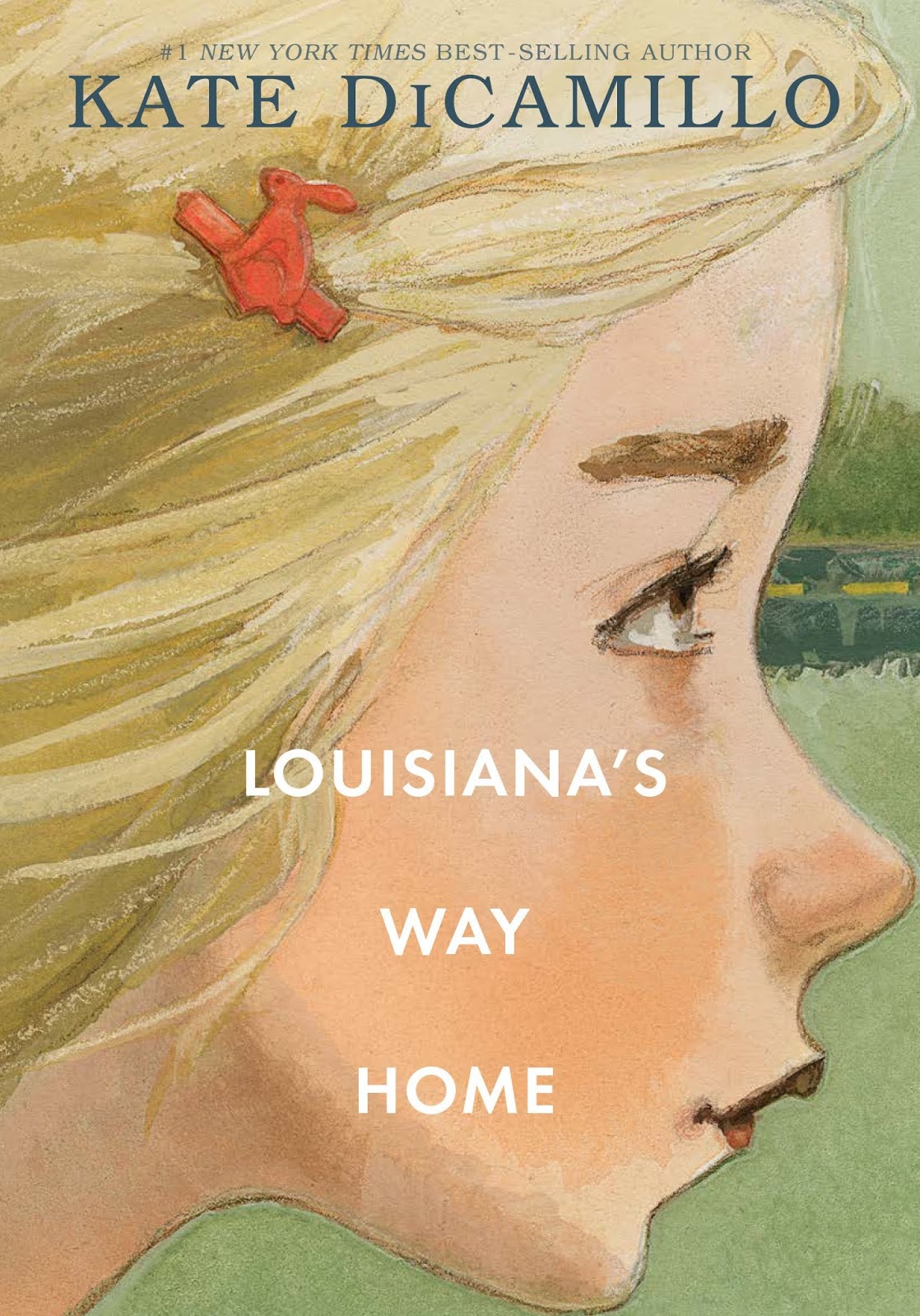
One of my new favourites though is Louisiana's Way Home by Kate DiCamillo. Her writing is stunning as always and Louisiana is a delightful, spunky creation. Suddenly, without explanation, Louisiana is on the run with her Grandma. What follows is a journey of major self discovery as Louisiana learns some painful home truths and discovers just how strong and resilient she really is.

We all, at some point, have to decide who we want to be in this world. It is a decision we make for ourselves. 

Forgiveness, hope and courage are DiCamillo's calling cards - they shine very brightly in this tender, bittersweet story. And it wouldn't be a DiCamillo story if we didn't also learn about the kindness of (some) strangers (although don't get me started on the grandmother!)

Perhaps what matters when all is said and done is not who puts us down but who picks us up.


I'm starting to loose track of ALL the princesses-turned-monster-fighting-superheroes in The Princess in Black series by Shannon Hale but #6 and the Science Fair Scare is still full of all the fun, derring-do, go-girl attitude of the earlier stories.

It's hard NOT to be charmed by these sassy young things with their alter-ego monster-fighting persona's. But I guess at some point, I'd like to see these girls (& the dashing young Goat-Boy) come out from behind their masks and let the world see who they really are all the time.

Book 6 feels like a transition point. Everyone now seems to be 'in' on the secret and it would be nice if the girls didn't have to pretend to be pretty, prim princesses in public any more.


I love junior fiction at this time of year. It's entertaining, easy reading. But they're not always light on topic or emotional impact. These books feature BIG themes with BIG heart. They are books that can be enjoyed by adults just as much as the younger people in their lives. There is way more to junior fiction than the Wimpy Kid and Dork Diaries, and I for one, am very grateful for that!

Wednesday, 12 December 2018

Australian Junior Fiction Catch Up

The run into Christmas and the silly season, leaves me tired, frazzled and depleted most years. This year I'm attempting a calmer, kinder approach. As a first line of defence I started interspersing junior fiction reads amongst my regular reads several weeks ago. I've been saving all the interesting looking ones for months now, so that I would have something 'just right' for this time.

Great junior fiction is the perfect antidote for the general madness and mayhem of the silly season. It's (usually) light and easy to read, sometimes interspersed with delightful illustrations and (usually) full of wonderful language. And almost all writers for younger people feel duty bound to end with hope. Bad and sad things may happen to their characters along the way, but there is always hope and wonder and love.

The Slightly Alarming Tale of the Whispering Wars by Jaclyn Moriarty is book 2 in her newly named Kingdoms and Empires series. The name of the series didn't make an appearance on the first book, so I was curious to see what this might mean for book 2 and any future books.


I loved Book 1 The Extremely Inconvenient Adventures of Bronte Mettlestone by Jaclyn Moriarty and had very high hopes for this one, so I was a little disconcerted to read the first few chapters with no Bronte in sight.

What was going on?
Where were we?
And who were all these new people?

The first couple of pages of this generously illustrated book show us maps of the various kingdoms within this world. Some of these names were familiar from Book 1, but other than the whispering element, nothing else seemed familiar.

TSATOTWW begins in the little town of Spindrift where we meet two groups of kids - one group from the orphanage, the other from an expensive, exclusive boarding school. A friendly sporting rivalry between the two schools quickly blows up when one of the children suddenly disappears. The Whisperers have kidnapped another child.

A tentative alliance is formed, a plan of rescue is hatched and Bronte makes an unexpected reappearance. Mystery, adventure and a little bit of magic is the name of the game.

I love this series for mature 9+ readers a lot and I hope that Moriarty has many more books planned for the Kingdoms and Empires. Due to the different time frame and setting in this book, it could be read as a stand-alone story, but you'll want to go back to see how Bronte came into the story in the first place. It was a savvy move by Moriarty to expand the horizons and history of this series to include the entire kingdom and I look forward to seeing where and when we end up next.

Inheritance by Carole Wilkinson is for slightly older readers - more 11+ through into the early teen years. It's a fabulous time slip story set in country Victoria.


Nic has been left by her dad at her Grandad's old homestead property while he goes off with his band to play the cruise ship circuit. With no wi-fi, no friends and loads of attitude, Nic starts exploring the big old home one room at a time. Eventually she discovers a locked room with no key in sight.

A fortuitous toe-stub whilst swimming in the dam and an old letter in a copy of Pride and Prejudice changes everything. Nic discovers dark secrets about her family history that have carry-over effects onto today's local history and her own family story.

Wilkinson weaves in indigenous issues, women's rights and early settler history into this engaging yet thought-provoking time travel story.

The Adventures of Catvinkle by Elliot Perlman is now top of my delightful dog story pile. Officially this is a book about a cat - the secret loving, baby shoe dancing, flying cat, Catvinkle, but it is also just as much about her new found friend (shhh! don't tell anyone that a cat and a dog are friends!) Ula the dalmatian.


Set in Amsterdam, Perlman (you may know him from his adult books, especially Seven Types of Ambiguity and The Street Sweeper) has turned the bedtime stories he used to tell his kids into a charming animal story for us all to relish.

There are LOTS of things to adore about this book, but the most endearing are the voices of Catvinkle and Ula. Perlman has got inside the heads of these two animals and they speak and act just as I imagine a cat and dog of these types would speak and act if they could!

The thing these three fabulous books share is complexity. The authors do not talk down to their young readers, they use interesting language, create nuanced, believable characters and they take you on a journey that is utterly compelling.

And then there is The Bad Guys Episode 8: Superbad by Aaron Blabey.

Personally, I'm getting pretty tired of their antics by now, but they continue to entertain and get 5-7 yrs old excited about reading, so I'm not going to complain too much.


After an excursion into outer space, then back in time to the dinosaurs, we are firmly back in the present with our world being taken over by the evil Mr Marmalade and his evil alien forces. And it wouldn't be the modern world without a female team of warriors to assist our bumbling bad guys.

In Superbad we learn that Agent Fox is actually part of a much larger, well organised group called The International League of Heroes. Her colleagues include Agent Kitty Kat, Agent Hogwild, Agent Doom, and Agent Shortfuse. They all have special talents and skills and they mean business. They help the Bad Guys learn control of their new super powers...until Marmalade turns up and throws everything into chaos...again!

Six Bad Guys' trading cards are in the back of the book, with 6 more promised to come in book 9. Blabey is onto a good thing, and he knows it!

Episode 1 The Bad Guys
Episode 2 Mission Unpluckable
Episode 3 The Furball Strikes Back
Episode 4 Apocalypse Meow

Saturday, 25 August 2018

Lenny's Book of Everything by Karen Foxlee

I fell in love with Karen Foxlee's writing in 2014 when I read and loved Ophelia and the Marvellous Boy.

A Most Magical Girl confirmed her ability to move me with her words. So much so, that I acquired her YA backlist to read...one day...!

So I was thrilled to discover recently that she had a new book, Lenny's Book of Everything, due out later in the year. When an ARC turned up last week with my reps tear-soaked tissue rave about how good it was ringing in my ears, I popped it on top of the TBR pile for the weekend.


All the PR on the inside covers suggested that this would be Foxlee's 'break-out book', the one that would finally tip her over into the big time (where I've always thought she belonged, by the by).

The opening sentence told me they were correct.

Our mother had a dark heart feeling.

Straight away I had that lovely goosebumpy shiver of anticipation feeling that happens oh-so rarely these days. I knew this book was going to break my heart yet I couldn't stop myself. Even when that breaking my heart feeling almost got too strong, I couldn't look away for long. Because Foxlee breaks your heart so tenderly, so hopefully, so sweetly that you can't not go along for the ride.

Every life has times of sadness and darkness, stories like this remind us that despite the darkness, within the sadness, there can be kindness, loving and beauty. This is what makes our lives worthwhile, this is what gets us through the bad times.

Foxlee also reminds us that words have power. They have meaning and purpose. Some people choose to put that power and purpose to a negative use, but Foxlee shows us the positive, glorious, wondrous nature of words and knowledge. Words that illuminate, uplift and provide hope are her speciality. Her words enrich our lives and fill our souls with joy.

I know, I'm gushing! But I'm not the only one smitten.

The book is full of gushing quotes:
Anna McFarlane (publisher, Allen & Unwin) - it raises spirits while it breaks hearts.
Eva Mills (publishing director) - broke my heart (in a good way!)...a deep understanding of humanity.
Juanita Keig (account manager) - importance of kindness and human solidarity.
Radhiah Chowdhury (editor) - soothes even as it relates the most unutterable pain.

Karen Foxlee's note tells us that this story about 'an encyclopedia set and a boy who kept growing' has been in her head for quite some time, and that when she 'finally sat down to write it, Lenny was there waiting for me. I felt immediately comfortable in her voice.' It shows.

The complexities and nuances within this story have been woven in seamlessly and apparently, effortlessly by Foxlee. Her characters are fully realised with whole back stories just sitting out of sight, influencing all their actions and reactions. The push and pull between her characters as they rubbed up against each other on a daily basis, felt so real and so natural. They loved, they annoyed, they cared and they hurt each other.

Foxlee said she was trying to explore 'love in all its forms' and how wonderful it is to be alive and that 'even in the darkest hours, there's always hope'. She succeeded.

Although Foxlee is Australian through and through, she has set this story in the 1970's in New York City. I've never lived in NYC, but I now feel like I have, at least, in this one little pocket of NYC so vividly described by Foxlee.

The rest of the story details I leave for you to discover yourself.

Not many books make me cry out loud - I can count the contenders on one hand - but Lenny's Book of Everything made me blubber. Yes, my heart was broken, but it wasn't unbearable. My heart was full of love, wonder and hope too and my heart was mended, again.

The comparisons to Wonder, The Boy in the Striped Pyjama's and The Book Thief are spot on. They are all very different stories, told in very different ways, but they all share an authenticity and tell an emotional truth that is universal and enduring.

The final hardback cover will look like this:


If you'd like to read about the creative process that made this stunning cover, read about it @Things Made From Letters.

Lenny's Book of Everything is a Nov 2018 publication Allen & Unwin.
Book 20 of #20booksofsummer (winter) WAHOO!!
Temperature in Northern Ireland 19℃
Temperature in Sydney 18℃

Monday, 16 July 2018

The Neverending Story by Michael Ende

I have a vague recollection of seeing the 1984 movie version of The NeverEnding Story in my late teens. It was a bit too juvenile for my sophisticated, desperate-to-be-grown-up self at that time, so other than a shaggy white flying dragon and a boy clinging to its neck, I remember nothing. And felt no need to know any more.

Until a copy of the book fell into my hands recently & I decided to add it to my #20booksofsummer (winter) list as a bit of light relief.


Die unendliche Geschichte was published in German in 1979 by Michael Ende, a prolific and very successful children's writer. He was born in 1929 in Bavaria to a surrealist painter and a physiotherapist. In 1935 the young family moved to Munich to live in an artistic community. But in 1936, his father's work was declared 'degenerate' by the Nazi's forcing him to work in secret.

The young Ende experienced bombings and compulsory membership in the Hitler Youth before being drafted into the Volksturm in 1945. However, the story goes that he tore up his papers and joined a Bavarian resistance movement for the remainder of the war instead.

After the war, he dabbled in poetry, acting and play writing. His first novel, Jim Knopf was published in 1960. However 1960's Germany was not a good time to be writing escapist literature. Post-war Germans were all about political commitment and realism; feeling undervalued he moved to Italy to live. It was here that he wrote The Neverending Story.

He went on to write 30 books before his death in 1995. Ende was a human rights activist, anti-rearmament and a campaigner for peace.

His influences included Rudolf Steiner, Rainer Maria Rilke and a life-long fascination with Japan.

The Neverending Story is a fantastical fairy tale, full of imaginative wish fulfilment. Each chapter begins with a letter of the alphabet, which must have a been a challenge for the translator, Ralph Manheim. The first half of the book sees motherless, unloved Bastian Balthazar Bux reading a story about another land in grave danger of disappearing into Nothingness. The protagonist appears to be a young warrior/hero called Atreyu with his faithful horse Artax and a luckdragon named Falkor. The story appears to be a lesson on imagination, the nature of lies, power and purpose.

This is where the movie ends.

Ende felt that this adaptation's content deviated so far from the spirit of his book that he requested that production either be halted or the film's title be changed; when the producers did neither, he sued them and subsequently lost the case. Ende called the film a "gigantic melodrama of kitsch, commerce, plush and plastic" (Ein "gigantisches Melodram aus Kitsch, Kommerz, Plüsch und Plastik").The film only adapts the first half of the book, and consequently does not convey the message of the title as it was portrayed in the novel. (Wikipedia)

I can see why Ende was upset. At this point the story did not feel 'neverending'. It was a tremendous fantasy about courage and truth, but it wasn't until the story moved onto Bastian's entry into the fantasy world that the cyclical nature of the story became apparent. Suddenly the tone shifted from imagination to creation. Pure escapism and wish fulfilment surrounded Bastian as he gradually learnt to be careful what you wish for. Bastian transformed himself from a dumpy, unloved, fearful boy into a strong, handsome, brave protagonist. It took him the rest of the story to realise that the real meaning of a well-lived life is love, memory and being true to yourself.

The Neverending Story is a classic quest story that will delight fantasy-loving readers of any age.

Book 11 of #20BooksofSummer (winter)

Wednesday, 20 June 2018

Cold Spring Harbor by Richard Yates

My first experience with Yates was way back in 2012 when I read Young Hearts Crying. It was so depressing, I haven't been able to try another one until now!

I love the covers that Vintage have selected for all their Yates books, they capture the melancholy and dissatisfaction that seems to infect all of his characters in one way or another. Cold Spring Harbor was no different, although ultimately less emotionally exhausting than Young Hearts Crying.


So many hopes dashes, disillusionment and mental health issues. Media reports often comment on the rise in mental health problems in our modern world, but Yates' novel remind us that they were always there, just not diagnosed and often self-medicated with copious amounts of alcohol.

Belonging was obviously a major theme in Yates' own life that carried through into all of his novels. His parents divorced when he was four, he moved around a lot, always short of money. His mother drank too much, he was bullied at school, joined the army in WWII, became a journalist, married, had children, divorced, remarried and had another child. He also drank too much, smoked and suffered from bouts of bronchitis, tuberculosis and bi-polar behaviours, before dying at age 66 of emphysema.*

In Cold Spring Harbor we have alcoholic mothers, absent fathers, divorced families, a family who moves around a lot and is always short of money, prep school bullying and army life. Everyone seems to be living a life of quiet desperation.

'My characters all rush around trying to do their best, trying to live well within their known and unknown limitations,' Yates explains. 'Doing what they can't help doing, ultimately and inevitably failing because they can't help being the people they are.'*

It's bleak stuff, on the very edge of hopeless. As with Young Hearts Crying, I got to the end and wondered what was the point of all that angst? Did I learn anything new about human nature? Did the characters learn anything new about themselves? Was there some political or social commentary being made by the author? I think it's probably a big fat no to all of that!

Cold Spring Harbor was most likely Yates' final attempt (it was his last published book) to work out his own sad life story. I can't decide if Rachel's closing words to her new born son were a sign of hope, wish fulfilment or irony on Yates' behalf.
"Oh you little marvel," she said. "Oh you're a wonder, that's what you are. You're a miracle. Because do you know what you're going to be? You're going to be a man."

* Nick Fraser Rebirth of a Dark Genius, The Guardian 17th Feb 2008

Book 6 #20BooksofSummer (Winter)
20℃ in Sydney
16℃ in Norther Ireland

Tuesday, 29 May 2018

Pachinko by Min Jin Lee

After returning home from our trip to Japan, I wasn't ready to let it go, so when I finished Memoirs of a Geisha, I turned straight to this glorious historical fiction set in Korea and Japan for solace. Not that Pachinko was a comforting read as such. There was tragedy, sadness, grief, loss and war. But there was also love, loyalty and strength of character.


Basically Pachinko is an epic multi-generational story. The consequences of a brief love affair by a young Korean girl with an older married man impacted several generations. The repercussions of the affair brought about great change and great joy as well as tremendous suffering and opportunity. 

Min Jin Lee explores the nature of belonging via all her characters. I hadn't realised how many Koreans had immigrated to Japan during the Japanese occupation of Korea from 1910 -1945 and how much discrimination they faced, and continue to face. After the war they were given the opportunity to move back to Korea, and some tried. But they often found that they had become so Japanese to their Korean neighbours that they were rejected. The political division into north and south Korea also prohibited the return of many former nationals. Yet they didn't belong in Japan either. 

To belong somewhere, is it country, language, culture, education, family, nature or nurture?

The Japanese call the Koreans who came to Japan during this time zainichi (foreign resident staying in Japan). They are a distinct minority group in Japan that are differentiated from even the Koreans who immigrated to Japan in the 1980's.

The Japanese, like most countries in the world, have not readily or gracefully accepted cultures and peoples who differ from themselves. Sunja's story highlighted all the discrimination, subtle and institutional, that this group of Koreans endured and the impact it had on individuals, families and the community as a whole.

I didn't like the cover at all when I began the book (I preferred the prettier pachinko-style smaller format and international covers) but by the end I became quite attached to the young woman on my cover. Her stoic stare gradually revealed the pain and determination to survive in an hostile environment. And I got to wondering who was this woman and what was her story.


As Lee found when she researched this book,
the Korean Japanese may have been historical victims, but when I met them in person, none of them were as simple as that. I was so humbled by the breadth and complexity of the people that I met in Japan that I put aside my old draft and started to write the book again.

It is this human complexity that she conveys so well in Pachinko.

Thursday, 24 May 2018

Kafka on the Shore by Haruki Murakami

I like to think that I have taken my 'what to read whilst travelling' choices to an inspired level of brilliance, but I really outdid myself with our recent trip to Japan. Reading Murakami in Japan now feels like the ONLY place to read Murakami!

Not only does the usual Murakami weirdness make sense when you're actually in Japan, but you also realise just how important the environment is to Murakami and his characters. His descriptions of the trees, forests, waterways and urban spaces are everywhere as you move around the country. As are the crows.

In this case, the boy named crow is a mentor to our young protagonist, Kafka Tamura, perhaps an alter ego, a Japanese Jiminy Cricket. Whatever crow is or isn't, right from word one, Murakami is flagging that symbolism, mythology and psychology will be our prime concerns in Kafka on the Shore.

In Japanese mythology, crows are seen as a sign of 'divine intervention in human affairs' (wikipedia). Western mythology tends to associate the crow with bad news or as a harbinger of death. They're selfish, spread gossip and neglect their young. And they're everywhere in Japan. They sit on telegraph wires, fence posts and roof tops. You often wake up to their cawing, even in the city.

Cats are the other creatures that dominant not only Murakami stories, but many Japanese stories, yet curiously I didn't see one single cat in three weeks, let alone a talking cat! The opposite of the crow, cats are creatures of good luck, although still often associated with death and hauntings.


Silence, I discover is something you can actually hear.


There is no denying that Murakami is on very intimate terms with kooky.

If the talking cats weren't enough, a cameo appearance by Johnny Walker and Colonel Sanders of KFC fame might tip you over the edge. A reference to the (fictional) Picnic at Hanging Rock as an example of another group loss of consciousness event caught my eye. Did Murakami know that it was an urban myth? Is that what he was implying about his own story? The sense of mystery and other-worldliness was certainly a shared atmosphere between the two stories.

I was also amazed by truck drivers who suddenly became classic music afficiandos, quiet librarians who turned out to be sex fiends and sex workers who quoted philosophers. What's not to love? The kookiness gets under my skin and into my head. Just like what happened to me with his previous books.

1Q84 is still roaming around in my head, Colourless Tsukuru less so, but it's still a memorable book experience.

Things outside you are projections of what's inside you, and what's inside you is a projection of what's outside you. So when you step into the labyrinth outside you, at the same time your stepping into the labyrinth inside. 

One of the really enjoyable aspects to reading Murakami in Japan is the place names. Suddenly they really mean something. Most of the action in Kafka takes place in Takamatsu on the island of Shikoku. 

We didn't get to Shikiko with this visit, but we did see one of the huge bridges, from a distance, that joins Shikoko to Honshu and we spent some time at the station that is the interchange for the JR line that goes to Takamatsu. Seeing the name of the city featured in my book up in lights suddenly grounded this surreal story into reality.

This is only my fourth Murakami (see my Author Challenge tab for details) so I'm not sure I can safely name all his common themes and ideas, but there are a few that I've clocked. Going into the woods/fear of getting lost, weird sex, talking creatures, dreams, random jazz references, loneliness and silence. And for me, the reader, there is an over-riding sense of bewilderment (WTF was that about?) as well as an overwhelming sense of wanting more (whatever it was a think I like it!) 


I'm caught between one void and another. I have no idea what's right, what's wrong. I don't even know what I want anymore. I'm standing alone in the middle of a horrific sandstorm. I can't move, and can't even see my fingertips.


Murakami doesn't wrap his stories up with a neat, tidy bow or resolve many of the story lines. This should be totally frustrating...and it is, but somehow you love being kept in the dark and confused at the same time. Perhaps it's the likeable characters? Or perhaps it's the not so subtle way he plays with your head? Or perhaps it is the hope that the next book he writes will bring you one step closer to understanding this maddening man and his ability to suck you into his world. 


Every one of us is losing something precious to us....Lost opportunities, lost possibilities, feelings we can never get back again. That's part of what it means to be alive. But inside our heads - at least that's how I imagine it - there's a little room where we store those memories.


Image source
Murakami likes to do the whole books in books thing. Kafka's backlist was an obvious start -The Castle, The Trial, Metamorphosis and In the Penal Colony in this case. But he also referenced The Arabian Nights, the complete works of Natsume Soseki, a book about the trial of Adolf Eichmann (I can only assume it was Hannah Arendt's Eichmann in Jerusalem), Electra by Sophocles, The Tale of the Genji and 'The Chrysanthemum Pledge' in Tales of Moonlight and Rain by Ueda Akinari.

So many tangents, so many connections, which one should I tackle next?

Friday, 9 March 2018

The Shepherd's Hut By Tim Winton

The Shepherd's Hut is Tim Winton's much anticipated latest novel. I am a fan, but with reservations. I loved Cloudstreet and Dirt Music but hated The Riders (it has the dubious honour of being one of my very first DNF books). Breath was good but a bit blokey and Eyrie was okay, but a bit blokey. I adore his children's picture book illustrated by Karen Louise called The Deep. And his essays in The Boy Behind the Curtain were truly luminous.

So I entered The Shepherd's Hut cautiously.


The first 20 or so pages were a struggle for me. I know that there are awful dad's out there, I know what they can do. I used to be a teacher, I've assisted some of those families in negotiating the quagmire of domestic violence over the years. But I don't feel the need to read about such sad, brutal things.

So I struggled with the first part of the story where we experienced Jaxie's dysfunctional relationship with his father. I thought, I can't do this.

Later that night, I tried again.

Without spoiling anything for anyone, Jaxie was on the run and suddenly we had a full-on road trip/survival story underway. Unusually for Winton, there wasn't a beach in sight, as Jaxie headed inland to the scrubby, salty desert areas of WA.

Some readers might find Jaxie's vernacular hard going. It annoyed me at the start, but I think I'm at an age when teenager-speak is annoying in whatever form it takes! But once Jaxie hit the road, the voice became more considered and thoughtful, and was perhaps meant to reflect the influence that Fintan had on him. If you disliked Huck Finn or Lincoln in the Bardo because of the local dialect, then steer clear of this one too. The swearing may also put off some readers.

Fintan was the ageing priest that Jaxie stumbled upon in the bush. We don't know why he's living a life of exile, but there were obviously some issues around the priesthood and the Catholic Church that Winton was exploring here. I'm still not sure what they were.

The same goes for Winton's well-known concern about toxic masculinity. He discusses it in detail, but what is the solution?

Because it's also #ReadIreland month over at Cathy's blog, I thought I would highlight the Irish character in Winton's story. Fintan, the priest is described by Jaxie like this,
I never did know what to make of Fintan MacGillis....He was Irish, he told me that straight up. But I never found out what it was he done to get himself put there by the lake, what kind of person he was before....He was one of them geezers been out on his own so long he talks to himself all day....You had to sort through all these bent up words to figure which was bullshit and which was true. What I mean is he made a lot of noise but sometimes he didn't say much. With that accent of his and the way he said things fancy and musical, it was like camouflage and you knew deep down he'd been doing this all his life, hiding in clear sight.

The Shepherd's Hut is not an easy read, but, in the end I found it to be a worthwhile encounter.
It's not quite a coming of age story because the becoming part was still to happen and it's not quite a road trip story as Jaxie's journey was nowhere near done. It was more like a vignette, a moment in time, a snapshot in time.

I'm not sure I learnt anything new or gained any insights into domestic violence, the lost and lonely or survival, but I can see an action-packed, fast-paced, gritty movie on the horizon!

Eyrie by Tim Winton
Dirt Music by Tim Winton
The Boy Behind the Curtain by Tim Winton
The Deep by Tim Winton

Facts:
  • Longlisted for the 2020 International Dublin Literary Award.

Saturday, 24 February 2018

The Enlightenment of the Greengage Tree by Shokoofeh Azar

The Enlightenment of the Greengage Tree has been attracting my attention for several months now, however it took its recent longlisting for this year's Stella Prize to finally make me pick it up. I'm nothing but a Stella groupie!

The cover alone might have been enticement enough (a collage of three of Azar's art works), but the promise of a mystical, magical tour through the horrors of revolutionary Iran, 'using the lyrical magic realism style of classical Persian storytelling', was the final prompt I needed to make this my first book to read from this year's prize.


Magical realism can be a problem for many readers I know. I'm happy to embrace some forms of magic realism more than others. I especially like those that draw fairy tales, fables and myths into our modern real-world setting. (FYI: I'm not so keen on the type of magic realism that brings in a lot of deliberately disorientating layers and details. I like my magical realism to still make sense somehow!)

Azar's use of magic realism did that and more. It's quite a skill to weave a story that allows your somewhat sceptical reader to accept the existence of ghosts, jinns and mermaids. But Azar did it for me - I was with her from the start, on that level at least.

However, it did take me a while to get going. It may have been a translation thing or it may have been a slightly different approach to sentence structure. Many of the books I gravitate towards lately are ones with concise, short sentences. So maybe it was simply my lack of practice in reading longer, flowing, complex sentences. Whatever it was, I found the start of The Enlightenment of the Greengage Tree choppy and erratic.

It wasn't until the special circumstances of our narrator were revealed at the beginning of chapter 5 that I was hooked. Suddenly the 'playful, poetic and deeply melancholy' Alice Pung quote on the back cover came to life.

I dropped into a dreamy, almost trance-like state every time I picked up the book. Jinns and groves of trees haunted my own dreams as fleeting childhood memories of news items about the 1979 Revolution were triggered by events in the story. It was angry, it was heart-rending, it was glorious, mesmerising and confronting.

Azar has given us a classic story of good and evil. Her words are fluid as is her approach to time and truth. Belonging, love and loss are the major themes while the search for solace is the main concern for her characters. Given the horrific events that occurred during the Iranian Revolution, it is easy to understand why and how an author would choose to wrap these unreal events up in mythology. When the real world you live in suddenly gets turned on it's head, sometimes the only response is imagination and the only hope is magic.

I, for one, hope with all my heart, that this story gets shortlisted for the Stella - it deserves to get as much attention as possible.

Translated from Farsi by Adrien Kijek#AustWomenWriters
#Stella2018

Saturday, 17 February 2018

The Sun and Her Flowers by Rupi Kaur

Basically I wanted to see what all the fuss was about.


I knew that Kaur was an Instapoet success with millions of followers which had spawned two books of poetry and invitations to numerous writer's festivals around the world. I knew she appealed to young people and that she was single-handedly turning them onto poetry. Our languishing poetry section at work was actually getting a work out for the first time in a long time, thanks to the requests for her two books.

I also knew that there was some debate about whether or not Kaur actually wrote poetry or not.

I am not a poetry expert in any way shape or form. I have enjoyed some poets and their works over the years because they move me or their elegant use of language blows my mind or the describe something familiar in such a new and novel way that I see something old and known in a completely different way. And I can see how Kaur's work would and could do this for many, many people.

She speaks simple truths, aphorisims even, about being female. Kaur explores relationships, love, sex and belonging. Her work often delves into darker themes of abuse, self-abuse, break-ups, depression, loss, grief, the beauty myth, difference, the immigrant experience and racism.


There is nothing difficult about her writing style, although her lack of capitals does my head in (showing my age I know!) Most of the pieces are like the one above. Brief pieces of advice illustrated by Kaur - a perfect Instagram post - that reaches and touches her target audience.

In The Sun and Her Flowers, Kaur has a few longer pieces that could be called observational poetry. Thankfully, I'm past a lot of the angst that Kaur writes about, but her words brought much of it racing back. All that insecurity, indecision and apprehension mixed with wild hope and bittersweet moments. False starts and wrong turns and so much time wasted worrying abut stuff that you can't change.

A part of me wishes I could go back and tell my younger self and all these young women that this is just a phase of life that passes. It feels like forever, but it's not. It feels like for keeps, but it's not.

But I don't, I can't, because everyone has to work that out for themselves in their own way.

Reading the words of someone who is in the middle of all that, helps me see the journey of my own life and makes me grateful to be long past all that. Middle age is not without it's own angst, but it's tempered by experience, maturity and growth. What seemed so important at twenty or thirty is no longer of concern at fifty. Other things take over. I'm sure my seventy year old self will smile wryly at the worries of my fifty year old self one day.

That's how it goes.

And that's what was missing from this collection of poems and aphorisms for me. A sense of future. A sense of perspective. The big picture. Reflection.

Kaur gives us a snapshot of a moment, a detail of now. Her voice is authentic, accepting and lyrical. I can see the appeal. And she's turning a generation onto the idea of poetry, nothing wrong in that at all.

Tuesday, 31 October 2017

The Guggenheim Mystery by Robin Stevens

The Guggenheim Mystery is the follow up story to Siobhan Dowd's 2007 The London Eye Mystery. Dowd sadly died of cancer at the end of 2007. She had been contracted to write two Ted Spark mysteries, but other than selecting the title of book two, she died before planning any of it.

The Siobhan Dowd Trust (established by Siobhan herself in her dying days) set out to find someone to finish her stories. Patrick Ness took over the half conceived A Monster Calls while Robin Stevens was given a title!


In her Author's Note at the end of the book, Stevens says,
I realised why Siobhan had chosen it (the Guggenheim) as the setting of Ted's second adventure. If Ted is a different detective, the Guggenheim, with its curving ramp, its rotunda shape and its insistence on viewing art from all angles at once, is a different sort of museum. Ted would be perfectly at home there - and if anything were to happen to one of the paintings, he would be the perfect person to solve the mystery.

It turns out that Stevens, like Ted's cousin, Salim, also grew up with a mother who worked in a museum. In fact, her mother was working at the Ashmolean in 2000 when thieves stole a Cezanne using smoke bombs. Steven's The Guggenheim Mystery is the perfect example of art imitating life!

The mystery was relatively easy for an adult reader to work out, but of course, I'm not the target audience. The three main characters are likeable and believable. The use of logical reasoning and deduction techniques appealed to my practical brain. There was a quest-type element to the detective work as each person who was questioned and eliminated, then gave them clues or advice on who to proceed to next.

Dowd created a love letter to London in The London Eye Mystery, in The Guggenheim Mystery Stevens has created her own love letter to New York.

Highly recommended for 10+ readers who love detective-type stories and diverse characters.

Wednesday, 25 October 2017

Readathon Reads

Part of the feeling of success and enjoyment that I had with this year's Readathon was mostly reading junior fiction, short stories and essays. It allowed me to switch between genres and feel that I was getting through books and pages. In previous readathons I would read through the pile of half finished books by my bed. I ended up reading a similar amount of pages, but maybe only finished one book. This year actually finishing books felt like a big deal and kept my enthusiasm keen until the end.

But now I have a stack of book responses to write #postreadathonblues!

To make my life simpler, I'm going to combine the junior fiction books into one post. I saved my two junior reads for the end when I was getting tired eyes and a smushy brain.

I read Miss Happiness and Miss Flower by Rumer Godden and The London Eye Mystery by Siobhan Dowd.

Miss Happiness came to me thanks to a recommendation within another book. Chasing the Sky is a book about twenty Australian women architects and utterly fascinating in it's own right. However, one of the architects mentioned that she had read Miss Happiness as a child and that it had been one of the inspirations for her to become an architect. I was intrigued.


I knew that I would enjoy Godden's writing style as I had thoroughly enjoyed The Greengage Summer unexpectedly last year. And I knew that it would be the prefect choice for late in the readathon as soon as I opened it and saw the big font, generous spacing and black and white illustrations.

The Japanese theme also appealed to me thanks to our planned trip to Japan in 2018.

The story is aimed at the 8+ age group and features a young girl sent to England to live with her aunt, uncle and cousins from India. She is unhappy and shy and not fitting in, until a great-aunt sends her two little Japanese dolls for Christmas. Miss Happiness and Miss Flower are also aliens in this very English world.

Young Nona sets out to make them more comfortable by making a Japanese doll's house for them. She befriends the local librarian who helps her pick the right books and gradually the rest of the family get involved in building this miniature home complete with niche, bonsai and tea ceremony.

The real delight for any budding designer though are the detailed drawings and instructions at the end of the book showing you how to make your very own Japanese doll's house. A quick google also revealed a whole world of people who have made their very own Japanese doll's house inspired by this charming book.

Miss Happiness and Miss Flower was published in 1961 and has a few cultural clangers relevant to it's time, but the universal themes of belonging, tolerance and friendship make it all worth while.

Jump forward to 2007 and The London Eye Mystery. Siobhan Dowd's story is set in a very modern London with characters who also share a love of architecture and design.


It would be easy to call this book A Curious Incident of the Dog at Night Time for 10 year olds, but it probably shares more in common with the feel-good Wonder by R J Palacio.

At it's heart is the mysterious disappearance of cousin Salim, who went into a pod on the London Eye, but didn't come down. His cousins, Ted and Kat spend the book working out what happened using logic, patterns and inductive reasoning. Ted is high functioning on the autism spectrum whilst Kat is a young girl of action.

The mystery is fairly simple to work out, but there's enough tension to keep young readers second guessing for a while. The part that appealed to me the most, though, was the love-letter to London feel that infused the whole story. Having spent quite a bit of time in London over the years, I was able to picture myself walking the same streets, riding the Tube, hearing the accents and experiencing the weather along with Ted and Kat.

My copy of The London Eye Mystery is a new edition (2015) with an Introduction by Robin Stevens. She says,
A mystery writer must play fair, but also play tricks: all the clues must be laid out in plain sight, while at the same time the reader is persuaded to ignore them until it's too late.

As an adult you can see how Dowd has done this, but there are enough distractions along the way to keep even the most critical reader a little wrong-footed at times.

Sadly, Dowd died in 2007 leaving behind one unfinished book idea (which Patrick Ness turned into A Monster Calls). Robin Stevens has now written a follow-up book about Ted and Kat called The Guggenheim Mystery published last month. I'm keen to see how the transition works.


David Dean's iconic retro covers may look familiar as his work has been used for many of Michael Morpurgo and Lauren St John's recent editions as well.

Monday, 15 May 2017

Yours Sincerely, Giraffe by Megumi Iwasa

One of my recent #readathon reads was the delightfully eccentric Yours Sincerely, Giraffe by Megumi Isawa. When my eyes started to get tired and words began to blur on the page, the simple but fun illustrations from Jun Takabatake were just the eye candy I needed.


The premise of the story is simple - Giraffe is bored. Until, that is, he spots a sign on a tree from an equally bored pelican who has decided to start up a postal service, 'willing to deliver anything anywhere'!

Giraffe decides to write a letter. He gives it to pelican with the instruction 'give it to the first animal you meet on the other side of the horizon.'


What follows is a rather absurd, but oh so charming tale of mistaken identity and misunderstanding as giraffe and his new penpal, penguin, try to imagine what each other look like and what it would be like to live on the other side of the horizon.

For teachers and parents, the added bonus with Yours Sincerely, Giraffe is the chance to discuss letter writing, difference and perception with your emerging reader. It's also a fabulous book to read aloud together.

New Zealand based Gecko Press have become renown for their promotion of unconventional, diverse and humorous books for children. These include Rose Lagercrantz's My Happy Life books and Ulf Nilsson's Detective Gordon series. Yours Sincerely, Giraffe is another quirky addition.

Monday, 8 May 2017

Journey to the River Sea by Eva Ibbotson

I started the Journey to the River Sea by Eva Ibbotson as part of my #readathon session. I had a lovely 15th anniversary edition of this modern day classic, complete with gorgeous blue butterfly. The following day I woke up with a terrible head cold and struggled to work, before realising that I was going to need a couple of days at home in bed to actually get better.

Journey to the River Sea became the perfect easy, delightful read to see me through my first day of feeling miserable at home.


This book was a pleasure in and of itself, but it also brought back so many lovely memories of other favourite childhood characters. Our orphaned heroine, Maia upon hearing that she was being sent to the Amazon to live with cousins she had never met, channelled her inner Jane Eyre, when she gave herself this stern talking to,
Fear is the cause of all evil, she told herself but she was afraid. Afraid of the future...afraid of the unknown. Afraid in the way of someone who is alone in the world.

Followed up quickly by an Anne Shirley-esque remark, 'And after that I don't know, but it's going to be all right.' Maia is courageous, funny and intelligent - the kind of child, we all wish we had been more like (well, at least, the kind of child, I wish I had been like).

There's the forbidding but ultimately lovable governess who provides Maia with thoughtful care, fun and inspiring life advice just like Mary Poppins or Professor McGonagall. The Little Lord Fauntleroy aspect is explored via Clovis, the very homesick and unwilling theatrical orphan boy. The mean twins are Nellie Olsen, John Reed and Veruca Salt all rolled into one (well, actually two, but you know what I mean!) And the lost boy, living with the Indians, has a touch of the Huck Finn's or Peter Pan about him.


Journey to the River Sea is historical fiction with heart. Set in 1910 England and Manaus on the banks of the Negro River in Brazil, Ibbotson gives us a tale of belonging, bravery and being true to yourself. There's also a treasure trove of gorgeous geography and anthropological treats along the way, with references to Humboldt, sloths and butterflies, just to name a few.

Highly recommended for mature 10+ readers and all lovers of fine children's literature.

My post for One Dog and His Boy from 2011 - when my reviews were short, sweet & simple.

Thursday, 6 April 2017

Antoinette by Kelly diPucchio

Kelly DiPucchio has won me over - head, heart and soul - with her two enchanting picture books about Gaston and Antoinette. They ooze charm, cuteness (but don't tell them!) and good humour.


Antoinette continues the very chic tale, that began with Gaston, about these two adorably diverse dog families from Paris. Fee-fe, Foo-fo, Ohh-la-la and Gaston have remained friends with Rocky, Ricky, Bruno and Antoinette, but this time it is Antoinette's turn to question where she belongs and what she is good at.

It's not until Ohh-la-la goes missing that Antoinette realises what her special talent is.

When Antoinette not only finds but rescues the missing Ohh-la-la in the nick of time, Mrs Poodle cries out in relief, "You found my Ohh-la-la." I defy the hardest of hearts not to chuckle at this point!


Caldecott Honoree Christian Robinson has illustrated both books with his mixed media collage and acrylic pictures. In a Q&A on Fishink, Robinson says of his artistic influences that,
I’m a bit of a sponge and my work is influenced and inspired by so many illustrators and painters that I love. Illustrators like Ezra Jack Keats and Abner Graboff inspire me to play with collage and cut outs. Designers like Paul Rand and Bruno Munari inspire me to keep things simple and have fun. Artist like Picasso and Mattise push me to explore color and shapes.

Given that I adore the simple designs and complementary colour palette that Robinson uses, I would have to say that he has successfully found his own unique style.

We can only hope that DiPucchio and Robinson have much more to say and illustrate about Gaston and Antoinette, because, I for one, am certainly not done with these two canny canine families.

Wednesday, 22 March 2017

Harry Potter and the Cursed Child by J K Rowling, John Tiffany & Jack Thorne

I had LOTS of doubts about a new Harry Potter.

Did we really need a new Harry Potter? Wasn't this just a crass cash grab? Was there anything new to be said about the power of love?

As it turns out the answer is yes!

Rowling along with Tiffany and Thorne had plenty more to say about the power of love and the art of forgiveness. After all, Harry was a pretty easy character to love. But what would happen if the main character was less lovable? How would we all respond then?

Young Albus is struggling. Struggling with being the youngest in a high achieving family. Struggling with being famous thanks to who his father is and struggling to feel competent or relevant.

It's only natural, then, that when he starts at Hogwarts that he would be drawn into friendship with another outsider. Another boy struggling with his family history and his sense of belonging - young Scorpius Malfoy.

I'm not going to reveal any major (or minor) plot points, you will have to read the book (or see the play) for yourself if you're that curious. My main concern, was centred around whether or not it was actually worthwhile to continue the series at all.

Given the huge response to Rowling's tweets in previous years about what the Potter children would have been up to, it's easy to say, yes, the interest was there.

Did Rowling herself feel compelled to write more about the Potter's and Hogwarts? I guess only she can really answer that, but given that she chose not to write a book herself perhaps suggests she was a little ambivalent or maybe just more focused on other creative pursuits.

Although perhaps those other creative pursuits played right into the idea of creating a play (see what I did there?)

As for the play itself, if I lived in the UK, I would have moved heaven and earth to get tickets for the show. Reviews for the play generally agree that the 2 part experience was worth it. As a theatrical production, The Cursed Child works. And if it ever comes to Australia, I will be there.

But what about the script?
Was it necessary to produce a hugely publicised co-written script for the event?

Given that it's Harry Potter, again, you'd have to say yes. People want to know, even if they disagree with what Rowling et al have ultimately devised.

The tricky thing about The Cursed Child though is that it's only half about Harry Potter and it's only half about the childhood world of Hogwarts. And Harry Potter as an adult, struggling with how to be a father, juggling work, marriage, friendships and fame is not the same as the youthful, idealistic Harry that we watched grow up. Mr Books, who has also read the script, said that the adult Harry, Hermione and Ron were still acting and sounding just like kids playing at being grown-ups. The transition was always going to be awkward - for all of us.

Albus (and Scorpius) are baring the brunt of inter-generational damage. Their character growth and development and that of all the main players felt believable and real.

All of that comes through in the script.

What doesn't come through as well though (at least for someone who is imaginatively impaired) is the glorious blend of ordinary life and magical life that is alive in the earlier books. I missed the descriptive language.

I ended up skimming through the final half of the script just to find out what happened. It was a quick, easy read that left me delighted to see that once again, the power of love and hope wins out. The magic of Harry Potter is still out there. You just have to believe!