Showing posts with label Fantasy. Show all posts

Wednesday, 12 December 2018

Australian Junior Fiction Catch Up

The run into Christmas and the silly season, leaves me tired, frazzled and depleted most years. This year I'm attempting a calmer, kinder approach. As a first line of defence I started interspersing junior fiction reads amongst my regular reads several weeks ago. I've been saving all the interesting looking ones for months now, so that I would have something 'just right' for this time.

Great junior fiction is the perfect antidote for the general madness and mayhem of the silly season. It's (usually) light and easy to read, sometimes interspersed with delightful illustrations and (usually) full of wonderful language. And almost all writers for younger people feel duty bound to end with hope. Bad and sad things may happen to their characters along the way, but there is always hope and wonder and love.

The Slightly Alarming Tale of the Whispering Wars by Jaclyn Moriarty is book 2 in her newly named Kingdoms and Empires series. The name of the series didn't make an appearance on the first book, so I was curious to see what this might mean for book 2 and any future books.


I loved Book 1 The Extremely Inconvenient Adventures of Bronte Mettlestone by Jaclyn Moriarty and had very high hopes for this one, so I was a little disconcerted to read the first few chapters with no Bronte in sight.

What was going on?
Where were we?
And who were all these new people?

The first couple of pages of this generously illustrated book show us maps of the various kingdoms within this world. Some of these names were familiar from Book 1, but other than the whispering element, nothing else seemed familiar.

TSATOTWW begins in the little town of Spindrift where we meet two groups of kids - one group from the orphanage, the other from an expensive, exclusive boarding school. A friendly sporting rivalry between the two schools quickly blows up when one of the children suddenly disappears. The Whisperers have kidnapped another child.

A tentative alliance is formed, a plan of rescue is hatched and Bronte makes an unexpected reappearance. Mystery, adventure and a little bit of magic is the name of the game.

I love this series for mature 9+ readers a lot and I hope that Moriarty has many more books planned for the Kingdoms and Empires. Due to the different time frame and setting in this book, it could be read as a stand-alone story, but you'll want to go back to see how Bronte came into the story in the first place. It was a savvy move by Moriarty to expand the horizons and history of this series to include the entire kingdom and I look forward to seeing where and when we end up next.

Inheritance by Carole Wilkinson is for slightly older readers - more 11+ through into the early teen years. It's a fabulous time slip story set in country Victoria.


Nic has been left by her dad at her Grandad's old homestead property while he goes off with his band to play the cruise ship circuit. With no wi-fi, no friends and loads of attitude, Nic starts exploring the big old home one room at a time. Eventually she discovers a locked room with no key in sight.

A fortuitous toe-stub whilst swimming in the dam and an old letter in a copy of Pride and Prejudice changes everything. Nic discovers dark secrets about her family history that have carry-over effects onto today's local history and her own family story.

Wilkinson weaves in indigenous issues, women's rights and early settler history into this engaging yet thought-provoking time travel story.

The Adventures of Catvinkle by Elliot Perlman is now top of my delightful dog story pile. Officially this is a book about a cat - the secret loving, baby shoe dancing, flying cat, Catvinkle, but it is also just as much about her new found friend (shhh! don't tell anyone that a cat and a dog are friends!) Ula the dalmatian.

Set in Amsterdam, Perlman (you may know him from his adult books, especially Seven Types of Ambiguity and The Street Sweeper) has turned the bedtime stories he used to tell his kids into a charming animal story for us all to relish.

There are LOTS of things to adore about this book, but the most endearing are the voices of Catvinkle and Ula. Perlman has got inside the heads of these two animals and they speak and act just as I imagine a cat and dog of these types would speak and act if they could!

The thing these three fabulous books share is complexity. The authors do not talk down to their young readers, they use interesting language, create nuanced, believable characters and they take you on a journey that is utterly compelling.

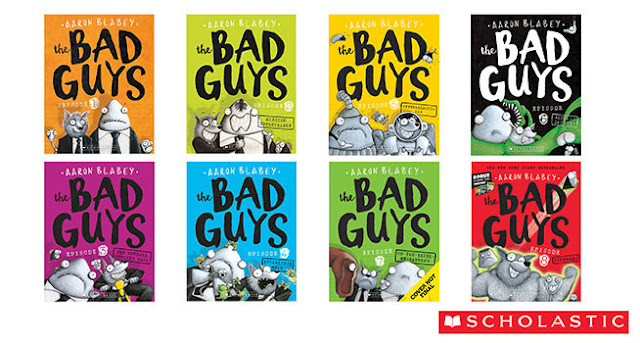
And then there is The Bad Guys Episode 8: Superbad by Aaron Blabey.

Personally, I'm getting pretty tired of their antics by now, but they continue to entertain and get 5-7 yrs old excited about reading, so I'm not going to complain too much.


After an excursion into outer space, then back in time to the dinosaurs, we are firmly back in the present with our world being taken over by the evil Mr Marmalade and his evil alien forces. And it wouldn't be the modern world without a female team of warriors to assist our bumbling bad guys.

In Superbad we learn that Agent Fox is actually part of a much larger, well organised group called The International League of Heroes. Her colleagues include Agent Kitty Kat, Agent Hogwild, Agent Doom, and Agent Shortfuse. They all have special talents and skills and they mean business. They help the Bad Guys learn control of their new super powers...until Marmalade turns up and throws everything into chaos...again!

Six Bad Guys' trading cards are in the back of the book, with 6 more promised to come in book 9. Blabey is onto a good thing, and he knows it!

Episode 1 The Bad Guys
Episode 2 Mission Unpluckable
Episode 3 The Furball Strikes Back
Episode 4 Apocalypse Meow

Monday, 16 July 2018

The Neverending Story by Michael Ende

I have a vague recollection of seeing the 1984 movie version of The NeverEnding Story in my late teens. It was a bit too juvenile for my sophisticated, desperate-to-be-grown-up self at that time, so other than a shaggy white flying dragon and a boy clinging to its neck, I remember nothing. And felt no need to know any more.

Until a copy of the book fell into my hands recently & I decided to add it to my #20booksofsummer (winter) list as a bit of light relief.


Die unendliche Geschichte was published in German in 1979 by Michael Ende, a prolific and very successful children's writer. He was born in 1929 in Bavaria to a surrealist painter and a physiotherapist. In 1935 the young family moved to Munich to live in an artistic community. But in 1936, his father's work was declared 'degenerate' by the Nazi's forcing him to work in secret.

The young Ende experienced bombings and compulsory membership in the Hitler Youth before being drafted into the Volksturm in 1945. However, the story goes that he tore up his papers and joined a Bavarian resistance movement for the remainder of the war instead.

After the war, he dabbled in poetry, acting and play writing. His first novel, Jim Knopf was published in 1960. However 1960's Germany was not a good time to be writing escapist literature. Post-war Germans were all about political commitment and realism; feeling undervalued he moved to Italy to live. It was here that he wrote The Neverending Story.

He went on to write 30 books before his death in 1995. Ende was a human rights activist, anti-rearmament and a campaigner for peace.

His influences included Rudolf Steiner, Rainer Maria Rilke and a life-long fascination with Japan.

The Neverending Story is a fantastical fairy tale, full of imaginative wish fulfilment. Each chapter begins with a letter of the alphabet, which must have a been a challenge for the translator, Ralph Manheim. The first half of the book sees motherless, unloved Bastian Balthazar Bux reading a story about another land in grave danger of disappearing into Nothingness. The protagonist appears to be a young warrior/hero called Atreyu with his faithful horse Artax and a luckdragon named Falkor. The story appears to be a lesson on imagination, the nature of lies, power and purpose.

This is where the movie ends.

Ende felt that this adaptation's content deviated so far from the spirit of his book that he requested that production either be halted or the film's title be changed; when the producers did neither, he sued them and subsequently lost the case. Ende called the film a "gigantic melodrama of kitsch, commerce, plush and plastic" (Ein "gigantisches Melodram aus Kitsch, Kommerz, Plüsch und Plastik").The film only adapts the first half of the book, and consequently does not convey the message of the title as it was portrayed in the novel. (Wikipedia)

I can see why Ende was upset. At this point the story did not feel 'neverending'. It was a tremendous fantasy about courage and truth, but it wasn't until the story moved onto Bastian's entry into the fantasy world that the cyclical nature of the story became apparent. Suddenly the tone shifted from imagination to creation. Pure escapism and wish fulfilment surrounded Bastian as he gradually learnt to be careful what you wish for. Bastian transformed himself from a dumpy, unloved, fearful boy into a strong, handsome, brave protagonist. It took him the rest of the story to realise that the real meaning of a well-lived life is love, memory and being true to yourself.

The Neverending Story is a classic quest story that will delight fantasy-loving readers of any age.

Book 11 of #20BooksofSummer (winter)

Wednesday, 6 December 2017

The Extremely Inconvenient Adventures of Bronte Mettlestone by Jaclyn Moriarty

I am a fan of the Moriarty sisters -  Liane, Nicola and Jaclyn - they have all gone off in different directions, genres and target audiences but the one thing they have in common is thoroughly engaging stories, believable characters and the ability to suck me into their world.

Jacyln's previous series that wowed my socks off was The Colour of Madeleine trilogy. These books were aimed at an older teen audience - light fantasy, a little romance and a great concept. The Extremely Inconvenient Adventures of Bronte Mettlestone is for younger readers - about 10 plus. It's another light fantasy with a great concept, but more concerned with family and friendship than romance, although I'm still wondering about Aunt Isabelle and the Butler!


Bronte begins her story with the sudden death of her parents. This is not as sad an event as you might expect as Bronte was left by her parents on Aunt Isabelle's doorstop when she was a baby. Bronte's feelings about her parents, are therefore, complicated.

Things quickly become even more complicated when the terms of their wills are revealed. Bronte is to go on a quest, an adventure no less, to visit all her aunts (there are ten more besides Aunt Isabelle!) The timing for each visit is very specific as are suggestions for places to eat, gifts to give each aunt and the very definite condition that Bronte travels alone. She is only ten years of age. Aunt Isabelle is horrified, but the will is cross-stitched in faerie thread which means that if Bronte doesn't follow the instructions exactly as stated, if she breaks the terms, then her home town will also break.

This is pretty serious sounding stuff you have to agree. But Bronte heads off on her quest with oodles of optimism, trust and commonsense.

She encounters dragons, rescues water sprites and goes on the run from pirates. She saves a baby in danger of drowning, befriends a girl running off to join the circus and meets a mysterious boy with no shoes.

Each aunt has stories to tell Bronte about her parents. She gradually learns some of their secrets as well as learning some startling new things about herself. Moriarty does all of this with a lightness of touch and a great deal of charm.


Kelly Canby's quirky line drawings are scattered throughout the book. They highlight the sense of fun that permeates the whole story as well as giving this lovely hardback edition a dash of style.

This would be a fabulous bedtime read aloud book to enjoy together as a family. Highly recommended.

Saturday, 26 August 2017

The Return of the King, Book VI by J R R Tolkien

Book VI in The Return of the King brings us back to the perilous journey of Sam and Frodo.
Sam now has possession of the ring and Frodo is missing.

Tolkien provides the reader with a quick catch up that feels natural and part of the drama (not the obvious recap that so many authors clumsily employ). He also lets us know what the time frame is in reference to what's going on for Merry, Pippin and Aragorn. This helps us and creates panic at the same time. Sam and Frodo still have so far to go to succeed in their mission, yet their friends are about to go into one of the biggest battles of all time!

The power of the ring, even on hobbits, is clearly described here. We also see why hobbits were the perfect choice to bear the burden of the ring on this quest. Their humility and simple tastes over-ruled or kept at bay the desire for power, dominance and the large-scale delusions of grandeur that the ring encouraged.

Yet, the ring, still does exercise a power over Frodo, so that, some might say, that Frodo actually fails in his mission to destroy the ring. When he is standing on the edge of the fires at the Mountain of Doom, he cannot cast the ring aside.

Mount Doom - Alan Lee

But kindness, goodness and pity save the day in the end. Frodo's patient acceptance of Gollum throughout the journey now has a own role to play. The power of the ring may have been too much for Frodo in the end, but it completely overwhelmed and subsumed Gollum. His desire and greed made him reckless, whilst Frodo's inherent goodness set up the situation that makes the right result, the result for good, prevail.

Tolkien himself, talks about this in several of his letters. Many of his readers found this failure to be a problem or a concern.

no 192 to Amy Ronald 27 July 1956
I have just had another letter regarding the failure of Frodo. Very few seem even to have observed it. But following the logic of the plot, it was clearly inevitable, as an event. And surely it is a more significant and real event than a mere 'fairy-story' ending in which the hero is indomitable? It is possible for the good, even the saintly, to be subjected to a power of evil which is too great for them to overcome – in themselves. In this case the cause (not the 'hero') was triumphant, because by the exercise of pity, mercy, and forgiveness of injury, a situation was produced in which all was redressed and disaster averted....
Frodo deserved all honour because he spent every drop of his power of will and body, and that was just sufficient to bring him to the destined point, and no further. Few others, possibly no others of his time, would have got so far. The Other Power then took over: the Writer of the Story (by which I do not mean myself), 'that one ever-present Person who is never absent and never named' (as one critic has said).


246 Mrs Eileen Elgar (drafts) Sept 1963
I do not think that Frodo's was a moral failure. At the last moment the pressure of the Ring would reach its maximum – impossible, I should have said, for any one to resist, certainly after long possession, months of increasing torment, and when starved and exhausted. Frodo had done what he could and spent himself completely (as an instrument of Providence) and had produced a situation in which the object of his quest could be achieved. His humility (with which he began) and his sufferings were justly rewarded by the highest honour; and his exercise of patience and mercy towards Gollum gained him Mercy: his failure was redressed.


 211 to Rhona Beare 14 Oct 1958
But I might say that if the tale is 'about' anything (other than itself), it is not as seems widely supposed about 'power'. Power-seeking is only the motive-power that sets events going, and is relatively unimportant, I think. It is mainly concerned with Death, and Immortality; and the 'escapes': serial longevity, and hoarding memory.


Part of my reread of The Hobbit and The Lord of the Rings was to compare them against my memory as well as with the movies. I couldn't make myself watch The Hobbit movies. The first one was so ghastly (when I watched it when it first came out), that I couldn't do the other two in the movie trilogy or re-watch the first this time around.

However re-watching The Lord of the Rings has been enjoyable and fascinating. We have an extended blu-ray version that divides each of the three movies into two full-length movies. I remember loving the first movie, but feeling more ambivalent about the other two.

Now I know why.

The first movie follows the action of the book fairly closely (with some notable omissions), but the second and third movie veer off in different directions and changes the story by adding extra scenes and killing off people that survive in the book.

The big one, of course is Saruman.

Which completely changes the end of the Book VI when Frodo, Sam, Merry & Pippin finally make their way back to The Shire.

Scouring of the Shire - Alan Lee
The return to The Shire is full of peril and change for our four fearless hobbits. Gates block their way and tall chimneys mar the view. Trees have been pulled down and hobbit-holes have been destroyed to make way for ugly timber structures.

Saruman and Wormtongue have made their way to The Shire, where his malice lingers,
You made me laugh, you hobbit-lordlings, riding along with all those great people, so secure and so pleased with your little selves. You thought you had done very well out of it all, and could now just amble back and have a nice quiet time in the country. Saruman's home could be all wrecked, and he could be turned out, but no one could touch yours

I had forgotten there was a final battle - the Battle of Bywater, 1419 - where Captain's Meriadoc and Peregrin came into their own. And that Frodo and Sam enjoy a whole year in the Shire together, rebuilding, replanting and bringing their world back to order before Frodo goes off with the Elves.

Frodo's prediction of Sam's life in The Shire was a lovely way to finish their time together,
you are my heir: all that I had and might have had I leave to you. And also you have Rose, and Elanor; and Frodo-lad will come, and Rosie-lass, and Merry, and Goldilocks, and Pippin; and perhaps more that I cannot see. Your hands and your wits will be needed everywhere. You will be the Mayor, of course, as long as you want to be, and the most famous gardener in history; and you will read things out of the Red Book, and keep alive the memory of the age that is gone, so that people will remember the Great Danger and so love their beloved land all the more.

Peace, hope and prosperity have overthrown the dark days of evil. The world has changed, things have moved on, but it's okay...as long as we learn the lessons that history has to teach us.

Grey Havens by Alan Lee

Well, that's it! After seven months and about 1500 pages, we have come to the end of our journey through Middle Earth.

Thank you to those who stayed with me to the very end, and those who shared but a part of the journey with me. All your comments and support and have been HUGELY appreciated and enjoyed.

I hope you found the readalong as rewarding as I did.

Appendix A - F (about 100 pages) remain unread in my edition. I have never been able to make myself read through these (my HLOTR fandom has yet to fall over into fanatic!) but I'm keeping my options (and the linky below) open for another month, to see what might happen.

I also have Tolkien's letters to finish.

If you've just stumbled onto this (re)readalong and would like to leave your review link or simply comment on our journey, please feel free to join in.

But for now,
dear friends, on the shores of the Sea comes the end of our fellowship in Middle-earth. Go in peace! I will not say: do not weep; for not all tears are evil.

#HLOTRreadalong2017 


The Fellowship of the Ring 

- Halfway post - Book one 
- TFOTR - Book two


The Two Towers


The Return of the King

Friday, 4 August 2017

The Return of the King, Book V by J R R Tolkien

Ohhh, I had forgotten how much I love this book. I mean really, really love this book.

I raced through Book V (The War of the Ring) so quickly because I could not literally put the book down. I knew what was going to happen next, but I wanted to be there and experience it all again! I love how being fully immersed in this world makes me feel.


In some ways I was reading this for the first time though.

My previous reads had been racy, breathless reads to find out what happened next to our four beloved Hobbits. I didn't linger over the descriptions of the buildings or meander through the more scenic sections, like I did this time. Having Alan Lee's full page illustrations to pour over at regular intervals helped my stunted imagination a lot. I could trace their journey or pick out details that Tolkien referred to thanks to Lee's meticulous drawings.

I even read all of the battle scenes for the first time with care and due diligence.

I discovered so many small comments and gentle observations with this reread,
For the Tower of Ecthelion, standing high within the topmost wall, shone out against the sky, glimmering like a spike of pearl and silver, tall and fair and shapely, and its pinnacle glittered as if it were wrought of crystals; and white banners broke and fluttered from the battlements in the morning breeze, and high and far he heard a clear ringing as of silver trumpets.
Alan Lee, Minas Tirith
I love this section for the growth and maturity that we see in Merry and Pippin in particular. At the beginning we see them as being a tad silly and foolish. But now they have faced danger and battle together and for the first time they are separated as Pippin is raced off to Minas Tirith by Gandalf.

We realise how much Pippin has matured when we see him through the eyes of strangers - Denethor 'I see that strange tales are woven about you.'
- Beregond 'you have endured perils and seen marvels that few of our greybeards could boast of.'

We also get a Tolkien clue about where things are up to for Frodo (and Sam) when Pippin,
wondered where Frodo was, and if he was already in Mordor, or if he was dead; and he did not know that Frodo from far away looked on that same moon as it set beyond Gondor ere the coming of the day.

Via Pippin and his brush with a Nazgul, we're also reminded of Tolkien's religious beliefs -
'No, my heart will not yet despair. Gandalf fell and has returned and is with us. We may stand, if only on one leg, or at least to be left still upon our knees.'

Gandalf finishes this chapter with ominous words, 'The Darkness has begun. There will be no dawn.'
before passing the story telling baton back to Merry and his journey with the Riders of Rohan.

Merry's kindly, generous, father/son like relationship with Theoden brings into stark contrast Pippin's experience with Denethor. Pippin offers his service to Denethor 'for pride stirred strangely within him, still stung by the scorn and suspicion in the cold voice' as a 'payment' of his debt to Boromir for saving his life at the expense of his own. While Merry is moved to service by 'love for this old man'.

Either way, these two Hobbits and their sense of duty and fealty to a cause bigger than they could have ever imagined, is inspiring and a little misty-eyed at the same time.

Aragorn and the Shadow Host scenes were pretty creepy and unfamiliar to me. I have a vague recollection of this scene in the movie, but for their entire journey through the mountains, I felt like I was in a new-to-me story. Like Gimli, my sense of time got seriously waylaid here. It was only at the end of the chapter that Tolkien reminded us of the time frame, 'but the next day there came no dawn, and the Grey Company passed on into the darkness of the Storm of Mordor'.

In previous reads, the next two chapters were usually given short shift by younger me. I wanted to get to the action - I wanted Merry and Pippin to meet up again. All that riding and fortifying and waiting drove me crazy!

However, this time around I enjoyed the anticipation and the slow build. So much so, that at the end of the siege of Gondor, I trumpeted out loud (much to the bemusement of a sleepy Mr Books) 'Rohan had come at last!' and hugged the book to my chest.

The battle scenes were heroic and desperate, as one would expect of any fictional battle scene, but what I noticed this time around was that Tolkien then gives plenty of time to the after effects of such a big battle. He shows us the field strewn with the dead and dying. We feel the pain of the injured - and not just the physical pain but the psychological pain as well. Denethor's failure of character at this time, as he gives into despair, reminds us that even those on the side of good can fall into dark ways.

We finish Book V with a battle plan. Our friends (isn't it lovely to have them all back together again?) realise they are out-numbered and out-gunned by those on the side of Mordor, so they plan a sleight of hand, in the hope that Frodo will be able to follow through with his plan, which has the potential to save them all, while Sauron is distracted by them at the Black Gate.

However, things look pretty hopeless at this point. The fellowship fear for Frodo and Sam's safety after hearing about the path they have chosen, and we already know what danger has actually befallen the pair. We, the reader, know that things are even bleaker than the fellowship fear.

I always thought that The Two Towers was my favourite of the trilogy but after this, I can safely say that Book V is now my favourite part of the story.

Will Book VI be able to keep this momentum going?

I leave you, tonight, with a quote from one of Tolkien's letters.

#213 to Deborah Webster 25 Oct 1958
I am in fact a Hobbit (in all but size). I like gardens, trees and unmechanized farmlands; I smoke a pipe, and like good plain food (unrefrigerated), but detest French cooking; I like, and even dare to wear in these dull days, ornamental waistcoats. I am fond of mushrooms (out of a field); have a very simple sense of humour (which even my appreciative critics find tiresome); I go to bed late and get up late (when possible). I do not travel much. I love Wales (what is left of it, when mines, and the even more ghastly sea-side resorts, have done their worst), and especially the Welsh language.


#HLOTRreadalong2017 


The Fellowship of the Ring 

- Halfway post - Book one 
- TFOTR - Book two


The Two Towers


The Return of the King

Book V
Book VI

Sunday, 16 July 2017

The Two Towers by J R R Tolkien

I had planned to write two posts about this, the second part of The Lord of the Rings trilogy, as it actually begs to be considered in its two separate sections. In fact, Tolkien originally wrote the book as one big book with six parts. He planned to name part III The Treason of Isengard and part IV The Journey of the Ringbearers or The Ring Goes East.

However, due to post-WWII paper shortages and size considerations, the book was eventually published as three books, with the middle one, The Two Towers, being published on the 11th November 1954.


Part III and part IV are two very distinct stories. The first part follows the trials and tribulations of the remnants of the fellowship after Frodo and Sam secretly depart. The second part is all about Frodo and Sam. And Gollum.

However whichever part you consider, the story continues to be about the role of fellowship, friendship, loyalty, duty, responsibility, honour, commitment and courage. The end of times may be fast approaching, morals may be slipping and attitudes may be changing, but our stalwart group shines on to show us a better, finer, more noble way.


One of the highlights of The Two Towers for me, though, are the Ents, and Treebeard in particular. I love his slow, thoughtful approach to life and decision making. But I'm being too hasty!

They found they were looking at a most extraordinary face. It belonged to a large Man-like, almost Troll-like, figure, at least fourteen feet high, very sturdy, with a tall head, and hardly any neck. Whether it was clad in stuff like green and grey bark, or whether that was its hide, was difficult to say. At any rate the arms, at a short distance from the trunk, were not wrinkled, but covered with a brown smooth skin. The large feet had seven toes each. The lower part of the long face was covered with a sweeping grey beard, bushy, almost twiggy at the roots, thin and mossy at the ends. But at the moment the hobbits noted little but the eyes. These deep eyes were now surveying them, slow and solemn, but very penetrating. They were brown, shot with a green light. Often afterwards Pippin tried to describe his first impressions of them. 
'One felt as if there were an enormous well behind them, filled up with ages of memory and long, slow, steady thinking; but their surface was sparkling with the present; like sun shimmering on the outer leaves of a vast tree, or on the ripples of a very deep lake.'
Treebeard by Alan Lee, Timothy Ide and Jerry Vanderstelt
I love this description of Treebeard and the Ents, but sadly I have never seen an illustration or a movie version of them that does justice to what I have in my mind. All the art work, to my mind, fails to capture that ponderous, slow, kind, considered gravitas that Tolkien refers to.

Lee and Vanderstelt are close to the mark, but the eyes in both are wrong while Ide's version is too scary. Severin's 3D model has a nice face, but is missing all the green, twiggy stuff. And they all lack the size and bulk that I feel is necessary for an Ent. I have always imagined a giant, stately oak tree as an Ent, not the spindly version that every artist seems to prefer.

Treebeard by Alexey Severin

The other character that appeals to me in The Two Towers is Boromir's brother, Faramir. He is a brave fighter, but prefers peace. As the younger son, he has a more balanced attitude towards power and leadership. He provides thoughtful counsel and safe harbour to Frodo and Sam, in much the same way that Treebeard assists Merry and Pippin.

Despite the dark days looming, honour and kindness can still be found, when least expected.


And that's why I enjoy these books so much. The fellowship, goodness and hope that shines through the darkness and despair is something we can all take heart from. 
The movies have this too, but the level of violence and the massive battle scenes so often overwhelm the other messages that Tolkien was trying to convey.

Previously I read these books so quickly, that I missed lots of the finer details. This leisurely reread has been a delight of rediscovery and paying attention.

How are you going? 
I see that Jean has finished and Nick is still adding page updates on Goodreads. I think Nancy may have fallen to the wayside. As with all of life's journeys, we travel at our own pace in our own way!


#HLOTRreadalong2017 


The Fellowship of the Ring 

- Halfway post - Book one 
- TFOTR - Book two


The Two Towers

- Welcome to Book
- Review


The Return of the King


Thursday, 4 May 2017

The Fellowship of the Ring by J R RTolkien

The books that comprise The Lord of the Rings are usually presented as a trilogy, but it was in fact designed by Tolkien to be one single book with six parts. Obviously the publishers baulked at publishing such a large tome of a book!


On 29th July 1954 George Allen & Unwin published the first volume consisting of the first two books with the title The Fellowship of the Ring.

The second volume, with the next two books was eventually titled The Two Towers and published on 11th November 1954. The final two books were published in The Return of the King on 20th October 1955.

**Spoiler alert**
I'm now assuming that you have read the book so that we can discuss the details of what has happened.

Book Two of The Fellowship of the Ring, is, well, all about the fellowship.

We begin this section of Lord of the Rings in Rivendell where we meet all the participants of the fellowship for the first time together. We hear their back stories and find out how they ended up in Rivendell at this time.

The Gates of Moria by Alan Lee

Tolkien used all kinds of storytelling devices to keep our interest and to build up the tension.

There's the info-dump chapter where we find out all about the ring's long and dubious history. Tolkien again used the action-packed chapters full of danger and tension followed by the safe-haven chapters of comfort and ease to keep the pace up without exhausting all of us.

The humour of Merry and Pippin and the gravitas of Gandalf provided light and shade. While foreshadowing continued to be one of Tolkien's favourite ways of promoting a sense of anticipation and foreboding.

Tolkien employed metafiction when Bilbo talked about his 'story' that he was writing about his journey and the parts still to be written or completed. Although I'm reluctant to call it metafiction as I don't think that Tolkien used this technique in a deliberately self-conscious or ironic way or in an attempt to question what was real or not.

Tolkien's ability to reference the depth and breadth of his created world was particularly impressive in the two books of The Fellowship - the song that Bilbo sang, the backstory of the ring, Moria and it's long history, the extensive descriptions of the scenery, the longevity of the Elves - although this immensely rich historical detail can at times be overwhelming to the unsuspecting reader.

This particular book also had deep sadness and loss. Gandalf's stand on the Bridge of Khazad-Dum is one of the pivotal moments in the whole story.

The very strong faith based themes evident within Gandalf's stand, fall & ultimate resurrection never felt like Tolkien was preaching. He always said that he never wrote the book with analogies in mind, but obviously the religious stories that he grew up with were a central part of his life and influenced the type of story he wrote as well as infiltrating the various details.

In The Letters of J R R Tolkien* No. 142 To Robert Murray, SJ on 2 December 1953, Tolkien said,
The Lord of the Rings is of course a fundamentally religious and Catholic work; unconsciously so at first, but consciously in the revision. That is why I have not put in, or have cut out, practically all references to anything like 'religion', to cults or practices, in the imaginary world. For the religious element is absorbed into the story and the symbolism. However that is very clumsily put, and sounds more self-important than I feel.

Unlike C S Lewis' Narnia series that is heavily and overtly Christian, it is possible to read The Lord of the Rings without thinking about the religious symbolism at all. It certainly escaped my earlier, younger reading of the books.

Researching Tolkien's intentions for this reread has added layers of meaning to my understanding of the story and of Tolkien himself, but with or without these layers, LOTR remains a rip-roaring, satisfying read.

Perhaps, like Tolkien, my first, early reading was quite unconscious, with this reread being much more conscious and deliberate on the look-out for symbolism and themes.


The mysterious lurking presence of Gollum haunts our journey throughout The Fellowship. We all know he's there, we're all on our guard, but no one wants to talk about it. Yet.

The landscape was all important as well. It affected the decisions that the fellowship had to make along the way and Tolkien also used it to explain certain characteristics of the various races  - thank goodness for the map inside the cover of the book to make sense of all that 'east of this/west of that' stuff.

My Alan Lee illustrated edition also helped to bring many of the places to life which made up for my woeful lack of imagination.


The Fellowship of the Ring was also all about the ring.

The ring personifies evil and is quickly established as a character in its own right. Some of the ring stuff is confusing. For instance, the how and why of the three rings are how exactly they are linked to the one, but not necessarily evil?

I'm not really sure if Tolkien's letter* to Milton Waldman (No. 131, circa 1951) helped clarify anything at all!

The chief power (of all the rings alike) was the prevention or slowing of decay (i.e. 'change' viewed as a regrettable thing), the preservation of what is desired or loved, or its semblance – this is more or less an Elvish motive. But also they enhanced the natural powers of a possessor – thus approaching 'magic', a motive easily corruptible into evil, a lust for domination. And finally they had other powers, more directly derived from Sauron ('the Necromancer': so he is called as he casts a fleeting shadow and presage on the pages of The Hobbit): such as rendering invisible the material body, and making things of the invisible world visible....
The Elves of Eregion made Three supremely beautiful and powerful rings, almost solely of their own imagination, and directed to the preservation of beauty: they did not confer invisibility. But secretly in the subterranean Fire, in his own Black Land, Sauron made One Ring, the Ruling Ring that contained the powers of all the others, and controlled them, so that its wearer could see the thoughts of all those that used the lesser rings, could govern all that they did, and in the end could utterly enslave them. He reckoned, however, without the wisdom and subtle perceptions of the Elves. The moment he assumed the One, they were aware of it, and of his secret purpose, and were afraid. They hid the Three Rings, so that not even Sauron ever discovered where they were and they remained unsullied. The others they tried to destroy....
(LOTR) was begun in 1936,5 and every part has been written many times. Hardly a word in its 600,000 or more has been unconsidered. And the placing, size, style, and contribution to the whole of all the features, incidents, and chapters has been laboriously pondered.

There was no where near as much fighting, violence and hand to hand combat in this book as I remember from the movie. Thank goodness!

I found the extensive and over the top battles in all of the movies tiresome and tedious. It often felt like the movie moved from one battle scene to the next. This reread has reminded me that the fighting scenes in The Fellowship at least, were sporadic and low-key, although I still found myself skimming parts of them at times.

The mirror of Galadriel by Alan Lee

The Fellowship of the Ring contained themes of isolationism vs connection, appearances vs reality and the passing of time. Courage, friendship, the corruption of power, fate vs free will and temptation also got a look in.

Some reviews have complained about the overly long descriptions and unsophisticated language. Occasionally I understand the complaint about the descriptions, but the uncomplicated language is one of the things that makes this story so accessible to young and old as well as to those readers who tend to avoid fantasy. I actually find the childlike elements in the story endearing not simplistic.

The Letters of J. R. R. Tolkien* No. 35, 2nd February 1939:

I think The Lord of the Rings is in itself a good deal better than The Hobbit, but it may not prove a very fit sequel. It is more grown up – but the audience for which The Hobbit was written has done that also. The readers young and old who clamoured for 'more about the Necromancer' are to blame, for the N. is not child's play

The lack of emotional depth can be more problematic to a modern reader used to complex, nuanced character development, however nostalgia is the predominate feeling in these books, and that is something we can all tap into.

The Letters of J R R Tolkien* No. 76 - In a letter to Christopher, 28th July 1944:

As to Sam Gamgee. I quite agree with what you say, and I wouldn't dream of altering his name without your approval; but the object of the alteration was precisely to bring out the comicness, peasantry, and if you will the Englishry of this jewel among the hobbits. Had I thought it out at the beginning, I should have given all the hobbits very English names to match the shire.

I feel like I've thrown a lot of bits and pieces together from my notes with only a passing nod at coherence. I hope I haven't overloaded you!

Enough of the chatter! It's time to hit the road again and check in on our stoic ring-bearer and friends.

*The Letters of J R R Tolkien edited by Humphrey Carpenter and assisted by Christopher Tolkien 1981.


#HLOTRreadalong2017 


The Fellowship of the Ring 

- Halfway post - Book one 
  - TFOTR - Book two


Monday, 1 May 2017

The Two Towers - Welcome to Book

It's time to check into the The Two Towers, and yes, I know I have yet to complete my review or wrap up post for The Fellowship of the Ring.

Unfortunately I have come down with some kind of flu bug that has knocked me for a six.

I promise to catch up soon, but for now here is the starting post for the next part of our #HLOTRreadalong2017. Please add your reviews to the link below and I'll pop by for a visit when I'm back on my feet.


I'm rereading the books over a leisurely period of time. I want to savour my illustrated editions and feel no pressure to be finished by a set date. My reading time frames are generous but also designed to keep things ticking along.


The Fellowship of the Ring in March - April
The Two Towers in May - June
The Return of the King in July - August


My plans for the #HLOTRreadalong2017 will be to:

  • Post a master post where people can sign up to join the readlaong or write their own post about their previous experiences with #HLOTR. Or if this is their first time, a post about why they've decided now is the time to read Tolkien. (tick)
  • Write a welcome to book post for the start of each book, providing basic facts, background information and my proposed reading pace.
                       The Hobbit  (tick)
                       The Fellowship of the Ring  (tick)
                       The Two Towers  (tick)
                       The Return of the Ring
  • Have at least one check-in post about halfway through each book - to see how everyone is going, to ask questions, rant, rave or refute.
                       The Fellowship of the Ring  (tick)
  • Post a wrap up/review at the end of each book where we can discuss our thoughts and feelings, ask questions and practice our Elvish! (links will be attached to the book titles above with the month that we read them.)
If you'd like to join in the LOTR section of the readalong, please feel free to write an introductory post heralding your intentions and share in the linky below. Latecomers are always welcome.

Tell us your history with Tolkien and the LOTR.
Why are you reading or rereading it now?
Have you learnt Elvish? Or read any other Tolkien books?

If you are rereading and would like to mention specific events that happen in the book, please remember to add **spoiler** alerts to protect the innocence of any first time readers.

Saturday, 25 March 2017

The Fellowship - check in time.

The 25th March is Tolkien Reading Day which seemed like an auspicious day to host our latest check-in post. The theme for the 2017 TRD is Poetry and Songs in Tolkien's Fiction. Therefore I will start our #HLOTRreadalong2017 business with Bilbo's Walking Song,

The Road goes ever on and on,
Down from the door where it began.
Now far ahead the Road has gone,
And I must follow, if I can,
Pursuing it with eager feet,
Until it joins some larger way
Where many paths and errands meet.
And whither then? I cannot say.

How are you going with your journey through The Fellowship of the Ring?
Are you going on and on?
Or perhaps you cannot say!

Have you found your way to Rivendell yet? Or did you get stalled in The Shire? Perhaps the Black Riders scared you from the path? Or maybe Tom Bombadil bored you to tears with his hey now! merry dol's!

Are you one of those who has raced ahead impatient to find out what happens next?


I confess that I am one of those readers who skim or skip the long poems in LOTR.
I was determined to read them this time round, which is partly why I have allowed generous reading times for each book. But I'm failing somewhat.

I happily read the smaller poems and songs, like Bilbo's walking song, but the 4 page epics are beyond me. I don't see the point of them and I'm just not that interested.


However Tolkien's ability to create a brand new world, complete with history, geography, myths and legends is very impressive. His descriptive passages are made to be read with the map alongside so that you can trace your finger over the paths, rivers and mountaintops that Frodo and his friends walk.

I have heard some people complain about how long it takes for the action to get going in LOTR, but I love our extended time in The Shire at the beginning. Meeting Bilbo again and getting to know Frodo and his friends has a lovely cosy, comfortable feel to it.

Bilbo's one hundred and eleventh birthday party is a lot of fun. The excitement, the excess, the humour. But even here, there is a sharp edge. Bilbo's sarcasm, Gandalf's growing concerns about events outside The Shire and the obvious power of the ring over Bilbo.


I was impressed to see that it was Tolkien who in fact coined the word 'tweens' in reference to hobbits in that irresponsible twenties phase between their childhood and coming of age at thirty-three.

Tolkien's usual foreshadowing techniques let us know that we should enjoy our warm, cosy time in The Shire as more dangerous times are fast approaching. Rumours of strange things happening, whispers and murmured hints reach our ears. Prepare, beware, watch out!

He uses words like strange, unwholesome, queer, dark, deadly, malice, revenge, enslaved, peril, torment, wretched and fear to great effect during these first few chapters. This time is clearly the calm before the storm.


It takes a while for Frodo to get going though.
As much as the most avid fan may enjoy this time in The Shire, by the end we are urging Frodo on his way. 

The casual passing of time that brings us to eve of Frodo's 50th birthday and the slow packing up and selling of Bag End almost feels irresponsible. 
His last leisurely stroll though The Shire on the way to Crickhollow is not as dramatic or as dangerous as I remember from the movie. Tolkien allows Frodo a real sense of leave-taking.

The tension builds as the menace of the Black Riders is felt, but a couple of near-misses is all that we witness at this point. The danger still feels like it is out there somewhere.

I had forgotten all about Tom Bombadil (he was absent from the movie).
I'm not sure why he's in the story at all, except as one of Tolkien's safe havens from the increasing danger. And the danger is not just in the form of Black Riders. We must beware stone-wrights, old man willow and some of the more suspicious folk in Bree.

The Letters of J R R Tolkien* No. 144 to Naomi Mitchison 25 April 1954:

Tom Bombadil is not an important person – to the narrative. I suppose he has some importance as a 'comment'. I mean, I do not really write like that: he is just an invention (who first appeared in the Oxford Magazine about 1933), and he represents something that I feel important, though I would not be prepared to analyze the feeling precisely. I would not, however, have left him in, if he did not have some kind of function. I might put it this way. The story is cast in terms of a good side, and a bad side, beauty against ruthless ugliness, tyranny against kingship, moderated freedom with consent against compulsion that has long lost any object save mere power, and so on; but both sides in some degree, conservative or destructive, want a measure of control. but if you have, as it were taken 'a vow of poverty', renounced control, and take your delight in things for themselves without reference to yourself, watching, observing, and to some extent knowing, then the question of the rights and wrongs of power and control might become utterly meaningless to you, and the means of power quite valueless. It is a natural pacifist view, which always arises in the mind when there is a war. But the view of Rivendell seems to be that it is an excellent thing to have represented, but that there are in fact things with which it cannot cope; and upon which its existence nonetheless depends. Ultimately only the victory of the West will allow Bombadil to continue, or even to survive. Nothing would be left for him in the world of Sauron.


I hope you're enjoying your time in Middle Earth as much as I am.
I haven't had as much time as I originally hoped to write more regular posts with this book, but the main thing is to read with pleasure and fellowship. The blogging can take care of itself!

*The Letters of J R R Tolkien edited by Humphrey Carpenter and assisted by Christopher Tolkien 1981.
#HLOTRreadalong2017 (with linky)

Wednesday, 22 March 2017

Harry Potter and the Cursed Child by J K Rowling, John Tiffany & Jack Thorne

I had LOTS of doubts about a new Harry Potter.

Did we really need a new Harry Potter? Wasn't this just a crass cash grab? Was there anything new to be said about the power of love?

As it turns out the answer is yes!

Rowling along with Tiffany and Thorne had plenty more to say about the power of love and the art of forgiveness. After all, Harry was a pretty easy character to love. But what would happen if the main character was less lovable? How would we all respond then?

Young Albus is struggling. Struggling with being the youngest in a high achieving family. Struggling with being famous thanks to who his father is and struggling to feel competent or relevant.

It's only natural, then, that when he starts at Hogwarts that he would be drawn into friendship with another outsider. Another boy struggling with his family history and his sense of belonging - young Scorpius Malfoy.

I'm not going to reveal any major (or minor) plot points, you will have to read the book (or see the play) for yourself if you're that curious. My main concern, was centred around whether or not it was actually worthwhile to continue the series at all.

Given the huge response to Rowling's tweets in previous years about what the Potter children would have been up to, it's easy to say, yes, the interest was there.

Did Rowling herself feel compelled to write more about the Potter's and Hogwarts? I guess only she can really answer that, but given that she chose not to write a book herself perhaps suggests she was a little ambivalent or maybe just more focused on other creative pursuits.

Although perhaps those other creative pursuits played right into the idea of creating a play (see what I did there?)

As for the play itself, if I lived in the UK, I would have moved heaven and earth to get tickets for the show. Reviews for the play generally agree that the 2 part experience was worth it. As a theatrical production, The Cursed Child works. And if it ever comes to Australia, I will be there.

But what about the script?
Was it necessary to produce a hugely publicised co-written script for the event?

Given that it's Harry Potter, again, you'd have to say yes. People want to know, even if they disagree with what Rowling et al have ultimately devised.

The tricky thing about The Cursed Child though is that it's only half about Harry Potter and it's only half about the childhood world of Hogwarts. And Harry Potter as an adult, struggling with how to be a father, juggling work, marriage, friendships and fame is not the same as the youthful, idealistic Harry that we watched grow up. Mr Books, who has also read the script, said that the adult Harry, Hermione and Ron were still acting and sounding just like kids playing at being grown-ups. The transition was always going to be awkward - for all of us.

Albus (and Scorpius) are baring the brunt of inter-generational damage. Their character growth and development and that of all the main players felt believable and real.

All of that comes through in the script.

What doesn't come through as well though (at least for someone who is imaginatively impaired) is the glorious blend of ordinary life and magical life that is alive in the earlier books. I missed the descriptive language.

I ended up skimming through the final half of the script just to find out what happened. It was a quick, easy read that left me delighted to see that once again, the power of love and hope wins out. The magic of Harry Potter is still out there. You just have to believe!

Thursday, 2 March 2017

The Fellowship of the Ring - The Prologue

I confess that I am one of those readers who often skips, skims or ignores prologues and introductions in my excitement to get to the story proper. I'm also concerned that the author might inadvertently reveal an important feature of the story to come.

But this time, with my aim to reread the HLOTR leisurely and thoughtfully, I took my time with the Prologue of The Fellowship of the Ring and I noticed several interesting things.


***Spoilers will abound from here on in - so only proceed if you are also rereading LOTR or come back when you have finished***

First I have come to realise that when the author themselves have included the prologue, they have done so deliberately and for a reason. (This is where a prologue differs from an introduction written by another. Introductions written by someone other than the author, I do usually save for the end of the story as they always seem to include spoilers.)

The main thing that struck me this time, was that Tolkien clearly tells us in his Prologue that Frodo, Samwise, Merry and Pippin all survive the war that he is about to tell us about.

He reveals that Merry (Meriadoc Brandybuck) writes a book called the Herblore of the Shire and later becomes the Master of Buckland. Frodo brings Bilbo's journals back to The Shire and adds his own account of the war. Tolkien refers to the descendants of the children of Master Samwise and the great grandson of Peregrin.

The first time I read LOTR I skimmed the Prologue. I found it dry and irrelevant. I had just finished The Hobbit and felt that I knew enough about hobbits and what I didn't know I would learn as I went along.

The second time I read LOTR I did tackle the Prologue but I still didn't pick up that our four main hobbits were clearly referenced with post war happenings.

With this reread, I not only tackled the Prologue, I thoroughly enjoyed every word of it. Yes, it reads like a dry history text, but it's meant to.

I was impressed with the depth and breadth of Tolkien's knowledge about his created world. He has created distinct languages, legends, customs, history and geography for his three breeds of hobbit. The inhabitants of this world have racial characteristics as well as individual regional differences and personal temperaments. They live in a variety of socio-economic states and enjoy diverse lifestyle choices. He explains their forms of government as well as local rules and laws.

Although the prologue is all about hobbits, Tolkien divulges how The Shire fits within the bigger world picture. He references the Red Book of Westmarch, of which The Hobbit, or as Bilbo preferred to call it, There And Back Again, was just a small part in the earlier chapters. He mentions several other ancient texts as well as future ones to be written by our main characters - you would have to agree that the prologue shows Tolkien as a master of intertextuality!

We find out that we are in the Third Age of Middle Earth (what about the other two?) and we are given several hints of the troubles to come.


Bilbo's 'alternate facts' around the finding of the ring are given a whole section in the prologue. Much of Gandalf's curiosity about the origins of the ring and it's power stem from this uncharacteristic fudging of the truth by Bilbo (a fudging that we were not aware of during our reading of The Hobbit). We are then reminded of this disturbing train of events early in chapter one. Tolkien really wants us to know that the ring somehow influenced Bilbo to act deceptively and out of character.
And perhaps, it's also Tolkien's way of having fun with the fact that he did indeed change large sections of the finding of the ring scenes from the first edition of The Hobbit, to later versions that he wrote to bring it into line with events in the LOTR.

And, in case you were wondering, like I was, why there was a whole section on pipe smoking, it's to surely show us that Merry lives to write his smoking book, which our omniscient narrator then quotes from at length!

Assuming, as I have that an author includes a prologue for a reason, why does Tolkien want us to know that Frodo, Sam, Merry and Pippin all survive the war?

Part of the pleasure of my first read, nearly 30 years ago, was the suspense and tension of not knowing if all my favourite hobbits would live. The modern reader is used to authors killing off main characters for dramatic purposes; I was therefore expecting to lose at least one of the four hobbits for good.

I wonder if it has anything to do with Tolkien's own war time experiences?

In his foreword, Tolkien sadly explains that by 1918 all but one of my close friends were dead. Perhaps he doesn't want his readers (who were initially his own children) to live through the same tragic circumstances. The fear of not knowing which hobbits will survive the coming ordeal is spared us, the alert reader.

How did you find the Prologue?

#HLOTRreadlaong2017