Showing posts with label Journey. Show all posts

Wednesday, 4 March 2020

Moby-Dick | Herman Melville #Classic


Well, I did it!
My seven-month #slowread of Moby-Dick is officially done and dusted.
If you've ever wondered if you should make the time to read this classic chunkster, then I say yea!
And I cannot recommend highly enough the #slowread approach.
Moby-Dick is improved and enhanced by taking your time.

The Atlantic | Aug 20, 2013 | David Gilbert
You cannot read this book for speed. It is designed for the long haul, the chapters never too long, naps seemingly built into the text. It is, dare I say, a voyage.

My journey through Moby-Dick has been one of various obsessions.
Early on, I got caught up in articles written to celebrate the 200th birthday of Melville. Why is this book so beloved and so reviled at the same time? Why is it considered so great by so many?

After I started reading, I went off on a Herman Melville obsession. I needed to know as much about the man himself. His life, his purpose, his influences. Biographies and articles were scoured. Who was this man and what were his obsessions? What was he trying to achieve in writing Moby-Dick? What were his demons? Was he Ishmael or Ahab? What was his legacy?
“Melville died in New York on September 28, 1891, blissfully unaware that, in the years to come, so many people would leave the hyphen out of 'Moby-Dick.”
― Richard Armour,
The Classics Reclassified.

Then I got caught up in the religious symbolism.
I had read a lot about his religious background and the number of biblical references through-out Moby-Dick, but I became more and more surprised (and curious) about the growing number of negative comments about Christianity in the book. What was going on here? Was this a personal tug-o-war between faith and how it was practised? What did Melville believe? Was this a crisis of faith? Or was this someone abandoning his strict childhood doctrine for a more modern, scientific, humanist approach to life?
And so, through all the thick mists of the dim doubts in my mind, divine intuitions now and then shoot, enkindling my fog with a heavenly ray. And for this I thank God; for all have doubts; many deny; but doubts or denials, few along with them, have intuitions. Doubts of all things earthly, and intuitions of some things heavenly; this combination makes neither believer nor infidel, but makes a man who regards them both with equal eye.

Themes became my next obsession as I researched all those allusions and metaphors about lines, threads and weaving. The repetition of life, from unknown beginning to unknown end. The Loom of Time. Who was controlling or designing the fabric of life? Which led to digging deeper into fate and destiny and free-will.
Is Ahab, Ahab? Is it I, God, or who, that lifts this arm? But if the great sun move not of himself; but is an errand-boy in heaven; nor one single star can revolve, but by some invisible power; how then can this one small heart beat; this one small brain think thoughts; unless God does that beating, does that thinking, does that living, and not I.

Shakespearean influences captured my imagination next. From the mad fools to the prideful tyrants. Amusing ditties and stunning word-play. The influence on Melville was obvious.
It was a clear steel-blue day. The firmaments of air and sea were hardly separable in that all-pervading azure; only, the pensive air was transparently pure and soft, with a woman's look, and the robust and man-like sea heaved with long, strong, lingering swells, as Samson's chest in his sleep.

And, it's funny.
That's something they don't always tell you about Moby-Dick.
So many of the stories and set-pieces are designed to be ridiculous, amusing or ironic. Ishmael is often (unknowingly) hilarious. Pip plays the fool. Stubb and Flask are funny.
Think not, is my eleventh commandment; and sleep when you can, is my twelfth.

However, by the time I reached the end of this epic journey, where we only had 3-4 chapters that actually featured Moby Dick in action, I realised that this was a book all about the journey. It's about all the stuff we learn about ourselves and the world as we travel through it. It's about working out our purpose in life. It's about obsession.

Moby-Dick is full of all that marvellous big picture stuff that you can really mull over, often hidden amongst all the details. And there were LOTS of details. One of Ishmael/Melville's purposes in life was to gain and show off share knowledge!

Although by the end, we come to understand that Moby-Dick is actually Ishmael's grief memoir. It was his way to honour the memory of his friends and colleagues who went down with the Pequod.

The advantages of the #slowread were numerous.

It gave me ample time for research, it made the 'tricky' chapters easier to digest, and I was able to read other books in and around it.

But the main benefit was how it created a richer, deeper, more immersive reading experience - one that I will never forget. Within that, was those 'tricky' chapters. I came to realise that all those tedious-seeming chapters on whale facts were actually a chance for Ishmael/Melville to offer up a bit of life wisdom/philosophy. If I had been doing my usual #fastread I would have missed most of these moments and therefore missed a huge part of the beauty and fascination of this story.

For instance the chapter we were all warned about - Chapter 32: Cetology - finishes (eventually!) with Ishmael/Melville comparing his book on whales to the grandeur of Cologne Cathedral that took centuries to complete,
For small erections may be finished by their first architects; grand ones, true ones, ever leave the copestone to posterity. God keep me from ever completing anything. This whole book is but a draft—nay, but the draft of a draft.

What an undertaking! What a vision! What a colossal insight into the mind of Melville!

Chapter 60: The Line - a chapter seemingly all about rope - finishes with,
All men live enveloped in whale-lines. All are born with halters round their necks; but it is only when caught in the swift, sudden turn of death, that mortals realize the silent, subtle, ever-present perils of life.

Deep, huh? And one of Melville's favourite themes - are our lives dictated by fate, destiny or chaos? Do we have free-will or choice or is everything pre-determined?

These little zingers sneak into almost every chapter. If I'd been skimming, I might have missed them. And it's all these little zingers that are at the heart of this story. They give us a peek into Melville's mind - all his doubts, insecurities and foibles are on show. It feels like he threw everything that he had into this book. Mind, body and spirit - he gave us everything - all his flaws and his magnificence. To take as we will.

Writing this book was an act of courage.

It takes another act of courage to read it.


A big thank you to Reese, Rick, Denise, Laurie, Katherine, Ruth, Deb, Lisbeth, Chris, Meredith, Silvia, Fanda, Marian, Sharon and Lisette for your company over the past 7 months. It's easier to be brave in a crowd.

The linky will stay open until the weekend for any final Moby-Dick posts.
Good-bye, and good luck to ye all - and this day three years I'll have a hot supper smoking for ye in old Nantucket. Hurrah and away!

Thursday, 20 December 2018

Junior Fiction - the rest!

Following on from my recent post featuring several fabulous Australian junior fiction titles, I thought it was time to venture further afield to see what the rest of the world (or at least the US, UK and Japan) were doing in this field.

The Afterwards is a new story by U.K. poet A. F. Harrold, illustrated by Emily Gravett, the well-known picture book illustrator. Like so many books for kids these days, the story explores friendship, death and loss. It is quite dark at times and some children may find the 'other world' that our young protagonist is able to visit quite creepy in much the same way that Neil Gaiman's Coraline's 'other mother' is creepy. But the ending is positive with a focus on living in the moment, honouring those you loved and being present.


Dear Professor Whale by Megumi Iwasa and Jun Takabatake (illustrator) wasn't quite as sweet and charming as Yours Sincerely, Giraffe, but it still highlighted the importance of friendship, kindness and belonging via the old-fashioned means of communication, letter writing.

The action centres around the reviving of the Whale Point Olympics. The older Olympians are honoured and revered while the youngsters are encouraged to engage in friendly competition and teamwork rather than winning gold medals at all cost.

The empathy message may have been laid on a bit thick this time round, but it's hard to take offence when it's so well-meaning and good-natured.


Front Desk by Kelly Yang is for the older end of the junior fiction spectrum - probably 10+ and is loosely based on her own experiences as a new immigrant to the States in the early 1990's. Yang wanted to tell her son about how she grew up and what it was like being an immigrant. In a letter at the front of the books she says,
I grew up in a motel. I didn't have any toys or nice clothes. My parents were struggling...and life was very, very hard for us; it was hard for everyone in our motel, from the immigrants we hid at night to the guests who stayed by the week, folks who got mistreated by the police and were stuck in the same sad cycle of poverty.
I had been searching for a way the right way to tell my son all of this, a way that didn't scare him, but inspired him....Draft after draft, I dug deeper and deeper until the shame and pain and joy of my childhood were so open and exposed, it scared me.

For such a hard won story, it reads lightly and easily. Diversity is celebrated, as is a strong sense of family and friendship. Belonging, perseverance and hard work are standards held up for admiration. Disadvantage and racism are sadly also on show and not just from the American population, Yang also subtly shows the tensions between mainland Chinese immigrants and Taiwanese Chinese.


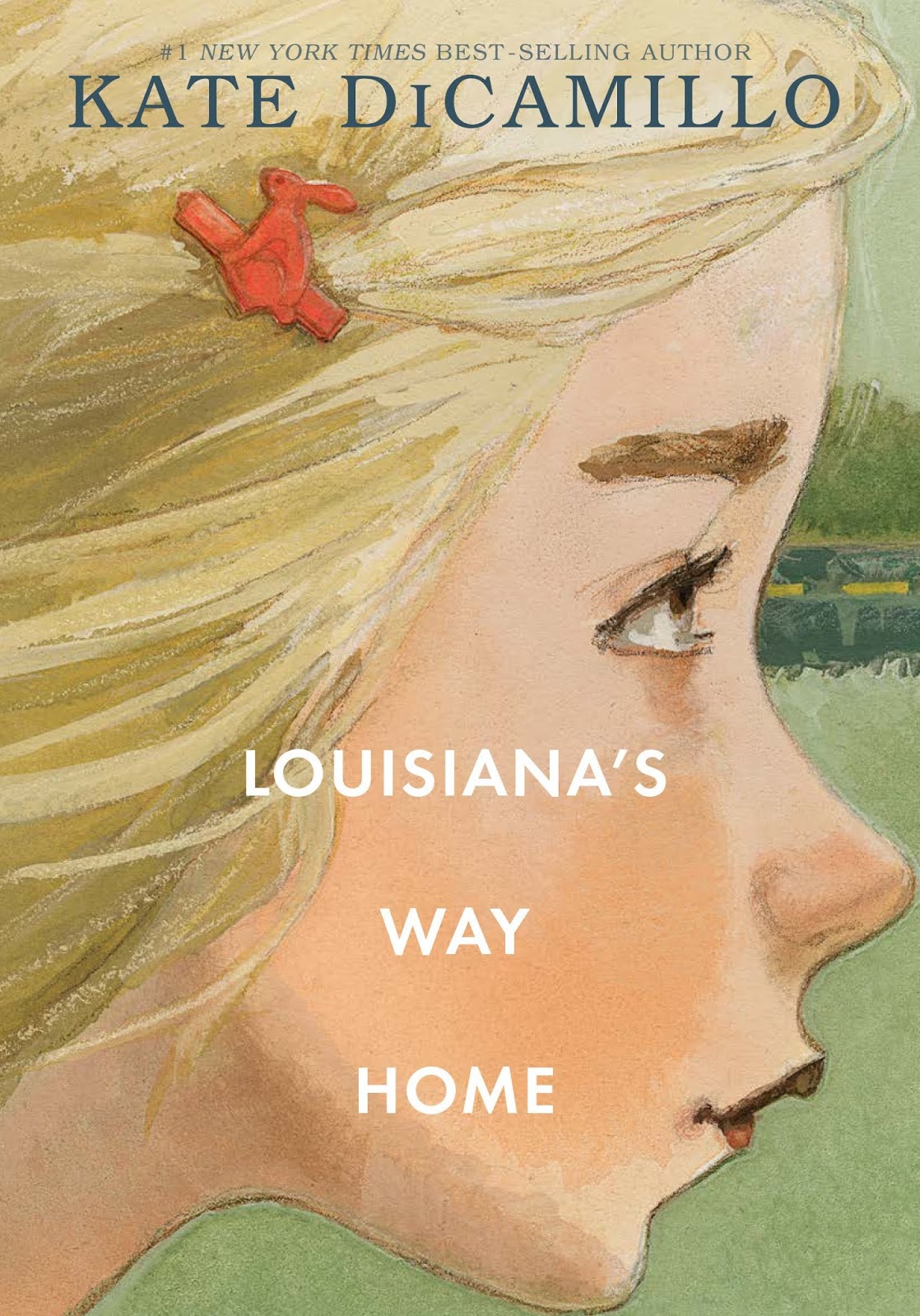
One of my new favourites though is Louisiana's Way Home by Kate DiCamillo. Her writing is stunning as always and Louisiana is a delightful, spunky creation. Suddenly, without explanation, Louisiana is on the run with her Grandma. What follows is a journey of major self discovery as Louisiana learns some painful home truths and discovers just how strong and resilient she really is.

We all, at some point, have to decide who we want to be in this world. It is a decision we make for ourselves. 

Forgiveness, hope and courage are DiCamillo's calling cards - they shine very brightly in this tender, bittersweet story. And it wouldn't be a DiCamillo story if we didn't also learn about the kindness of (some) strangers (although don't get me started on the grandmother!)

Perhaps what matters when all is said and done is not who puts us down but who picks us up.


I'm starting to loose track of ALL the princesses-turned-monster-fighting-superheroes in The Princess in Black series by Shannon Hale but #6 and the Science Fair Scare is still full of all the fun, derring-do, go-girl attitude of the earlier stories.

It's hard NOT to be charmed by these sassy young things with their alter-ego monster-fighting persona's. But I guess at some point, I'd like to see these girls (& the dashing young Goat-Boy) come out from behind their masks and let the world see who they really are all the time.

Book 6 feels like a transition point. Everyone now seems to be 'in' on the secret and it would be nice if the girls didn't have to pretend to be pretty, prim princesses in public any more.


I love junior fiction at this time of year. It's entertaining, easy reading. But they're not always light on topic or emotional impact. These books feature BIG themes with BIG heart. They are books that can be enjoyed by adults just as much as the younger people in their lives. There is way more to junior fiction than the Wimpy Kid and Dork Diaries, and I for one, am very grateful for that!

Friday, 14 December 2018

Washington Black by Esi Edugyan

Reading Washington Black by Esi Edugyan was like eating a big bag of sweets. Some were good, some not so good. And after gorging myself on the first half, I found the second half a bit too much take.


The first half of Washington Black was unputdownable. I loved the engaging voice of the child narrator. His early life on the plantation was brutal yet fascinating. Edugyan included some strong, descriptive passages in these early chapters and I found the secondary characters just as intriguing.

Washington's fear and mistrust of everyone was more than understandable, but the constant tension built up by this fear with every change or arrival of a new character eventually lost it's impact by overuse. The tension was continually being built up but never quite realised....although perhaps, this is what it's like to live in a state of slavery in Washington's world.

For me the tale started to lose it's way when Wash and Titch took off to the Arctic in search of Titch's father. It reminded me of what happened when I read Elizabeth Gilbert's The Signature of All Things where 'something went a little off kilter'. I began to doubt my narrator, I became sceptical and even a little cynical. I became aware of the writer and felt manipulated at times. I was being asked to go on a journey that had lost its believability and maybe even lost its way.

Billed as a coming of age story or a life after slavery story, neither felt predominant to me. With such a strong start on the plantation, I expected to be taken on the struggle as Wash's came to terms with his newfound freedom. But I never got a strong sense of what life was really like for a freed slave in western 'civilisation' - the injustice, unfairness, the everyday prejudices, burdens and guilt. The existential angst wasn't fully realised.

And Wash's personal growth felt too much too soon - it was too big a jump from uneducated child slave to scientific, emotionally intelligent young man. The soaring heights of the first half floundered and crash landed.

Titch's emotional arc didn't make sense to me either. He had me right up to the point of  his disbelief/fear/hope/joy at being reunited with his father after thinking that he was dead. I was incredibly moved by this exchange. Titch obviously had his own struggle with personal freedom, yet his sudden disappearance was the first moment when I felt caught in the author's web.

There were a few tiny touches of surrealism or mysticism which were left unexplained and unresolved. They added a fable-like element to the story, and maybe that's were the problem lies. In the end I wasn't sure if this was an allegory or an historical fiction, adventure story. I felt like I was getting mixed messages by the end.

I will certainly read more books by Edugyan - when her writing soared, it dazzled and some of her minor characters were so well-drawn and vivid, that I was disappointed when the story moved on without them. Potential and possibility abounds.

Giller Prize winner
Man Booker shortlist
Longlisted for the 2020 International Dublin Literary Award.

Monday, 16 July 2018

The Neverending Story by Michael Ende

I have a vague recollection of seeing the 1984 movie version of The NeverEnding Story in my late teens. It was a bit too juvenile for my sophisticated, desperate-to-be-grown-up self at that time, so other than a shaggy white flying dragon and a boy clinging to its neck, I remember nothing. And felt no need to know any more.

Until a copy of the book fell into my hands recently & I decided to add it to my #20booksofsummer (winter) list as a bit of light relief.


Die unendliche Geschichte was published in German in 1979 by Michael Ende, a prolific and very successful children's writer. He was born in 1929 in Bavaria to a surrealist painter and a physiotherapist. In 1935 the young family moved to Munich to live in an artistic community. But in 1936, his father's work was declared 'degenerate' by the Nazi's forcing him to work in secret.

The young Ende experienced bombings and compulsory membership in the Hitler Youth before being drafted into the Volksturm in 1945. However, the story goes that he tore up his papers and joined a Bavarian resistance movement for the remainder of the war instead.

After the war, he dabbled in poetry, acting and play writing. His first novel, Jim Knopf was published in 1960. However 1960's Germany was not a good time to be writing escapist literature. Post-war Germans were all about political commitment and realism; feeling undervalued he moved to Italy to live. It was here that he wrote The Neverending Story.

He went on to write 30 books before his death in 1995. Ende was a human rights activist, anti-rearmament and a campaigner for peace.

His influences included Rudolf Steiner, Rainer Maria Rilke and a life-long fascination with Japan.

The Neverending Story is a fantastical fairy tale, full of imaginative wish fulfilment. Each chapter begins with a letter of the alphabet, which must have a been a challenge for the translator, Ralph Manheim. The first half of the book sees motherless, unloved Bastian Balthazar Bux reading a story about another land in grave danger of disappearing into Nothingness. The protagonist appears to be a young warrior/hero called Atreyu with his faithful horse Artax and a luckdragon named Falkor. The story appears to be a lesson on imagination, the nature of lies, power and purpose.

This is where the movie ends.

Ende felt that this adaptation's content deviated so far from the spirit of his book that he requested that production either be halted or the film's title be changed; when the producers did neither, he sued them and subsequently lost the case. Ende called the film a "gigantic melodrama of kitsch, commerce, plush and plastic" (Ein "gigantisches Melodram aus Kitsch, Kommerz, Plüsch und Plastik").The film only adapts the first half of the book, and consequently does not convey the message of the title as it was portrayed in the novel. (Wikipedia)

I can see why Ende was upset. At this point the story did not feel 'neverending'. It was a tremendous fantasy about courage and truth, but it wasn't until the story moved onto Bastian's entry into the fantasy world that the cyclical nature of the story became apparent. Suddenly the tone shifted from imagination to creation. Pure escapism and wish fulfilment surrounded Bastian as he gradually learnt to be careful what you wish for. Bastian transformed himself from a dumpy, unloved, fearful boy into a strong, handsome, brave protagonist. It took him the rest of the story to realise that the real meaning of a well-lived life is love, memory and being true to yourself.

The Neverending Story is a classic quest story that will delight fantasy-loving readers of any age.

Book 11 of #20BooksofSummer (winter)

Thursday, 24 May 2018

Kafka on the Shore by Haruki Murakami

I like to think that I have taken my 'what to read whilst travelling' choices to an inspired level of brilliance, but I really outdid myself with our recent trip to Japan. Reading Murakami in Japan now feels like the ONLY place to read Murakami!

Not only does the usual Murakami weirdness make sense when you're actually in Japan, but you also realise just how important the environment is to Murakami and his characters. His descriptions of the trees, forests, waterways and urban spaces are everywhere as you move around the country. As are the crows.

In this case, the boy named crow is a mentor to our young protagonist, Kafka Tamura, perhaps an alter ego, a Japanese Jiminy Cricket. Whatever crow is or isn't, right from word one, Murakami is flagging that symbolism, mythology and psychology will be our prime concerns in Kafka on the Shore.

In Japanese mythology, crows are seen as a sign of 'divine intervention in human affairs' (wikipedia). Western mythology tends to associate the crow with bad news or as a harbinger of death. They're selfish, spread gossip and neglect their young. And they're everywhere in Japan. They sit on telegraph wires, fence posts and roof tops. You often wake up to their cawing, even in the city.

Cats are the other creatures that dominant not only Murakami stories, but many Japanese stories, yet curiously I didn't see one single cat in three weeks, let alone a talking cat! The opposite of the crow, cats are creatures of good luck, although still often associated with death and hauntings.


Silence, I discover is something you can actually hear.


There is no denying that Murakami is on very intimate terms with kooky.

If the talking cats weren't enough, a cameo appearance by Johnny Walker and Colonel Sanders of KFC fame might tip you over the edge. A reference to the (fictional) Picnic at Hanging Rock as an example of another group loss of consciousness event caught my eye. Did Murakami know that it was an urban myth? Is that what he was implying about his own story? The sense of mystery and other-worldliness was certainly a shared atmosphere between the two stories.

I was also amazed by truck drivers who suddenly became classic music afficiandos, quiet librarians who turned out to be sex fiends and sex workers who quoted philosophers. What's not to love? The kookiness gets under my skin and into my head. Just like what happened to me with his previous books.

1Q84 is still roaming around in my head, Colourless Tsukuru less so, but it's still a memorable book experience.

Things outside you are projections of what's inside you, and what's inside you is a projection of what's outside you. So when you step into the labyrinth outside you, at the same time your stepping into the labyrinth inside. 

One of the really enjoyable aspects to reading Murakami in Japan is the place names. Suddenly they really mean something. Most of the action in Kafka takes place in Takamatsu on the island of Shikoku. 

We didn't get to Shikiko with this visit, but we did see one of the huge bridges, from a distance, that joins Shikoko to Honshu and we spent some time at the station that is the interchange for the JR line that goes to Takamatsu. Seeing the name of the city featured in my book up in lights suddenly grounded this surreal story into reality.

This is only my fourth Murakami (see my Author Challenge tab for details) so I'm not sure I can safely name all his common themes and ideas, but there are a few that I've clocked. Going into the woods/fear of getting lost, weird sex, talking creatures, dreams, random jazz references, loneliness and silence. And for me, the reader, there is an over-riding sense of bewilderment (WTF was that about?) as well as an overwhelming sense of wanting more (whatever it was a think I like it!) 


I'm caught between one void and another. I have no idea what's right, what's wrong. I don't even know what I want anymore. I'm standing alone in the middle of a horrific sandstorm. I can't move, and can't even see my fingertips.


Murakami doesn't wrap his stories up with a neat, tidy bow or resolve many of the story lines. This should be totally frustrating...and it is, but somehow you love being kept in the dark and confused at the same time. Perhaps it's the likeable characters? Or perhaps it's the not so subtle way he plays with your head? Or perhaps it is the hope that the next book he writes will bring you one step closer to understanding this maddening man and his ability to suck you into his world. 


Every one of us is losing something precious to us....Lost opportunities, lost possibilities, feelings we can never get back again. That's part of what it means to be alive. But inside our heads - at least that's how I imagine it - there's a little room where we store those memories.


Image source
Murakami likes to do the whole books in books thing. Kafka's backlist was an obvious start -The Castle, The Trial, Metamorphosis and In the Penal Colony in this case. But he also referenced The Arabian Nights, the complete works of Natsume Soseki, a book about the trial of Adolf Eichmann (I can only assume it was Hannah Arendt's Eichmann in Jerusalem), Electra by Sophocles, The Tale of the Genji and 'The Chrysanthemum Pledge' in Tales of Moonlight and Rain by Ueda Akinari.

So many tangents, so many connections, which one should I tackle next?

Friday, 9 March 2018

The Shepherd's Hut By Tim Winton

The Shepherd's Hut is Tim Winton's much anticipated latest novel. I am a fan, but with reservations. I loved Cloudstreet and Dirt Music but hated The Riders (it has the dubious honour of being one of my very first DNF books). Breath was good but a bit blokey and Eyrie was okay, but a bit blokey. I adore his children's picture book illustrated by Karen Louise called The Deep. And his essays in The Boy Behind the Curtain were truly luminous.

So I entered The Shepherd's Hut cautiously.


The first 20 or so pages were a struggle for me. I know that there are awful dad's out there, I know what they can do. I used to be a teacher, I've assisted some of those families in negotiating the quagmire of domestic violence over the years. But I don't feel the need to read about such sad, brutal things.

So I struggled with the first part of the story where we experienced Jaxie's dysfunctional relationship with his father. I thought, I can't do this.

Later that night, I tried again.

Without spoiling anything for anyone, Jaxie was on the run and suddenly we had a full-on road trip/survival story underway. Unusually for Winton, there wasn't a beach in sight, as Jaxie headed inland to the scrubby, salty desert areas of WA.

Some readers might find Jaxie's vernacular hard going. It annoyed me at the start, but I think I'm at an age when teenager-speak is annoying in whatever form it takes! But once Jaxie hit the road, the voice became more considered and thoughtful, and was perhaps meant to reflect the influence that Fintan had on him. If you disliked Huck Finn or Lincoln in the Bardo because of the local dialect, then steer clear of this one too. The swearing may also put off some readers.

Fintan was the ageing priest that Jaxie stumbled upon in the bush. We don't know why he's living a life of exile, but there were obviously some issues around the priesthood and the Catholic Church that Winton was exploring here. I'm still not sure what they were.

The same goes for Winton's well-known concern about toxic masculinity. He discusses it in detail, but what is the solution?

Because it's also #ReadIreland month over at Cathy's blog, I thought I would highlight the Irish character in Winton's story. Fintan, the priest is described by Jaxie like this,
I never did know what to make of Fintan MacGillis....He was Irish, he told me that straight up. But I never found out what it was he done to get himself put there by the lake, what kind of person he was before....He was one of them geezers been out on his own so long he talks to himself all day....You had to sort through all these bent up words to figure which was bullshit and which was true. What I mean is he made a lot of noise but sometimes he didn't say much. With that accent of his and the way he said things fancy and musical, it was like camouflage and you knew deep down he'd been doing this all his life, hiding in clear sight.

The Shepherd's Hut is not an easy read, but, in the end I found it to be a worthwhile encounter.
It's not quite a coming of age story because the becoming part was still to happen and it's not quite a road trip story as Jaxie's journey was nowhere near done. It was more like a vignette, a moment in time, a snapshot in time.

I'm not sure I learnt anything new or gained any insights into domestic violence, the lost and lonely or survival, but I can see an action-packed, fast-paced, gritty movie on the horizon!

Eyrie by Tim Winton
Dirt Music by Tim Winton
The Boy Behind the Curtain by Tim Winton
The Deep by Tim Winton

Facts:
  • Longlisted for the 2020 International Dublin Literary Award.

Saturday, 24 February 2018

The Enlightenment of the Greengage Tree by Shokoofeh Azar

The Enlightenment of the Greengage Tree has been attracting my attention for several months now, however it took its recent longlisting for this year's Stella Prize to finally make me pick it up. I'm nothing but a Stella groupie!

The cover alone might have been enticement enough (a collage of three of Azar's art works), but the promise of a mystical, magical tour through the horrors of revolutionary Iran, 'using the lyrical magic realism style of classical Persian storytelling', was the final prompt I needed to make this my first book to read from this year's prize.


Magical realism can be a problem for many readers I know. I'm happy to embrace some forms of magic realism more than others. I especially like those that draw fairy tales, fables and myths into our modern real-world setting. (FYI: I'm not so keen on the type of magic realism that brings in a lot of deliberately disorientating layers and details. I like my magical realism to still make sense somehow!)

Azar's use of magic realism did that and more. It's quite a skill to weave a story that allows your somewhat sceptical reader to accept the existence of ghosts, jinns and mermaids. But Azar did it for me - I was with her from the start, on that level at least.

However, it did take me a while to get going. It may have been a translation thing or it may have been a slightly different approach to sentence structure. Many of the books I gravitate towards lately are ones with concise, short sentences. So maybe it was simply my lack of practice in reading longer, flowing, complex sentences. Whatever it was, I found the start of The Enlightenment of the Greengage Tree choppy and erratic.

It wasn't until the special circumstances of our narrator were revealed at the beginning of chapter 5 that I was hooked. Suddenly the 'playful, poetic and deeply melancholy' Alice Pung quote on the back cover came to life.

I dropped into a dreamy, almost trance-like state every time I picked up the book. Jinns and groves of trees haunted my own dreams as fleeting childhood memories of news items about the 1979 Revolution were triggered by events in the story. It was angry, it was heart-rending, it was glorious, mesmerising and confronting.

Azar has given us a classic story of good and evil. Her words are fluid as is her approach to time and truth. Belonging, love and loss are the major themes while the search for solace is the main concern for her characters. Given the horrific events that occurred during the Iranian Revolution, it is easy to understand why and how an author would choose to wrap these unreal events up in mythology. When the real world you live in suddenly gets turned on it's head, sometimes the only response is imagination and the only hope is magic.

I, for one, hope with all my heart, that this story gets shortlisted for the Stella - it deserves to get as much attention as possible.

Translated from Farsi by Adrien Kijek#AustWomenWriters
#Stella2018

Wednesday, 6 December 2017

The Extremely Inconvenient Adventures of Bronte Mettlestone by Jaclyn Moriarty

I am a fan of the Moriarty sisters -  Liane, Nicola and Jaclyn - they have all gone off in different directions, genres and target audiences but the one thing they have in common is thoroughly engaging stories, believable characters and the ability to suck me into their world.

Jacyln's previous series that wowed my socks off was The Colour of Madeleine trilogy. These books were aimed at an older teen audience - light fantasy, a little romance and a great concept. The Extremely Inconvenient Adventures of Bronte Mettlestone is for younger readers - about 10 plus. It's another light fantasy with a great concept, but more concerned with family and friendship than romance, although I'm still wondering about Aunt Isabelle and the Butler!


Bronte begins her story with the sudden death of her parents. This is not as sad an event as you might expect as Bronte was left by her parents on Aunt Isabelle's doorstop when she was a baby. Bronte's feelings about her parents, are therefore, complicated.

Things quickly become even more complicated when the terms of their wills are revealed. Bronte is to go on a quest, an adventure no less, to visit all her aunts (there are ten more besides Aunt Isabelle!) The timing for each visit is very specific as are suggestions for places to eat, gifts to give each aunt and the very definite condition that Bronte travels alone. She is only ten years of age. Aunt Isabelle is horrified, but the will is cross-stitched in faerie thread which means that if Bronte doesn't follow the instructions exactly as stated, if she breaks the terms, then her home town will also break.

This is pretty serious sounding stuff you have to agree. But Bronte heads off on her quest with oodles of optimism, trust and commonsense.

She encounters dragons, rescues water sprites and goes on the run from pirates. She saves a baby in danger of drowning, befriends a girl running off to join the circus and meets a mysterious boy with no shoes.

Each aunt has stories to tell Bronte about her parents. She gradually learns some of their secrets as well as learning some startling new things about herself. Moriarty does all of this with a lightness of touch and a great deal of charm.


Kelly Canby's quirky line drawings are scattered throughout the book. They highlight the sense of fun that permeates the whole story as well as giving this lovely hardback edition a dash of style.

This would be a fabulous bedtime read aloud book to enjoy together as a family. Highly recommended.

Sunday, 12 November 2017

Once Upon A Small Rhinoceros by Meg McKinlay

Once Upon A Rhinoceros is my kind of picture book.

As a child I dreamed of setting off into the big, wide world to explore. I've always wanted to see what there was to be seen. I couldn't wait to be grown up so that I could finally just go.

Small rhinoceros has the very same dream; she wants to see the world. She patiently waits until the time is right, and as you can see by the glorious cover designed by Leila Rudge, she succeeds.


She sailed on...through the woolly wild of winter and the smooth sweep of summer...to faraway lands and beyond.

On her return home, her family and friends are happy to see her, but unimpressed by her tales...all except for one quiet voice who asks,
'Did you get lost?'
'Many times.'
'And was it...wonderful?' 
'Oh yes!'  

Oh yes indeed!


With themes of independence and freedom, pushing the boundaries of what is considered 'normal' and daring to be different to fulfil your heart's desire, Once Upon A Small Rhinoceros will charm you and inspire you in equal measure.

Meg McKinlay has written some of my favourite books for teens and children, including the CBCA award winning A Single Stone, No Bears and Ten Tiny Things. She has a wonderful blog post describing her creative journey with this particular story here.

Leila Rudge adds collage elements to her pencil, paint and paper 'hand snipped' illustrations. She has written and illustrated the wonderful CBCA Notable book Ted, the very popular CBCA shortlisted book, Gary as well as No Bears with McKinlay.

#AusReadingMonth
#AustralianWomenWriters Challenge

Sunday, 27 August 2017

Lincoln in the Bardo by George Saunders

I was feeling a little cautious about reading Lincoln in the Bardo. Anytime I had heard someone talk about the book, they would mention the ghosts, the many, many voices and the grief. It sounded like it might be hard work or a bit too clever for its own good.


Fortunately, though, a reading copy recently came my way at work. And I was tempted.

Bardo is the transitional phase after death and before ones next rebirth when the consciousness is no longer connected to the physical body. After trawling the internet I found a copy of The Tibetan Book of the Dead that allowed me to see inside. It gave me one of those ah-ha moments - the  fragmentary multi-voice story telling format that Saunders used throughout his book, reflected the format used in this Buddhist classic.

Saunders made use of this device for both the historical and the ghostly sections of the book. I found it to be effective and affecting how he combined the fragments to make a kind of cohesive narrative whole.

I also wanted to know if the primary sources quoted by Saunders during the historical record sections of the novel were real or fictional. I found this review by Maureen Corrigan from earlier in the year that answered that question for me.

One thing bothers me about this extraordinary novel — more of a question, really, than a quibble. Throughout Lincoln in the Bardo, Saunders intersperses chapters packed with quotes from historical sources. He gives citations for these historical sources and some are legit — like Doris Kearns Goodwin's book on Lincoln, for instance. But other sources are made up. All the historical passages are tossed together indiscriminately.
 
It's not like Saunders is doing anything new here: novelists have been playing with historical narrative since the term "postmodern" was invented. But, I wonder if just in the past couple of months, our taste and tolerance for this kind of melding of fact and fiction has diminished?


There was a brief chapter early in the book, that I believe Saunders used deliberately to play with this idea about what is fact and what is fiction. His historical sources are talking about the moon the night of the White House dinner when Willie was extremely ill. Some recalled the 'beautiful moon', 'the brilliance of the moon' or 'the golden moon', while others remark that 'there was no moon that night', or 'a fat, green crescent hung above' or 'the night continued dark and moonless' or 'the full yellow moon hung among morning stars'.

When I read this section, I was reminded of the comment often made by police officers about the fickle nature of eyewitness accounts when at the scene of a crime, and how all the witnesses will describe the victim and the perpetrator in completely contrasting terms. The unreliability of our memories only intensifies as more time goes by.

Perhaps Saunders is trying to say that even primary sources cannot be trusted to tell the 'whole truth and nothing but the truth'?

The Lincoln Family 1861 - Willie is seated at the front.

The ghosts in Lincoln in the Bardo are certainly not to be trusted. They're still very attached to the idea of their physical bodies. They have failed to grasp that they are in fact dead as they spend their time in bardo going over and over the thing that led them to this point. Knowledge and acceptance is what finally allows them to pass over with a 'matterlightblooming phenomenon' into the great unknown.

This will be a book that divides its readers. The many voices and the blurring of fact and fiction will annoy some and delight others.

I was one of those delighted.

The scenes of Lincoln's grieving were so very touching as were those featuring Willie coming to terms with his own death. Ultimately, Lincoln in the Bardo is a story about letting go. Letting go of the one you loved and letting go of the life you once lived.

Lincoln in the Bardo has been longlisted for this year's Man Booker Prize.

Sunday, 16 July 2017

The Two Towers by J R R Tolkien

I had planned to write two posts about this, the second part of The Lord of the Rings trilogy, as it actually begs to be considered in its two separate sections. In fact, Tolkien originally wrote the book as one big book with six parts. He planned to name part III The Treason of Isengard and part IV The Journey of the Ringbearers or The Ring Goes East.

However, due to post-WWII paper shortages and size considerations, the book was eventually published as three books, with the middle one, The Two Towers, being published on the 11th November 1954.


Part III and part IV are two very distinct stories. The first part follows the trials and tribulations of the remnants of the fellowship after Frodo and Sam secretly depart. The second part is all about Frodo and Sam. And Gollum.

However whichever part you consider, the story continues to be about the role of fellowship, friendship, loyalty, duty, responsibility, honour, commitment and courage. The end of times may be fast approaching, morals may be slipping and attitudes may be changing, but our stalwart group shines on to show us a better, finer, more noble way.


One of the highlights of The Two Towers for me, though, are the Ents, and Treebeard in particular. I love his slow, thoughtful approach to life and decision making. But I'm being too hasty!

They found they were looking at a most extraordinary face. It belonged to a large Man-like, almost Troll-like, figure, at least fourteen feet high, very sturdy, with a tall head, and hardly any neck. Whether it was clad in stuff like green and grey bark, or whether that was its hide, was difficult to say. At any rate the arms, at a short distance from the trunk, were not wrinkled, but covered with a brown smooth skin. The large feet had seven toes each. The lower part of the long face was covered with a sweeping grey beard, bushy, almost twiggy at the roots, thin and mossy at the ends. But at the moment the hobbits noted little but the eyes. These deep eyes were now surveying them, slow and solemn, but very penetrating. They were brown, shot with a green light. Often afterwards Pippin tried to describe his first impressions of them. 
'One felt as if there were an enormous well behind them, filled up with ages of memory and long, slow, steady thinking; but their surface was sparkling with the present; like sun shimmering on the outer leaves of a vast tree, or on the ripples of a very deep lake.'
Treebeard by Alan Lee, Timothy Ide and Jerry Vanderstelt
I love this description of Treebeard and the Ents, but sadly I have never seen an illustration or a movie version of them that does justice to what I have in my mind. All the art work, to my mind, fails to capture that ponderous, slow, kind, considered gravitas that Tolkien refers to.

Lee and Vanderstelt are close to the mark, but the eyes in both are wrong while Ide's version is too scary. Severin's 3D model has a nice face, but is missing all the green, twiggy stuff. And they all lack the size and bulk that I feel is necessary for an Ent. I have always imagined a giant, stately oak tree as an Ent, not the spindly version that every artist seems to prefer.

Treebeard by Alexey Severin

The other character that appeals to me in The Two Towers is Boromir's brother, Faramir. He is a brave fighter, but prefers peace. As the younger son, he has a more balanced attitude towards power and leadership. He provides thoughtful counsel and safe harbour to Frodo and Sam, in much the same way that Treebeard assists Merry and Pippin.

Despite the dark days looming, honour and kindness can still be found, when least expected.


And that's why I enjoy these books so much. The fellowship, goodness and hope that shines through the darkness and despair is something we can all take heart from. 
The movies have this too, but the level of violence and the massive battle scenes so often overwhelm the other messages that Tolkien was trying to convey.

Previously I read these books so quickly, that I missed lots of the finer details. This leisurely reread has been a delight of rediscovery and paying attention.

How are you going? 
I see that Jean has finished and Nick is still adding page updates on Goodreads. I think Nancy may have fallen to the wayside. As with all of life's journeys, we travel at our own pace in our own way!


#HLOTRreadalong2017 


The Fellowship of the Ring 

- Halfway post - Book one 
- TFOTR - Book two


The Two Towers

- Welcome to Book
- Review


The Return of the King


Monday, 15 May 2017

Yours Sincerely, Giraffe by Megumi Iwasa

One of my recent #readathon reads was the delightfully eccentric Yours Sincerely, Giraffe by Megumi Isawa. When my eyes started to get tired and words began to blur on the page, the simple but fun illustrations from Jun Takabatake were just the eye candy I needed.


The premise of the story is simple - Giraffe is bored. Until, that is, he spots a sign on a tree from an equally bored pelican who has decided to start up a postal service, 'willing to deliver anything anywhere'!

Giraffe decides to write a letter. He gives it to pelican with the instruction 'give it to the first animal you meet on the other side of the horizon.'


What follows is a rather absurd, but oh so charming tale of mistaken identity and misunderstanding as giraffe and his new penpal, penguin, try to imagine what each other look like and what it would be like to live on the other side of the horizon.

For teachers and parents, the added bonus with Yours Sincerely, Giraffe is the chance to discuss letter writing, difference and perception with your emerging reader. It's also a fabulous book to read aloud together.

New Zealand based Gecko Press have become renown for their promotion of unconventional, diverse and humorous books for children. These include Rose Lagercrantz's My Happy Life books and Ulf Nilsson's Detective Gordon series. Yours Sincerely, Giraffe is another quirky addition.

Monday, 8 May 2017

Journey to the River Sea by Eva Ibbotson

I started the Journey to the River Sea by Eva Ibbotson as part of my #readathon session. I had a lovely 15th anniversary edition of this modern day classic, complete with gorgeous blue butterfly. The following day I woke up with a terrible head cold and struggled to work, before realising that I was going to need a couple of days at home in bed to actually get better.

Journey to the River Sea became the perfect easy, delightful read to see me through my first day of feeling miserable at home.


This book was a pleasure in and of itself, but it also brought back so many lovely memories of other favourite childhood characters. Our orphaned heroine, Maia upon hearing that she was being sent to the Amazon to live with cousins she had never met, channelled her inner Jane Eyre, when she gave herself this stern talking to,
Fear is the cause of all evil, she told herself but she was afraid. Afraid of the future...afraid of the unknown. Afraid in the way of someone who is alone in the world.

Followed up quickly by an Anne Shirley-esque remark, 'And after that I don't know, but it's going to be all right.' Maia is courageous, funny and intelligent - the kind of child, we all wish we had been more like (well, at least, the kind of child, I wish I had been like).

There's the forbidding but ultimately lovable governess who provides Maia with thoughtful care, fun and inspiring life advice just like Mary Poppins or Professor McGonagall. The Little Lord Fauntleroy aspect is explored via Clovis, the very homesick and unwilling theatrical orphan boy. The mean twins are Nellie Olsen, John Reed and Veruca Salt all rolled into one (well, actually two, but you know what I mean!) And the lost boy, living with the Indians, has a touch of the Huck Finn's or Peter Pan about him.


Journey to the River Sea is historical fiction with heart. Set in 1910 England and Manaus on the banks of the Negro River in Brazil, Ibbotson gives us a tale of belonging, bravery and being true to yourself. There's also a treasure trove of gorgeous geography and anthropological treats along the way, with references to Humboldt, sloths and butterflies, just to name a few.

Highly recommended for mature 10+ readers and all lovers of fine children's literature.

My post for One Dog and His Boy from 2011 - when my reviews were short, sweet & simple.

Thursday, 4 May 2017

The Fellowship of the Ring by J R RTolkien

The books that comprise The Lord of the Rings are usually presented as a trilogy, but it was in fact designed by Tolkien to be one single book with six parts. Obviously the publishers baulked at publishing such a large tome of a book!


On 29th July 1954 George Allen & Unwin published the first volume consisting of the first two books with the title The Fellowship of the Ring.

The second volume, with the next two books was eventually titled The Two Towers and published on 11th November 1954. The final two books were published in The Return of the King on 20th October 1955.

**Spoiler alert**
I'm now assuming that you have read the book so that we can discuss the details of what has happened.

Book Two of The Fellowship of the Ring, is, well, all about the fellowship.

We begin this section of Lord of the Rings in Rivendell where we meet all the participants of the fellowship for the first time together. We hear their back stories and find out how they ended up in Rivendell at this time.

The Gates of Moria by Alan Lee

Tolkien used all kinds of storytelling devices to keep our interest and to build up the tension.

There's the info-dump chapter where we find out all about the ring's long and dubious history. Tolkien again used the action-packed chapters full of danger and tension followed by the safe-haven chapters of comfort and ease to keep the pace up without exhausting all of us.

The humour of Merry and Pippin and the gravitas of Gandalf provided light and shade. While foreshadowing continued to be one of Tolkien's favourite ways of promoting a sense of anticipation and foreboding.

Tolkien employed metafiction when Bilbo talked about his 'story' that he was writing about his journey and the parts still to be written or completed. Although I'm reluctant to call it metafiction as I don't think that Tolkien used this technique in a deliberately self-conscious or ironic way or in an attempt to question what was real or not.

Tolkien's ability to reference the depth and breadth of his created world was particularly impressive in the two books of The Fellowship - the song that Bilbo sang, the backstory of the ring, Moria and it's long history, the extensive descriptions of the scenery, the longevity of the Elves - although this immensely rich historical detail can at times be overwhelming to the unsuspecting reader.

This particular book also had deep sadness and loss. Gandalf's stand on the Bridge of Khazad-Dum is one of the pivotal moments in the whole story.

The very strong faith based themes evident within Gandalf's stand, fall & ultimate resurrection never felt like Tolkien was preaching. He always said that he never wrote the book with analogies in mind, but obviously the religious stories that he grew up with were a central part of his life and influenced the type of story he wrote as well as infiltrating the various details.

In The Letters of J R R Tolkien* No. 142 To Robert Murray, SJ on 2 December 1953, Tolkien said,
The Lord of the Rings is of course a fundamentally religious and Catholic work; unconsciously so at first, but consciously in the revision. That is why I have not put in, or have cut out, practically all references to anything like 'religion', to cults or practices, in the imaginary world. For the religious element is absorbed into the story and the symbolism. However that is very clumsily put, and sounds more self-important than I feel.

Unlike C S Lewis' Narnia series that is heavily and overtly Christian, it is possible to read The Lord of the Rings without thinking about the religious symbolism at all. It certainly escaped my earlier, younger reading of the books.

Researching Tolkien's intentions for this reread has added layers of meaning to my understanding of the story and of Tolkien himself, but with or without these layers, LOTR remains a rip-roaring, satisfying read.

Perhaps, like Tolkien, my first, early reading was quite unconscious, with this reread being much more conscious and deliberate on the look-out for symbolism and themes.


The mysterious lurking presence of Gollum haunts our journey throughout The Fellowship. We all know he's there, we're all on our guard, but no one wants to talk about it. Yet.

The landscape was all important as well. It affected the decisions that the fellowship had to make along the way and Tolkien also used it to explain certain characteristics of the various races  - thank goodness for the map inside the cover of the book to make sense of all that 'east of this/west of that' stuff.

My Alan Lee illustrated edition also helped to bring many of the places to life which made up for my woeful lack of imagination.


The Fellowship of the Ring was also all about the ring.

The ring personifies evil and is quickly established as a character in its own right. Some of the ring stuff is confusing. For instance, the how and why of the three rings are how exactly they are linked to the one, but not necessarily evil?

I'm not really sure if Tolkien's letter* to Milton Waldman (No. 131, circa 1951) helped clarify anything at all!

The chief power (of all the rings alike) was the prevention or slowing of decay (i.e. 'change' viewed as a regrettable thing), the preservation of what is desired or loved, or its semblance – this is more or less an Elvish motive. But also they enhanced the natural powers of a possessor – thus approaching 'magic', a motive easily corruptible into evil, a lust for domination. And finally they had other powers, more directly derived from Sauron ('the Necromancer': so he is called as he casts a fleeting shadow and presage on the pages of The Hobbit): such as rendering invisible the material body, and making things of the invisible world visible....
The Elves of Eregion made Three supremely beautiful and powerful rings, almost solely of their own imagination, and directed to the preservation of beauty: they did not confer invisibility. But secretly in the subterranean Fire, in his own Black Land, Sauron made One Ring, the Ruling Ring that contained the powers of all the others, and controlled them, so that its wearer could see the thoughts of all those that used the lesser rings, could govern all that they did, and in the end could utterly enslave them. He reckoned, however, without the wisdom and subtle perceptions of the Elves. The moment he assumed the One, they were aware of it, and of his secret purpose, and were afraid. They hid the Three Rings, so that not even Sauron ever discovered where they were and they remained unsullied. The others they tried to destroy....
(LOTR) was begun in 1936,5 and every part has been written many times. Hardly a word in its 600,000 or more has been unconsidered. And the placing, size, style, and contribution to the whole of all the features, incidents, and chapters has been laboriously pondered.

There was no where near as much fighting, violence and hand to hand combat in this book as I remember from the movie. Thank goodness!

I found the extensive and over the top battles in all of the movies tiresome and tedious. It often felt like the movie moved from one battle scene to the next. This reread has reminded me that the fighting scenes in The Fellowship at least, were sporadic and low-key, although I still found myself skimming parts of them at times.

The mirror of Galadriel by Alan Lee

The Fellowship of the Ring contained themes of isolationism vs connection, appearances vs reality and the passing of time. Courage, friendship, the corruption of power, fate vs free will and temptation also got a look in.

Some reviews have complained about the overly long descriptions and unsophisticated language. Occasionally I understand the complaint about the descriptions, but the uncomplicated language is one of the things that makes this story so accessible to young and old as well as to those readers who tend to avoid fantasy. I actually find the childlike elements in the story endearing not simplistic.

The Letters of J. R. R. Tolkien* No. 35, 2nd February 1939:

I think The Lord of the Rings is in itself a good deal better than The Hobbit, but it may not prove a very fit sequel. It is more grown up – but the audience for which The Hobbit was written has done that also. The readers young and old who clamoured for 'more about the Necromancer' are to blame, for the N. is not child's play

The lack of emotional depth can be more problematic to a modern reader used to complex, nuanced character development, however nostalgia is the predominate feeling in these books, and that is something we can all tap into.

The Letters of J R R Tolkien* No. 76 - In a letter to Christopher, 28th July 1944:

As to Sam Gamgee. I quite agree with what you say, and I wouldn't dream of altering his name without your approval; but the object of the alteration was precisely to bring out the comicness, peasantry, and if you will the Englishry of this jewel among the hobbits. Had I thought it out at the beginning, I should have given all the hobbits very English names to match the shire.

I feel like I've thrown a lot of bits and pieces together from my notes with only a passing nod at coherence. I hope I haven't overloaded you!

Enough of the chatter! It's time to hit the road again and check in on our stoic ring-bearer and friends.

*The Letters of J R R Tolkien edited by Humphrey Carpenter and assisted by Christopher Tolkien 1981.


#HLOTRreadalong2017 


The Fellowship of the Ring 

- Halfway post - Book one 
  - TFOTR - Book two