Showing posts with label Friendship. Show all posts

Sunday, 13 December 2020

Life After Truth | Ceridwen Dovey #AWW


I had the pleasure of hearing Ceridwen Dovey talk about her latest book, Life After Truth at a recent work event (the YouTube recording of the event can be found here). By the time she had finished speaking, I knew this would be my next read.

I'm not sure why I've found it so hard to write up my review for this book though. I thoroughly enjoyed it and highly recommend it as a great holiday read. So instead of talking about my journey with the book, I will focus on what I learnt from the author talk, which then informed how I read the story.

Ceridwen evoked a lovely reading memory for me when she talked about one of her inspirations for writing a story about a 15 year reunion at Harvard University. Like me, she had devoured Erich Segal's Harvard stories, The Class (1985) and Doctors (1988) way back when.

I read The Class in the early 1990's. I remember loving the huge rollicking epic nature of the story as we followed the fates and fortunes of five or six Harvard undergrads during their college days and into their adult lives. Back then, the chunkier the book, the better, was my motto! When I googled the book to refresh my memory, I was amazed at how simply seeing the names, Andrew Eliot, Jason Gilbert Jr, Theodore Lambros, Daniel Rossi and George Keller again, brought back so much of the story.

The second inspiration for Ceridwen was her very own 15 yr, class of 2003 reunion, in 2018. All her friends and class mates were approaching 40 and various mid-life crisis were on show -  emotional, hormonal, intellectual, financial and philosophical. 

The class of 2003 had some interesting graduates besides Dovey. Natalie Portman and Jared Kushner for starters. Mark Zuckerberg was in the following year.

Ceridwen stresses that none of her characters are based on real life people.  However, she was drawn to using the polar opposite characters, of a movie star and the son of a President in her story, as she found the contrast appealing. Thanks to her social anthropology background, she likes to write not so much what she knows, but towards what she wants to know. Which is, 'how do people make meaning from their daily lives.' Or how do live the second half of your life differently to the first half.

For anyone who has read Dovey's earlier books, it is noticeable that the voice is very different in this story. It was a deliberate choice, although, also slightly out of Ceridwen's hands, as she finds that writing in different voices and styles comes naturally to her. She considers Life After Truth to be some kind of self-help novel, written in a fog of insomnia. 

She tried submitting and getting one of her books published under a different name to reflect the different voice she had used. But the publishers were not keen for a pseudonym, and neither was Dovey, as she feels that what she does is closer to the literary concept of heteronyms. The publishers were even less keen to go with this idea!

Recently she got around this by creating a story for Audible Originals called Once More With Feeling. It was a story she wrote, in what she describes as a 'warmer more accessible voice', purely with how it would sound, read aloud, in mind. Apparently she has a whole linen cupboard full of such stories, written in different voices, that she doesn't know what to do with.

As for Life After Truth, Dovey considers this her attempt to document the post truth world we all now live in, as well as a little nod towards the Harvard motto, Veritas, and what life is like for it's students after graduation.

Epigraph: 
...the Love-god, golden-haired, stretches his charmed bow | with twin arrows, and is aimed at happiness, | the other at life's confusion.

Euripides, Iphigenia in Aulis 


First Line:
JOMO GÜNTER-RIEHL. Address: 200 Church Street, Apartment 7A, Tribeca, New York 10013. Occupation: Founder & Director of Gem Acquisitions, House of Riehl Luxury Jewelers. Gradutae Degrees: MBA, University of California, Berkeley '13.

Last time I wrote one of these updates it was to brag about my life. 


Facts:
  • One of Dovey's favourite poets is Fernando Pessoa - famous for his use of heteronyms.
  • She studied social anthropology at Harvard

My Reviews of her Other Works (so far):
#AustralianWomenWriters

Wednesday, 29 July 2020

The Secret Library of Hummingbird House | Julianne Negri #AWW


When I was ten, I would have devoured this gem of a book, several times over! 

The Secret Library of Hummingbird House features a mysterious old house, a secret book and time travel (amusingly, back in time to the 1970's when I was ten)! What's not to love?

Especially when it's all wrapped up with a very likeable protagonist, Hattie, going through some stuff with her recently separated parents, a younger sister with an imaginary eagle as a friend, a best friend who will no doubt realise he is gay when he is a little bit older and a mean girl at school to avoid at all costs.

Hattie already feels that life is careening out of her control, when she discovers that the crumbling mansion next door to her dad's house is slated for demolition to make way for...you guessed it, another apartment block. The house and the ancient mulberry tree growing in its grounds, hold many happy family memories for Hattie, pre-separation.

Her plans to save the house lead to a full-moon midnight escapade to the house and a chance to slip back in time to meet another young girl also feeling lost in time. A young girl who also collects lost words and has a story of her own to tell.

Set in a pre-covid Melbourne with a secret yarn-bomber covering the trees, fences and signs with crochet wraps, Julianne Negri has written a story about standing up for yourself and letting go of the past. Adapting to the inevitable changes that occur in all our lives at every stage is the thread that joins all the characters together. Everyone has their own way of avoiding or denying change before coming around to accepting that change doesn't have to be all bad, it's just different.

A delightful read for 10+ readers. Lots of fun and full of positive messages woven naturally into the story.

Tuesday, 19 May 2020

Cherry Beach | Laura McPhee-Browne #AWW


I've been dragging my feet about writing (or finishing) off several reviews for books read a month ago. Part of the problem has been a recent return to work which has left me wondering how on earth I used to fit everything in before Covid-19 came along and slowed things down for a while. But the other part is having little desire to say anything right now.

I enjoyed Cherry Beach. It was angsty and full of the drama of young adult friendships and relationships. From my vantage point (many years away from this often torturous period of life) I could appreciate the difficulty one has in moving on from childhood friendships that fail to crossover into an adult relationships. It's not easy to let go people you no longer share anything in common with, except some childhood memories. Despite the love, the shared experiences and all the best intentions, some friendships do not go forward. And that's okay. But it's not always easy to know this when you're young, or to know how to do so gracefully. The graceful part is especially hard to negotiate.

The common ground can disappear, different experiences move you away from each other and a friendship that once enriched and supported you, becomes a drag on your energies and brings you down. How do you move on? How do you protect yourself from any fallout? How do you honour what you once had?

Hetty and Ness are two such friends, trying to navigate their way through the twenty-something phase. They leave behind Melbourne (and their shared childhood) to have a year living overseas in Canada. Their lives veer off into vastly different directions. 

What happens next is exquisitely bittersweet, yet captures the intense emotions of young adulthood perfectly. The insecurity, the anxiety, and the hugeness of what life might become. Which road to take, who to be with, who to trust and love and who not to. Sadly, some young people set off down a road of self-destruction and those on the sidelines can do very little to stop it. Adult responsibilities and choices can be a burden or you can embrace them. This is that story.

This a debut novel by Laura McPhee-Browne. She is a social worker in Melbourne and her writing has appeared in a variety of journals and magazines.

The gorgeous cover art is by Emma Currie.

Thursday, 20 December 2018

Junior Fiction - the rest!

Following on from my recent post featuring several fabulous Australian junior fiction titles, I thought it was time to venture further afield to see what the rest of the world (or at least the US, UK and Japan) were doing in this field.

The Afterwards is a new story by U.K. poet A. F. Harrold, illustrated by Emily Gravett, the well-known picture book illustrator. Like so many books for kids these days, the story explores friendship, death and loss. It is quite dark at times and some children may find the 'other world' that our young protagonist is able to visit quite creepy in much the same way that Neil Gaiman's Coraline's 'other mother' is creepy. But the ending is positive with a focus on living in the moment, honouring those you loved and being present.


Dear Professor Whale by Megumi Iwasa and Jun Takabatake (illustrator) wasn't quite as sweet and charming as Yours Sincerely, Giraffe, but it still highlighted the importance of friendship, kindness and belonging via the old-fashioned means of communication, letter writing.

The action centres around the reviving of the Whale Point Olympics. The older Olympians are honoured and revered while the youngsters are encouraged to engage in friendly competition and teamwork rather than winning gold medals at all cost.

The empathy message may have been laid on a bit thick this time round, but it's hard to take offence when it's so well-meaning and good-natured.


Front Desk by Kelly Yang is for the older end of the junior fiction spectrum - probably 10+ and is loosely based on her own experiences as a new immigrant to the States in the early 1990's. Yang wanted to tell her son about how she grew up and what it was like being an immigrant. In a letter at the front of the books she says,
I grew up in a motel. I didn't have any toys or nice clothes. My parents were struggling...and life was very, very hard for us; it was hard for everyone in our motel, from the immigrants we hid at night to the guests who stayed by the week, folks who got mistreated by the police and were stuck in the same sad cycle of poverty.
I had been searching for a way the right way to tell my son all of this, a way that didn't scare him, but inspired him....Draft after draft, I dug deeper and deeper until the shame and pain and joy of my childhood were so open and exposed, it scared me.

For such a hard won story, it reads lightly and easily. Diversity is celebrated, as is a strong sense of family and friendship. Belonging, perseverance and hard work are standards held up for admiration. Disadvantage and racism are sadly also on show and not just from the American population, Yang also subtly shows the tensions between mainland Chinese immigrants and Taiwanese Chinese.


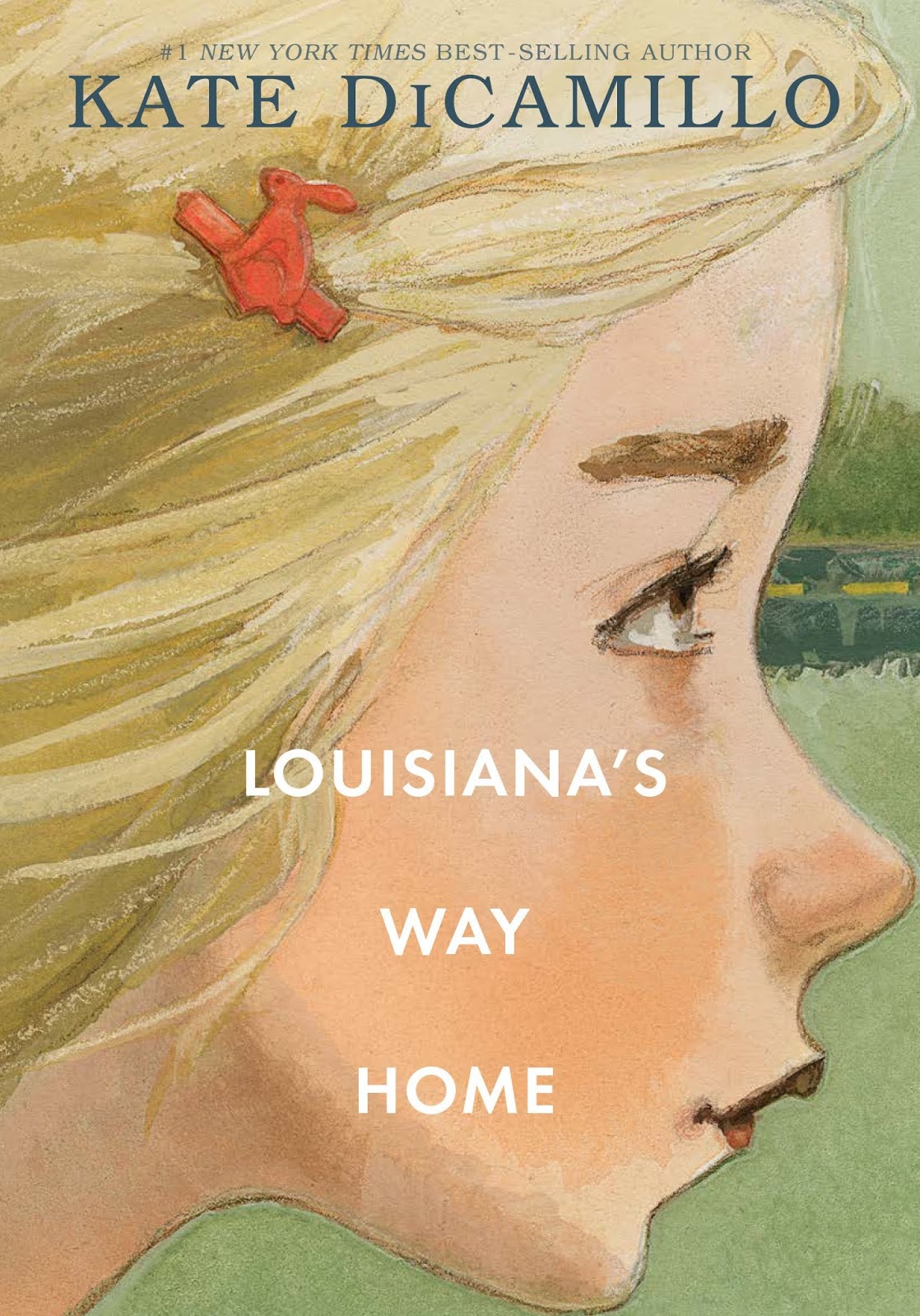
One of my new favourites though is Louisiana's Way Home by Kate DiCamillo. Her writing is stunning as always and Louisiana is a delightful, spunky creation. Suddenly, without explanation, Louisiana is on the run with her Grandma. What follows is a journey of major self discovery as Louisiana learns some painful home truths and discovers just how strong and resilient she really is.

We all, at some point, have to decide who we want to be in this world. It is a decision we make for ourselves. 

Forgiveness, hope and courage are DiCamillo's calling cards - they shine very brightly in this tender, bittersweet story. And it wouldn't be a DiCamillo story if we didn't also learn about the kindness of (some) strangers (although don't get me started on the grandmother!)

Perhaps what matters when all is said and done is not who puts us down but who picks us up.


I'm starting to loose track of ALL the princesses-turned-monster-fighting-superheroes in The Princess in Black series by Shannon Hale but #6 and the Science Fair Scare is still full of all the fun, derring-do, go-girl attitude of the earlier stories.

It's hard NOT to be charmed by these sassy young things with their alter-ego monster-fighting persona's. But I guess at some point, I'd like to see these girls (& the dashing young Goat-Boy) come out from behind their masks and let the world see who they really are all the time.

Book 6 feels like a transition point. Everyone now seems to be 'in' on the secret and it would be nice if the girls didn't have to pretend to be pretty, prim princesses in public any more.


I love junior fiction at this time of year. It's entertaining, easy reading. But they're not always light on topic or emotional impact. These books feature BIG themes with BIG heart. They are books that can be enjoyed by adults just as much as the younger people in their lives. There is way more to junior fiction than the Wimpy Kid and Dork Diaries, and I for one, am very grateful for that!

Saturday, 8 December 2018

Kitchen by Banana Yoshimoto

I've loved Japanese literature for many years now, but since visiting Japan earlier this year, my fascination and interest has exploded! Kitchen by Banana Yoshimoto popped up on several lists as a great contemporary example of Japanese literature.


Kitchen is a slim book containing two stories - Kitchen and Moonlight Shadow - both deal with death, grief, mothering and healing. Kitchen is the longer of the two and I was enchanted from page one. The language is deceptively simple and at times I worried that it was too simple. I wasn't sure if this was a translation issue or part of Yoshimoto's urban grunge charm. Except that somehow, very quickly, with no fuss or bother, Mikage's tragic tale crept into my heart and stayed. 

Yoshimoto has created two beautiful, tender tale about loss and how to move forward from it. Her writing is suffused with innocence and warmth. Although her characters experience discontent and confusion, loneliness and urban angst, ultimately there is hope and love. 

In her Preface, Yoshimoto says,
Growth and the overcoming of obstacles are inscribed on a person's soul. If I have become any better at fighting my daily battles, be they violent or quiet, I know it is only thanks to my many friends and acquaintances.

Both these stories are testimony to this belief. Friendship acts as a band aid for heartbreak. Being connected and making room for others in your life is what gets you through the tough days. For Yoshimoto's characters, this connection often occurred around the rituals of food, eating and tea drinking.

A dream-like almost mystical element imbued her work as well. Both stories have a dash of magic realism or other-worldliness, that I found to be appealing in a very Japanese way. The emotion is subtle and subdued and the cast of characters quirky and eccentric in a 1980's version of Harajuku style. I suspect that this particular version of Japanese gender fluidity might meet with some raised eyebrows by current Western thinking, however it felt culturally and historically appropriate to my burgeoning knowledge of Japanese society.

Yoshimoto said that her two main themes are 'the exhaustion of young Japanese in contemporary Japan' and 'the way in which terrible experiences shape a person’s life'.

I'm not really sure that I spotted the exhaustion of which she speaks, but there was certainly an ennui and disconnect with the more traditional values of Japanese society.


I decided to not include any quotes in this post, because when I tried, they didn't work out of context.

If you enjoy minimalist, zen-like Japanese literature, then I think this will work for you. But if Murakami, Yoko Ogawa, Hiro Arikawa or Takashi Hiraide are not your thing, they stay away from the Kitchen!

In 1987 Yoshimoto won the 6th Kaien Newcomers' Literary Prize for Kitchen. In 1988 the novel was nominated for the Mishima Yukio Prize and in 1999 it received the 39th Recommendation by the Minister of Education for Best Newcomer Artist. In 1988 she also won the 16th Izumi Kyōka Prize for Literature for the novella Moonlight Shadow, which is included in most editions of Kitchen.

First published in 1988 and translated into English by Megan Backus in 1993.

Thursday, 8 November 2018

Dog Stories

I delightful batch of dog stories have turned up at work this month. I loved all three for different reasons, but my favourite of the batch was The Tales of Mr Walker by Jess Black.

Based on a true story, Mr Walker is a delightful illustrated chapter book about the Labrador Ambassador at the Park Hyatt in Melbourne.

The books is full of charming, funny and heart-warming tales. Featuring his first day in the hotel to helping out with a marriage proposal, to preparing for a charity ball, stopping a gang of thieves and entertaining a celebrity pianist. Mr Walker spreads love and happiness wherever he goes.

It's a wonderful family read aloud book or a treasure for your favourite 7 yr old to curl up with.

Royalties from the sale of this book go to Guide Dogs Victoria.


The Dog Who Lost his Bark by Eoin Colfer is a darker dog tale for a more mature reader.

When I was little, my mum had to ban me from watching Kimba the White Lion and Lassie as I used to get too upset whenever Kimba or Lassie got lost, scared or in trouble (which seemed to happen every episode!) Even now, I struggle with books or movies that feature animal violence or cruelty in any way (The Lion King makes me blubber every time).

So the first two chapters of The Dog Who Lost His Bark were very tough going for me. P. J. Lynch's sweet black and white illustrations helped me keep going though...a dog this cute and adorable had to be okay in the end surely.

Sensitive souls beware though, the first two chapters are harrowing.

However the pay off is worth the initial angst. Without giving anything away that the cover doesn't already tell you, our cute adorable dog finds a happy home AND finds a way to show his gratitude for being rescued and loved so well, when things go wrong for young Patrick.

Colfer has created a heart warming, gentle story that is perfectly complemented by Lynch's realistic drawings.

I loved it.


Good Rosie! by Kate DiCamillo is a picture book suitable for younger readers.

Rosie is a good dog, but she's also a little shy and nervous about leaving the house and playing with other dogs. The park is a bit too busy and the other dogs too noisy and active.

This is the story of how Rosie overcomes her fears and embraces new friends. Charming and delightful with some slightly odd-ball moments, Good Rosie! is a picture book designed as an early graphic novel with nine short chapters.


All three books have illustrators who have captured the movement and poses of the dogs to perfection. The dogs are portrayed in such an authentic, loving way, that it's impossible not to love them simply from their front covers. As you get to know each one via their stories, the pictures highlight their adorable little quirks and ways that make them unique.

I have spent most of my life being scared of dogs - too big, too boisterous, too many teeth. But I have always responded strongly to dog stories (as long as they don't talk! But that's another story). These three dog books celebrate a dog's life through the eyes of the dogs themselves. When the world seems like a cold, harsh, unloving place, a good dog story can save the day.

Monday, 4 December 2017

Maybe by Morris Gleitzman

Morris Gleitzman's Holocaust series for younger readers has already attracted much praise and many accolades. His stories carefully balance the reality of what actually happened with modern day sensibilities. Sad, bad things happen to his characters, but he doesn't describe them in gory detail. There is bleakness and injustice and cruelty, but there is also hope, love and mercy. And we all know that Felix survives the war, thanks to book number 3, Now.


Once is 10 yr old Felix's story about trying to find his parents. He is befriended by the spunky, Zelda and sheltered by a dentist called Barney, who is modelled on the real life Polish Jewish doctor who took in and cared for war orphans. Felix uses stories to make sense of the crazy things going on around him and to protect the traumatised Zelda. But, ultimately, Once is the story of lost innocence as Felix finally realises and accepts what is really happening.

Then is the heart-breaker.
The reality of the war and the horror of the Holocaust are really brought to bear in book 2. Gleitzman doesn't shy away from tough details or sadness, but then, how could you write a meaningful story about the Holocaust without them? The magic ingredient in all these books is hope. Felix is always optimistic and despite what awful things might happen, he always finds his way back to a position of hope.

I read the first three books of this series in a huge binge session one rainy, cold weekend. After wiping away my tears at the end of Then, I picked up Now straight away, desperate to find out what happened next. I cannot begin to tell you the huge relief I felt, as I realised that Felix not only survived the war and all the terrible things that happened to him, but fathered at least one child!

Now jumps forward 70 years and we meet an 80 yr old Felix living in Melbourne. He is spending time with his granddaughter, Zelda. But bushfires threaten to disturb the peaceful life that Felix has made for himself as a doctor in Australia. Now is a story about closure, memory and forgiveness.

And Felix's story could have finished there. That was the plan.

But Felix had other ideas.

After takes us back to the war. Felix is now 12 yrs old and has been hiding out in Gabriek's barn for 2 years. When things go bad, he finds himself in the forest with the partisans learning to fight. They also teach Felix some basic doctoring techniques and he quickly realises that he has a knack for it - more so than for fighting and killing. This is a story about the choices we make.

Soon is the tragic tale of what happens when the war finally ends. The horror, the cruelty and the hunger do not disappear just because the war is over. New threats and new fears throw out any ideas that Felix may have had that he only needed the war to end to feel safe and secure again. Instead his post-war life is filled with worry and despair. How can he stay hopeful when everything seems absolutely hopeless? Soon is a story about dreams and imagination.


Maybe is the refugee story that I thought Felix would want to tell us about. He is now 14 yrs of age and in the process of emigrating to Australia. This is his chance to live a in safe, modern world, where he can put his past behind him. But not all Australians welcome the idea of accepting an influx of war orphans and sadly, orphanages can be good - or bad - in any country.

Felix has had to grow up fast and the only thing that bugged me about this book was his voice. At times I wondered if Gleitzman was going to suddenly tell us that Felix was on the autism spectrum. The naive, childish voice didn't match Felix's life experience at all. It jarred. It was like he'd been allowed to grow up physically and intellectually, but not emotionally. The trauma of war, can do that to a person for sure, and maybe that's what Gleitzman was trying to get at. But it felt like a flaw in the story that Felix did not sound like a 14 yr old.

The simple storytelling style of 10 yr old Felix has not been allowed to mature and evolve into a teen story. Yet....

This reader, for one, is always hopeful and optimistic.

Gleitzman's webpage is a treasure trove of information about his books - for dedicated readers, teachers and parents. He also has lists of books that inspired or helped him with his research for this series.

Gleitzman's list of books about bushfires
Gleitzman's list of books about the Holocaust
Book 7 Always (to be published)
Book 6 Maybe
Book 5 Soon
Book 4 After
Book 3, 2 & 1 Now, Then & Once

Wednesday, 25 October 2017

Readathon Reads

Part of the feeling of success and enjoyment that I had with this year's Readathon was mostly reading junior fiction, short stories and essays. It allowed me to switch between genres and feel that I was getting through books and pages. In previous readathons I would read through the pile of half finished books by my bed. I ended up reading a similar amount of pages, but maybe only finished one book. This year actually finishing books felt like a big deal and kept my enthusiasm keen until the end.

But now I have a stack of book responses to write #postreadathonblues!

To make my life simpler, I'm going to combine the junior fiction books into one post. I saved my two junior reads for the end when I was getting tired eyes and a smushy brain.

I read Miss Happiness and Miss Flower by Rumer Godden and The London Eye Mystery by Siobhan Dowd.

Miss Happiness came to me thanks to a recommendation within another book. Chasing the Sky is a book about twenty Australian women architects and utterly fascinating in it's own right. However, one of the architects mentioned that she had read Miss Happiness as a child and that it had been one of the inspirations for her to become an architect. I was intrigued.


I knew that I would enjoy Godden's writing style as I had thoroughly enjoyed The Greengage Summer unexpectedly last year. And I knew that it would be the prefect choice for late in the readathon as soon as I opened it and saw the big font, generous spacing and black and white illustrations.

The Japanese theme also appealed to me thanks to our planned trip to Japan in 2018.

The story is aimed at the 8+ age group and features a young girl sent to England to live with her aunt, uncle and cousins from India. She is unhappy and shy and not fitting in, until a great-aunt sends her two little Japanese dolls for Christmas. Miss Happiness and Miss Flower are also aliens in this very English world.

Young Nona sets out to make them more comfortable by making a Japanese doll's house for them. She befriends the local librarian who helps her pick the right books and gradually the rest of the family get involved in building this miniature home complete with niche, bonsai and tea ceremony.

The real delight for any budding designer though are the detailed drawings and instructions at the end of the book showing you how to make your very own Japanese doll's house. A quick google also revealed a whole world of people who have made their very own Japanese doll's house inspired by this charming book.

Miss Happiness and Miss Flower was published in 1961 and has a few cultural clangers relevant to it's time, but the universal themes of belonging, tolerance and friendship make it all worth while.

Jump forward to 2007 and The London Eye Mystery. Siobhan Dowd's story is set in a very modern London with characters who also share a love of architecture and design.


It would be easy to call this book A Curious Incident of the Dog at Night Time for 10 year olds, but it probably shares more in common with the feel-good Wonder by R J Palacio.

At it's heart is the mysterious disappearance of cousin Salim, who went into a pod on the London Eye, but didn't come down. His cousins, Ted and Kat spend the book working out what happened using logic, patterns and inductive reasoning. Ted is high functioning on the autism spectrum whilst Kat is a young girl of action.

The mystery is fairly simple to work out, but there's enough tension to keep young readers second guessing for a while. The part that appealed to me the most, though, was the love-letter to London feel that infused the whole story. Having spent quite a bit of time in London over the years, I was able to picture myself walking the same streets, riding the Tube, hearing the accents and experiencing the weather along with Ted and Kat.

My copy of The London Eye Mystery is a new edition (2015) with an Introduction by Robin Stevens. She says,
A mystery writer must play fair, but also play tricks: all the clues must be laid out in plain sight, while at the same time the reader is persuaded to ignore them until it's too late.

As an adult you can see how Dowd has done this, but there are enough distractions along the way to keep even the most critical reader a little wrong-footed at times.

Sadly, Dowd died in 2007 leaving behind one unfinished book idea (which Patrick Ness turned into A Monster Calls). Robin Stevens has now written a follow-up book about Ted and Kat called The Guggenheim Mystery published last month. I'm keen to see how the transition works.


David Dean's iconic retro covers may look familiar as his work has been used for many of Michael Morpurgo and Lauren St John's recent editions as well.

Monday, 15 May 2017

Yours Sincerely, Giraffe by Megumi Iwasa

One of my recent #readathon reads was the delightfully eccentric Yours Sincerely, Giraffe by Megumi Isawa. When my eyes started to get tired and words began to blur on the page, the simple but fun illustrations from Jun Takabatake were just the eye candy I needed.


The premise of the story is simple - Giraffe is bored. Until, that is, he spots a sign on a tree from an equally bored pelican who has decided to start up a postal service, 'willing to deliver anything anywhere'!

Giraffe decides to write a letter. He gives it to pelican with the instruction 'give it to the first animal you meet on the other side of the horizon.'


What follows is a rather absurd, but oh so charming tale of mistaken identity and misunderstanding as giraffe and his new penpal, penguin, try to imagine what each other look like and what it would be like to live on the other side of the horizon.

For teachers and parents, the added bonus with Yours Sincerely, Giraffe is the chance to discuss letter writing, difference and perception with your emerging reader. It's also a fabulous book to read aloud together.

New Zealand based Gecko Press have become renown for their promotion of unconventional, diverse and humorous books for children. These include Rose Lagercrantz's My Happy Life books and Ulf Nilsson's Detective Gordon series. Yours Sincerely, Giraffe is another quirky addition.

Monday, 8 May 2017

Journey to the River Sea by Eva Ibbotson

I started the Journey to the River Sea by Eva Ibbotson as part of my #readathon session. I had a lovely 15th anniversary edition of this modern day classic, complete with gorgeous blue butterfly. The following day I woke up with a terrible head cold and struggled to work, before realising that I was going to need a couple of days at home in bed to actually get better.

Journey to the River Sea became the perfect easy, delightful read to see me through my first day of feeling miserable at home.


This book was a pleasure in and of itself, but it also brought back so many lovely memories of other favourite childhood characters. Our orphaned heroine, Maia upon hearing that she was being sent to the Amazon to live with cousins she had never met, channelled her inner Jane Eyre, when she gave herself this stern talking to,
Fear is the cause of all evil, she told herself but she was afraid. Afraid of the future...afraid of the unknown. Afraid in the way of someone who is alone in the world.

Followed up quickly by an Anne Shirley-esque remark, 'And after that I don't know, but it's going to be all right.' Maia is courageous, funny and intelligent - the kind of child, we all wish we had been more like (well, at least, the kind of child, I wish I had been like).

There's the forbidding but ultimately lovable governess who provides Maia with thoughtful care, fun and inspiring life advice just like Mary Poppins or Professor McGonagall. The Little Lord Fauntleroy aspect is explored via Clovis, the very homesick and unwilling theatrical orphan boy. The mean twins are Nellie Olsen, John Reed and Veruca Salt all rolled into one (well, actually two, but you know what I mean!) And the lost boy, living with the Indians, has a touch of the Huck Finn's or Peter Pan about him.


Journey to the River Sea is historical fiction with heart. Set in 1910 England and Manaus on the banks of the Negro River in Brazil, Ibbotson gives us a tale of belonging, bravery and being true to yourself. There's also a treasure trove of gorgeous geography and anthropological treats along the way, with references to Humboldt, sloths and butterflies, just to name a few.

Highly recommended for mature 10+ readers and all lovers of fine children's literature.

My post for One Dog and His Boy from 2011 - when my reviews were short, sweet & simple.

Thursday, 4 May 2017

The Fellowship of the Ring by J R RTolkien

The books that comprise The Lord of the Rings are usually presented as a trilogy, but it was in fact designed by Tolkien to be one single book with six parts. Obviously the publishers baulked at publishing such a large tome of a book!


On 29th July 1954 George Allen & Unwin published the first volume consisting of the first two books with the title The Fellowship of the Ring.

The second volume, with the next two books was eventually titled The Two Towers and published on 11th November 1954. The final two books were published in The Return of the King on 20th October 1955.

**Spoiler alert**
I'm now assuming that you have read the book so that we can discuss the details of what has happened.

Book Two of The Fellowship of the Ring, is, well, all about the fellowship.

We begin this section of Lord of the Rings in Rivendell where we meet all the participants of the fellowship for the first time together. We hear their back stories and find out how they ended up in Rivendell at this time.

The Gates of Moria by Alan Lee

Tolkien used all kinds of storytelling devices to keep our interest and to build up the tension.

There's the info-dump chapter where we find out all about the ring's long and dubious history. Tolkien again used the action-packed chapters full of danger and tension followed by the safe-haven chapters of comfort and ease to keep the pace up without exhausting all of us.

The humour of Merry and Pippin and the gravitas of Gandalf provided light and shade. While foreshadowing continued to be one of Tolkien's favourite ways of promoting a sense of anticipation and foreboding.

Tolkien employed metafiction when Bilbo talked about his 'story' that he was writing about his journey and the parts still to be written or completed. Although I'm reluctant to call it metafiction as I don't think that Tolkien used this technique in a deliberately self-conscious or ironic way or in an attempt to question what was real or not.

Tolkien's ability to reference the depth and breadth of his created world was particularly impressive in the two books of The Fellowship - the song that Bilbo sang, the backstory of the ring, Moria and it's long history, the extensive descriptions of the scenery, the longevity of the Elves - although this immensely rich historical detail can at times be overwhelming to the unsuspecting reader.

This particular book also had deep sadness and loss. Gandalf's stand on the Bridge of Khazad-Dum is one of the pivotal moments in the whole story.

The very strong faith based themes evident within Gandalf's stand, fall & ultimate resurrection never felt like Tolkien was preaching. He always said that he never wrote the book with analogies in mind, but obviously the religious stories that he grew up with were a central part of his life and influenced the type of story he wrote as well as infiltrating the various details.

In The Letters of J R R Tolkien* No. 142 To Robert Murray, SJ on 2 December 1953, Tolkien said,
The Lord of the Rings is of course a fundamentally religious and Catholic work; unconsciously so at first, but consciously in the revision. That is why I have not put in, or have cut out, practically all references to anything like 'religion', to cults or practices, in the imaginary world. For the religious element is absorbed into the story and the symbolism. However that is very clumsily put, and sounds more self-important than I feel.

Unlike C S Lewis' Narnia series that is heavily and overtly Christian, it is possible to read The Lord of the Rings without thinking about the religious symbolism at all. It certainly escaped my earlier, younger reading of the books.

Researching Tolkien's intentions for this reread has added layers of meaning to my understanding of the story and of Tolkien himself, but with or without these layers, LOTR remains a rip-roaring, satisfying read.

Perhaps, like Tolkien, my first, early reading was quite unconscious, with this reread being much more conscious and deliberate on the look-out for symbolism and themes.


The mysterious lurking presence of Gollum haunts our journey throughout The Fellowship. We all know he's there, we're all on our guard, but no one wants to talk about it. Yet.

The landscape was all important as well. It affected the decisions that the fellowship had to make along the way and Tolkien also used it to explain certain characteristics of the various races  - thank goodness for the map inside the cover of the book to make sense of all that 'east of this/west of that' stuff.

My Alan Lee illustrated edition also helped to bring many of the places to life which made up for my woeful lack of imagination.


The Fellowship of the Ring was also all about the ring.

The ring personifies evil and is quickly established as a character in its own right. Some of the ring stuff is confusing. For instance, the how and why of the three rings are how exactly they are linked to the one, but not necessarily evil?

I'm not really sure if Tolkien's letter* to Milton Waldman (No. 131, circa 1951) helped clarify anything at all!

The chief power (of all the rings alike) was the prevention or slowing of decay (i.e. 'change' viewed as a regrettable thing), the preservation of what is desired or loved, or its semblance – this is more or less an Elvish motive. But also they enhanced the natural powers of a possessor – thus approaching 'magic', a motive easily corruptible into evil, a lust for domination. And finally they had other powers, more directly derived from Sauron ('the Necromancer': so he is called as he casts a fleeting shadow and presage on the pages of The Hobbit): such as rendering invisible the material body, and making things of the invisible world visible....
The Elves of Eregion made Three supremely beautiful and powerful rings, almost solely of their own imagination, and directed to the preservation of beauty: they did not confer invisibility. But secretly in the subterranean Fire, in his own Black Land, Sauron made One Ring, the Ruling Ring that contained the powers of all the others, and controlled them, so that its wearer could see the thoughts of all those that used the lesser rings, could govern all that they did, and in the end could utterly enslave them. He reckoned, however, without the wisdom and subtle perceptions of the Elves. The moment he assumed the One, they were aware of it, and of his secret purpose, and were afraid. They hid the Three Rings, so that not even Sauron ever discovered where they were and they remained unsullied. The others they tried to destroy....
(LOTR) was begun in 1936,5 and every part has been written many times. Hardly a word in its 600,000 or more has been unconsidered. And the placing, size, style, and contribution to the whole of all the features, incidents, and chapters has been laboriously pondered.

There was no where near as much fighting, violence and hand to hand combat in this book as I remember from the movie. Thank goodness!

I found the extensive and over the top battles in all of the movies tiresome and tedious. It often felt like the movie moved from one battle scene to the next. This reread has reminded me that the fighting scenes in The Fellowship at least, were sporadic and low-key, although I still found myself skimming parts of them at times.

The mirror of Galadriel by Alan Lee

The Fellowship of the Ring contained themes of isolationism vs connection, appearances vs reality and the passing of time. Courage, friendship, the corruption of power, fate vs free will and temptation also got a look in.

Some reviews have complained about the overly long descriptions and unsophisticated language. Occasionally I understand the complaint about the descriptions, but the uncomplicated language is one of the things that makes this story so accessible to young and old as well as to those readers who tend to avoid fantasy. I actually find the childlike elements in the story endearing not simplistic.

The Letters of J. R. R. Tolkien* No. 35, 2nd February 1939:

I think The Lord of the Rings is in itself a good deal better than The Hobbit, but it may not prove a very fit sequel. It is more grown up – but the audience for which The Hobbit was written has done that also. The readers young and old who clamoured for 'more about the Necromancer' are to blame, for the N. is not child's play. 

The lack of emotional depth can be more problematic to a modern reader used to complex, nuanced character development, however nostalgia is the predominate feeling in these books, and that is something we can all tap into.

The Letters of J R R Tolkien* No. 76 - In a letter to Christopher, 28th July 1944:

As to Sam Gamgee. I quite agree with what you say, and I wouldn't dream of altering his name without your approval; but the object of the alteration was precisely to bring out the comicness, peasantry, and if you will the Englishry of this jewel among the hobbits. Had I thought it out at the beginning, I should have given all the hobbits very English names to match the shire.

I feel like I've thrown a lot of bits and pieces together from my notes with only a passing nod at coherence. I hope I haven't overloaded you!

Enough of the chatter! It's time to hit the road again and check in on our stoic ring-bearer and friends.

*The Letters of J R R Tolkien edited by Humphrey Carpenter and assisted by Christopher Tolkien 1981.


#HLOTRreadalong2017 


The Fellowship of the Ring 

- Halfway post - Book one 
  - TFOTR - Book two


Friday, 25 November 2016

Harriet Clare #6 Christmas Fair by Louise Park

Louise Park is an amazingly prolific Australian children's author who writes under several pseudonyms, including H. I. Larry (Zac Power books), Mac Park (Boy Vs Beasts books) and Poppy Rose (Bella Dancerella series).

The Harriet Clare series of books are written under her own name. Harriet Clare Secret Notebook #5 Mystery Dare was published a couple of months ago and Secret Notebook #6 Christmas Fair came out this month.

My six year old niece adores these books.

Their mix of fun fonts, activities and easy to read story lines are perfect for her. Harriet, just like my niece, is a bit of a tomboy who is sporty, but loves craft and dancing. I also suspect she relates to another red-head with unruly hair!

Christmas Fair is full of the delights and anticipation of an Australian summer - the count down to finish the school year and the big end of year concert, the putting up of the Christmas tree and the obligatory photo with Santa at the shopping centre.

Written in diary format, Harriet takes us on the highs and lows of getting ready for the festive season and summer holidays. Social dilemma's cause her a few hiccups along the way though, and Harriet asks for our help in the form of little boxes with 'what else could I have done?' or 'what would you have done?'


Harriet includes her recipe for Christmas Decoration Dough, so you can make your own tree decorations. She leaves you spaces to draw your own Christmas tree next to hers and she has great ideas on how to decorate your own Christmas cards. Harriet also shows you how to make your own snow globe.

Marlene Monterrubio's illustrations are decorative, expressive and add to the sense of fun.

The Harriet Clare series is perfect for the emerging reader who is just gaining some book confidence and feels ready to spread her wings a little. She has her own website here for more fun activities and information.

#AusReadingMonth

Thursday, 24 November 2016

A Most Magical Girl by Karen Foxlee

Karen Foxlee has a way about her.

Her words weave magic. She draws you in, she makes you believe, she makes you feel brave.

A Most Magical Girl follows an ordinary, everyday Victorian girl, who, rather like Harry Potter, suddenly finds herself in a magical world. Her role is to fulfil the prophecy as the 'youngest and most able member of the Great and Benevolent Magical Society' to assume the role of 'Valiant Defender of Good Magic'.

The sinister Mr Angel has other ideas, of course!

Annabel is rather annoying to start with.
Privileged, pampered and totally unprepared for her new life, she spends a lot of the first section bemoaning these changes. Annabel is the epitome of the reluctant hero.

However, as the danger escalates, and Mr Angel's darklings turn London murky and foggy, Annabel finds that bravery and resilience are required. With a good heart and a clear head (and a couple of faithful companions), it turns out that Annabel is capable of great and daring things indeed!

To be honest, I didn't love A Most Magical Girl as much as Ophelia and the Marvellous Boy, but Ophelia was pretty special, and pretty hard to top.
However, AMMG is a lovely, magical ride, with lots of action (especially in the second half of the book). Foxlee's characters are memorable and believable. And Annabel's journey towards courage is inspiring.

Highly recommended for mature 10+ readers.

Thursday, 11 August 2016

Snail and Turtle Rainy Days by Stephen Michael King

I adore snail and turtle, their friendship is so delightful.

They display kindness, generosity and tenderness towards each other and Rainy Days continues this theme.

Poor snail is unable to come out to play due to the rain. No matter what turtle says or does, snail refuses to come out of his shell.

Turtle accepts snails situation and doesn't push him to do what he simply cannot do....until turtle has a bright idea!

With a bit of planning and building and thoughtfulness, turtle comes up with the perfect solution to help snail deal with the inclement weather.

A lovely story that encourages us to think about the needs and feelings of others.

Snail and Turtle Are Friends by Stephen Michael King.

Sunday, 17 July 2016

Another Night in Mullet Town by Steven Herrick

Another Night in Mullet Town by Steven Herrick is a verse novel for teens set in a small coastal town with lots of fishing references.

How's that for a hard sell?

The trouble is, I adore Herrick's writing and his ability to draw complex, authentic characters with so few words.

He could probably write a story about boxing or a spider plague and I would still love it, although I hope he doesn't test me out on that score!

Of course, Another Night is Mullet Town is not just about fishing.

Herrick explores his usually themes of belonging, friendship, family and community. He also touches on trust and everyday courage.

I grew up with boys like Jonah and Manx. Herrick writes their stories very sympathetically, however I didn't feel the emotional impact with this story as I have with his earlier books.
People like you and me, Jonah, we drag down the price of everything we touch. 
Life for Jonah and Manx means fishing for mullet at the lake, watching their school mates party on Friday night and wishing they had the courage to talk to Ella and Rachel.
But now their lakeside town is being sold off, life doesn't seem so simple. Manx holds a grudge against the wealthy blow-ins from the city and Jonah just wants his parents to stop arguing.
 
One memorable night at the lake will change everything.
Another Night in Mullet Town has a teen sex scene, drinking and some drug references.
This was one of my reads for Dewey's readathon in April.

The Simple Gift by Steven Herrick
Pookie Aleera is Not My Boyfriend by Steven Herrick

Wednesday, 13 July 2016

Auggie and Me: Three Wonder Stories by R J Palacio

I loved Wonder when I first read it almost five years ago.

I devoured it in one night and knew that it was a winner straight away.

Even my non-reading youngest booklet (sigh) loved Wonder and even went so far as to say that if there were more books like this he might actually read more.

High praise indeed!

However, I was a little sceptical last year when Palacio published a sequel of sorts that features three of the characters not given a voice in Wonder.

Was this just milking a sure thing? Could these three stories add to and enhance our time in Auggie's world?

In her Introduction to Auggie and Me, Palacio says that this book
is an expansion of Auggie's world. The three stories in Auggie and Me - The Julian Chapter, Pluto and Shingaling, all originally published as short ebooks - are told from the perspective of Julian, Christopher and Charlotte, respectively. They are three completely different narratives...they all do have one thing in common, though, which is Auggie Pullman.
 As it turns out though, these three stories are just as wonderful as the original story.

They give us insight into why Julian bullies Auggie. Palacio creates a nuanced, complex character with a backstory of his own.

Through Christopher and Charlotte we experience the wider world that Auggie lives in but is not always aware of. Both Christopher and Charlotte have a lot going on in their own lives which makes it difficult for them to fully engage with what Auggie's world. Christopher's chapter also gives us a chance to see Auggie as a young child as he remembers some of their early adventures.

If you loved Wonder, you'll love Auggie and Me too.

It evokes similar heart-warming feelings and continues the theme of kindness that has made Wonder so special to so many readers around the world.

8/20

Tuesday, 5 April 2016

Trixie Belden #3 The Gatehouse Mystery by Julie Campbell

I think I can now safely say that my little trip down Trixie memory lane is done and dusted (for now!)

The Gatehouse Mystery sees Trixie, Honey and Jim safely back in Sleepyside. The summer holidays are drawing to a close and we finally meet Trixie's older brothers, Brian and Mart.

The mystery of the gatehouse is also the genesis for the 'Bob-Whites of the Glen' - the name the kids give themselves and their little group. The disused gatehouse on Honey's family property makes the perfect meeting place. But before it can be a clubhouse, the bob-whites have to solve the mystery of the lost diamond.

A sense of belonging is very strong in this book. For someone who moved around quite a bit as a kid and never felt liked they belonged anywhere, this aspect of the Trixie books was very, very appealing and satisfying.

My childhood self had also written notes inside the cover detailing all their birth dates and ages. They Bob-whites became my surrogate (book) group and I did everything possible to be a close to them as possible.

I loved the little romances that eventually developed between the various characters as the series progressed, but I always had a soft spot for Mart. His big words, snappy comebacks and cheeky, sunny, sensitive nature that could be annoying or charming in equal measure appealed to me.

My adult self was delighted to realise that I had actually married my very own Mart Belden!
Northern Bob-white

In my previous Trixie post, Jean asked about the bob-white. As a kid I was so completely not interested in birds that it never even occurred to me to check out what a bob-white looked like.

Now I know!
I'm also very impressed that Jim was able to teach them all the bob-white call to use when they needed help.

It has been delightful rediscovering my love for the Trixie books. But I am now ready to hand the first three over to my niece in the hope of instilling Trixie-love into the next generation.

Trixie Belden #1 and the Secret of the Mansion
Trixie Belden #2 The Red Trailer Mystery

Thursday, 31 March 2016

Where the Trees Were by Inga Simpson

One of my good friends has adored Inga Simpson's previous two books, Nest and Mr Wigg, so when Simpson's third book hit the stands recently, I knew it was time for me to see what it was that Anne loved so much about Simpson's writing.

Where the Trees Were appealed to me for lots of different reasons.

First up the stunning, bark-inspired cover created by Allison Colpoys - love it!

Secondly, the childhood section of this book is set in the Lachlan Valley - which is also where Simpson grew up near Grenfell - and where I spent my teenage years in Cowra.

Most of my friends lived on farms, riding bikes, herding sheep, catching the bus in for school every day, just like the characters in the book. One of my friend's even had a spot on her farm where we could occasionally spot a platypus in the creek.

Everything rang true, even down to the part about the boys leaving school in Year 10 to help out on the family farm, the tragic car accident that happened in every year in a rural school and all the clever science kids heading off to ANU for their tertiary studies.

I realised that Ambelin Kwaymullina's comment “to find yourself in story is the right of every child” is also the right of every adult.  I was ridiculously excited to read a story set in my own backyard and to see so many of my childhood experiences reflected in Where the Trees Were.

The alternating chapters that featured the adult story were set in Canberra. The childhood wrongs were gradually revealed through adult eyes. Subtle layers of meaning were peeled back. Indigenous land rights, burial grounds and environmental concerns were explored.

I learnt a lot about arborglyphs (burial trees), sadly a topic that I had never heard about before.

Simpson also teased us with some tantalising information relating to her next project - a history of Australian nature writers - as her protagonist, Jayne, uncovered some 19th century native flower artwork.

The only jarring note was the alternating chapter switch between first person and third person narrative. There were many times in the grown-up chapters when I wasn't sure who was talking, Jayne, or her partner Sarah. But perhaps I wasn't paying close enough attention.

Overall, a satisfying, intelligent work that has inspired me to seek out Simpson's previous two novels.