Showing posts with label Science. Show all posts

Friday, 23 October 2020

The Cloudspotter's Guide | Gavin Pretor-Pinney #NonFiction


Non-fiction reads are usually a labour of love for me. I start them in a fit of passion and enthusiasm, that then waxes and wanes with my mood, time and other interests. 

I ask you to cast your minds back to a time before Covid. A world safe and secure from disease and disaster, when all was calm and peaceful. Yeah, right!

How quickly we forget the traumas and tribulations that concerned us when things were 'normal'.

Back on the 8th January, I was feeling rather distressed by three months of bushfire smoke. Sydney had been surrounded by out of control fires to the north, south and west. It didn't matter which way the wind blew, we were shrouded in smoke and ash. I hadn't seen blue skies or clouds for months. I began to feel desperate for the sight of just one white fluffy cloud! The Cloudspotter's Guide by Gavin Pretor-Pinney called my name, or more precisely the lovely cover by Paul Catherall drew me into it's promise of fair days ahead once more.

I read the first half in a fit of smoky sorrow, seeking the stars and more predictable skies. 
But then Covid happened. My reading habits changed. My passions and interests and moods changed. I grew less concerned about blue skies and clouds, and more focused on the invisible germs floating in the air around us.

It has only been with the advent of Spring, warmer weather and the easing of Covid concerns in NSW,  that I raised my eyes to the heavens once again.

I've always been a bit of an amateur cloudspotter.

My interest started when I was about 10. I was required to do a project on the cloud types for school. At the time, I had an uncle who worked for the water board. One of his daily duties was to check the meteorological equipment. He provided me with sheets of information about clouds. I've always loved sorting and classifying stuff, so my 10 yr old self was amazed, then impressed that someone, or multiple someone's, had watched the clouds for so long that there was now a whole system of precise classification and labelling for me to learn.

I have spent many hours trying to find shapes in the clouds. I also found during my teaching years, that cloud gazing was a fabulous way to calm anxious or frenetic classes. 

Recent social media tags have given me the joy of following #cloudporn and our house in the mountains has introduced me to the joys of watching the mist ebb and flow through the gum trees. The Cloudspotter's Guide was simply waiting for the right time to jump out of my TBR pile.

Pretor-Pinney has created a lovely looking book for those of us devoted to gazing at the skies. The book aims to provide the facts about 'all the delightful and eccentric characters in the cloud family' for the general reader. He has included poems and charts and pictures in a glorious 'celebration of the carefree, aimless and endlessly life-affirming pastime of cloudspotting.' 

Cumulus

In 2004 he started The Cloud Appreciation Society. 

There is a cloudspotter's Manifesto and lovely wood engravings gracing the first page of each chapter by Bill Sanderson. Myths, legends, religious beliefs and stories about clouds are littered throughout the facts and figures.

I learnt a lot too.
  • For instance, there's the incredible story of Lt-Col William Rankin, a pilot who had to eject from his plane at a height of 47 000 ft, to only get stuck with his parachute and light-weight summer clothes, in the violent, swirling updrafts of a cumulonimbus storm cloud for 40 mins. He was battered by hailstones at -50℃, deafened by thunderclaps and almost struck by lightning. He managed to survive the decompression, the fall and the storm without any broken bones, with only some bruising and frostbite.
  • Lightning heats the air around it instantaneously to 27 000℃!
  • There is no difference between sheet and fork lightning. All lightning is fork lightning; sheet lightning is simply lightning hiding behind the clouds and illuminating said cloud from behind.
  • The main way to classify lightning is by where the bolt goes. To the ground or in-cloud are the most common possibilities, but there's also cloud-to-cloud lightning and cloud-to-air.
  • The main difference between fog and mist is that if you can see less than 1km through, it's fog - between 1-2km's, it's mist. They are both earth-bound stratus clouds.
  • You can also have advection fog (sea fog), radiation fog, steam fog (Arctic sea smoke), upslope fog, valley fog, freezing fog and ice fog.
Cumulonimbus

  • When the sun is low on the horizon, the high clouds will be bright white, the middle clouds golden and the lowest clouds will be red.
  • Rainbows are not the only 'optical delights' - there are double bows, cloudbows, fogbows and a glory, which can appear around the head of a cloudspotter's shadow.
  • Contrails are man-made clouds. Scientists are studying the environmental impact of contrails. After 9/11 and the three day no flights period, they realised that contrails 'reduced ground temperatures during the day and raised them at night.' Which made me wonder what might be happening to our skies and temperatures now that flights have been drastically reduced during Covid. Turns out that the scientists are asking this question too. 
  • And Morning Glory! Not a cocktail or a pretty flower, but an amazing cloud formation almost guaranteed to be seen near Burketown, NT between the end of Sept and Feb...in the morning. A favourite with glider pilots who like to surf the warm currents.

The Cloudspotter's Guide is definitely a keeper.

Saturday, 14 December 2019

The Adventures of Alexander von Humboldt by Andrea Wulf & Lillian Melcher

From the New York Times bestselling author of The Invention of Nature, comes a breathtakingly illustrated and brilliantly evocative recounting of Alexander von Humboldt’s five–year expedition in South America. Humboldt (1769-1859) was an intrepid explorer and the most famous scientist of his age. His restless life was packed with adventure and discovery, but his most revolutionary idea was a radical vision of nature as a complex and interconnected global force that does not exist for the use of humankind alone. 
To celebrate Alexander von Humboldt’s 250th birthday in 2019, Andrea Wulf partners with artist Lillian Melcher to bring this daring expedition to life.Inspired by his diaries, plant specimens, engravings, sketches, maps and drawings, Wulf tells this story from a completely new perspective, revealing a man who was not only the most famous scientist of his time, but who also believed that the arts and sciences were intrinsically connected. Melcher’s stunning illustrations bring alive Humboldt’s adventures, from his dangerous river journey along the Orinoco to his spectacular climb of Chimborazo. 
The Adventures of Alexander von Humboldt tells a story of hardship, danger, excitement and discovery, but also of Humboldt’s encounters with the natural world, the indigenous people of South America and his early warnings of harmful human-induced climate change. The result is a lush and thrilling journey of discovery through Humboldt’s years in South America.

I wanted to love this book so much.

I adored Wulf's The Invention of Nature when I read it three years ago. It is still one of my all-time favourite non-fiction books, which is why I hunted down the graphic version when I heard about it a few months ago.

I'm happy to tackle non-fiction graphics thanks to the marvellous Radioactive: Marie and Pierre Curie by Lauren Redniss. It you're not really sure how beautiful and informative a scientific biographic story can be, then Radioactive may just be the one to convert you. This was my benchmark when I started The Adventures of Alexander von Humboldt.

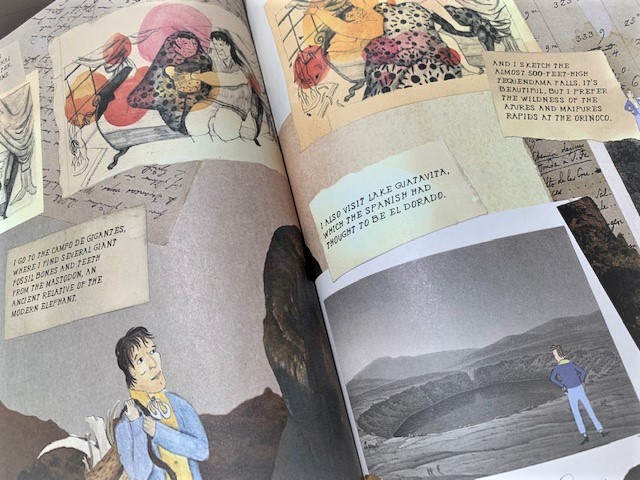
The book is an over-sized hardback, printed on quality paper. It's a joy to hold and Melcher's collages are glorious. She used many of Humboldt's maps, engravings and illustrations to create the backdrops. Letters, diary entries, notes and sketches, herbarium specimens are also superimposed into many of the pages. There's a lot to look at in these details. It was a great way to present some of the information.

But I struggled with the information font that capitalised EVERY SINGLE LETTER AND WORD. It felt like they were shouting at me the whole time. (Yes, I know that most graphic novels use capital letters, it's supposed to make it easier to read...when reading someone else's handwriting. But if you're using a typeprint, then surely there is no need for this standard?)

And I REALLY struggled with the portrait drawings of Humboldt, Bonpland and the other characters as well as the speech bubbles attached to them. They lacked substance. The figures were lifeless and expressionless. The dialogue was dull and failed to add anything to the story. In fact, the dialogue often repeated the information provided in the text. It was also often hard to know which speech bubble to read first. By the end of the book, I still couldn't remember which one was Humboldt and which one was Bonpland; their personalities never came alive.

Melcher's design was often quite striking but sadly, most of her watercolours and sketches left me cold. I preferred the pages with less stuff (i.e. less figures and more collage).


It was a grand idea to turn Humboldt's story into a graphic non-fiction, but sadly the final result was less than grand. Rookie mistakes, I suspect - 'How hard can it be to make a graphic book?' A lot harder than you might think.

The graphic novels I've read and loved over the years are the ones that make you feel something. They make connections; they go on an internal journey as well as the physical one. They make you forget that you're looking at 'cartoon' figures; they take on a life of their own. When they speak, they have something meaningful to say. Even the non-fiction ones.

Beautiful, arty graphics are possible - think Shaun Tan and Neil Gaiman - as well as most of the picture books I've featured on this blog. However it's a lot harder to get the synchronicity between the text/dialogue and the illustrations just right - a lot harder than most people think.

I admire Wulf & Melcher for their intent, but I wish they had taken more time to develop their graphic book technique.

If you really want to know about this amazing scientist who was way ahead of his time, then read Wulf's The Invention of Nature: The Adventures of Alexander von Humboldt, the Lost Hero of Science (2015). You won't be sorry.

Saturday, 23 November 2019

Trace Fossils by Alice Gorman


I plan to read Alice Gorman's Dr Space Junk vs the Universe (2019) in the very near future. Knowing I wouldn't have time to feature it during this year's #AusReadingMonth, I decided to search for any other examples of her essay writing instead, to give us all a taste of what's to come.

Trace Fossils: The Silence of Ediacara, the shadow of uranium popped in the Griffith Review 55: State of Hope | Jan 2017 - an edition dedicated entirely to South Australia. It also appeared on The Conversation: Friday essay | 3 Feb 2017.

I'm rather fascinated by the whole idea of space archaeology (the archaeology of orbital debris, terrestrial launch sites, and satellite tracking stations), which is the field that Gorman lectures in at Flinders University. However, she began her career working on Indigenous stone tool analysis and the Aboriginal use of bottle glass after European settlement, which is where this essay is coming from.

My first question was what are trace fossils? Gorman describes them as - the preserved impressions left by the passage of a living body through sediment.

Wikipedia expanded this by saying that they are impressions or other preserved signs of activity left by animals, plants, protists, and bacteria. These can be tubes, lines, scratches, or other features, like dinosaur footprints or shrimp burrows. They are created in soft sediments and have been found in rocks as far back as the Late Precambrian (2 billion to half a billion years ago).

Apparently South Australia, around the remote areas of Woomera and the Nullarbor Plain, have plenty of trace fossils on offer. This area was once covered by glaciers during various ice ages followed by seas as the glaciers retreated and the earth warmed up. Storm surges caused an influx of sediment that embedded fern fronds and other sea creatures. Segmented worms were squashed, curled up on the bottom of the sea bed.

As Gondwanaland was created these old sea beds were pushed up into mountain ranges.

Which brings us to the Ediacaran Period, a geological period I had never heard of before. It began 635 million years ago and ended 542 million years ago with the Cambrian explosion of animal life. It's a relatively 'new' period, only receiving official status in 2004. Ediacaran fossils were first discovered by Reg Sprigg in 1946 in the Ediacaran Hills, Flinders Ranges. They indicate the earliest forms of complex life on earth.

Now you know!
Gorman provides a very readable, easy to follow potted history of the area to current times. From giant megafauna and Aboriginal life, the arrival of colonists and cattle, the hunt for uranium, a rocket testing range to nuclear bomb testing.

Aboriginal people became a trace fossil in the land deemed empty – hidden in plain sight. Kokatha, Pitjantjatjara, Adnyamathanha and Barngarla people lived on missions around the state, and gathered in coastal towns that offered them the employment that the rocket range had promised but didn’t deliver.
 
At this time, white Australians thought Aboriginal occupation had been a few thousand years at most, and many believed Aboriginal people were dying out – the inevitable result of the “stone age” being superseded by the “space age”.

Visiting these areas devastated by livestock and human intervention is a sobering experience, yet Gorman is constantly fascinated by the small details, the junk, if you like, that is left behind. Whether it's a crushed fern fossil from a billion years ago, a twisted coke can in the sand or twisty ties left tied to a fence around a nuclear test site. They all tell a story.

Modern uses for this remote area of SA now include detention centres, farms for giant wind turbines and tourism.
the same apparent “emptiness” that brought rockets, nuclear tests and detention centres now attracts commercial interest in storing nuclear waste from other nations. It’s the end of a cycle that starts with the mining and export of Australian uranium. The redistribution of uranium is a very Anthropocene process, part of the dismantling and reassembling of the planet.

As a long-time fanatic of geology, archaeology, anthropology and evolutionary studies, this tantalising but brief glimpse into the life and times of the desert of South Australia has stirred some dormant microbes of excitement and intellectual stimulation within me.

It's funny (peculiar) how only last week I was considering my collection of fossil books as a possibility for the Non-fiction November | Be the Expert week. Ever since, I've had these vague stirrings of longing to reread the Leakey family bio and the various books on Pompeii, Troy, Charles Darwin, fossils and evolution that I have tucked away somewhere.

Curiously my current fiction read, The Garden of Fugitives by Ceridwen Dovey also has a Pompeian archaeology story strand. Finding Gorman's Trace Fossil essay was obviously meant to be.

If you can recommend any other books about archaeological digs, fossils or evolution, I would love to hear about them in the comments below.

Image source

Favourite Quote: deep time is always waiting to burst through the crusts of the surface.

Facts:

Monday, 7 October 2019

FranKissStein by Jeanette Winterson


I have spent a ridiculous amount of time wondering how best to write the title of this book - FRAN KISS STEIN like the cover, FRANKISSSTEIN like the title page of the book or Frankissstein like Goodreads.
FranKissStein appealed to me, but it's not a version I've spotted anywhere else.
Whatever you call it, though, Frankissstein: A Love Story was fascinating stuff.
  • I was never bored except in the company of others.

After reading McEwan's Machines Like Us earlier in the year, I was in the mindset to be thinking about AI, robots and what our future world might look like as technology takes hold or even takes over. It was very interesting to be able to compare and contrast two such prominent authors and their approaches to the topic and their different ways of weaving a story around it.
  • The timeless serenity of the past that we British do so well is an implanted memory - you could call it a fake memory...where the turbulence of the past is recast as landmark, as tradition, as what we defend, what we uphold....History is what you make it.

Last year I also read Shelley's Frankenstein and a bio about her and her mother (Romantic Outlaws). All of this gave my reading of Frankissstein a much richer experience as my knowledge of the original story and details about Shelley, and her mother's life, were still fresh in my mind.

Winterson weaves together several strands of story. We start with a reimagining of Shelley's time in Italy with her husband, Percy, her sister, Claire, Lord Byron and Dr Polidori where she first develops the idea for her story Frankenstein.
  • Percy - the mystery of life is on earth, not elsewhere.

We then jump to now, or perhaps a now just minutes away, where sex bots, AI, cryopreservation and cephalic isolation are becoming the norm. Our modern characters are called Dr Ry Shelley (a transgender doctor/journalist), Ron Lord (the sexbot king), Claire (the admin assistant who keeps popping up everywhere in different roles), Poly D (the Vanity Fair reporter) and Prof. Victor Stein (a TED talking scientist).
  • Victor - I want to live long enough to reach the future.

Later on, Winterson also brings in an alternate ending for the original story, with some time in the lunatic asylum, Bedlam. Frankenstein has been admitted by Captain Walton, after he found him floating by his ship on an ice floe. To make it even more interesting, the director of Bedlam, Mr Wakefield, then invites Mary Shelley to his facility to talk with the patient who claims he should have 'perished on the ice'. Love it!
  • Ry - I am what I am, but what I am is not one thing, not one gender. I live with doubleness....I am in the body that I prefer. But the past, my past, isn't subject to surgery. I didn't do it to distance myself from myself. I did it to get nearer to myself.

To round out the tale, we finish with a glimpse into the life of Ada Lovelace, Byron's mathematician daughter.
  • Ada - It was hoped that numbers would tame the Byronic blood in my veins....My life in numbers has been as wild as any life lived among words.

There are so many ideas to explore within these pages - gender, duality, consciousness, religion, soul, history, change and knowledge - just to name a few. What's real and what's false? Does history repeat itself? What's the difference between privacy and secrecy? Is history memory or fact? Are inventions dreams or machines? What does it mean to be alive? Can technology be bad or good, or is just the use it gets put to?
  • Byron - we are haunted by ourselves, he says, and that is enough for any man....The human race seeks its own death. We hasten towards what we fear most.

We also have books in books, with references to Albert Camus, Virginia Woolf, Margaret Atwood and Ovid.

Winterson's delicious imagery emerges from page one and draws you into the various strands of story, with a poetic, Romantic writing style for the 19th century sections morphing into a more jarring, rapid speak for the now.
  • every solid thing had dissolved into its watery equivalent.
  • We were all around the fire that night, the room more shadows than light, for we had few candles.
  • We update ourselves individually and generationally. We can adapt within a generation to a changing world.

Ultimately, I found Frankissstein to be the more satisfying, complex read. Machines Like Us failed to excite me or fully engage me in the discussion that McEwan was aiming to stimulate. Whereas Winterson stimulated me from start to finish. But, I've just realised, none of that really tells you why I enjoyed this story so.

The technical stuff obviously played its role, but the stuff I'm still thinking about two weeks later is all the discussion around gender, personality and who we really are.

What is it that really makes us human? From the stories well tell about ourselves to the way we chose to present ourselves to the world. It's an age-old process that flows over into the kind of future we end up creating for ourselves. We merge fact and fiction, dreams, beliefs and misconceptions, until we have something that makes us unique. Or does it?

Favourite Quote: Humans: so many good ideas. So many failed ideals.

Favourite Character: Ry Shelley, who seemed to inhabit quite a bit of Winterson's own persona, and certainly captured my own doubts and questioning way of viewing pretty much everything.

Favourite or Forget? Loved it. It would make for a great book group discussion.

Facts:
  • Longlisted for 2019 Man Booker Prize

Friday, 14 December 2018

Washington Black by Esi Edugyan

Reading Washington Black by Esi Edugyan was like eating a big bag of sweets. Some were good, some not so good. And after gorging myself on the first half, I found the second half a bit too much take.


The first half of Washington Black was unputdownable. I loved the engaging voice of the child narrator. His early life on the plantation was brutal yet fascinating. Edugyan included some strong, descriptive passages in these early chapters and I found the secondary characters just as intriguing.

Washington's fear and mistrust of everyone was more than understandable, but the constant tension built up by this fear with every change or arrival of a new character eventually lost it's impact by overuse. The tension was continually being built up but never quite realised....although perhaps, this is what it's like to live in a state of slavery in Washington's world.

For me the tale started to lose it's way when Wash and Titch took off to the Arctic in search of Titch's father. It reminded me of what happened when I read Elizabeth Gilbert's The Signature of All Things where 'something went a little off kilter'. I began to doubt my narrator, I became sceptical and even a little cynical. I became aware of the writer and felt manipulated at times. I was being asked to go on a journey that had lost its believability and maybe even lost its way.

Billed as a coming of age story or a life after slavery story, neither felt predominant to me. With such a strong start on the plantation, I expected to be taken on the struggle as Wash's came to terms with his newfound freedom. But I never got a strong sense of what life was really like for a freed slave in western 'civilisation' - the injustice, unfairness, the everyday prejudices, burdens and guilt. The existential angst wasn't fully realised.

And Wash's personal growth felt too much too soon - it was too big a jump from uneducated child slave to scientific, emotionally intelligent young man. The soaring heights of the first half floundered and crash landed.

Titch's emotional arc didn't make sense to me either. He had me right up to the point of  his disbelief/fear/hope/joy at being reunited with his father after thinking that he was dead. I was incredibly moved by this exchange. Titch obviously had his own struggle with personal freedom, yet his sudden disappearance was the first moment when I felt caught in the author's web.

There were a few tiny touches of surrealism or mysticism which were left unexplained and unresolved. They added a fable-like element to the story, and maybe that's were the problem lies. In the end I wasn't sure if this was an allegory or an historical fiction, adventure story. I felt like I was getting mixed messages by the end.

I will certainly read more books by Edugyan - when her writing soared, it dazzled and some of her minor characters were so well-drawn and vivid, that I was disappointed when the story moved on without them. Potential and possibility abounds.

Giller Prize winner
Man Booker shortlist
Longlisted for the 2020 International Dublin Literary Award.

Thursday, 22 February 2018

The Wonder Down Under by Nina Brochmann & Ellen Stokken Dahl

No, The Wonder Down Under is not a travel guide about Australia. It's full title is The Wonder Down Under: A User's Guide to the Vagina. And it was utterly fascinating and illuminating from start to finish.


Nina Brochmann & Ellen Stokken Dahl are medical students (probably fully fledged doctors by now) from Oslo who worked in the area of sexual health. They quickly realised that there were myths and misconceptions about pretty much every area of female genitalia and health. Their subsequent research revealed that they also had some of their own misconceptions to bust.

As a 50 year old woman, long interested and curious about her body, I have read widely on this topic over the years. Yet I learnt so much from this book, my head is still spinning!

My only disappointment is that Brochmann & Dahl stopped before peri-menopause. Trying to find accurate, up-to-date, easy to read information about this stage of female life is very challenging. Perhaps they will revise the next edition with a chapter or two on this long ignored, hidden side of female health?

So, what DID I learn?

I learnt that the female egg does not sit passively waiting inside the fallopian tube for the winning male sperm to come along. Just like with sperm, there are thousands of eggs released each month that compete to be the final contender for impregnation. It is usually the sperm left waiting at the mouth of the fallopian tube for the mature egg to make her grand appearance.

The clitoris is not a 'little button' but is in fact the same size as a penis, except it extends internally in the shape of a wishbone. The clitoris is but the tip of the iceberg! The infamous g-spot is most likely the internal extension of the clitoris being stimulated during vaginal sex.

Only about 15% of women have 'spontaneous' desire or a wish to have sex NOW. Many females experience 'responsive' desire instead which is dependant on touch.
one in three women has a responsive form of sexual desire. At the opposite end of the scale, there are the 15% who have the 'classic' spontaneous form of sexual desire, in which you feel desire for sex out of the blue. All the other women are somewhere in between the two. Now and then, they fancy having sex without quite understanding why, whereas other times, sex sounds like a bit of drag until they feel their body responding and their head slowly joins the party. Only a small group of around 5% lacks any desire for sex, whether spontaneous or responsive.

I also learnt that the hymen is an elastic ring or fold of skin rather than a mucus membrane, which they go on to discuss very thoroughly in the Youtube clip below.


This is a fabulous book for teens and young women everywhere. Along with all the facts and figures, they discuss hair removal, periods, pain, contraceptive options, sexually transmitted diseases, masturbation, sex and pregnancy. The book is practical, empowering and fun. Popular science at it's very, very best.

Regardless of your age or gender, you will learn something you didn't know before by the end of this book.

The Wonder Down Under will be published by Yellow Kite Books via Hachette in Australia on International Women's Day 2018. It's translated into English by Lucy Moffatt.

Tuesday, 26 September 2017

Stories & Shout-Outs #13


After taking a bit of a break from joining in things - to give myself time to get ready for AusReading Month in November (warm up post coming very soon) - a few bookish events, readalongs and readathons have now come along and caught my eye.

The fine folk in Canada recently celebrated Science Literacy Week. Their website had a great list of science books to browse - check it out. My wishlist just got in touch with its inner big bang theory and exploded!

Naomi @Consumed By Ink is also getting into the 2017 Giller Prize longlist which celebrates fine Canadian literature.

I've been eyeing off the 100 Day Project for a few years now, but I have never been able to come up with an original idea let alone being capable of actually sticking something out for a hundred whole days!

Kim @Sophisticated Dorkiness decided to tackle the challenge this year with 100 bookstagram reviews on instagram. She writes about her experience here. I really enjoyed watching and reading her 100 days - it was a huge achievement and very inspirational.

It's big excitement time for the upcoming October 21st Dewey Readathon. They're hosting a #30DaysofReadathon to get everyone in the mood. Post it, instagram it, tweet it - share the buzz!


There's a L.M. Montgomery The Blue Castle readalong with Consumed by Ink and Sarah Emsley coming up too. The idea is to read (or reread as the case may be) the book before November so that you can blog/tweet about it with Naomi & Sarah using #ReadingValancy.

I don't need much excuse to reread The Blue Castle, but their timing is impeccable. Because I cannot read The Blue Castle without revisiting it's Australian cousin, The Ladies of Missalonghi by Colleen McCullough...which is a perfect book for this year's #AusReadingMonth with it's Blue Mountains setting.

I do agree with Naomi though, The Blue Castle has never had a good cover. Mine is a shocker.


I spotted this fab post with an amazing infographic (below) from Global English Editing about World Books last night. They've listed the most iconic book set in 150 countries around the world. Their choices will no doubt garner much discussion and debate, but personally I am very happy to see Cloudstreet represent Australia and delighted to see Pride and Prejudice come out on top in the UK.

I would have preferred to see Huck Finn instead of Tom Sawyer for the US. Japan's Tale of the Genji is about the twenty-third time I've now been recommended this as a must read book before visiting Japan, so I guess I should look into that some more.

I also liked the mix of fiction, non-fiction, poetry and plays in this list. For anyone, like me, who likes to read books in or about the country they're visiting, or hoping to visit, this is the perfect way to scratch that itch!


During our recent time in Cuba, we stayed with a friend of a friend and her husband in their B&B in Trinidad. They were incredibly generous and welcoming hosts and we had a ball the two nights we stayed with them. Hurricane Irma has had a huge, but fortunately not drastic, effect on their home and garden, Casa Los Mangos.

Fiona writes about their experience of living through the storm here.

Today I learnt about the difference between a tiger snake and highland copperhead. Our neighbour thought this might have been a baby tiger snake thanks to the shape of its head. But after posting the pic on instagram, a snake handler came back to me with the correct identification.

This particular baby copperhead was spotted on the top step of our mountain getaway on the weekend. Baby or not, it scared the bejesus out of me!


I consider myself to be very lucky - nearly 50 years of age and this was my first up close and personal with a snake - a cute little, sleepy, sluggish baby snake at that! The best kind.

Wishing you all a reptile-free, rewarding reading and blogging week.

Thursday, 14 September 2017

The Vanishing Futurist by Charlotte Hobson

I found the The Vanishing Futurist to be a rather peculiar read.

I'm always fascinated by the Russian Revolution and this was a curious and different angle from which to view it. But it was rather weird reading a book that I wasn't completely sure if I was enjoying it or not. The cover by LaBoca, on the other hand, I adored every time I saw it!


I loved learning about Russian avant-garde art which I knew next to nothing about before. I also wasn't aware of the English governesses who travelled to Russia at the turn of the century and got caught up the revolutionary fervour of the times.

The disintegration of Russian society, the poverty, the hardships and how so many of them simply adapted to and accepted the massive changes was, as always, mind-boggling. And how quickly society, just with different faces in charge, reverted back to those who had stuff (including the power) and those who didn't. How idealism quickly turned to cynicism, hope became drudgery and freedom lost out to total control.

Less convincing was the love story between Gerty and Nikita, mostly because I wasn't sure that I liked either of them very much. It took me quite a while to work out all the people living in the IRT commune, I kept getting them mixed up - perhaps not enough character development to make them gel for me? The sudden jumps forward to modern day Gerty writing her memoirs for her daughter in England also felt a little contrived.

Alexander Rodchenko: Cpstume design for We, 1919-1920
© A. A. Bakhrushin State Central Theatre Museum

The Vanishing Futurist was shortlisted for this year's Walter Scott Prize. I had never heard about the Walter Scott Prize for Historical Fiction before, which I thought was a terrible crime, given my love of historical fiction.

I quickly learnt that it is,

Sponsored by Sir Walter Scott’s distant kinsmen the Duke and Duchess of Buccleuch, the Prize celebrates quality, and innovation of writing in the English language, and is open to books published in the previous year in the UK, Ireland or the Commonwealth. 
Reflecting the subtitle ‘Sixty Years Since’ of Scott’s most famous work Waverley, the majority of the storyline must have taken place at least 60 years ago.Honouring the achievements of the founding father of the historical novel, the Walter Scott Prize for Historical Fiction is one of the most prestigious literary prizes in the world. With a total value of over £30,000, it is unique for rewarding writing of exceptional quality which is set in the past. 
The Prize was founded in 2010, and is awarded at the Borders Book Festival in Melrose, Scotland, in June every year. The winner receives £25,000 and shortlisted authors each receive £1000.

and that this year's shortlist looked like this,


Jo Baker A Country Road, A Tree (Doubleday)

Sebastian Barry Days Without End (Faber)

Charlotte Hobson The Vanishing Futurist (Faber)

Hannah Kent The Good People (Picador Australia)

Francis Spufford Golden Hill (Faber)

Graham Swift Mothering Sunday (Scribner)

Rose Tremain The Gustav Sonata (Chatto & Windus)


What an amazing feast of historical fiction!
I have now created a page so that I can follow this award in the future (see pages tab on right hand side of this blog).

Vladimir Tatlin: Costume design for Life for the Tsaw, 1913-1915 © A. A. Bakhrushin State Central Theatre Museum

I'm glad I finished the book because I do love learning about new-to-me stuff.

The Russian avant-garde movement began around the 1890's under the Tsarist Empire and wound up by the 1930's (although these dates are often debated). It included Suprematism, Constructivism, Russian Futurism, Cubo-Futurism, Zaum and Neo-primitivism. 
The Russian avant-garde reached its 'creative and popular heights' during the 1917 Revolution, but eventually it clashed with the newly emerged ideals of Socialist Realism (which 'is characterized by the glorified depiction of communist values, such as the emancipation of the proletariat, by means of realistic imagery') Wikipedia

Anna Aslanyan summed up her review on The Vanishing Futurist in The Spectator with,
The disappearing act at the centre of the plot serves as a powerful metaphor for the demise of revolutionary art. The fate of the idealist inventor anticipates that of the Russian avant-garde, best described by Bruce Chatwin in his 1973 essay: ‘The Party did squash it. But it also died of fatigue.’

If this era intrigues you as much as it does me, you might like to check out these Russian avant-garde articles:


I can feel a new obsession percolating!

Anton Lavinskii, Battleship Potemkin, 1926

Thursday, 20 July 2017

Fantastically, Fearless, Rebel Women in Books

It would be nice to think that books were one of the places where equality of access and representation were available to both sexes, especially given that over half the authors of all books written are now women. Sadly, though, it is still not the case.

Reviews of books in leading newspapers and journals around the world still show that women lag behind men in pretty much every arena (VIDA 2015 Count). There was also the recent video showing a young girl and her mum pulling books out of their library bookshelf that featured male only protagonists (human or animal), books with shared male/female protagonists, books where the girls barely spoke or failed to participate in the action etc, until they were left with the handful of books featuring positive female protagonists.

Recently the Little People Big Dreams series hit the Australian market and showed that there is a huge market for stories about girls. Especially books about successful, resourceful, smart girls.

This year at work we have had three new books about women and girls that have gone ballistic. We've had trouble keeping up with the demand as the publishers scrambled to bring in more stock from overseas and reprint.

Fantastically Great Women Who Changed the World by Kate Pankhurst is a picture book for the 4+ age group.


Pankhurst (a descendent of the suffragette Emmeline Pankhurst) has compiled a book celebrating the life and achievements of 12 fantastic women.

Featuring Emmeline, Frida Kahlo, Coco Chanel, Gertrude Ederle (the Channel swimmer), Mary Anning, Mary Seacole (nurse), Agent Fifi, Sagagawea (translator and guide for Lewis and Clark), Rosa Parks, Anne Frank, Amelia Earhart, Jane Austen and Marie Curie, each double page spread is illustrated in a cartoon-like way with speech bubbles, maps, text boxes and loads of humour.


The book finishes with a 'Gallery of Greatness' full of inspirational girl power quotes and a challenge to its young readers about how they might, too, change the world.

For the older reader (12+), Rachel Ignotofsky has collated Women in Science: 50 Fearless Pioneers Who Changed the World. 

Beginning in 350 CE with Hypatia, an astronomer, mathematician and philosopher in Alexandria, she travels around the world to highlight women scientists throughout the ages.


Each woman's history is discussed, plus any obstacles that she may have had to overcome to do what she did. But the main focus is on their incredible accomplishments. 

Ignotofsky has also included pages of timelines, statistics on the gender gap in science and lab tools.


Ignotofsky has a new book coming out later this month called Women in Sports: 50 Fearless Athletes Who Played to Win. 

Like her science book it will feature famous, internationally renown women as well as lesser-known champions plus more stats on female participation in sport, pay and muscle anatomy.

I can't wait to see which group of women she tackles next.


Finally we come to the best-selling Good Night Stories for Rebel Girls by Elena Favilli and
Francesca Cavallo.

This is the book that has had the most attention and the biggest buzz. Aimed at the 9+ market, Favilli and Cavallo have indeed created 100 Tales of Extraordinary Women. 


Most of the bios begin with the 'once upon a time' tag and tell a fairly simplified, and dare I say, sanitised version of each woman's life. For example Anna Politkovskaya's page finishes with 
Anna continued to risk her life until she died, writing the truth in order to make the world a better place.

A quick wikipedia search reveals that she was in fact murdered in the elevator of her block of flats in 2006. She had also been held, beaten and tortured previously. Her murderers have never been brought to justice.

There is nothing wrong with making a story of someone's life - after all, we all do it with our own lives, in one way or another. Each bio is also only one page long. Only so much information can be included.


Favilli and Cavallo have clearly chosen to view all these women and their achievements through a positive, inspiring, feminist lens that is suitable for younger readers. They have avoided language that echoes those used by victims or martyrs.

And for anyone who, like me, feels that the story is too brief or too safe, they can always do a quick google to flesh out the details!

One of the big pluses about Rebel Girls are the generous full page portraits of each of the women. Sixty female artists from all round the world contributed illustrations for the book. They have used a wide variety of styles and media which makes the book a visual feast as well as being inspirational.


Goodnight Stories features a large number of modern day women who are still alive and still achieving great things. Which begs the question, what's next?

For starters, the authors are planning a second book of Rebel Girls, and as they did with the first book, they will be using Kickstarter crowd funding to do so.

The Big Dreams, Little People series published by Frances Lincoln, continues with three new releases
- Emmeline Pankhurst, Audrey Hepburn and Rosa Parks - due in the Australian market before Christmas.

My other favourite girl power picture books include:

The Paperbag Princess by Robert Munsch
Princess Smartypants by Babette Cole
Louise Builds a Boat by Louise Pfanner
Ada Twist Scientist by Andrea Beaty
The Princess in Black series by Shannon & Dean Hale

Saturday, 18 March 2017

The Case Against Fragrance by Kate Grenville

I didn't expect to read one of my Top Ten Tuesday Autumn Reads so quickly, but a curious reaction at work today prompted me to devour Kate Grenville's The Case Against Fragrance in one sitting.


I've known for quite some time now that certain garden chemicals, cleaning products as well as regular old dust particles can give me ghastly long-lasting sinus headaches.

But it took me longer - much, much longer to accept that some perfumes and fragrances also had a similar effect.

As a family we moved to soap free washing powders and body washes a number of years ago when one of the booklets developed eczema. The link between soap and skin problems seemed obvious.

However, because I didn't wear perfume very often, it took a long while for me to link my sudden migraines to scent. I blamed hormones, chocolate, red wine, cheese and work, but some non-scientific and sporadic testing over the past few years, has led me to finally believe that it's perfume. Not all types of fragrances though - perfume and some room air fresheners seem to be the main contenders. I'm fine with essential oils, incense, shampoos and hand lotions.

I usually cope fine if the scent is on someone else or in another room or if enough time (& air) have gone before me in an enclosed space.

Our recent holiday in Mexico was a case in point. The hotel we stayed at used a specially designed fragrance for their boutique rooms. If we came back to our room not long after the cleaner had been and we turned on the air-con, I ended up with a sinus headache. But if we stayed out all day and opened up the verandah doors when we did come back, I was fine.

When we checked out the hotel presented us with a small vial of their special room scent, so we could be transported back to Mexico with one whiff of their special spray!
The first time I sprayed it at home, I ended up with a headache and felt nauseous. Not the kind of holiday memory they intended I'm sure!

Today at work, one of my colleagues cleaned the bathroom with some regular supermarket purchased spray cleaner. I was a room away, but the outside doors were closed. Within minutes I felt ill and dizzy and completely overpowered by the scent. Opening the doors up and turning on the fans helped me feel better, but tonight I'm feeling all sinusy with a sore throat.

I've never had such an immediate reaction before.

Reading Grenville's book tonight seemed like the logical thing to do.

Grenville is not a scientist, but she has used her formidable research skills to present her case against fragrance. Early on she says that,
using fragrance is a choice,and my hope is that this book might give people the chance to make that choice an informed one.

She presents studies (among people who get migraines, around half get them from fragrance - pg24), lists signs and symptoms, defines terms, lays out the history of the use of scent and how scent is produced, reveals the various industry and government bodies who regulate the use of fragrances and chemicals as well as providing anecdotes about her experience with fragrance intolerance.

Did you know that 'when you smell something, it's because little bits of it have just gone up your nose'? Grenville goes on to explain how this actually occurs and why it can be beneficial for us.

Problems around trade secrets, loopholes in labelling, animal testing and industry based research and assessments are discussed. Lists of impossible sounding chemicals and some of their known side-effects are noted. Grenville devotes two chapters to the recent research around the indestructible nature of synthetic musks - how it has invaded our water sources, is stored in our bodies and affects our hormones (it was common to find musks in over ninety per cent of the people tested pg125).

She concludes with a discussion about recommended dosages,
How small is safe, how weak is safe and what the long-term effects might be, are questions no one yet has the answers to.

What to do? Grenville encourages us to consider creating low-scent work places and buying fragrance-free products (if you can only afford one alternative product, spending a little extra on laundry powder is one of the best ways to make life safer for you and your family pg168).

Have you ever had a reaction to the fragrances and scents in perfumes, cleaning products or air fresheners?

I wonder how many people have been suffering in silence, not knowing what the problem was? Or how many people have had a milder reaction to fragrances and therefore haven't made the link?

Thursday, 13 October 2016

The Invention of Nature by Andrea Wulf

The Invention of Nature: The Adventures of Alexander Von Humboldt The Lost Hero of Science has been on my radar ever since it first came out in 2015.

But it was our forthcoming trip to Cuba that brought it front and centre. There is a national park near Baracoa, in eastern Cuba that is named after Humboldt that we hope to visit. I wanted to know what on earth Humboldt was doing in Cuba.

It turned out that Humboldt was an extraordinary scientific adventurer who had a profound and lasting effect on the way we view the world, nature and the place of humans to this day.

In her prologue, Wulf mentioned that
the irony is that Humboldt's views have become so self-evident that we have largely forgotten the man behind them.

Her book set out to reveal the forgotten man, follow the web of his influence as well as remind us of all that he achieved during his lifetime.

The chapters that detailed his influence on men like Simon Bolivar, Charles Darwin, Henry David Thoreau, Ernst Haeckle, George Perkins Marsh and John Muir felt like an intrusion at first.
I didn't feel that we needed these bio's within a bio, but as each one wore on, I found myself caught up in what these men also achieved and how far-reaching Humboldt's influence actually was.

Below are some of the basic facts about Humboldt's life, with a few of his observations and theories that I gleaned from this very accessible, easy to read and enjoyable homage.
  • Born in the same year as Napoleon
  • Older brother, Wilhelm
  • Father died when he was nine.
  • 'formal, cold and emotionally distant' mother (pg 13)
  • privileged but unhappy childhood.

  • invented isotherms.
  • 'He came up with the idea of vegetation and climate zones that snake across the globe'. (pg5)
  • more place names are named after him than anyone else.
  • in 1869, huge world wide public celebrations occurred in honour of his centenary birthday.
  • First job was as a mining inspector. He became interested in the working conditions of the miners and invented a breathing mask and a lamp that would work in the 'deepest oxygen-poor shafts'. (pg 21)
  • 'Comparison became Humboldt's primary means of understanding nature.' (pg 32)
  • Good friends with Goethe - 'That something of Humboldt was in Goethe's Faust - or something of Faust in Humboldt - was obvious to many.' (pg 37)

  • June 1799 sailed to South America on board Pizarro, a Spanish frigate, with Aime Bonpland, a French scientist as his companion.
  • Slave market at Cumana made 'Humboldt a life-long abolitionist'. (pg 53)
  • Nov 1799 experienced first earthquake.
  • (pg 54) 'memories and emotional responses...would always form a part of man's experience and understanding of nature.'
  • 7th Feb 1800 set off to explore the Orinoco.
  • Travelled via Lake Valencia where locals told him that the lake was rapidly disappearing 'he concluded that the clearing of the surrounding forests, as well as the diversion of water for irrigation, had caused the falling water level.' (pg 57) 
  • 'The action of humankind across the globe, he warned, could affect future generations.' (pg 58)
  • 'Humboldt did not regard the indigenous people as barbaric....In fact, he talked about the 'barbarism of civilised man' when he saw how the local people were treated by colonists and missionaries.' (pg 71)

  • Dec 1800 arrived in Havana, Cuba.
  • March 1801 sailed to Cartagena. Planned to 'cross, climb and investigate the Andes' as they trekked towards Lima.
  • Climbed Chimborazo, then thought to be the highest mountain in the world.
  • 'He saw the earth as one great living organism where everything was connected, conceiving a bold new vision of nature that still influences the way that we understand the natural world.' (pg2)
  • Produced his first sketch of the Naturgemalde - a visual representation of the different zones of plants in relation to climate, location, altitude.
  • discovered the magnetic equator.

  • Spent 1803 in Mexico.
  • March 1804 sailed to the US via Cuba.
  • 'Monoculture and cash crops did not create a happy society'.  'All problems in the colonies, he was certain, were the result of the 'imprudent activities of the Europeans.' (pg 150)

  • August 1804 arrived back in Paris.
  • April 1805 Rome.
  • November 1805 Berlin.
  • Wrote the Essays on the Geography of Plants - first ecology book - discussed global patterns, continental shift.
  • Published Views of Nature - 'poetic vignettes' about the web of life (pg 132)
  • Nov 1807 returned to Paris.
  • Published his four volume Political Essays on the Kingdom of New Spain between 1808-1811.

  • 1829 travelled to Russia and the Siberian steppes, 'following the border that separated Russia from China' (pg 210).
  • Created the 'Magnetic Crusade' to measure magnetic variations across the globe. In three years his magnetic stations collected nearly two million observations.

  • In 1834 he started work on Cosmos: A Sketch of the Physical Description of the Universe (published in 1845).
  • 'As science moved away from nature into laboratories and universities, separating itself off into distinct disciplines, Humboldt created a work that brought together all that professional science was trying to keep apart.' (pg 235)
  • Second volume published in 1847. 
  • Third in 1850.
  • 'Humboldt had become the most famous scientist of his age, not just in Europe but across the world.' (pg 273)

  • Fourth volume of Cosmos published in 1856.
  • Fifth in 1859.
  • Two days after he sent the manuscript to the publishers, he collapsed. He died two weeks later at age 89.

  • Humboldt's ideas 'seeped into the poems of Walt Whitman and the novels of Jules Verne.' (pg 282) 
  • Also Aldous Huxley, Ezra Pound, Gabriel Garcia Marquez and the paintings of Frederic Edwin Church.


Humboldt was friends with, sponsored or mentored almost every well-known scientist that was alive during his lifetime. He was courted by presidents, royal families and artists. He wrote thousands of letter every year and read thousands more.

Wulf's biography has been thoughtfully arranged, with a few gorgeous coloured plates, extensive notes (at the back of the book where they don't clutter up the narrative) and an inspiring bibliography.

One of Humboldt's strengths was his ability to make science and the wonder of nature accessible to everyone. Wulf has replicated this strength in her award winning biography.

Along with 'Humboldt's disciples, and their disciples in turn, (Wulf has) carried his legacy forward.' (pg 336)

Winner of the 2015 Costa Biography award and Winner of the 2016 Royal Society Science Book Prize.

Wednesday, 15 June 2016

Phasmid by Rohan Cleave and Coral Tulloch

When I see titles like this on the CBCA Eve Pownall list I always do a little inward groan.

After all, why would I want to read a book about stick insects?

But then I actually take the time to read them and I'm blown away by the amazing natural world around us and the people who choose to work in these areas.

Phasmid: Saving the Lord Howe Island Stick Insect is one of those unbelievable but true stories about a near extinct insect brought back from the brink by a group of passionate, dedicated scientists.

The story is easy to read and surprisingly engaging. We follow the phasmid through its life cycle and life on Lord Howe Island. We learn about the arrival of rats via the early settlers' boats - a fast breeding predator of the phasmid that had wiped it out completely by 1930.


That is, until....a small group of scientists were climbing nearby Balls Pyramid in 2001 and discovered a small colony of phasmids at home in the crevices of the rock face. At this point there were less than 30 phasmids left in the wild.

This is the part I love the most.

Over the next 15 years this small group of devoted scientists created a program at Melbourne Zoo to breed the phasmids in captivity. This involved all night observations to learn what exactly the phasmid needed to survive and grow.

They now have over 12 000 nymphs and their program is famous around the world. They have had visits from Jane Goodall and Sir David Attenborough and, as of Feb 2016, they have eggs hatching at San Diego Zoo. Called 'insurance populations', off shore breeding helps to ensure the survival of the phasmid - more eggs have also been shipped to Bristol Zoo in the U.K. and Toronto Zoo in Canada.


The final four pages of the book contains stacks of interesting detailed information about the phasmids and the breeding program. 

Plans are underway to eradicate all the rats and mice from Lord Howe Island in the hope of establishing a phasmid community back on the island in the future.

Author, Rohan Cleave is an invertebrate keeper at Melbourne Zoo. He hopes that by highlighting the plight of one small animal at risk, he can get children interested in and concerned about the well being of all wildlife.

Illustrator Coral Tulloch, who won the CBCA Eve Pownall award with Alison Lester for their book, One Small Island, once again creates beautiful water colour landscapes as well as up close looks at the phasmid.

Produced by the CSIRO, Phasmid is a fascinating, hopeful look at environmental issues for young readers.

My CBCA shortlist post is here.