The Best Short Stories (first published in 1997 by Wordsworth Editions) contains 17 such examples. My 2011 reprint is rounded out with a rather dry Introduction by Cedric Watts, who informs us that Maupassant's tales 'dealt predominantly with the provincial bourgeoisie, urban employees and civil servants.'

For the past three years, I've been reading a handful of these stories at a time to coincide with Paris in July. This year, I decided it was time to be finished with them. Not because I haven't been enjoying them, but three years is long enough for a book to by taking up space on my bedside table.
I wanted to take my time with each story and not rush from one to the next. I've made that mistake in the past with short story anthologies, and as a result I have no recollection of many of them. I decided to make brief notes on each story. I also gathered together some points about the short story format to help me with my notes. I've now learnt about anecdotal stories, fables, frame stories, sketches and vignettes. Plus the various permutations of the,
- epical short story - realistic, withholding part of the narrative for a revelation with a decisive ending and universal insight.
- lyrical - open ended stories with a central recurring image or symbol.
- artifice - a literary conceit using metaphoric devices and incongruity.
Furthermore, I discovered the scathing Works of Guy de Maupassant by Leo Tolstoy* published in 1894. Tolstoy, the master of the backhanded compliment, declared
I could not help but see, in spite of the indecent and insignificant subject of the story, that the author possessed what is called talent.
2019:
- Madame Husson's 'Rosier' (1888) is a classic frame story whereby our weary train traveller, Aubertin finds himself stranded in Gisors, until he suddenly remembers an old school chum, now Dr Marambot, who is practising in Gisors. Over dinner, Marambot relates another 'amusing story' to Aubertin about why the 'proud people of Gisors' call all drunkards Madame Husson's 'Rosier'.
Both men feel superior to the other, one with city vs country airs and the other with his comfortable life, wealth and status. I also loved the little nod to Jane Austen when the good doctor says, 'A little town, in fact, is like a large one. The incidents and amusements are less varied, but one makes more of them; one has fewer acquaintances, but one meets them more frequently.' I could hear Mrs Bennet's strident tone complaining/boasting to Mr Darcy throughout this piece!
The morality tale that follows suggests that these country acquaintances are ridiculous and even dangerous, in their self-importance and that virtue is a fallacy.
- That Pig of a Morin (1882) is another frame story about morality and virtue. In, what could only be described as a #metoo moment these days, a beautiful young woman is accosted by a strange man (Morin) on a train. He sees her smiling beauty as an invitation to try it on. Fortunately the guards believe her and Morin is arrested.
Two local men, taking pity on Morin, visit the young woman's guardian to try and sort the matter before it goes to court. They are invited to stay the night. The young woman is reasonable but unflinching and replies to the suggestion that Morin's act was excusable given how beautiful she was, with a resounding, 'between the desire and the act...there is room for respect.'
However, she then allows herself to be seduced by the handsome young man under her guardian's roof later that night. They both enjoy a night of tender passion, that has no dastardly consequence or repercussions, as the end note shows us. From this we can learn that educated, handsome, charming men can have their way with beautiful women if only they approach matters in the right way!
- Useless Beauty (1890) is my kind of short story. Punchy, with great psychological twists and turns and two characters that feel real. It's also an incredible modern story, with hints of domestic abuse, emotional blackmail and 'secret, unknowable troubles.'
She said, "You loved your children as victories....They were victories over me, over my youth, over my beauty, over my charms, over the compliments which were paid me and over those that were whispered around me without being paid to me personally."
He said, "But you belong to me; I am your master - your master - I can exact from you what I like and when I like - and I have the law on my side."
My favourite in this collection so far.
- The Olive Orchard, Le Champ d'Oliviers (1890) is another strong contender for favourite due to its disturbing build up of tension. One could almost see a Hitchcock movie unfolding in front of one's eyes as our sturdy, active abbé is confronted by his past in the form of a desperate, dangerous young man claiming to be his son.
I find these longer form vignettes the most satisfying. Maupassant takes the time to build up the characters, divulge background information, then surprise us with a twist, a revelation or a shock ending. I'm never quite sure what his universal meaning is or which direction his moral compass was pointing to though. Tolstoy judged that he had no"knowledge of the difference between good and evil, he loved and represented what it was not right to love and represent, and did not love and did not represent what he ought to have loved and represented." Which may be a bit harsh. And probably reflects Tolstoy's discomfort with Maupassant's lack of religious feeling more than anything else.
Moral ambiguity is another modern story telling trait that Maupassant was showing off, which is fine, I don't need need to have all my stories tied up with a neat bow. But I do like my short stories to have a sense of the ending, or an emotional truth that the reader can connect to or empathise with. This is one of the stories where Maupassant gets the mix of nuance, complexity and "the contradictions of life"* just right.
- A Deal aka A Sale, À vendre (1885)
This is where I do agree with Tolstoy wholehearted. Maupassant's depiction of peasant life is one dimensional and without sympathy.
The insufficient comprehension of the lives and interests of the working classes, and the representation of the men from those classes in the form of half-animals, which are moved only by sensuality, malice, and greed, forms one of the chief and most important defects of the majority of the modern French authors, among them Maupassant.
This mean spirited anecdote, about a man selling his wife to his neighbour, is meant to be amusing. It's not. Holding up those less fortunate and less educated than you to ridicule only demeans you.
- Love: being pages from a sportsman's notebook This is Maupassant giving us the gift of his attention. Beautiful passages describing the marshes and the intense cold felt on a youthful hunting expedition, reveal his ability to write a nature story with heart.
"the water of marshes, in which their throbs all the unknown life of birds, beasts and fishes. A marsh is a world of its own upon this earth of ours, a different world, with its own habits, its fixed populations, and its people who come and go, its voices, its sounds, and, essentially, its mystery."
"It was freezing hard enough to split stones."
- Two Little Soldiers (1885) is another brief tale of love. Two homesick soldiers find a rural retreat that reminds them of home. From the privacy of their retreat they have the pleasure every Sunday of watching a lovely young milkmaid walk by them to milk her cow. Eventually they strike up a shy friendship with her until one of the soldiers, slightly bolder than the other, meets up with her on separate occasions. When the other soldier find out he is "unmanned...motionless, bewildered and grieving...He wanted to weep, to run away, to hide somewhere, never to be seen again."
Repressed emotions, jealousy, unrequited love - three of Maupassant's signature themes.
- Happiness (1884) is the final story in this collection and once again returns to the theme of love wrapped up as a frame story. I've decided I'm not a big fan of the frame story. I find them too contrived. The relevance or connection between the original, or the set up, and the framed story is often tenuous at best, but in this rather tender tale, it works better than most. The transition between a dinner party in a villa overlooking the Mediterranean where everyone is discussing love, to suddenly seeing Corsica looming up on the horizon "no longer hidden by the sea-mists" is smooth. Which then reminds one of the gentleman of "an admirable example of constant love, of love which was quite marvellously happy" set in Corsica.

I've enjoyed my slow, leisurely read of this short story collection. It has allowed me to read with purpose and to commit each one to my memory far more than any other short story collection I've ever read before. I find that just looking at the titles of the ones I read two years ago (below) is enough to bring much of the detail of the story to mind. Given how much has happened to me in that time, and how many other stories have crossed my path, that level of recall is quite miraculous.
I cannot say that I will always read short stories with such considered appreciation, but this has shown me that by doing so, I can gain a far deeper understanding of the author's style and technique. And that my reading experience can be richer and longer lasting than the few short pages of writing first suggests.
2018:
2017:
- 1-3. Boule de Suif (Dumpling), Deux Amis (Two Friends), La Maison Tellier (Madame Tellier Establishment)
- 4. Mademoiselle Fifi
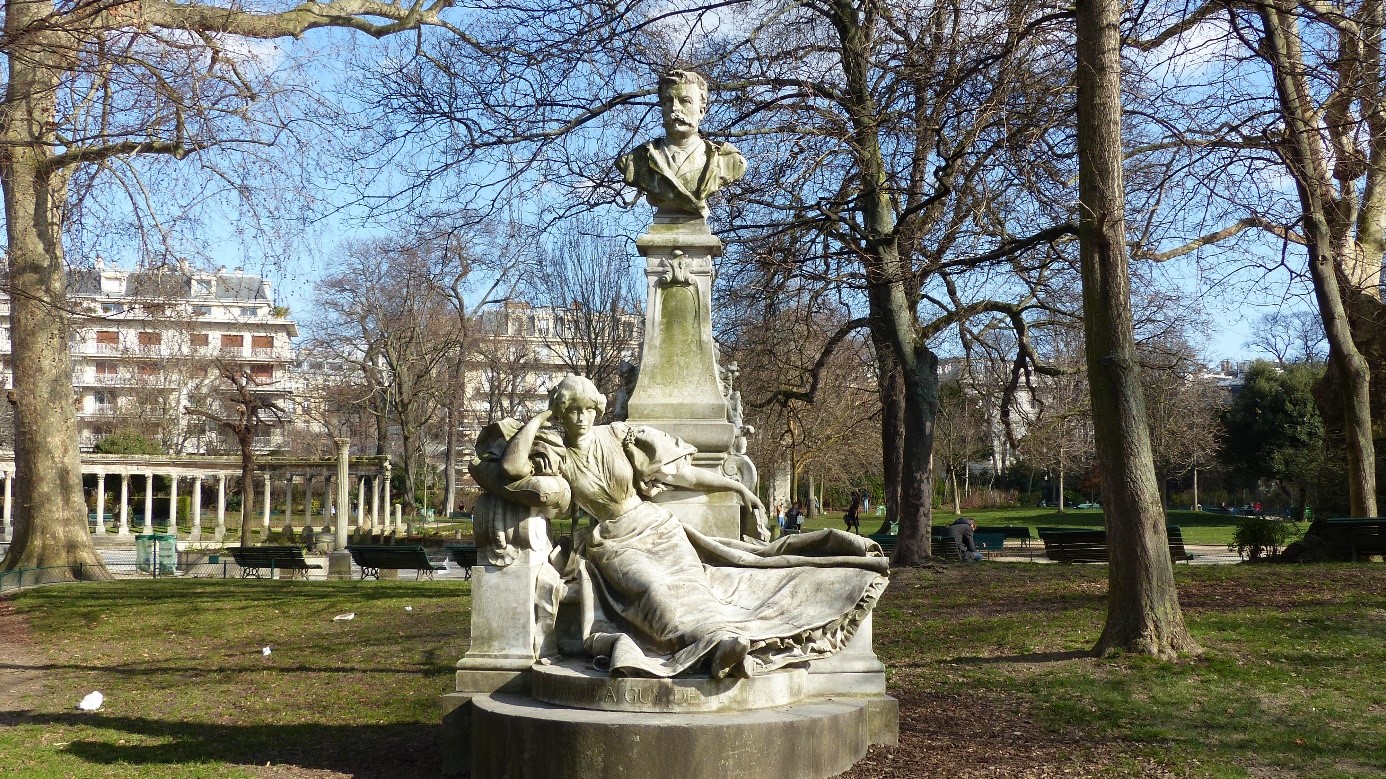 |
| Monument to Guy de Maupassant in Parc Monceau. |
Book 15 #20 Books of
Sydney 19℃
Dublin 23℃


