Showing posts with label French. Show all posts

Saturday, 22 August 2020

The Plague | Albert Camus #ReadtheNobels


What does one read during a pandemic that has changed the way we all live our lives? 

The Plague (La Peste) by Albert Camus of course! 

This existentialist (or absurdist, depending on who you talk to) classic from 1947 presents us with the day to day changes that occurred in a small city in Algeria when the plague suddenly turned up out of the blue.

The French Algerian town of Oran experienced real life plague events in 1556, 1678 as well as three lesser outbreaks in the early 1900's. Camus wrote his fictional version of The Plague during and after WWII. Since then many have drawn parallels between the coming of the plague in his book and the Nazi's. I'll leave that for students of English and Philosophy to mull over, but for today, this review will focus more on the parallels between what we're all experiencing now with Covid-19 and what the imaginary characters of this real town experienced during their fictional plague.

But first a little reminder about the definition of existentialist literature. 

Existentialism is all about the experience of the individual - the thinking, feeling, acting, living human being - as they navigate an absurd, meaningless world with a sense of confusion, angst, anxiety and disorientation. It is the individuals responsibility to make sense of the world, not society or religion.

While Absurdism is the conflict between the human tendency to seek some kind of inherent value and meaning in life with our inability to actually find any in a purposeless, meaningless, chaotic and irrational universe! Camus was an Absurdist and believed we should live a life rich in 'purposeful experience' in spite of the 'psychological tension of the Absurd'.

The fictional plague in Oran began with the sighting of one dead rat by Dr Bernard Rieux on the 16th April. It was considered to be 'odd' by the doctor and 'a practical joke' by the concierge. The next day there were three dead rats. The doctor was now 'intrigued' while the concierge hung around the doorstep waiting to catch the 'jokers'. However on his rounds, the doctor realised that the dead rats were everywhere and that 'the whole district was talking about the rats.' Most people agreed that it was 'peculiar, but it will pass.'

By the next day the papers had picked up the story and the authorities started to talk about 'emergencies measures.'

In the population, some people complained, some were disconcerted, some felt threatened or anxious. People began to accuse the authorities of inaction and others escaped town completely. Rumours spread along with a sense of foreboding. 'Surprise gradually gave way to panic.'

Mistaken ideas had to be readjusted as new information about the rats and the plague were learnt the hard way...with people dying. Old habits and daily routines had to change and fear set in. 

Dr Rieux was keen to prepare and take precautions, whilst the authorities tried not to upset public opinion. However, hygiene posters popped up around town, gas was injected into the sewers to kill the rats and the water supply was strictly supervised. Hospital wards were 'suitably equipped' and relatives of patients were urged to get tested.

Some people began to suggest the whole thing was exaggerated and refused to change their ways. Trams were still packed and the theatres and restaurants were full each night as many chose to defy the odds and thought that somehow the plague would not affect them.

As things worsened, the ports were closed and guards were set on the town gates. The people blamed the authorities and prioritised 'their personal concerns.' Discussions raged about whether everyone was actually dying of the plague or of other causes instead or even whether this number of deaths was within the normal range for the month.

A sense of unreality crept in. Some bewailed their fate, while others 'accepted with good humour'. Monotony and indifference became factors as the 'dreary struggle between the happiness of each individual and the abstractions of the plague' set in.

Summer arrived and the heat served only to exaggerate the fear and anxiety. 'The plague sun extinguished all colours and drove away all joy.' Yet for some 'a sort of crazed excitement, an uneasy freedom' bubbled up, sending them out into the streets, craving pleasure and company, despite the risks.

A vaccination was talked about, with very few understanding the 'industrial quantities' that would be required to actually inoculate the general population. 

Our good doctor believed that most people were more often good than bad and that the main vice was ignorance, especially 'ignorance that thinks it knows everything.
There were no longer any individual destinies, but a collective history that was the plague, and feelings shared by all.

As more people became sick and died, exhaustion and indifference set in. People began to neglect the good hygiene practices of before and mass burials became the norm. Irrational superstitions and old prophecies and predictions emerged. At this point, Camus, via his characters went into a lengthy discussion about the nature of good and evil, the meaning of life and death and the lessons that could be learnt from history, yet never seem to be learnt.

As the course and nature of the plague changed, ebbed and flowed and eventaully eased, people reacted with a curious mix of excitement and depression. The uncertainty was the hardest thing to live with, yet saved up reserves of hope were always close to the surface. People began to wonder what life would be look like after the plague. Would it return to 'normal'? What had been changed irrevocably?

'The plague would leave its mark, at least on people's hearts.'

'All that a man could win in the game of plague and life was knowledge and memory.'

Camus leaves the ending open. Deliberately, I suspect. 
We don't get to see the end of the plague in Oran, yet reading this 70 years later, we know that this fictional plague and all the earlier historical plagues did in fact, eventually disappear. So much so, that when another one appears in 2020, we have no knowledge or memory to help us work out what to do! 

It's like each generation has to learn everything anew all over again, ad nauseam, instead of learning from history. One gets a sense that every generation thinks it is somehow immune, separate, different or special compared to any previous generations and that there is nothing that those older times could possibly teach us now. Our refusal to not see the repeating patterns of history is nothing but wilful ignorance. 

I'm only part of the way into Absurdism with Camus, as I believe it IS possible to find some meaning in the chaos if you only pay attention to the history.

Facts:
  • Born 7th November 1913 in French Algeria
  • Died 4th January 1960 
  • Was living in Paris when the Germans invaded during WWII. 
  • Unable to join the army due to his earlier tuberculosis diagnosis, so fled to Lyon, then Oran with his wife, where they taught in the local primary school.
  • On medical advice he moved to the French Alps to help his tuberculosis. Started writing La Peste.
  • In 1943 returned to Paris and joined the French Resistance. 
  • Became friends with Jean-Paul Sartre. 
  • Greatly influenced by Simone Weil. He saw her writings as an antidote to nihilism.
  • Camus wrote in cycles - each cycle being a novel, an essay and a play. 
    • The first cycle, Sysyphus was about the absurd (L'Étranger, Le Mythe de Sysiphe, and Caligula). 
    • The second cycle, Prometheus, was revolt (La Peste (The Plague), L'Homme révolté (The Rebel), and Les Justes (The Just Assassins) 
    • The third cycle was love, Nemesis (Le Premier homme (The First Man)
  • My Popular Penguin Classic was translated by Robin Buss.
  • Introduction by Tony Judt.
  • Camus was awarded the Nobel Prize for Literature in 1957.
  • He asks: Is it possible for humans to act in an ethical and meaningful manner, in a silent universe?
  • In his notebooks, Camus suggested that the book ‘may be read in three different ways’:
    • It is at the same time a tale about an epidemic; a symbol of Nazi occupation (and incidentally the prefiguration of any totalitarian regime, no matter where), and thirdly, the concrete illustration of a metaphysical problem, that of evil.

Favourite Quotes:
  • There have been as many plagues in the worlds as there have been wars, yet plagues and wars always find people equally unprepared.
  • "This rotten bastard of a disease! Even those who don'y have it, carry it in their hearts."
  • "What is true of the ills of this world is also true of the plague. It may serve to make some people great. However, when you see the suffering and the pain that it brings, you have to be mad, blind or a coward to resign yourself to the plague."
  • "I have decided to reject everything that, directly or indirectly, makes people die or justifies others in making them die."
  • He knew what those jubilant crowds did not know but could have learned from books: that the plague bacillus never dies or disappears for good; that it can lie dormant for years and years in furniture and linen-chests; that it bides its time in bedrooms, cellars, trunks, and bookshelves; and that perhaps the day would come when, for the bane and the enlightening of men, it would rouse up its rats again and send them forth to die in a happy city.
Book 9 of 20 Books of Summer Winter

Wednesday, 5 August 2020

A Little Paris in July in the Kitchen

To finish off another wonderful year of Paris in July with Tamara @Thyme For Tea, I'm going to tempt you with a few of the Parisian style means I enjoyed through July.

My favourite local cafe is called Cafe d'Yvoire. They specialise in French cakes, desserts and meals. Mostly I just enjoy my morning coffee with my latest read on my days off work. But this year has been different. Covid-19 has changed many things and one of the big things has been the pressure on small businesses to stay viable during lockdowns and social distancing restrictions. 

During the height of lockdown, I continued to get my morning coffee as a takeaway, purchased through the window. For family lockdown Saturday night dinners, I would also take home various desserts for us to try. I fell in love with the salted caramel cheesecake (below), while Mr Books is a traditional lemon meringue tart man, and B19 was happy with anything chocolate-y.

Once we were allowed to dine in again, I found myself still eating the desserts, this time with my morning coffee and book! I had to increase the distance of my morning walk to justify the change!


I may have also treated myself to their magnificent Croque Madame once or twice during July as well!


It wasn't all just eating out and takeaway though.

For Mother's Day the boys gave me a book set called Art of French Cuisine. I will need more time and patience to tackle the sweet book, but the savoury book gave me lots to work with. 

With some roast beef one night, I made the Gratin Dauphinois with Haricots verts aux tomates cerises. The Gratin in particular was a HUGE hit.


A couple of weeks later I tried Julia Child's Suprêmes de Volaille aux Champignons from her Mastering the Art of French Cooking Volume One

The rich, creamy sauce was a little too much for B19, but I fell in love big time. So much so, I'm going to include a version of the recipe below. I highly recommend it.

Trying to follow one of Julia child's recipes can be a trying experience. She liked to skip back and forth between the master recipe and the one you're trying to actually cook! Finding an online version that has been collated and tidied up is much easier to use. This is one of those, with my little tweeks.

Ingredients:
  • suprêmes - chicken breasts (I cut the chicken into quarters & adjusted cooking time slightly to allow for the smaller pieces, I didn't want to have to eat a whole chicken breast on my own.)
  • 1 teaspoon fresh lemon juice
  • pinch of white pepper
  • 5 Tablespoons butter
  • 120 grams white mushrooms, sliced
  • 2 Tablespoons shallots, diced
  • ⅛ teaspoon salt
  • Sauce:
  • ¼ cup chicken of beef stock
  • ¼ cup dry vermouth
  • 1 cup of whipping cream
  • salt/pepper to taste
  • 2 tablespoons fresh parsley, chopped
Instructions:
  • Rub the chicken breasts with drops of lemon juice and season with salt & white pepper.
  • Heat the butter in a heavy, oven-proof casserole until it is foaming.
  • Stir in the minced shallots and saute for a minute - do not wait to brown.
  • Stir in the mushrooms and saute lightly for 1-2 minutes - do not wait to brown.
  • Sprinkle with salt.
  • Quickly flip the chicken breasts in the butter mixture. 
  • Cover and cook over medium high heat for 8-10 minutes.
  • After that time, flip chicken breasts and cook on opposite side for another 8-10 minutes until chicken temperature reaches at least 165 degrees.
  • Remove the chicken to a warm plate (leave mushrooms/onions in the pot) and cover while making the sauce.
  • To make sauce, pour the chicken/beef stock and vermouth in with the cooking butter and mushrooms/onions.
  • Over medium high heat, boil down quickly until liquid is syrupy.
  • Stir in cream and boil down again over medium high heat until cream has thickened slightly. 
  • Off heat, taste for seasoning, and add drops of lemon juice to taste.
  • Pour the sauce over the chicken, sprinkle with parsley and serve immediately.


Bon appetit!

Monday, 3 August 2020

Maigret and the Killer | Georges Simenon #ParisinJuly


A big part of the reason I love reading Maigret's so much is the glimpse into life in Paris in the middle of the 20th century. Maigret and the Killer opens with Mrs Maigret and her man, dining out with friends discussing the merits of the Madame Pardon's 'unparalleled boeuf bourguignon...filling, yet refined', provincial cookery that was 'born of necessity', whilst finishing off the meal with the obligatory 'coffee and calvados'.

This is the 70th book in the series and the year is 1969. The setting is Quai d'Anjou - the home of the young man killed in the first chapter. His parents are the wealthy owners of a cosmetic company. A stroll around the Quai d'Anjou is definitely on the cards if I ever return to Paris in real life!


As always, time with Maigret is easy. He may be getting stressed out by the details of the crime, but all the reader has to do is simply sit back and enjoy the ride. It's a pleasure watching how Maigret works to solve the case. It's a joy to walk the streets of Paris with him and I never get tired of watching him eat. Whether its a golden tench baked in the oven, or 'rilletes made locally, coq au vin blanc and, after goat's cheese, rum babas' washed down with a little after dinner cognac, Maigret looks forward to each and every meal.

And I look forward to each and every Maigret.

Facts
  • This Penguin edition was published 2019.
  • Originally titled Maigret et le tueur. 
  • Translated by Shaun Whiteside.

Book 6 of 20 Books of Summer Winter

Thursday, 30 April 2020

The Conquest of Plassans | Émile Zola #FRAclassic


La Conquête de Plassans, or The Conquest of Plassans (1874) is the fourth novel in Émile Zola's twenty-volume Rougon-Macquart series that I have been reading with Fanda for #Zoladdiction. My Oxford World's Classics 2014 edition is translated by Helen Constantine and has an Introduction by *Patrick McGuinness. He reminded me that,
Like all of Zola's fiction, (The Conquest of Plassans) is also a novel of human truth told with drama, symbolism, lyricism, and imaginative power.

It's set between 1858 and 1864, straight after the events in the very first book, The Fortune of the Rougons. The central drama follows the political machinations of the Catholic Church and the Second Empire against the disaffected rural provinces. A topic, I confess I knew very little about. Even Wikipedia acknowledges the difficulty for modern readers with this now little-known historical period.
Although the novel does assume in its readers a degree of familiarity with the battle between clerical political interests and governmental influence in the provincial towns of the Second Empire - knowledge which Zola's contemporary readers would certainly have taken for granted, but which seems obscure and almost arcane now - its strength lies not in its politics but in its human drama. On the face of it this could have been a relatively dull series of political observations, but instead by the end it is almost a melodrama, such is the anticlerical fury which Zola instils in his work.
To help me get my head around all the French Empires and Republics, I created my own little timeline below.
  • Kingdom of France 987 - 1872
  • First Republic 1872 - 1804 
    • Napoléon Bonaparte
  • First Empire 1804 - 1815 
    • Napoléon I
  • Bourbon Restoration 1815 - 1830 
    • Louis XVIII (1814-1824) 
    • Charles X (1824-1830)
  • July Monarchy 1830 - 1848
    • Louis Philippe I
  • Second Republic 1848 - 1852 
    • President Louis-Napoléon Bonaparte
  • Second French Empire 1852 - 1870 
    • Napoleon III
  • Third Republic 1870 - 1940 
  • Vichy Government 1940 - 1944 
    • Philippe Pétain
  • Provisional Government of the French Republic 1944 - 1946 
    • Charles de Gaulle
  • Fourth Republic 1946 - 1958
  • Fifth Republic 1958 - present
Plassans is now in the hands of the Rougon family as we saw in the first book. They are Bonapartists. The bloody nature of his succession, with all it's betrayals and double-dealing, left a bad taste in the mouth of the locals. As this story begins in 1858, the Legitimists (or Royalists) have political favour.

Abbé Faujas', the new man in town (and surely the epitome of literary stranger danger), has his own self-interests at heart. As does Félicité Rougon, the matriarch of the family and the unofficial ruler of Plassans. She may appear to be helping him, but Bonapartist or not, if he gets in her way, she will do everything in her power to come out on top. Félicité is clearly in it for the long game.

Faujas has been enlisted, by a shadowy group of Bonapartists in Paris, to bring Plassans to heel. Le Petit Napoleon was not popular in the countryside after the violent 1851 coup d état although every effort was made to turn this opinion around. The Catholic Church and it's priests are shown here, to be as political, ambitious and lusting for power as the next man. Zola shines a light on religious hypocrisy and power plays and reveals the toxic mix of small town gossip and self-serving intrigues.

It's a heady mix of dastardly deeds, hysteria and madness.

The cover illustration, The Orange Trees, or The Artists Brother in His Garden, 1878 by Gustave Caillebotte is a very appropriate choice given the amount of time our characters spend in the back garden. 

The story begins with Mouret enjoying his garden of Eden-style space, pottering around in his vegetable and herb garden, picking fruit. It's a safe haven for his children to play in. On either side are two opposing political families - on the right are the rich Rastoil's with a pretentious English-style garden and on the left, the family of the sub-prefect, Péqueur des Saulaies with a carpet of rolling grass and a pond. The Rastoil's are Legitimists and the sub-prefect and his friends are 'bigwigs of the Empire.' Mouret is probably a Republican (like Zola), but prefers not to get caught up in the politicking.

Abbé Faujas, our very own snake in the grass, is very interested in what's happening in both gardens.

The Artist's Garden at Vétheuil | Claude Monet | 1881

As Faujas' influence grows, he uses the intermediary garden to bring together the two different groups. As he spends more time in the garden, Mouret spends less and less, isolating himself in his room instead. The addition of Faujas' sister and brother-in-law, Trouche, hasten the disintegration of Mouret's family life...and his mind. Slugs not only attack his lettuces but his peace of mind. And when Trouche takes over the garden, pulling up all the vegetables and fruit trees to create a vulgar flower show, we see this as sign of Mouret's fall from grace.

It is symbolic, and rather satisfying, that Mouret uses remnants of this showy garden as a catalyst for his last dramatic and fiery act. The garden of Eden becomes an apocalyptic fire of Hell. A Zola-esque form of purification has occurred on this troubled site.

Faujas was deliberately created by Zola to be misogynistic. Early on he says to Marthe, Mouret's wife and cousin, (she is a descendant of the legitimate Rougon line, while Mouret is part of the less than salubrious Macquart branch of the family) "you are like all women, even the noblest causes are ruined when they get hold of them."

Yet Marthe succumbs to religious fanaticism anyway, although it's often hard to tell if her fervour is for God or for Faujas. As she becomes more caught up in her religiosity, her family life suffers. The house falls into disrepair, domestic duties are ignored and eventually all her children leave or are farmed out to others.

The Mouret's decaying marriage is also another example of Zola's fixation on genetic dysfunction. This is not a genetically healthy family and when two cousins from the two different branches come together, it is sure to be disastrous. The youngest Mouret daughter is feeble-minded, but that's not enough for Zola. He throws a rat into this seemingly happy existence, to see what these characters will do.

And what they do, is unravel, rather magnificently into madness and illness. Imperfection or flaws are not enough for Zola. Natural determinism is what he is really exploring, and whether or not an individual can rise above their genetic makeup. Zola clearly believes they can't. Even though, he draws the Mouret family sympathetically (the Simpsons of the Second Empire!) they are doomed to suffer the same fate as the rest of the extended family.

The Conquest of Plassans could have been a dry novel about politics and religion, instead Zola created a gripping, fascinating insight into a period of time long gone. That time may be long gone, but our world is still suffering from the same kinds of intrigues and machinations. Except now it is faith-based initiatives being used to drive government policy across the globe, supposedly in the name of God, but really just about power and money.

Zola wrote about his time in history, but his books are now considered classics because they can still have the power to speak to us, 150 years later.

Monday, 2 September 2019

The Count of Monte Cristo by Alexandre Dumas

The Count of Monte Cristo by Alexandre Dumas was read for yet another successful readalong hosted by Nick @One Catholic Life. I know that readalongs are not for everyone, but I love them for a few, very good reasons.
  1. They motivate me to read a book (usually a classic) that has been languishing on my TBR pile for far too long. Given that my day job encourages me to read contemporary books, reading my much loved classics is a bit of an indulgence at this point in my life. A well-timed readalong, makes me work out a way to fit it into my schedule though.
  2. I love the social nature of a readalong. Most start off in a flurry of twitter activity & posting before settling down into a slower but steadier pace, especially the longer readalongs, which have become my personal preference.
  3. Readalongs encourage me to delve into a book and its author, in far greater detail than I normally would.
  4. The shared knowledge and constant support of a readalong can keep me going when my enthusiasm flags or we hit a tricky patch.
  5. These long range classic readalongs tap very nicely into my slow reading philosophy. Most of the contemporary stories I jump into, are read quickly, before moving onto the next. I also tend to read several books at once. Having a much anticipated classic book that can travel with me leisurely for several months feels like a luxury of the highest degree. 


So, how did I go with this particular readalong?

After bailing halfway through the previous readalong of Don Quixote, I felt determined to not let another classic defeat me. The sense of relief I felt as I quickly realised that this story was much more accessible than Don Quixote was huge. Here was an incredible, melodramatic story full of adventure, twist and turns, that was going to grab my attention and drag me all the way through to the end in a froth of excitement, disbelief and suspense. Given the original serialisation of this story, reading a chapter at a time, allowed me to experience some of the anticipation that the reading public must have felt in 1844. The urge to read ahead onto the next dramatic scene was strong...and I confess, irresistible at times.

I loved this story of intrigue and derring-do. Memory and the act of remembering where strong features. I also appreciated that Dumas did not wrap everything up in a neat tidy bow at the end. Lessons were learnt, people changed and every decision had consequences. But he left us with hope, 'wait and hope'.

Edmond Dantès story is all about justice, punishment, revenge and mercy. It has everything. From wronged imprisonment, lost love, unexpected friendships, nail-biting escapes, sudden wealth, revenge, kidnapping, manipulation, slavery, regret, arranged marriages, murder, second chances, loyalty, deception, revelations, benevolence, forgiveness and lesbians. Dantès original plan to seek revenge on the four men who plotted to imprison him, naturally had unexpected consequences, not only on the four men, but their families and on Dantès himself. Revenge is not sweet, but bittersweet.

The trickiest thing for me to get right with this particular story was the names. People changed their names, remarried and intermarried at a rate of knots. Dantès was also a master of disguise with multiple aliases. I especially struggled to remember who were the four original 'bad guys' who were responsible for getting Edmond arrested in the first place.

Image source
The political elements within the novel intrigued me. Reading so many Zola's in recent times as well as reading Les Misérables last year has given me some appreciation of French revolutionary history. But trying to get my head around the Second Empire and the Second Republic still confuses me. It was obviously also a difficult subject for Dumas and his family.

His father Thomas-Alexandre Dumas Davy de la Pailleterie was born on Haiti in 1762 to a French nobleman, the Marquis Alexandre Antoine Davy de la Pailleterie and Marie-Cessette Dumas, a slave woman of African descent. Thomas-Alexandre was taken to Paris by his father in 1776 to be educated. According to wikipedia, his father sold Marie-Cessette and their three other children before arranging to take Thomas-Alexandre with him to France!

When his father remarried, Thomas-Alexandre decided to take his mother's surname as his own. His son, Alexandre also chose to use Dumas throughout his writing career. Despite their personal successes and aristocratic heritage, both men faced discrimination and racial slurs. Alexandre is famously quoted as saying to someone who insulted him about his African ancestry,

My father was a mulatto, my grandfather was a Negro, and my great-grandfather a monkey. You see, Sir, my family starts where yours ends.

Thomas-Alexandre entered the army as a private, at age 24, eventually rising to a position during Napoleon's revolutionary army as,
one of the highest-ranking men of African descent ever in a European army. He was the first person of colour in the French military to become brigadier general, the first to become divisional general, and the first to become general-in-chief of a French army. (wikipedia)

Thomas-Alexandre was married in 1792 to Marie-Louise Élisabeth Labouret from Villers-Cotterêts. They had three children - two daughters Marie-Alexandrine (born 10th September 1794) and Louise-Alexandrine (born January or February 1796, died 1797) and a son, Alexandre Dumas (24th July 1802 – 5th December 1870).

Dumas and Napoleon had a falling out when he criticised Bonaparte for invading Egypt, questioning his leadership skills. He asked to sail home early. On the way his ship was sunk and Dumas was imprisoned in Naples. Bonaparte apparently did very little to help and Dumas was eventually released nearly two years later, malnourished, impoverished and physically broken. Bonaparte ignored all his requests for a military pension and he died five years later. Alexandre was only three years old.

Despite the later amity between Bonaparte and Dumas, it was fairly clear that he held republican beliefs throughout his career.

Alexandre Dumas circa 1832

Alexandre Dumas married in 1840 actress Ida Ferrier but he then followed the custom of many French gentlemen of that time by having numerous affairs (up to 40, so the story goes!) and multiple children with various women including;
  • Alexandre Dumas, fils (1824–1895), son of Marie-Laure-Catherine Labay (1794–1868). He became a successful novelist and playwright.
  • Marie-Alexandrine Dumas (5 March 1831 – 1878), the daughter of Belle Krelsamer (1803–1875).
  • Micaëlla-Clélie-Josepha-Élisabeth Cordier (born 1860), the daughter of Emélie Cordier.
  • Henry Bauer, the son of a woman whose surname was Bauer.

Young Alexandre started work with Louis-Philippe, Duke of Orléans where he began writing articles and plays. In 1830 he participated in the revolution that deposed Charles X to replace him with Louis-Phillipe, the Citizen King. When King Louis-Phillipe was then ousted by Louis-Napoleon Bonaparte, Dumas fled to Belgium in 1851. Around 1859 he moved to Russia for two years where the French speaking elite welcomed him and where his writing was hugely popular. In 1861 he moved to Italy for three years to participate in the movement for Italian unification. He eventually returned to Paris in 1864.
He died 5th December 1870.
  • The Count of Monte Cristo was originally published in the Journal des Débats in eighteen parts. Serialization ran from 28 August 1844 to 15 January 1846. The first edition in book form was published in Paris by Pétion in 18 volumes with the first two issued in 1844 and the remaining sixteen in 1845.
  • Dumas used a collaborating ghost writer, Auguste Maquet, who was responsible for suggesting plot outlines.
  • The story was probably based on the real life events of a shoemaker from Nimes, Pierre Picaud.
  • My 2012 Coralie Bickford-Smith designed Penguin Classics edition was originally translated into English by Robin Buss in 1996. According to wikipedia,
Buss' translation updated the language, making the text more accessible to modern readers, and restored content that was modified in the 1846 translation because of Victorian English social restrictions (for example, references to Eugénie's lesbian traits and behaviour) to reflect Dumas' original version.

A huge thank you to Nick for hosting another fabulous readalong and for all my fellow readalongers who have tweeted, commented and generally been friendly and supportive throughout our time together. Tackling these chunkster classics in such fine company is a huge part of why I continue to join in despite personal time pressures, work commitments and new release overload.
I can't wait to see what Nick has in store for us next year!

Book 22 of 20 Books of Summer Winter.

Sunday, 28 July 2019

The Best Short Stories by Guy de Maupassant

Guy de Maupassant (1850-1893) wrote nearly 300 short stories during his life. They were uneven at times yet distinct in style. Full of irony, deception, narrative drama, arguments & quarrels. De Maupassant was also a naturalist with a tendency to lean towards the bleaker side of real life. The Guardian says that he considered life to be "brutal, incoherent, disjointed, full of inexplicable, illogical and contradictory disasters".

The Best Short Stories (first published in 1997 by Wordsworth Editions) contains 17 such examples. My 2011 reprint is rounded out with a rather dry Introduction by Cedric Watts, who informs us that Maupassant's tales 'dealt predominantly with the provincial bourgeoisie, urban employees and civil servants.'


For the past three years, I've been reading a handful of these stories at a time to coincide with Paris in July. This year, I decided it was time to be finished with them. Not because I haven't been enjoying them, but three years is long enough for a book to by taking up space on my bedside table.

I wanted to take my time with each story and not rush from one to the next. I've made that mistake in the past with short story anthologies, and as a result I have no recollection of many of them. I decided to make brief notes on each story. I also gathered together some points about the short story format to help me with my notes. I've now learnt about anecdotal stories, fables, frame stories, sketches and vignettes. Plus the various permutations of the,

  1. epical short story - realistic, withholding part of the narrative for a revelation with a decisive ending and universal insight.
  2. lyrical - open ended stories with a central recurring image or symbol.
  3. artifice - a literary conceit using metaphoric devices and incongruity.

Furthermore, I discovered the scathing Works of Guy de Maupassant by Leo Tolstoy* published in 1894. Tolstoy, the master of the backhanded compliment, declared
I could not help but see, in spite of the indecent and insignificant subject of the story, that the author possessed what is called talent.

2019:


  • Madame Husson's 'Rosier' (1888) is a classic frame story whereby our weary train traveller, Aubertin finds himself stranded in Gisors, until he suddenly remembers an old school chum, now Dr Marambot, who is practising in Gisors. Over dinner, Marambot relates another 'amusing story' to Aubertin about why the 'proud people of Gisors' call all drunkards Madame Husson's 'Rosier'.
Both men feel superior to the other, one with city vs country airs and the other with his comfortable life, wealth and status. I also loved the little nod to Jane Austen when the good doctor says, 'A little town, in fact, is like a large one. The incidents and amusements are less varied, but one makes more of them; one has fewer acquaintances, but one meets them more frequently.' I could hear Mrs Bennet's strident tone complaining/boasting to Mr Darcy throughout this piece!
The morality tale that follows suggests that these country acquaintances are ridiculous and even dangerous, in their self-importance and that virtue is a fallacy.

  • That Pig of a Morin (1882) is another frame story about morality and virtue. In, what could only be described as a #metoo moment these days, a beautiful young woman is accosted by a strange man (Morin) on a train. He sees her smiling beauty as an invitation to try it on. Fortunately the guards believe her and Morin is arrested.
Two local men, taking pity on Morin, visit the young woman's guardian to try and sort the matter before it goes to court. They are invited to stay the night. The young woman is reasonable but unflinching and replies to the suggestion that Morin's act was excusable given how beautiful she was, with a resounding, 'between the desire and the act...there is room for respect.'
However, she then allows herself to be seduced by the handsome young man under her guardian's roof later that night. They both enjoy a night of tender passion, that has no dastardly consequence or repercussions, as the end note shows us. From this we can learn that educated, handsome, charming men can have their way with beautiful women if only they approach matters in the right way!

  • Useless Beauty (1890) is my kind of short story. Punchy, with great psychological twists and turns and two characters that feel real. It's also an incredible modern story, with hints of domestic abuse, emotional blackmail and 'secret, unknowable troubles.' 
She said, "You loved your children as victories....They were victories over me, over my youth, over my beauty, over my charms, over the compliments which were paid me and over those that were whispered around me without being paid to me personally."
He said, "But you belong to me; I am your master - your master - I can exact from you what I like and when I like - and I have the law on my side."
My favourite in this collection so far.

  • The Olive Orchard, Le Champ d'Oliviers (1890) is another strong contender for favourite due to its disturbing build up of tension. One could almost see a Hitchcock movie unfolding in front of one's eyes as our sturdy, active abbé is confronted by his past in the form of a desperate, dangerous young man claiming to be his son.
I find these longer form vignettes the most satisfying. Maupassant takes the time to build up the characters, divulge background information, then surprise us with a twist, a revelation or a shock ending. I'm never quite sure what his universal meaning is or which direction his moral compass was pointing to though. Tolstoy judged that he had no"knowledge of the difference between good and evil, he loved and represented what it was not right to love and represent, and did not love and did not represent what he ought to have loved and represented." Which may be a bit harsh. And probably reflects Tolstoy's discomfort with Maupassant's lack of religious feeling more than anything else.
Moral ambiguity is another modern story telling trait that Maupassant was showing off, which is fine, I don't need need to have all my stories tied up with a neat bow. But I do like my short stories to have a sense of the ending, or an emotional truth that the reader can connect to or empathise with. This is one of the stories where Maupassant gets the mix of nuance, complexity and "the contradictions of life"* just right.

  • A Deal aka A Sale, À vendre (1885)
This is where I do agree with Tolstoy wholehearted. Maupassant's depiction of peasant life is one dimensional and without sympathy.
The insufficient comprehension of the lives and interests of the working classes, and the representation of the men from those classes in the form of half-animals, which are moved only by sensuality, malice, and greed, forms one of the chief and most important defects of the majority of the modern French authors, among them Maupassant.
This mean spirited anecdote, about a man selling his wife to his neighbour, is meant to be amusing. It's not. Holding up those less fortunate and less educated than you to ridicule only demeans you.
 
  • Love: being pages from a sportsman's notebook This is Maupassant giving us the gift of his attention. Beautiful passages describing the marshes and the intense cold felt on a youthful hunting expedition, reveal his ability to write a nature story with heart.
"the water of marshes, in which their throbs all the unknown life of birds, beasts and fishes. A marsh is a world of its own upon this earth of ours, a different world, with its own habits, its fixed populations, and its people who come and go, its voices, its sounds, and, essentially, its mystery."
"It was freezing hard enough to split stones.
 
  • Two Little Soldiers (1885) is another brief tale of love. Two homesick soldiers find a rural retreat that reminds them of home. From the privacy of their retreat they have the pleasure every Sunday of watching a lovely young milkmaid walk by them to milk her cow. Eventually they strike up a shy friendship with her until one of the soldiers, slightly bolder than the other, meets up with her on separate occasions. When the other soldier find out he is "unmanned...motionless, bewildered and grieving...He wanted to weep, to run away, to hide somewhere, never to be seen again."
Repressed emotions, jealousy, unrequited love - three of Maupassant's signature themes.

  • Happiness (1884) is the final story in this collection and once again returns to the theme of love wrapped up as a frame story. I've decided I'm not a big fan of the frame story. I find them too contrived. The relevance or connection between the original, or the set up, and the framed story is often tenuous at best, but in this rather tender tale, it works better than most. The transition between a dinner party in a villa overlooking the Mediterranean where everyone is discussing love, to suddenly seeing Corsica looming up on the horizon "no longer hidden by the sea-mists" is smooth. Which then reminds one of the gentleman of "an admirable example of constant love, of love which was quite marvellously happy" set in Corsica.

I've enjoyed my slow, leisurely read of this short story collection. It has allowed me to read with purpose and to commit each one to my memory far more than any other short story collection I've ever read before. I find that just looking at the titles of the ones I read two years ago (below) is enough to bring much of the detail of the story to mind. Given how much has happened to me in that time, and how many other stories have crossed my path, that level of recall is quite miraculous.

I cannot say that I will always read short stories with such considered appreciation, but this has shown me that by doing so, I can gain a far deeper understanding of the author's style and technique. And that my reading experience can be richer and longer lasting than the few short pages of writing first suggests.

2018:


2017:

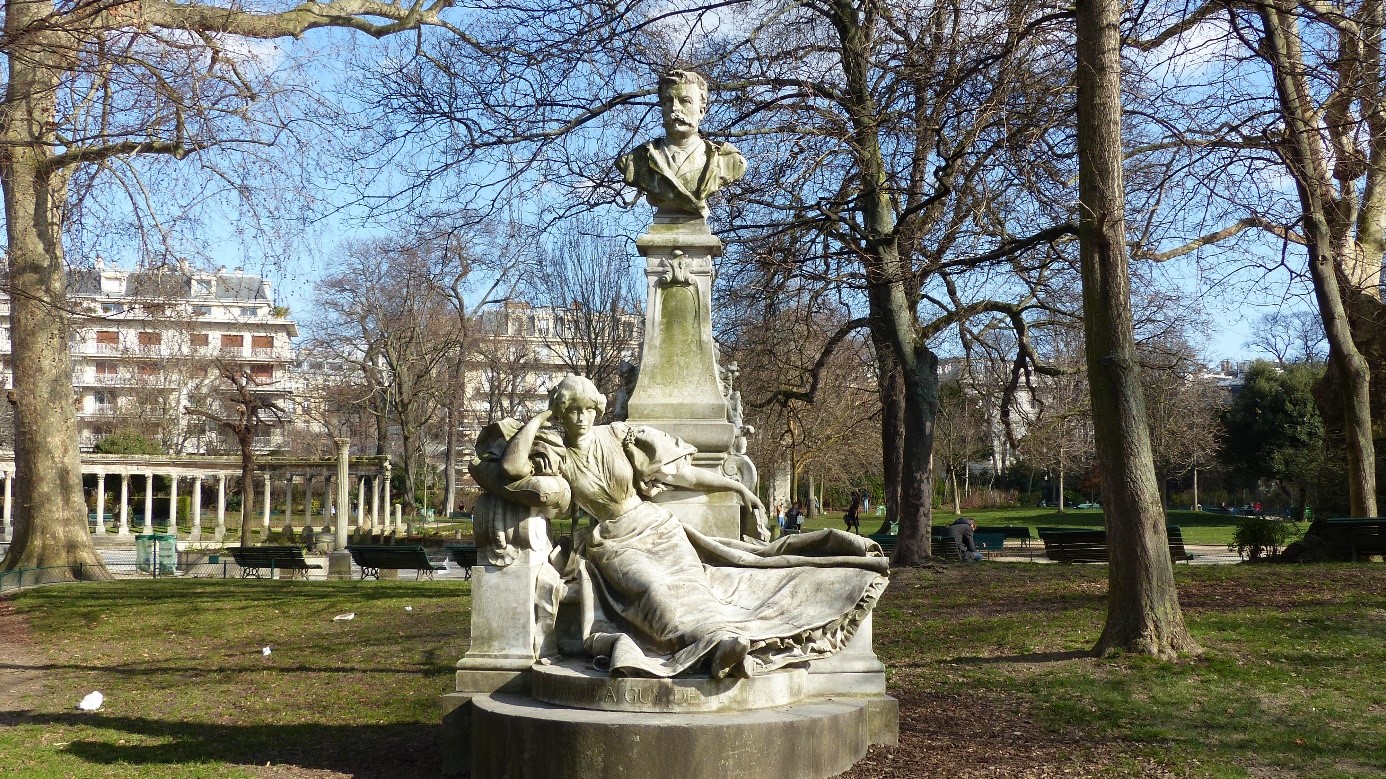
Monument to Guy de Maupassant in Parc Monceau.

Book 15 #20 Books of Summer Winter
Sydney 19℃
Dublin 23℃

Friday, 26 July 2019

Maigret and the Ghost #62 by Georges Simenon

Reading a Maigret or two during Paris in July has now become one of those things that I look forward to with a great deal of anticipation each year. Because of this though, I now associate Maigret with dreary, winter nights and rainy days (although not so much of the rain this year). My last two Maigret's, which were both set in Paris in high summer, had me all turned upside down and seasonally confused.

Fortunately Maigret and the Ghost takes us back to winter in Paris, and it feels like the seasons (if not the months) are back in sync for now.


This was mid-November and it had rained all day. Maigret hadn't left the stiflingly hot atmosphere of his office since eight o'clock the previous morning. Before crossing the courtyard, he turned up the collar of his overcoat.

I classify these crime stories as cosy, simply because even though people die we don't then have detailed forensic information or grisly crime scenes raked over by specialists using all sorts of forensic jargon. This type of gory story seems to dominate many of the modern crime stories, which is why I don't read (or watch) them. It's not my thing.

The Maigret's are pure detective story. The books are about the man, more than the crime. He is our hero that we come to admire, if not love, with each book. We get to know his techniques and his moods. The pleasure in reading comes from watching Maigret untangle the clues. His psychological methods and intuition become familiar and reliable.

In this case, we see Maigret, weary after coming off an all-nighter solving another unrelated crime, suddenly being informed of a shooting incident involving an inspector from a neighbouring precinct. Maigret quickly realises that his colleague was onto something big and that time is of the essence to stop another major criminal act from taking place. Art smuggling, forgeries, kidnapping and blackmail are the crimes with missing witnesses, nosy neighbours and deceptive suspects the spanners in the works.

It may be a little weird to say a crime novel was a lot of fun, but when Simenon gets it right, watching Maigret piece it all together is such a joy. This is one of the Maigret's where Simenon gets out of the way and lets Maigret do all the work instead.

Highly recommended.

Series:
  • 1. The Strange Case of Peter the Lett, The Case of Peter the Lett, Maigret and the Enigmatic Lett (1931)
  • 2. The Crime at Lock 14, Maigret Meets a Milord, Lock 14 (1931)
  • 3. The Death of Monsieur Gallet, Maigret Stonewalled (1931)
  • 4. The Crime of Inspector Maigret, Maigret and the Hundred Gibbets (1931)
  • 5. A Battle of Nerves, Maigret's War of Nerves, A Man's Head (1931)
  • 6. A Face for a Clue, Maigret and the Concarneau Murders, Maigret and the Yellow Dog, The Yellow Dog (1931)
  • 7. The Crossroad Murders, Maigret at the Crossroads (1931)
  • 8. A Crime in Holland, Maigret in Holland (1931)
  • 9. The Sailor's Rendezvous (1931)
  • 10. At the "Gai Moulin", Maigret at the "Gai Moulin" (1931)
  • 11. Guinguette by the Seine, Maigret and the Tavern by the Seine, The Bar on the Seine (1931)
  • 12. The Shadow in the Courtyard, Maigret Mystified (1932)
  • 13. Maigret and the Countess, The Saint-Fiacre Affair, Maigret Goes Home, Maigret on Home Ground (1932)
  • 14. The Flemish Shop, Maigret and the Flemish Shop (1932)
  • 15. Death of a Harbo(u)r Master, Maigret and the Death of a Harbor Master (1932)
  • 16. The Madman of Bergerac (1932)
  • 17. Liberty Bar, Maigret on the Riviera (1932)
  • 18. The Lock at Charenton (1933)
  • 19. Maigret Returns (1934)
  • 20. Maigret and the Hotel Majestic (1942)
  • 21. Maigret in Exile (1942)
  • 22. Maigret and the Spinster (1942)
  • 23. To Any Lengths, Signe Picpus, Maigret and the Fortuneteller (1944)
  • 24. Maigret and the Toy Village (1944)
  • 25. Maigret's Rival, Inspector Cadaver (1944)
  • 26. Maigret in Retirement (1947)
  • 27. Maigret in New York, Inspector Maigret in New York's Underworld, Maigret in New York's Underworld (1947)
  • 28. A Summer Holiday, No Vacation for Maigret, Maigret on Holiday (1948)
  • 29. Maigret's Dead Man, Maigret's Special Murder (1948)
  • 30. Maigret's First Case (1949)
  • 31. My Friend Maigret, The Methods of Maigret (1949)
  • 32. Maigret at the Coroner's (1949)
  • 33. Maigret and the Old Lady (1950)
  • 34. Madame Maigret's Own Case, Madame Maigret's Friend, The Friend of Madame Maigret (1950)
  • 35. Maigret's Memoirs (1951)
  • 36. Maigret and the Strangled Stripper, Maigret in Montmartre, Inspector Maigret and the Strangled Stripper (1951)
  • 37. Maigret Takes a Room, Maigret Rents a Room (1951)
  • 38. Inspector Maigret and the Burglar's Wife, Maigret and the Burglar's Wife (1951)
  • 39. Inspector Maigret and the Killers, Maigret and the Gangsters (1952)
  • 40. Maigret's Revolver (1952)
  • 41. Maigret and the Man on the Boulevard, Maigret and the Man on the Bench (1953)
  • 42. Maigret Afraid (1953)
  • 43. Maigret's Mistake (1953)
  • 44. Maigret Goes to School (1954)
  • 45. Inspector Maigret and the Dead Girl, Maigret and the Young Girl (1954)
  • 46. Maigret and the Minister, Maigret and the Calame Report (1955)
  • 47. Maigret and the Headless Corpse (1955)
  • 48. Maigret Sets a Trap (1955)
  • 49. Maigret's Failure (1956)
  • 50. Maigret's Little Joke, None of Maigret's Business (1957)
  • 51. Maigret and the Millionaires (1958)
  • 52. Maigret Has Scruples (1958)
  • 53. Maigret and the Reluctant Witnesses (1959)
  • 54. Maigret Has Doubts (1959)
  • 55. Maigret in Court (1960)
  • 56. Maigret in Society (1960)
  • 57. Maigret and the Lazy Burglar (1961)
  • 58. Maigret and the Black Sheep (1962)
  • 59. Maigret and the Saturday Caller (1962)
  • 60. Maigret and the Dosser, Maigret and the Bum (1963)
  • 61. Maigret Loses His Temper, Maigret's Anger (1963)
  • 62. Maigret and the Ghost, Maigret and the Apparition (1964)
  • 63. Maigret on the Defensive (1964)
  • 64. The Patience of Maigret, Maigret Bides His Time (1965)
  • 65. Maigret and the Nahour Case (1967)
  • 66. Maigret's Pickpocket (1967)
  • 67. Maigret Takes the Waters, Maigret in Vichy (1968)
  • 68. Maigret Hesitates (1968)
  • 69. Maigret's Boyhood Friend (1968)
  • 70. Maigret and the Killer (1969)
  • 71. Maigret and the Wine Merchant (1970)
  • 72. Maigret and the Madwoman (1970)
  • 73. Maigret and the Loner (1971)
  • 74. Maigret and the Flea, Maigret and the Informer (1971)
  • 75. Maigret and Monsieur Charles (1972)
  • A Maigret Christmas
Book 14 of 20 Books of Summer Winter
Sydney 19℃
Dublin 23℃

Wednesday, 24 July 2019

All Happy Families: A Memoir by Herve Le Tellier

All Happy Families wasn't the memoir I was hoping it would be. Le Tellier is upfront from the beginning, letting us know that he doesn't feel love for his parents. I was therefore expecting a heartfelt exploration into all the whys and wherefores of his troubled childhood. Instead, we simply got a recital of the family tree with some anecdotes about things that were said and done.


Don't get me wrong, Herve's family was pretty ghastly. His mother would now be diagnosed with a pretty major personality disorder and his step father with codependency. His biological father obviously spent the rest of his just being grateful that he got out. Herve had lots of very good reasons to distance himself from the family of his birth as soon as he could, but the problem was, he also kept us, the reader, at a distance.

Memoirs, these days, are expected to provide various psychological insights as well as catharsis for the author. One of the very best that I've read in recent times is, Nadja Spiegleman's I'm Supposed to Protect You From All This. Le Tellier's book has obviously been cathartic for him, but I didn't feel like I got to know him at all. His lack of curiosity about why his mother and other family members acted the way they did was, well, curious. This complete detachment was no doubt his survival technique, but I wanted him to draw this bow too and show us how he had embraced his life away from the parental home. How does one go on to develop empathy, caring kindness and healthy relationships when one has a childhood lacking in all of the above?

Le Tellier does state at the end that he doesn't 'know what it might mean to anyone other than me. But by putting into words to my story, I've understood that sometimes a child's only choice is to escape.'

I guess what I was hoping for was some insights into the lingering after effects of such an upbringing (there are always lingering after effects). The decisive breaks away from his childhood experience as well as the personal realisations that he must have made throughout his adult life would have been fascinating to read. Perhaps this is just the first step for Le Tellier in this process or maybe he's simply not as introspective as I am!

I also chose to read this book now thanks to Paris in July. Casual mentions of some antique furniture and a country house with references to French history and pop culture were interesting, but the place of origin was ultimately less significant than the family of origin.

Favourite or Forget: Knowing a less extreme version of Le Tellier's mother, made this book interesting, with my own personal insights coming from Le Tellier's example.

Facts:
  • Translated in 2019 by Adriana Hunter a British translator of over 60 French novels.
Book 13 of 20 Books of Summer Winter
Sydney 24℃
Dublin 20℃

Tuesday, 8 January 2019

Les Miserables by Victor Hugo

The End!

How on earth do I sum up in mere words such a magnificent, majestic, momentous story?! Les Miserables is a story full of pathos, compassion, extravagance and just a few flaws. Fortunately these flaws of logic and historical truth don't get in the way of Hugo's grander themes about love, redemption and sacrifice.

I struggled to accept Hugo's premise for the forward march of humankind with the promise of inevitable Progress towards some greater point. This belief, that all progress and evolution is good, was common among many writers, politicians and thinkers of the time, a belief which still infects many people today. However his ideas about the positive outcomes for universal education, suffrage and abolishing slavery felt spot on and admirable.


In his Introduction to my Penguin edition of the book, Norman Denny, explains that although
he was masterly in the construction of his novel, (Hugo) had little or no regard for the discipline of novel-writing. He was wholly unrestrained and unsparing of his reader. He had to say everything and more than everything; he was incapable of leaving anything out.

Which is a shame, because some basic editing would have made an easier journey of it, for this new-to-the-story reader in particular. I powered through the Waterloo diversion and enjoyed Valjean and Cosette's sojourn in the convent, but the soppy love story between Marius and Cosette and then the barricades nearly did me in!

The student uprising, with their youthful idealism, the creation of the barricades, the endless pontificating, the senseless waste of life that just kept going on, and on, and on, chapter after chapter. So much detail and importance assigned to a little remembered, little known footnote in history.

Although, perhaps that was Hugo's point.

All our lives are filled with moments significant and important to us, but of little consequence to future historians. Smaller moments within bigger historic periods, like the French Revolution and Empire, get swallowed up by time. Only the events that allow historians to draw a narrative line that suits their agenda get included (and we all have an agenda when it comes to creating the story of our lives, even historians).

It was only after finishing the book, that I went back and read the Introductions in all three books. In the Rose edition, Adam Thirwell has written a very thoughtful piece about Hugo's intentions for this epic book. He notes that,
What is relevant?....How can you know what fact will emerge, and destroy you?....We all live our lives so blissful in our ignorance of an infinity which could invade us at any moment....The true story is chance.
Hugo said that the poet's duty was to elevate political events to the dignity of historical events....he was interested in transforming politics into history, and rewriting history so that it included the unknown, the ignored, the forgotten....to show how far history is fiction.

Donougher also noted that Hugo believed that 'classicists wanted art to improve and idealise reality, while he insisted it should 'paint life', with its confusion of the good, the bad and the absurd.'

Hugo himself was a romantic, a liberal, a poet. He used his fame to promote his political views. He wrote a story that, according to David Bellos (The Novel of the Century) showed that 'moral progress is possible for all, in every social sphere' without reassuring us with a 'tale of the triumph of good over evil, but a demonstration of how hard it is to be good.'


Throughout the year I read/referred to three different translations of Les Miserables - the Denny, the Rose and the Donougher. I started the year with the Denny, so that ended up being the main one I stayed with the whole time. I developed a strong affection for it and the lovely hardcover design by Coralie Bickford-Smith. I really enjoyed his language choices. I found it easy to read and it flowed well. But Denny did edit and make changes to Hugo's work - he also put two whole chapters into an appendix at the back.

The other two versions became my comparison reads when I had the time or inclination.

I can safely say that the Rose version will not be staying with me beyond this readalong. I disliked many of the word choices she made, especially the modern colloquial that jarred within the pages of a book so obviously set within a specific time.

I really liked the Donougher though, when my copy finally arrived in February. The deckled edges tickled my fancy every time I picked it up and the soft cover book was much easier to travel with (for weekends away).

Next time I read Les Mis, this will be the version I will read the whole way through.

At various times throughout the year, I would get fixated on translation choices. I found this fabulous summary of ALL the Les Mis translations by R. Plunket from Scotland on his VERY extensive review about the book here.

Below are his abridged comments, from that review, about the various translations:

Now onto the translation. First a little bit of translation history. American Charles Wilbour was the first to translate the novel and his version was published by Carleton in 1862 just months after the novel was published in Brussels. The fact that Wilbour, at the age of just twenty nine, completed the translation so quickly is astounding. The translation is very close to Hugo's French and is highly regarded.... An abridged version of Wilbour's translation was released in the UK by Catto & Windus in 1874. The unabridged version was finally released in the country in 1890. 
The only downsides of Wilbour's translation are that it contained no footnotes and French verse parts were not translated. This was rectified in 1987 by an updated translation by Lee Fahnestock and Norman MacAfee, released by Signet. The vocabulary is more modern so the translation will appear more readable to someone who finds 19th Century texts difficult. This is the most common paperback version in the USA and has the musical logo on the cover. It is unabridged like the original Wilbour, has full place names instead of dashes (so you get Digne instead of D-, this was a revision Hugo himself made to the text in 1881) and French verse parts are translated into English in footnotes. 
Sir Frederic Charles Lascelles Wraxall's translation was the first to be released in the UK and appeared in 1862, just before the release of the last volume of Wilbour's translation in America. Wraxall's translation was the only one to pay copyright to the publishers. It was advertised as the most "literal" translation. It is abridged as it deliberately misses chapters and books (Wraxall gives his reasons for this in the preface). The text was even further abridged from the fourth edition onwards. The omitted parts were translated in the USA by J Blamire for the 1886 Deluxe Edition by Routledge and this same text was used for the 1938 Heritage Press release with illustrations from Lynn Ward. Little Brown also supplemented the Wraxall text in 1887. Later reprints by various publishers, such as Allison & Co, supplemented the text using Wilbour. Even with the supplementations, the Wraxall version is still very poorly regarded. Hugo himself even voiced his disapproval. 
The Wraxall translation was also heavily plagarised by others. The translation by William Walton et al. (actually a pseudonym of John Thomson of the Philadelphia Free Library), released in 1892 by the publisher G Barrie, borrows heavily from Wraxall.
Isobel F Hapgood's translation first appeared in 1887 and was published by Thomas Crowell. Hapgood's translation was generally very well regarded at the time, although some of the language used has become outdated. Hapgood's main defect is that she misses out the Cambronne section. This omission was restored by a handful of publishers in the early Twentieth Century including John Wannamaker, Dumont and Century Co. Crowell continued to publish a copyright version without the supplementation so it is clear that Hapgood did not approve of such additions....
 
The early years of the post war era was mainly filled with adaptations and abridgments of Wilbour's text (a famous abridgment by James K Robinson reduced Wilbour's text to under 400 pages). 
Norman Denny was the first person to offer a new translation in the Twentieth Century. This is the most common version available in the UK, released in 1976 by Folio Press (with bizarre illustrations) and by Penguin as a paperback in 1980. Highly readable but Denny takes great liberties with Hugo's text and a lot of material is omitted. Two sections are moved to the end of the book as appendixes. Penguin continues to print this but thankfully they have now released this superior translation by Christine Donougher. 
Finally in 2008 an unabridged translation by Julie Rose was released by The Modern Library in the US and Vintage in the UK. The main criticism of this translation is that the vocabulary is very modern and at times feels awkward. For instance Rose uses the term "slimy spook" to describe Javert in one section. I have never heard this term before and I cannot imagine it being a good translation of the French term Mouchard. I do respect Rose for translating such a difficult text. Her translation just didn't click with me. 
So now we come to the new translation by Christine Donougher. So why is this translation superior to the others? It is complete and unabridged, unlike Denny, Wraxall and Hapgood. It doesn't feel like the language has been dumbed down, unlike Rose. It has excellent notes and footnotes, unlike Wilbour and the updated versions of his text. The text flows well. I would say the closest translation to Donougher in terms of style is probably Hapgood. It is certainly as readable as say Denny.... 
In summary Christine Donougher's translation of Les Misérables is the best version available in English and I would advise all fans of the novel to buy it. Well done to Penguin for publishing this splendid edition.

Finally, a big thank you to Nick for keeping us on track and motivated (especially via twitter) all year. Slow reading my way through this monumental story was a magic way to do it, even if I didn't manage to maintain the schedule the whole year.

Final posts by host & some of the participants:


(please let me know below if I've missed your final post, so that I can add it in.)

My Les Mis posts throughout the year:


#lesmisreadalong

Tuesday, 13 November 2018

Non-Fiction November - Week 3

Week 3: (Nov. 12 to 16) – Be The Expert/Ask the Expert/Become the Expert (Julie @ JulzReads): Three ways to join in this week! You can either share three or more books on a single topic that you have read and can recommend (be the expert), you can put the call out for good nonfiction on a specific topic that you have been dying to read (ask the expert), or you can create your own list of books on a topic that you’d like to read (become the expert).


This year I've been reading Les Miserables by Victor Hugo one chapter at a time with Nick and his band of merry followers. The whole chapter a day thing hasn't always gone to plan - Les Mis in fits and starts would be a better description of my reading year!

I find myself constantly fascinated by this period of history - the various stages of the French Revolution, the wars with England and Spain, the art and writers from this time. I was one of the few readalong participants who enjoyed Hugo's two week diversion back in time to 'witness' Napoleon's defeat at Waterloo!

In the past I've read two of the four Max Gallo Napoleon books (but ran out of steam).


I have The Novel of the Century: The Extraordinary Adventure of Les Miserables by David Bellos by my bed to start very soon (I've waited until this close to the end in case there were any spoilers in it, which I believe there are!) so I'm hoping it will flesh out some of the history for me.

But I still get the Second Empire, Second Republic and Third Republic stuff all mixed up. Reading my way through Zola is helping with this, but I'd like to know more.

This is where I ask for your help.

Have you read any really good (non-fiction or fiction) about the French Revolution through to the Third Republic era?

Or perhaps something more general that brings that time (the mid 1700's through to the late 1800's) in Europe to light?

Help me become a French Revolution/Republic expert in the future.

2017 Be the Expert - Man's inhumanity to man/Holocaust literature.

Saturday, 1 September 2018

Les Mis Chapter-a-Day Readalong Update

Life has been a bit crazy again this year, and lots of my good intentions for this blogging life have been curtailed, postponed or in a state of constant catch-up. But the one thing that has kept me going, albeit in fits and starts, is my chapter-a-day read of Les Miserables with Nick and friends from @One Catholic Life.


My last Les Mis check in post was way, way back in early April, which is when my chapter-a-day approach took it's first battering.

We had a three week trip to Japan planned. I didn't want to take a chunkster in my luggage, I also prefer to read books set in the country I'm travelling in at the time, so Les Mis was never going to work for a trip to Japan. I decided to read ahead before leaving.

Over two nights I read about 25 chapters. It was exciting, I felt that the pace picked up and the story was getting very interesting again as we got to back the main action of the story (and away from one of Hugo's very lengthy diversions). I loved seeing Valjean and Cosette settling into a more peaceful life in Vol 3, Book 5, getting to know each other and feel safe. Their life was frugal and inconspicuous.

The night time chase scene through the back streets of Paris in Book 6 was one of the high points in the story so far. So much tension, fear and suspense. It was easy to race through these chapters as I couldn't wait to see what happened next, and how or if, Valjean was going to escape the clutches of Javert once again.

But I did wonder at the time, how they might have been read differently and understood differently, if I had read them one at a time, slowly and thoughtfully.

Book 6 spent time LOTS of time discussing religion and one particular institution, the Petit-Picpus convent. I was glad to NOT be reading these chapters whilst on holiday. I found them dry and rather tedious, but knew that in the usual Hugo style, they were leading us slowly but surely to a point.


I did discover that there was no real Petit-Picpus convent thanks to this post at Carpe Horas and that there is a Les Mis fan community called Abaissé where some kind soul had posted a modern day photographic journey that showed the route of the Javert-Valjean chase. Lily Blackmore also has several Les Mis photo posts of her time in Paris in search of Les Mis connections. 

The love for this book runs deep and strong.

Book 7 in my Penguin edition of Les Mis, is treated as an afterthought by the translator, Norman Denny, and popped into the back of the book as Appendix A. A part of me can see why. Book 7 is another Hugo digression. This time into the nature of history, religion and faith. An interesting footnote into the mind and beliefs of the author, that reflected the times he lived through, but certainly not designed to make the reader feel like they can't wait to read the next chapter!

Since returning from Japan I have found it difficult to get back into a good routine.

June was a flurry of visits and weekends away. July saw the entire family sick with a nasty winter cold one after the other. And August was all about exams, as B18 studied for his final in-school exams.

I read Les Mis in fits and bursts throughout this time. Mostly it became a weekend thing where I would read all seven chapters in one hit. But I felt rather disconnected from the story and the readalong the entire time.

Last week I decided to reassert control over my Les Mis journey.

It was time to savour Hugo's work a chapter-a-day once again. With Vol 4, Book 3 I returned to reading this epic story little by little, one day at a time. Each night, before bed, I read my chapter. I'm trying to read each one carefully and thoughtfully.

And it has been a delight.

I have rediscovered the thrill I had at the beginning of the year.

The art of slow reading is not an easy path to follow, but I'm glad to be back on track. I can feel some of the year's stresses melting away, I'm feeling more connected and centred, my brain feels like it's working smarter and I've rediscovered the joy of reading (Les Mis).

As John Miedema, author of Slow Reading (2009) said,
If you want the deep experience of a book, if you want to internalise it, to mix an author's ideas with your own and make it a more personal experience, you have to read it slowly.

My hard-won tips for getting the most out of slow reading (Les Mis) are:
  • Pick a time of the day that works best for you AND stick to it.
  • Leave ALL devices in another room.
  • Do a brief meditation or breathing exercise to calm your mind & focus your attention.
  • Underline words or phrases that move you, that you don't know or want to research further.
  • Read some chapters or sections aloud.
  • Pause, consider, ponder, reflect.
  • Be kind to yourself. There will be times when Slow Reading isn't possible. Don't beat yourself up if you're going through one of those times. Wait it out. You'll know when you're ready to Slow Read again. And you'll love & appreciate it even more when you return to it.

The Battle of Waterloo the Victor Hugo Way
Finally Facing My Waterloo
Birthday Check In
Week 2 Catch Up
Translations
Week 1 First Impressions
#lesmisreadalong