Showing posts with label 20 Books of Winter. Show all posts

Tuesday, 1 September 2020

The End...

of 20 Books of Summer Winter.


Another calendar season has been and gone, and what do I have to show for it?

I certainly didn't even go close to completing this year's 20 books challenge for starters. Although, if I had included picture books for children, I would have romped it in! 

Last year I easily read and reviewed 20 books, but this year I only read and reviewed 13. I read another 2 (graphic novels) but they are yet to be reviewed. And I have several more books half read - but anyway you look at it, I'm about a month behind in my pre-Covid reading schedule.
  • The Dictionary of Lost Words (67%), my next book club book.
  • The Golden Maze (7%), non-fiction about Prague by an Australian writer.
  • The Cloud Spotters Guide (58%), non-fiction about, um, clouds!
  • The Fire This Time (74%), an anthology of black American essays, poems and articles.
  • Fracture (38%), an Argentinian writing a story set in Japan.
  • plus my chapter-a-day of War and Peace (62%). 
Only 8 of these books were on my original list. The rest are ring-ins. This happens every year though, so nothing surprising there! 

I thought I was reading more during these Covid times, but 20 Books of Winter would seem to indicate that I'm actually reading a lot less. Now I'm curious to work out why? 

I'm having way more time at home thanks to our severely curtailed social life. I have some new responsibilities at work, but the hours have stayed the same. I'm not watching a significant amount of TV instead as I'd be lucky to watch an hour of TV a day. I am walking a lot more than of old, sometimes twice a day if I can drag Mr Books away from his work desk! Blogging has taken a big hit, so that's not taking up my time either. Time just seems to be disappearing. 

Some of it is thanks to my smart phone. Actually, on reflection, that's probably the main suck of my time. 

During these Covid times, I’m spending way more time trawling news, covid facts & figures and when I can’t stand the real world any longer, I play games. 

I go through phases of realising how un-smart it is making me and how much time it is sucking away from my life and I will curtail my time using it. But then it gradually increases again until I reach another crisis point of wondering where on earth all my time is disappearing to! 

Since that point has obviously been reached once again, I vow to curtail my use of my not-so-smart phone for the ENTIRE MONTH OF SEPTEMBER! It's time for a technology spring clean.

Last week I was on my phone for an average of 4 hrs and 3 mins each day!! 
How did THAT happen?

My days off work have the biggest usage spikes, but every day could do with less phone time and more reading time. If you see me on loitering on twitter for too long, tell me to get off and read a book instead!

Which, finally brings me to the books I did actually read during 20 Books of Summer Winter. 

All but one were wonderful, interesting reads, so I cannot complain. Reading goals are good to have, even if they don't get achieved every year. And the company at 20 Books is always very fine indeed.

How did you fare this year?
1.
3/20 - 12th July 2020


2.
10/20 - 24th August 2020


3.
7/20 - 13th August 2020


5.
2/20 - 19 June 2020


8.
1/20  - 11 June 2020


9.
4/20 - 14 July 2020


10.
5/20 - 20 July 2020


11.
8/20 - 19th Aug 2020


12.
9/20 - 22nd Aug 2020


13.
13/20 - 30 August 2020 


14.
Heartstopper Vol 2 | Alice Oseman


15.
Heartstopper Vol 3 | Alice Oseman


Check in with Cathy @746 Books to see how everyone else went this year.

Sunday, 30 August 2020

The Gravity of Us | Phil Stamper #TeenFiction

Teen romance, The Gravity of Us never quite reached the stars it was aiming for. 

It took me ages to finish this cute story about budding online journalist Cal and 'astrokid', Leon. The romance was sweet, tender and funny and the stuff about NASA's astronaut program that both families were caught up in, was fascinating too, but when I compare it to Oseman's Heartstopper trilogy, it doesn't.

The reader could feel the effort required by Stamper to put the book together. It often felt like he was trying to do too much. But it also had some lovely, lovely moments and ideas around belonging, taking risks and living in the moment. It was also nice to see social media being used by the characters as a positive, pro-active tool to bring like-minded people together and to effect change, although I also suspect, it is this very social media use that will date the story very quickly.

The moments that felt most forced, or clunky, were around Leon's anxiety issues and Cal's reporting, when Stamper's storytelling became earnest and informative. 

So, it's a bit of an odd read really. I didn't love it, but I didn't hate it. I appreciated it's good intentions and tender heart, but sometimes the execution left me cold. I'm obviously not the target audience, having left my teen years behind me many, many moons ago, but at that age I was looking for romances that felt believable. Perhaps that's where this one doesn't quite hit the mark. Everyone was too exceptional to be real.

Fun but forgettable.

Book 13 of 20 Books of Summer Winter

Friday, 28 August 2020

A Testament of Character | Sulari Gentill #CosyCrime


A Testament of Character is book 10 in the Rowland Sinclair Mystery series, and really, if you haven't dipped your toes into this series yet, you really don't know what you're missing! While my love for the Maisie Dobbs series (see previous review) has waxed and waned a little, my love for Rowly and his three friends has never wavered. 

Gentill has consistently written well constructed, endearing and historically accurate stories. Set between the wars in Sydney, although she's not afraid to take us on around the world to keep the story lines fresh and interesting. 

Book 9 saw us having some rather scary experiences with Rowly in Shanghai, so it was nice to start this book in the Raffles Hotel, Singapore with our beloved four relaxing and rejuvenating in the style they know best - jazz, good food and liquor, cards and dancing. Until the sudden death of a good friend sees them all flying off to New York.

Naturally, things do not run smoothly or go to plan. But what's the point of writing a mystery series without complications, and well, a mystery?!

Once again, Gentill puts one of our beloved four into a very compromising and dangerous situation that has this particular reader fearful for their life and limb.

It was curious to read two books in a row that included Joe Kennedy as a peripheral character. In Maisie Dobbs he was the rather dubious US ambassador in London, and with Rowly he was attending a party at the Hearst penthouse hosted by Marion Davies. His best side did not shine through in either book! 

It is these brushes with well-known historical figures that I find most endearing in the Rowland Sinclair series. Our time in the US sees Rowly and friends chatting with Orson Wells, fighting off the remnants of the Gustin Gang and Joe Lombardo's gangsters in Boston, playing one of the first sets of the Parker Brothers Monopoly game and meeting up with F, Scott Fitzgerald for a drink (or five!) at the Grovepark Inn, Asheville, and later with Zelda at the nearby Highland Hospital.

But now I think it's time for our intrepid travellers to return home, unless Gentill decides to detour them via London, so they be there for the death of King George V and the coronation and abdication of King Edward the VIII.

#1 A Few Right Thinking Men

What I loved about this book: the witty dialogue, the opening of the Sydney Harbour Bridge (which my own grandparents attended on their honeymoon in 1932).
What I learnt or want to remember about this book: all that stuff about the New Guard, fascism in Australia and Eric Campbell.

#2 A Decline in Prophets

What I loved about this book: the art deco cover, a Cary Grant cameo, the Bohemian lifestyle & a cruise to New York.
What I learnt or want to remember about this book: Norman Lindsay's Blue Mountains soirée's

#3 Miles Off Course

What I loved about this book: the visit to the Hydro Majestic Hotel in Medlow Bath, more Norman Lindsay & a run-in with Stella Miles Franklin
What I learnt or want to remember about this book: meeting Rowly's half brother for the first time.

#4 Paving the New Road

What I loved about this book: meeting a young, naive Eva Braun as well as Nancy Wake and Unity Mitford. Flying lessons with Kingsford-Smith.
What I learnt or want to remember about this book: who is Egon Kisch? The horror of Rowly's kidnapping and torture by the SA (Ernst RÓ§hm).

#5 Gentlemen Formerly Dressed

What I (loved) about this book: how history has taught us nothing - how Brexit, isolationist policies and right wing thinking is once again dominating our politics.
What I learnt or want to remember about this book: Fascism in London 1933 & eugenics.

#6 A Murder Unmentioned

What I loved about this book: the Sinclair family backstory - domestic violence and murder.
What I learnt or want to remember about this book: A young Bob Menzies made an appearance.

#7 Give the Devil His Due

What I loved about this book: an appearance by Errol Flynn and the seedier side of 1933 Sydney. The development of more complex, nuanced relationships between our four friends as well as Rowly's extended family.
What I learnt or want to remember about this book: Maroubra speedway.

Prequel - The Prodigal Son (e-book only - download your copy here.)

What I loved about this book: the very first meeting of Rowly, Edna, Clyde and Milton.
What I learnt or want to remember about this book: Gentill can draw too - her illustrations graced the pages of this e-book novella.

#8 - A Dangerous Language

What I loved about this book: 1935 Canberra & Melbourne and the increasing frisson between Rowly and Edna.
What I learnt or want to remember about this book: Gentill plans to continue the series until the end of WWII. I don't mind the new covers, but I loved the previous art deco covers more - they were more stylish and Bohemian to my mind.

#9 - All the Tears in China

What I loved about this book: 1935 Shanghai, Sir Victor Sassoon and the colourful cover (although I would have liked to see the art deco cover for this too!)
What I learnt or want to remember about this book: Russian revolution refugees in Shanghai & the horrific conditions in Ware Road Gaol.

What I loved about this book: The little nod to Brideshead Revisited, Hugh Lygon and his teddy bear - it would seem that our dearly departed Danny stole his teddy bear when they were at Oxford together!
What I learnt or want to remember about this book: How long it took to fly to NY in 1935 - just 14 days!

Book 12 or 20 Books of Summer Winter

Monday, 24 August 2020

The White Girl | Tony Birch #AUSfiction


The White Girl by Tony Birch was my August book club choice. 

I'm always a little nervous when it's my turn to pick the book in case it turns out to be a book universally disliked, poorly written or just one of those duds that doesn't spark any kind of joy in anyone.

Thankfully, that wasn't the case with The White Girl.

I was initially concerned for young Sissy, the granddaughter of Odette Brown (our strong, resilient protagonist), early on in the story, that something ghastly would happen to her at the hands of the bullying young men who lived on the nearby farm. I actually had to put the book down for a few days, the fear and anxiety around what could happen to her was too much to think about or read about. 

I am grateful that Birch, ultimately, chose not to go down that road. 

So many awful things did happen, but they happened earlier in the story or off stage so to speak. In some ways this could be seen as an easy way out for the reader. So many young Aboriginal women had to experience and live through what happened to Sissy's mother, and almost happened to her, that making the reader face this fact would have been a valid and historically correct thing to do.
‘Trouble? Our people have been in one sort of trouble or another from the first day we set eyes on a white person’.

But this is a story about strong women and survival and the choices we make. Odette is determined to protect young Sissy in a way she could not protect her own daughter. It's not until she discovers the whole truth about Lila and learns of how the Kane boys are beginning to harass Sissy that Odette makes a huge decision. 

Odette is not a victim, instead she does what needs to be done.

As an early childhood educator with 18 years experience, I taught a number of Indigenous kids with incredibly strong, devoted grandmothers, determined to protect their grandchildren in ways they were unable to protect their own children. The tragedy is that Birch's story, set in a fictional town in 1960's Australia, still felt so relevant for my teaching experiences throughout 1990's, early 2000's Australia.

Initially you could think that Birch's story was fairly simple and straightforward storytelling. However, the simplicity masks deeper layers, subtly explored and exposed. Characters that could be seen as one-dimensional or even a stereotype feel fleshed out by the end of the book.

Birch even gives the awful Kane family some redeeming qualities with the younger son/brother who tries to protect, explain and understand everyone. We become aware of the ghastly childhoods they experienced at the hands of their father, that goes some way towards explaining their awful behaviour. The law and the church could not protect this family of white boys from the horrors of their childhood, yet it believed they could somehow protect and provide for Indigenous kids. 

Birch covers so many difficult, confronting topics, yet it never feels heavy or preachy. The story telling is fierce yet tender and full of hope. His restraint acts as a powerful tool that makes the reader face all the things left unsaid. The story is a beacon of resilience and strength for Indigenous readers and a challenge for non-Indigenous readers to step out in someone else's shoes.

I was trying to find a way to finish this post, when I read Sue @Whispering Gums thoughtful review from last year, She summed up my thoughts so succinctly that I have borrowed (with permission) her final paragraph:
What Birch shows, then, is that survival for indigenous people was (and mostly still is) quite a cat-and-mouse game. It involves “taking a chance with these white people”. This is a risk, Odette and her friends realise, but is often all they have. And that, I think, is the main message Birch wants to leave with his non-indigenous readers. The question is, can we rise to the challenge, and be trusted? Are we prepared to heed the truths being shared? So far, I’d say, the jury is still out.

Facts:
  • Birch is a novelist, a short story-writer, poet, academic historian, climate justice-Indigenous rights activist 
  • He grew up in inner-city Melbourne with an Aboriginal, Barbadian (convict), Irish and Afghani heritage.
  • Birch’s great grandfather on his mother’s side was an Afghani, Bouta Khan, from the Punjab. 
  • His great grandfather was James “Prince” Moodie, transported from Barbados to Tasmania.
  • Birch spent a decade as a firefighter. 
  • When he was 30, he went to the University of Melbourne, as a mature-age student.
  • In 2003 he was awarded the Chancellor’s Medal for the best PhD in Arts. 
  • He is now the Bruce McGuinness research fellow at Victoria University.
  • His work includes climate change research and how it impacts Indigenous communities and people on the margins of society.

Favourite Quote:
After visiting with her parents Odette walked Sissy past the other graves, explaining the connection she had to family and Odette’s childhood friends.
‘You need to know all of these people,’ she said, ‘and you must remember them.’
Sissy looked around at the headstones. ‘There’s a lot of people here, Nan. How will I remember all of them?’
‘Through the stories,’ Odette said. ‘I’m telling them to you, and it will be your job to remember. It’s just like the story in the book you’re reading. The story of the dog from Africa. You told me about that today, and already I can remember it. Our stories are not written in any books, which means you’ll need to keep telling them to your own family one day.’

Book 10 of 20 Books of Summer Winter

Saturday, 22 August 2020

The Plague | Albert Camus #ReadtheNobels


What does one read during a pandemic that has changed the way we all live our lives? 

The Plague (La Peste) by Albert Camus of course! 

This existentialist (or absurdist, depending on who you talk to) classic from 1947 presents us with the day to day changes that occurred in a small city in Algeria when the plague suddenly turned up out of the blue.

The French Algerian town of Oran experienced real life plague events in 1556, 1678 as well as three lesser outbreaks in the early 1900's. Camus wrote his fictional version of The Plague during and after WWII. Since then many have drawn parallels between the coming of the plague in his book and the Nazi's. I'll leave that for students of English and Philosophy to mull over, but for today, this review will focus more on the parallels between what we're all experiencing now with Covid-19 and what the imaginary characters of this real town experienced during their fictional plague.

But first a little reminder about the definition of existentialist literature. 

Existentialism is all about the experience of the individual - the thinking, feeling, acting, living human being - as they navigate an absurd, meaningless world with a sense of confusion, angst, anxiety and disorientation. It is the individuals responsibility to make sense of the world, not society or religion.

While Absurdism is the conflict between the human tendency to seek some kind of inherent value and meaning in life with our inability to actually find any in a purposeless, meaningless, chaotic and irrational universe! Camus was an Absurdist and believed we should live a life rich in 'purposeful experience' in spite of the 'psychological tension of the Absurd'.

The fictional plague in Oran began with the sighting of one dead rat by Dr Bernard Rieux on the 16th April. It was considered to be 'odd' by the doctor and 'a practical joke' by the concierge. The next day there were three dead rats. The doctor was now 'intrigued' while the concierge hung around the doorstep waiting to catch the 'jokers'. However on his rounds, the doctor realised that the dead rats were everywhere and that 'the whole district was talking about the rats.' Most people agreed that it was 'peculiar, but it will pass.'

By the next day the papers had picked up the story and the authorities started to talk about 'emergencies measures.'

In the population, some people complained, some were disconcerted, some felt threatened or anxious. People began to accuse the authorities of inaction and others escaped town completely. Rumours spread along with a sense of foreboding. 'Surprise gradually gave way to panic.'

Mistaken ideas had to be readjusted as new information about the rats and the plague were learnt the hard way...with people dying. Old habits and daily routines had to change and fear set in. 

Dr Rieux was keen to prepare and take precautions, whilst the authorities tried not to upset public opinion. However, hygiene posters popped up around town, gas was injected into the sewers to kill the rats and the water supply was strictly supervised. Hospital wards were 'suitably equipped' and relatives of patients were urged to get tested.

Some people began to suggest the whole thing was exaggerated and refused to change their ways. Trams were still packed and the theatres and restaurants were full each night as many chose to defy the odds and thought that somehow the plague would not affect them.

As things worsened, the ports were closed and guards were set on the town gates. The people blamed the authorities and prioritised 'their personal concerns.' Discussions raged about whether everyone was actually dying of the plague or of other causes instead or even whether this number of deaths was within the normal range for the month.

A sense of unreality crept in. Some bewailed their fate, while others 'accepted with good humour'. Monotony and indifference became factors as the 'dreary struggle between the happiness of each individual and the abstractions of the plague' set in.

Summer arrived and the heat served only to exaggerate the fear and anxiety. 'The plague sun extinguished all colours and drove away all joy.' Yet for some 'a sort of crazed excitement, an uneasy freedom' bubbled up, sending them out into the streets, craving pleasure and company, despite the risks.

A vaccination was talked about, with very few understanding the 'industrial quantities' that would be required to actually inoculate the general population. 

Our good doctor believed that most people were more often good than bad and that the main vice was ignorance, especially 'ignorance that thinks it knows everything.
There were no longer any individual destinies, but a collective history that was the plague, and feelings shared by all.

As more people became sick and died, exhaustion and indifference set in. People began to neglect the good hygiene practices of before and mass burials became the norm. Irrational superstitions and old prophecies and predictions emerged. At this point, Camus, via his characters went into a lengthy discussion about the nature of good and evil, the meaning of life and death and the lessons that could be learnt from history, yet never seem to be learnt.

As the course and nature of the plague changed, ebbed and flowed and eventaully eased, people reacted with a curious mix of excitement and depression. The uncertainty was the hardest thing to live with, yet saved up reserves of hope were always close to the surface. People began to wonder what life would be look like after the plague. Would it return to 'normal'? What had been changed irrevocably?

'The plague would leave its mark, at least on people's hearts.'

'All that a man could win in the game of plague and life was knowledge and memory.'

Camus leaves the ending open. Deliberately, I suspect. 
We don't get to see the end of the plague in Oran, yet reading this 70 years later, we know that this fictional plague and all the earlier historical plagues did in fact, eventually disappear. So much so, that when another one appears in 2020, we have no knowledge or memory to help us work out what to do! 

It's like each generation has to learn everything anew all over again, ad nauseam, instead of learning from history. One gets a sense that every generation thinks it is somehow immune, separate, different or special compared to any previous generations and that there is nothing that those older times could possibly teach us now. Our refusal to not see the repeating patterns of history is nothing but wilful ignorance. 

I'm only part of the way into Absurdism with Camus, as I believe it IS possible to find some meaning in the chaos if you only pay attention to the history.

Facts:
  • Born 7th November 1913 in French Algeria
  • Died 4th January 1960 
  • Was living in Paris when the Germans invaded during WWII. 
  • Unable to join the army due to his earlier tuberculosis diagnosis, so fled to Lyon, then Oran with his wife, where they taught in the local primary school.
  • On medical advice he moved to the French Alps to help his tuberculosis. Started writing La Peste.
  • In 1943 returned to Paris and joined the French Resistance. 
  • Became friends with Jean-Paul Sartre. 
  • Greatly influenced by Simone Weil. He saw her writings as an antidote to nihilism.
  • Camus wrote in cycles - each cycle being a novel, an essay and a play. 
    • The first cycle, Sysyphus was about the absurd (L'Étranger, Le Mythe de Sysiphe, and Caligula). 
    • The second cycle, Prometheus, was revolt (La Peste (The Plague), L'Homme révolté (The Rebel), and Les Justes (The Just Assassins) 
    • The third cycle was love, Nemesis (Le Premier homme (The First Man)
  • My Popular Penguin Classic was translated by Robin Buss.
  • Introduction by Tony Judt.
  • Camus was awarded the Nobel Prize for Literature in 1957.
  • He asks: Is it possible for humans to act in an ethical and meaningful manner, in a silent universe?
  • In his notebooks, Camus suggested that the book ‘may be read in three different ways’:
    • It is at the same time a tale about an epidemic; a symbol of Nazi occupation (and incidentally the prefiguration of any totalitarian regime, no matter where), and thirdly, the concrete illustration of a metaphysical problem, that of evil.

Favourite Quotes:
  • There have been as many plagues in the worlds as there have been wars, yet plagues and wars always find people equally unprepared.
  • "This rotten bastard of a disease! Even those who don'y have it, carry it in their hearts."
  • "What is true of the ills of this world is also true of the plague. It may serve to make some people great. However, when you see the suffering and the pain that it brings, you have to be mad, blind or a coward to resign yourself to the plague."
  • "I have decided to reject everything that, directly or indirectly, makes people die or justifies others in making them die."
  • He knew what those jubilant crowds did not know but could have learned from books: that the plague bacillus never dies or disappears for good; that it can lie dormant for years and years in furniture and linen-chests; that it bides its time in bedrooms, cellars, trunks, and bookshelves; and that perhaps the day would come when, for the bane and the enlightening of men, it would rouse up its rats again and send them forth to die in a happy city.
Book 9 of 20 Books of Summer Winter

Wednesday, 19 August 2020

Homeland Elegies | Ayad Akhtar #USfiction


I had to remind myself of the exact definition of elegy as I was reading Ayad Akhtar's latest novel, Homeland Elegies: A Novel. In a promotional video on the Little Brown publishing page, he mentioned this book was not only about that longing for the home country that his parent's generation felt, but an elegiac response to the death of his mother and the decline of his father.

An elegy is a poem of serious reflection written, usually, as a lament for the dead. In more modern terms it can also be a lament for a tragic event, expressing mournfulness and sorrow. Or as Samuel Taylor Coleridge says in Specimens of the Table Talk of the late Samuel Taylor Coleridge, Vol 2 (1835)
Elegy is a form of poetry natural to the reflective mind. It may treat of any subject, but it must treat of no subject for itself; but always and exclusively with reference to the poet. As he will feel regret for the past or desire for the future, so sorrow and love became the principal themes of the elegy. Elegy presents every thing as lost and gone or absent and future.

Documenting the regrets and desires, sorrows and loves of Muslims in America over the past fifty years is the aim of Homeland Elegies, but most of the drama plays out in more recent times. Akhtar himself is our reference point, as he explores the changes in America post 9-11 and post-Trump, via the lens of his own family. His sense of being 'other' or an outsider informs his perspective. He explores the hope and eventual disillusionment of his parents generation as they struggle to be American, to belong and to be accepted.

The confusion I experienced when I started to read Homeland Elegies was a deliberate device used by Akhtar. It worked. I got very caught up in trying to work out what was real and was not, because the story reads like a memoir. Akhtar is our main character. He is a writer and playwright, who writes about the Muslim experience in America. He is a writer who needs to 'deform actual events enough to be able to see them more clearly.'

I found myself googling Akhtar and reading his wikibio to try to sort out the truth from the fiction. It wasn't easy. Again, it was the video linked above that revealed Akhtar's intent to play fast and loose with the facts, pushing the boundaries between reality and fiction. He wanted to write a story that collapsed real life into a tale. He wanted to confront our fascination with fake news; how a good story has become more important than the truth. Or more accurately, how a good story (or even a bad story) has become confused with the truth until no-one is certain where the truth lies anymore.

It was a discombobulating read.

It was also rather sad. The story revealed a family and a country in decline. It was an indictment on a country that claims to be proud of it's migrant history, accepting the tired, the poor, the huddled masses, the wretched refuse, the homeless and the tempest-tossed. But not really. Unless you happen to be uber-rich. Being non-white and non-Christian and not rich is a problem every single day for anyone who is different. Especially since 9-11. Especially since Trump.

Akhtar has written a fascinating, absorbing and heart-breaking story. 

Facts:
  • Akhtar was born 28th October, 1970, Staten Island, New York
  • Grew up in Milwaukee, Wisconsin
  • Won the Pulitzer Prize for Drama 2013 for his play, Disgraced
  • In 2017 he won the Steinberg Playwright Award
  • Homeland Elegies is a September release with Little Brown.

Favourite Quotes:
  • the treachery of an American society that abandoned the weak and monetized the unlucky.
  • the incompetence - even malfeasance - so abundantly on display at the municipal level. It was startling to see in this picture of America a nation so much like the one my parents described in Pakistan, where cutting corners, taking bribes, selling perks - all this was just business as usual.
  • justice is the will of the strong borne by the weak.
  • We were a nation in thrall to our own stupidity.
  • students' growing intolerance for difficult ideas....they slap you with moral rhetoric about why you're wrong to make them do something they don't want to do.
  • College was now a consumer experience, not a pedagogical one.
  • "I'm here because I was born and raised here. This is where I've lived my whole life. For better, for worse - and it's always a bit of both - I don't want to be anywhere else. I've never even thought about it. America is my home."

Book 8 of 20 Books of Summer Winter

Thursday, 13 August 2020

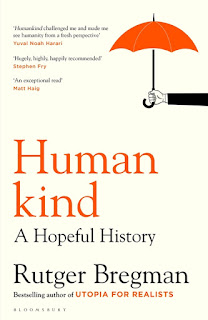
Humankind: A Hopeful History | Rutger Bregman #NonFiction


Humankind: A Hopeful History is more than just a popular science book that hits the right note during this unsettling time in our human history. For starters, Bregman uses a LOT more footnotes than one usually finds in a popular science book. He has obviously spent a lot of time researching, questioning and thinking about his topic - that we are in fact, when push comes to shove, mostly a species of decent and kind beings.

Humankind is a book designed to explore the best and most hopeful aspects of human nature. According to Bregman this is one of the things that we all share in common, regardless of race, culture, and religion. Yes, there are some sociopaths out there, but they are a very specific and aberrant group. They are not the norm. 

I understand there have been some concerns about cultural appropriation of stories surrounding this book and I understand where those concerns come from. But that's not what this book is about. It's about the kindness we all share as human beings, and our ability to pull together in tough times. It's the things that unite us, not divide us. Although, Bregman does spend some time, later in the book, discussing why it is that some of the divides have come into being. It turns out the Age of Enlightenment was not so enlightening after all!

He discusses war, slavery, the Holocaust, sexism, racism, xenophobia and catastrophes within the context of his premise. He dissects the role that media, news and the internet have on exposing the exceptional, the unusual and the shocking as opposed to the usual, the everyday and the normal. The aim of the news and information as we now know it, is to grab your attention and shock, not to enlighten.

He exposes the fallacy and myths surrounding The Lord of the Flies theory, the selfish gene, the reality of battles and warfare "interviewing veterans of WWII, they found that more than half had never killed anybody", the mystery of Easter Island, the 1971 Stanford University Prison study, the Robbers Cave experiment, the 1961 Stanley Milgram shock experiment, the bystander effect and terrorism.

Reading Humankind, as I did, during the early stages of the Covid-19 lockdown, I was struck by this particular thought:
Infectious diseases like measles, small pox, tuberculosis, syphilis, malaria, cholera & plague were all unheard of until we traded our nomadic lifestyle for farming. So where did they come from? From our new domesticated pets - or more specifically, their microbes.


I was saddened when he noted later on that "education has become something to endure." The truth of this has been brought home to me constantly over the past decade as the boys finished their school years. They have no inspirational stories to tell about their school days, like Mr Books and I both do. They have plenty of tales about what they got up to with their friends during the breaks, but nothing about what they learnt. All they ever wanted to know was what they would need to pass their exams to get them out of there. How did education become such a dull, routine thing?

Bregman finished with his very own 10 rules to live by (everyone seems to be doing it lately!)

  • when in doubt assume the best
  • think in win-win scenarios
  • ask more questions
  • temper your empathy, train your compassion
  • try to understand the other, even if you don't understand where they're coming from
  • love you own as others love their own
  • avoid the news
  • don't punch Nazis
  • come out of the closet: don't be ashamed to do good
  • be realistic

I found Humankind to be an interesting read, especially the debunking of the deeply flawed human psychology studies from the 60's and 70's, the very same ones I learnt about at uni thirty years ago, which were held up to be self-evident truths at the time. However I did grow rather weary of Bregman's tone by the end. His determination to be hopeful began to seem like one of the self-fulling, Pygmalion Effects that he wrote about! 

Bregman offers a hopeful antidote to our current pandemic and political situations. It's always nice to be reminded that most people are decent folk doing the best they can. In fact, there are way more kind people on the planet, than not. And that's a good thing.

Facts:
  • Translated by Elizabeth Manton and Erica Moore.
  • Bregman was born the year I finished my Diploma of Education (1988).
  • Author of Utopia for Realists: How We Can Build the Ideal World (2016).

Book 7 of 20 Books of Summer Winter

Monday, 3 August 2020

Maigret and the Killer | Georges Simenon #ParisinJuly


A big part of the reason I love reading Maigret's so much is the glimpse into life in Paris in the middle of the 20th century. Maigret and the Killer opens with Mrs Maigret and her man, dining out with friends discussing the merits of the Madame Pardon's 'unparalleled boeuf bourguignon...filling, yet refined', provincial cookery that was 'born of necessity', whilst finishing off the meal with the obligatory 'coffee and calvados'.

This is the 70th book in the series and the year is 1969. The setting is Quai d'Anjou - the home of the young man killed in the first chapter. His parents are the wealthy owners of a cosmetic company. A stroll around the Quai d'Anjou is definitely on the cards if I ever return to Paris in real life!


As always, time with Maigret is easy. He may be getting stressed out by the details of the crime, but all the reader has to do is simply sit back and enjoy the ride. It's a pleasure watching how Maigret works to solve the case. It's a joy to walk the streets of Paris with him and I never get tired of watching him eat. Whether its a golden tench baked in the oven, or 'rilletes made locally, coq au vin blanc and, after goat's cheese, rum babas' washed down with a little after dinner cognac, Maigret looks forward to each and every meal.

And I look forward to each and every Maigret.

Facts
  • This Penguin edition was published 2019.
  • Originally titled Maigret et le tueur. 
  • Translated by Shaun Whiteside.

Book 6 of 20 Books of Summer Winter

Monday, 20 July 2020

The Parisian | Isabella Hammad


My journey with The Parisian has been a labour of love. I started reading it the week before Australia went pear-shaped with Covid-19 back in March. I was really enjoying it, but it's a thoughtful read and I struggled to give this book the attention it deserved during those early, weird weeks of Covid confusion. 

For a month or so, I needed books for comfort instead. Then when I started back at work, new releases got in the way as I struggled to manage my time efficiently. 

Last week I decided it was time to finish it. 

During the reading break, I'd forgotten just how lovely is the writing and how absorbing is Midhat's story. It's hard to believe this historically rich, self-assured novel is a debut.

I learnt so much about the end of the Ottoman Empire and the Levant area circa WWI - WWII. The reference to Paris is slight, in that the story begins with a young Midhat moving to France in October 1914, at the beginning of WWI, to train to be a doctor. His time in Paris is not very long in the scheme of his whole life, but it was an informative few years for him. On his return to his home town, Nablus, he affects a Parisian air, wearing the latest Parisian fashion and discussing the latest Parisian books, art and philosophy. 

Midhat is loosely based on Hammad's own great-grandfather, Midhat. A man whose family teased him and joked about his Parisian ways for the remainder of his life. These are the stories that Hammad grew up listening to. Her grandmother, Ghada (who features briefly as a young girl towards the end of the book) was the main source of these stories about this gentle, sensitive man who happened to live his life during extremely turbulent and 'interesting times'.

From the first page, Hammad shows us Midhat's fascination with all things French. Meeting another Arab (who has been to France before) on board the ship taking him to Marseille, he observes,
He wore a pale blue three-piece suit, and an indigo tie with a silver tiepin in the shape of a bird. A cane of some dark unpainted wood leaned against the table.

He then went on to warn/shock/entice Midhat about the women of France 'they are treated like queens', the alcohol and religion, 'you should know that missionaries are always different from the natives. The religion is less strong in France.'

Part One is about Midhat's time in Montpellier, training to be doctor from the home of Docteur Molineu. He has a daughter, Jeanette who fascinates and confounds Midhat from the start. He feels his outsider status and constantly struggles with how different life is in France, to his home. Confusion and faux pas' abound. From this distance he remembers the significant events from his childhood.

Midhat is a daydreamer, a romantic soul, so naturally he falls in love with Jeanette. A major misunderstanding leads him to run away to Paris. Regret sets in.

Part Two begins with Midhat living in Paris.
He took his first look at Paris - the cluttered pavements, the zinc roofs, the faceless rush....The people seemed less to walk down the street than hurtle; he heard the cry of a seagull and the earth muttered beneath his feet as though somewhere below water was churning.
Politics, philosophy and wartime gaiety take up his time, as he completes his training. 
Sometimes after dinner Midhat would go out with Faruq to bars and cabarets. As the city moved from her mood of wartime grief to one of revelry, Parisian nightlife began to thrive on the electric atmosphere of the home front. Ration-dimmed streetlights greyed the boulevards but cinemas and theatres still packed out nightly and even stayed open during the zeppelin attacks. Under the sustained pressure of war, the people of Paris behaved as though they had approached the end of the world.
Paris in half-mourning | Ralph Burton |1915


Hammad only gives us a few chapters about this significant, informative time in his life, before returning Midhat to Nablus.

The memories of regret and nostalgia around Jeannette, Montpellier and Paris inform every decision he makes there after. A hidden letter changes everything.

Political events and family expectations inform his career choice, his eventual marriage and friendships. 

Part Three shows the growing unrest in Palestine at this time, which seems to pass Midhat by as he lives on his Parisian memories. Yet his inner turmoil often reflects the outer madness taking hold of his homeland.

Back in Nablus, Midhat finds that he is once again an outsider, struggling to belong in his home town as he constantly longs for another place, another love.

Hammad has created an incredibly immersive story about a fascinating period in history, told from a Palestinian point of view. Hammad has chosen to use a fairly traditional, classic style of storytelling which suits this time period perfectly. She claims Virginia Woolf and Henry James as influences on her writing, especially James' ability with dialogue and how he reveals the things unsaid. 

The Parisian is a book worthy of your time. It rewards, delights and informs the reader, in much the same way that a careful read of Dickens or Zola does. I'm very curious to see what Hammad might do next.
  • Winner of the Creative Award at Palestine Book Awards 2019.
  • Shortlisted for the 2020 Sir Walter Scott Prize for Historical Fiction.
Book 5 of 20 Books of Summer Winter

Tuesday, 14 July 2020

The End of the World is Bigger than Love | Davina Bell #AWW


I recently read an interview with Ann Patchett where see was asked about hard it was to scrap a piece of writing that wasn't working and to start again. The interviewer thought it might almost be like a little death to let go a hard-won piece of writing, but Patchett was more pragmatic. Her reply was that writing was like baking a cake. Sometimes you burnt the cake and had to make it again. But before you did, you could cut open the burnt cake and still eat the warm, gooey, soft bits in the middle that weren't burnt.

With that in mind, I jettisoned the over-cooked post I had been labouring over for a couple of weeks for this book. It was a relief to let it go.

I enjoyed The End of the World is Bigger than Love by Davina Bell so much, that my desire to write a response that did it justice, had got all messy and complicated with too many ingredients. If you promise to read on, I promise no more cooking metaphors!

This young adult novel will not suit everybody's tastes.

Lots of readers do not like dual narratives, so be warned, this book is narrated by twins, Summer and Winter.

Our two protagonists are also unreliable narrators, another love/hate device for many readers. Personally, I loved the mixed messages we were getting from Summer and Winter throughout the book. Who was telling the truth? Who wasn't? And why?

The story also jumps time and place fairly regularly as the girls remember all sorts of stuff about their childhood from their current position, stranded on a deserted island, without their father, after the world has gone to shit rather suddenly and dramatically. And rather presciently given current Covid-19 events.

This is a story about memories, feelings, thinking and relationships, therefore, not at all suitable for those seeking adventure and action.

Then there's the mix of cyber-terrorism, eco-dystopian, speculative fiction and coming-of-age themes with a whiff of romance that might put some readers off. This rather unconventional mix, however, worked beautifully for me. Even the ambiguous ending wasn't enough to deter me from my glowing, gushing feelings for this book.

Finally, Summer is pretty verbose. She uses lots of words instead of just a few and her energy levels and enthusiasm for everything is pretty high. In fact, she comes across as one of those rather annoying teenage girls who talks very loudly, very fast and thinks that everyone wants to know every little thing about her, and they want to know it right now! In real life, this would annoy me no end, but here, I found Summer to be rather endearing. 
Perhaps it was all the books.

Both Summer and Winter are great readers, thanks to the library left to them by their mother. Their list of desert island books was truly impressive. Why did they never try to leave the island for two years?  I say the books! 

Why would you need the rest of the big bad climate-mess world and the deadly greying, when you could read and reread books like Anne of Green Gables, The Diary of a Young Girl, To Kill a Mockingbird, The Outsiders, The Secret Garden, and Extremely Loud and Incredibly Close to name just a few.

This book may not be for you, and that's okay, but for those of you like me, who love to fall headlong into a bookish world of words and ideas, uncertainty and mystery with two strong characters, then this is the book to dive into. 

Love can sometimes feel like the end of the world, and the end of the world may be bigger than love, but if you have to face down the end of the world as you know it, then it's much better to do so with love by your side.

Obviously, my time with Summer has affected me more than I thought!

I wasn't sure what to expect from this book, and it's not an easy book to describe, but I thoroughly enjoyed my time with Summer and Winter, even when I wanted to shake them or give them a good piece of my mind! Being a teenager is not an easy thing. Books like this remind of us how awkward and uncertain and fearless this time can be and can also make us grateful for how short a period of time this phase actually is in the scheme of a whole life, even though it doesn't feel like that at the time.

Favourite Quote:
We live on a blue planet that circles around a ball of fire next to a moon that moves the sea, and you don’t believe in miracles?

Davina Bell has had an interesting career trajectory. From working in publishing/editing to writing award-winning picture books for children and primary school aged kids, and now, The End of the World is Bigger than Love.

Facts:
  • Our Australian Girl: Alice Stories
  • The Underwater Fancy Dress Parade (illustrator Allison Colpoys)
  • Birthday Baby (with Jane Godwin and illustrated by Freya Blackwood)
  • Hattie Helps Out (with Jane Godwin and illustrated by Freya Blackwood)
  • Oh, Albert! (illustrator Sara Acton)
  • Under the Love Umbrella (illustrator Allison Colpoys)
  • Lemonade Jones (with Karen Blair)
  • The Corner Park Clubhouse series
  • Baby Day (with Jane Godwin and illustrated by Freya Blackwood)
  • All the Ways to Be Smart (illustrator Allison Colpoys)
  • All the Factors of Why I Love Tractors (illustrator Jennie Lovlie)
Book 4 of 20 Books of Summer Winter