Showing posts with label Courage. Show all posts

Thursday, 20 December 2018

Junior Fiction - the rest!

Following on from my recent post featuring several fabulous Australian junior fiction titles, I thought it was time to venture further afield to see what the rest of the world (or at least the US, UK and Japan) were doing in this field.

The Afterwards is a new story by U.K. poet A. F. Harrold, illustrated by Emily Gravett, the well-known picture book illustrator. Like so many books for kids these days, the story explores friendship, death and loss. It is quite dark at times and some children may find the 'other world' that our young protagonist is able to visit quite creepy in much the same way that Neil Gaiman's Coraline's 'other mother' is creepy. But the ending is positive with a focus on living in the moment, honouring those you loved and being present.


Dear Professor Whale by Megumi Iwasa and Jun Takabatake (illustrator) wasn't quite as sweet and charming as Yours Sincerely, Giraffe, but it still highlighted the importance of friendship, kindness and belonging via the old-fashioned means of communication, letter writing.

The action centres around the reviving of the Whale Point Olympics. The older Olympians are honoured and revered while the youngsters are encouraged to engage in friendly competition and teamwork rather than winning gold medals at all cost.

The empathy message may have been laid on a bit thick this time round, but it's hard to take offence when it's so well-meaning and good-natured.


Front Desk by Kelly Yang is for the older end of the junior fiction spectrum - probably 10+ and is loosely based on her own experiences as a new immigrant to the States in the early 1990's. Yang wanted to tell her son about how she grew up and what it was like being an immigrant. In a letter at the front of the books she says,
I grew up in a motel. I didn't have any toys or nice clothes. My parents were struggling...and life was very, very hard for us; it was hard for everyone in our motel, from the immigrants we hid at night to the guests who stayed by the week, folks who got mistreated by the police and were stuck in the same sad cycle of poverty.
I had been searching for a way the right way to tell my son all of this, a way that didn't scare him, but inspired him....Draft after draft, I dug deeper and deeper until the shame and pain and joy of my childhood were so open and exposed, it scared me.

For such a hard won story, it reads lightly and easily. Diversity is celebrated, as is a strong sense of family and friendship. Belonging, perseverance and hard work are standards held up for admiration. Disadvantage and racism are sadly also on show and not just from the American population, Yang also subtly shows the tensions between mainland Chinese immigrants and Taiwanese Chinese.


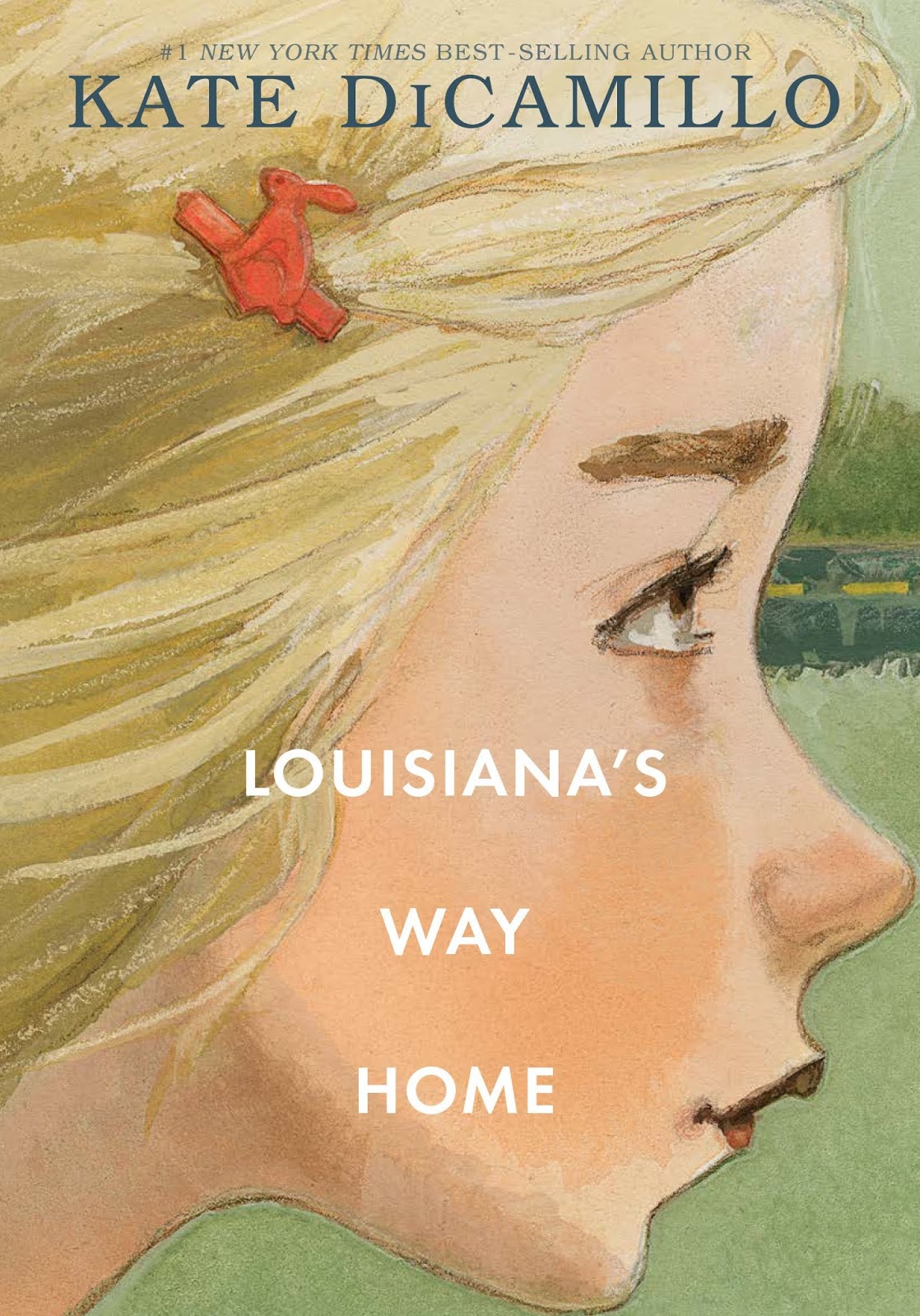
One of my new favourites though is Louisiana's Way Home by Kate DiCamillo. Her writing is stunning as always and Louisiana is a delightful, spunky creation. Suddenly, without explanation, Louisiana is on the run with her Grandma. What follows is a journey of major self discovery as Louisiana learns some painful home truths and discovers just how strong and resilient she really is.

We all, at some point, have to decide who we want to be in this world. It is a decision we make for ourselves. 

Forgiveness, hope and courage are DiCamillo's calling cards - they shine very brightly in this tender, bittersweet story. And it wouldn't be a DiCamillo story if we didn't also learn about the kindness of (some) strangers (although don't get me started on the grandmother!)

Perhaps what matters when all is said and done is not who puts us down but who picks us up.


I'm starting to loose track of ALL the princesses-turned-monster-fighting-superheroes in The Princess in Black series by Shannon Hale but #6 and the Science Fair Scare is still full of all the fun, derring-do, go-girl attitude of the earlier stories.

It's hard NOT to be charmed by these sassy young things with their alter-ego monster-fighting persona's. But I guess at some point, I'd like to see these girls (& the dashing young Goat-Boy) come out from behind their masks and let the world see who they really are all the time.

Book 6 feels like a transition point. Everyone now seems to be 'in' on the secret and it would be nice if the girls didn't have to pretend to be pretty, prim princesses in public any more.


I love junior fiction at this time of year. It's entertaining, easy reading. But they're not always light on topic or emotional impact. These books feature BIG themes with BIG heart. They are books that can be enjoyed by adults just as much as the younger people in their lives. There is way more to junior fiction than the Wimpy Kid and Dork Diaries, and I for one, am very grateful for that!

Monday, 8 May 2017

Journey to the River Sea by Eva Ibbotson

I started the Journey to the River Sea by Eva Ibbotson as part of my #readathon session. I had a lovely 15th anniversary edition of this modern day classic, complete with gorgeous blue butterfly. The following day I woke up with a terrible head cold and struggled to work, before realising that I was going to need a couple of days at home in bed to actually get better.

Journey to the River Sea became the perfect easy, delightful read to see me through my first day of feeling miserable at home.


This book was a pleasure in and of itself, but it also brought back so many lovely memories of other favourite childhood characters. Our orphaned heroine, Maia upon hearing that she was being sent to the Amazon to live with cousins she had never met, channelled her inner Jane Eyre, when she gave herself this stern talking to,
Fear is the cause of all evil, she told herself but she was afraid. Afraid of the future...afraid of the unknown. Afraid in the way of someone who is alone in the world.

Followed up quickly by an Anne Shirley-esque remark, 'And after that I don't know, but it's going to be all right.' Maia is courageous, funny and intelligent - the kind of child, we all wish we had been more like (well, at least, the kind of child, I wish I had been like).

There's the forbidding but ultimately lovable governess who provides Maia with thoughtful care, fun and inspiring life advice just like Mary Poppins or Professor McGonagall. The Little Lord Fauntleroy aspect is explored via Clovis, the very homesick and unwilling theatrical orphan boy. The mean twins are Nellie Olsen, John Reed and Veruca Salt all rolled into one (well, actually two, but you know what I mean!) And the lost boy, living with the Indians, has a touch of the Huck Finn's or Peter Pan about him.


Journey to the River Sea is historical fiction with heart. Set in 1910 England and Manaus on the banks of the Negro River in Brazil, Ibbotson gives us a tale of belonging, bravery and being true to yourself. There's also a treasure trove of gorgeous geography and anthropological treats along the way, with references to Humboldt, sloths and butterflies, just to name a few.

Highly recommended for mature 10+ readers and all lovers of fine children's literature.

My post for One Dog and His Boy from 2011 - when my reviews were short, sweet & simple.

Thursday, 4 May 2017

The Fellowship of the Ring by J R RTolkien

The books that comprise The Lord of the Rings are usually presented as a trilogy, but it was in fact designed by Tolkien to be one single book with six parts. Obviously the publishers baulked at publishing such a large tome of a book!


On 29th July 1954 George Allen & Unwin published the first volume consisting of the first two books with the title The Fellowship of the Ring.

The second volume, with the next two books was eventually titled The Two Towers and published on 11th November 1954. The final two books were published in The Return of the King on 20th October 1955.

**Spoiler alert**
I'm now assuming that you have read the book so that we can discuss the details of what has happened.

Book Two of The Fellowship of the Ring, is, well, all about the fellowship.

We begin this section of Lord of the Rings in Rivendell where we meet all the participants of the fellowship for the first time together. We hear their back stories and find out how they ended up in Rivendell at this time.

The Gates of Moria by Alan Lee

Tolkien used all kinds of storytelling devices to keep our interest and to build up the tension.

There's the info-dump chapter where we find out all about the ring's long and dubious history. Tolkien again used the action-packed chapters full of danger and tension followed by the safe-haven chapters of comfort and ease to keep the pace up without exhausting all of us.

The humour of Merry and Pippin and the gravitas of Gandalf provided light and shade. While foreshadowing continued to be one of Tolkien's favourite ways of promoting a sense of anticipation and foreboding.

Tolkien employed metafiction when Bilbo talked about his 'story' that he was writing about his journey and the parts still to be written or completed. Although I'm reluctant to call it metafiction as I don't think that Tolkien used this technique in a deliberately self-conscious or ironic way or in an attempt to question what was real or not.

Tolkien's ability to reference the depth and breadth of his created world was particularly impressive in the two books of The Fellowship - the song that Bilbo sang, the backstory of the ring, Moria and it's long history, the extensive descriptions of the scenery, the longevity of the Elves - although this immensely rich historical detail can at times be overwhelming to the unsuspecting reader.

This particular book also had deep sadness and loss. Gandalf's stand on the Bridge of Khazad-Dum is one of the pivotal moments in the whole story.

The very strong faith based themes evident within Gandalf's stand, fall & ultimate resurrection never felt like Tolkien was preaching. He always said that he never wrote the book with analogies in mind, but obviously the religious stories that he grew up with were a central part of his life and influenced the type of story he wrote as well as infiltrating the various details.

In The Letters of J R R Tolkien* No. 142 To Robert Murray, SJ on 2 December 1953, Tolkien said,
The Lord of the Rings is of course a fundamentally religious and Catholic work; unconsciously so at first, but consciously in the revision. That is why I have not put in, or have cut out, practically all references to anything like 'religion', to cults or practices, in the imaginary world. For the religious element is absorbed into the story and the symbolism. However that is very clumsily put, and sounds more self-important than I feel.

Unlike C S Lewis' Narnia series that is heavily and overtly Christian, it is possible to read The Lord of the Rings without thinking about the religious symbolism at all. It certainly escaped my earlier, younger reading of the books.

Researching Tolkien's intentions for this reread has added layers of meaning to my understanding of the story and of Tolkien himself, but with or without these layers, LOTR remains a rip-roaring, satisfying read.

Perhaps, like Tolkien, my first, early reading was quite unconscious, with this reread being much more conscious and deliberate on the look-out for symbolism and themes.


The mysterious lurking presence of Gollum haunts our journey throughout The Fellowship. We all know he's there, we're all on our guard, but no one wants to talk about it. Yet.

The landscape was all important as well. It affected the decisions that the fellowship had to make along the way and Tolkien also used it to explain certain characteristics of the various races  - thank goodness for the map inside the cover of the book to make sense of all that 'east of this/west of that' stuff.

My Alan Lee illustrated edition also helped to bring many of the places to life which made up for my woeful lack of imagination.


The Fellowship of the Ring was also all about the ring.

The ring personifies evil and is quickly established as a character in its own right. Some of the ring stuff is confusing. For instance, the how and why of the three rings are how exactly they are linked to the one, but not necessarily evil?

I'm not really sure if Tolkien's letter* to Milton Waldman (No. 131, circa 1951) helped clarify anything at all!

The chief power (of all the rings alike) was the prevention or slowing of decay (i.e. 'change' viewed as a regrettable thing), the preservation of what is desired or loved, or its semblance – this is more or less an Elvish motive. But also they enhanced the natural powers of a possessor – thus approaching 'magic', a motive easily corruptible into evil, a lust for domination. And finally they had other powers, more directly derived from Sauron ('the Necromancer': so he is called as he casts a fleeting shadow and presage on the pages of The Hobbit): such as rendering invisible the material body, and making things of the invisible world visible....
The Elves of Eregion made Three supremely beautiful and powerful rings, almost solely of their own imagination, and directed to the preservation of beauty: they did not confer invisibility. But secretly in the subterranean Fire, in his own Black Land, Sauron made One Ring, the Ruling Ring that contained the powers of all the others, and controlled them, so that its wearer could see the thoughts of all those that used the lesser rings, could govern all that they did, and in the end could utterly enslave them. He reckoned, however, without the wisdom and subtle perceptions of the Elves. The moment he assumed the One, they were aware of it, and of his secret purpose, and were afraid. They hid the Three Rings, so that not even Sauron ever discovered where they were and they remained unsullied. The others they tried to destroy....
(LOTR) was begun in 1936,5 and every part has been written many times. Hardly a word in its 600,000 or more has been unconsidered. And the placing, size, style, and contribution to the whole of all the features, incidents, and chapters has been laboriously pondered.

There was no where near as much fighting, violence and hand to hand combat in this book as I remember from the movie. Thank goodness!

I found the extensive and over the top battles in all of the movies tiresome and tedious. It often felt like the movie moved from one battle scene to the next. This reread has reminded me that the fighting scenes in The Fellowship at least, were sporadic and low-key, although I still found myself skimming parts of them at times.

The mirror of Galadriel by Alan Lee

The Fellowship of the Ring contained themes of isolationism vs connection, appearances vs reality and the passing of time. Courage, friendship, the corruption of power, fate vs free will and temptation also got a look in.

Some reviews have complained about the overly long descriptions and unsophisticated language. Occasionally I understand the complaint about the descriptions, but the uncomplicated language is one of the things that makes this story so accessible to young and old as well as to those readers who tend to avoid fantasy. I actually find the childlike elements in the story endearing not simplistic.

The Letters of J. R. R. Tolkien* No. 35, 2nd February 1939:

I think The Lord of the Rings is in itself a good deal better than The Hobbit, but it may not prove a very fit sequel. It is more grown up – but the audience for which The Hobbit was written has done that also. The readers young and old who clamoured for 'more about the Necromancer' are to blame, for the N. is not child's play

The lack of emotional depth can be more problematic to a modern reader used to complex, nuanced character development, however nostalgia is the predominate feeling in these books, and that is something we can all tap into.

The Letters of J R R Tolkien* No. 76 - In a letter to Christopher, 28th July 1944:

As to Sam Gamgee. I quite agree with what you say, and I wouldn't dream of altering his name without your approval; but the object of the alteration was precisely to bring out the comicness, peasantry, and if you will the Englishry of this jewel among the hobbits. Had I thought it out at the beginning, I should have given all the hobbits very English names to match the shire.

I feel like I've thrown a lot of bits and pieces together from my notes with only a passing nod at coherence. I hope I haven't overloaded you!

Enough of the chatter! It's time to hit the road again and check in on our stoic ring-bearer and friends.

*The Letters of J R R Tolkien edited by Humphrey Carpenter and assisted by Christopher Tolkien 1981.


#HLOTRreadalong2017 


The Fellowship of the Ring 

- Halfway post - Book one 
  - TFOTR - Book two


Thursday, 24 November 2016

A Most Magical Girl by Karen Foxlee

Karen Foxlee has a way about her.

Her words weave magic. She draws you in, she makes you believe, she makes you feel brave.

A Most Magical Girl follows an ordinary, everyday Victorian girl, who, rather like Harry Potter, suddenly finds herself in a magical world. Her role is to fulfil the prophecy as the 'youngest and most able member of the Great and Benevolent Magical Society' to assume the role of 'Valiant Defender of Good Magic'.

The sinister Mr Angel has other ideas, of course!

Annabel is rather annoying to start with.
Privileged, pampered and totally unprepared for her new life, she spends a lot of the first section bemoaning these changes. Annabel is the epitome of the reluctant hero.

However, as the danger escalates, and Mr Angel's darklings turn London murky and foggy, Annabel finds that bravery and resilience are required. With a good heart and a clear head (and a couple of faithful companions), it turns out that Annabel is capable of great and daring things indeed!

To be honest, I didn't love A Most Magical Girl as much as Ophelia and the Marvellous Boy, but Ophelia was pretty special, and pretty hard to top.
However, AMMG is a lovely, magical ride, with lots of action (especially in the second half of the book). Foxlee's characters are memorable and believable. And Annabel's journey towards courage is inspiring.

Highly recommended for mature 10+ readers.

Thursday, 27 October 2016

Danny the Champion of the World by Roald Dahl

Danny the Champion of the World is a homage to good parenting, especially good parenting by a loving father.

It's also about courage, loyalty and a little bit of class politics.

Danny extols the virtues of working class values, but as with all Dahl books, he subverts it a little. Honesty and the concept of being a law-abiding citizen are given a little Dahl-esque tweak.

Danny could be read as a modern day Robin Hood, except the class divide commentary is never really fully resolved here.

The local rich guy is too obviously the baddie and the idea of poaching being an art form is just a tad too convenient.

We all know that the simple, clean, wholesome life that Danny and his dad enjoyed is not the real picture of working class poverty. There may not be any magical elements in this particular Dahl story, but there is a lot of wish-fulfilment and whimsy.

Danny is rightly concerned about the ethics of stealing the pheasants. Having the entire village in on the scheme, doesn't really make it proper. But Dahl doesn't confront or challenge this dilemma at all which I found very curious and the one thing that would stop me recommending this book whole-heartedly.

Perhaps, though, it could become a good discussion about what to do when the adults in your life are doing something illegal? Or about the shades of grey that exist within some laws and some traditions? Or it could even be the opportunity to tackle the big question of class inequality - why some people are poor and don't have enough to eat well while others wilfully waste the abundance that they do have?

Even Dahl's final message to the reader is loaded with ambiguity and class tension.

As a child I would have found this message quite confronting because I knew from a very young age that your didn't always get what you deserved, let alone what you wanted.

A Message 
to Children Who Have Read This Book 

When you grow up 
and have children of your own
do please remember
something important

a stodgy parent is no fun at all

What a child wants
and deserves
is a parent who is 

SPARKY

Danny is part of my 1001 Children's Books to Read Before I Die challenge.

Thursday, 28 July 2016

Mrs Dog by Janeen Brian

Mrs Dog by Janeen Brian and illustrated by Marjorie Crosby-Fairall touched me to my childhood bones.

Growing up in rural NSW meant that the story featured in Mrs Dog was not unknown to me. So many of my friends who lived on farms had a story about a dog and a lamb not unlike Freeman's one.

Mrs Dog is a retired farm dog that takes on the care of an orphaned lamb.

Lamb learns to act like Mrs Dog around the yard and with the other animals. Mrs Dog teaches her how to be safe around the farm. But the only thing lamb can't do is bark like Mrs Dog.
Until one day, when Mrs Dog finds herself  in grave danger, and lamb discovers how brave she really is.

The illustrations have a gentle, nostalgic feel and combined with the text created, for me, a connection to the heart-warming movie, Babe.

The Babe connection was made with the naming of the creatures from Mrs Dog's point of view - there are 'woolly-heads', 'tall-one', 'tall-two', 'baa-rah' and 'beaky-wings'.


Mrs Dog is a tender, touching story. It's full of hope, courage and kindness in all guises.

Dog stories like this resonate so strongly because they are not only based on true stories that we can relate to, but because they also remind us of our better natures.

Sunday, 17 July 2016

Another Night in Mullet Town by Steven Herrick

Another Night in Mullet Town by Steven Herrick is a verse novel for teens set in a small coastal town with lots of fishing references.

How's that for a hard sell?

The trouble is, I adore Herrick's writing and his ability to draw complex, authentic characters with so few words.

He could probably write a story about boxing or a spider plague and I would still love it, although I hope he doesn't test me out on that score!

Of course, Another Night is Mullet Town is not just about fishing.

Herrick explores his usually themes of belonging, friendship, family and community. He also touches on trust and everyday courage.

I grew up with boys like Jonah and Manx. Herrick writes their stories very sympathetically, however I didn't feel the emotional impact with this story as I have with his earlier books.
People like you and me, Jonah, we drag down the price of everything we touch. 
Life for Jonah and Manx means fishing for mullet at the lake, watching their school mates party on Friday night and wishing they had the courage to talk to Ella and Rachel.
But now their lakeside town is being sold off, life doesn't seem so simple. Manx holds a grudge against the wealthy blow-ins from the city and Jonah just wants his parents to stop arguing.
 
One memorable night at the lake will change everything.
Another Night in Mullet Town has a teen sex scene, drinking and some drug references.
This was one of my reads for Dewey's readathon in April.

The Simple Gift by Steven Herrick
Pookie Aleera is Not My Boyfriend by Steven Herrick

Saturday, 21 February 2015

Stand Up and Cheer by Loretta Re


One of the many pleasures of being a bookseller, is meeting the authors and attending their book launches.

I've known about this little gem based on real life events in Albury, NSW for a while now.

Loretta lives locally and a year or so ago, she popped into our bookshop to discuss publication options and, eventually, cover design options.

Due to the regional nature of her story, Re's manuscript was rejected by several major publishers. In the end, her friend, Juliet, from The Wild Colonial Company, decided to publish it for her.

This week we had the Sydney launch of Stand Up and Cheer (the Albury launch was October last year). Juliet & author Sue Woolfe introduced Loretta and her book to a packed house, followed by the usual festivities and book signings.

Stand Up and Cheer is dear to my heart because Mr Books grew up in Albury & the story of the Dutch plane, Uiver's sudden landing in Albury in 1934 during the great round the world air race is a well-known town tale.

Even though we already knew how the story ended, Re created a lovely piece of tense writing that had me on the edge of my seat!


This is a small country town story, but its heart encompasses the whole world.

A truly great book, with a message worth saying, will transcend its setting. Stand Up and Cheer does this by emboding the universal themes of courage (physical & moral), friendship & innovation.

It's well-written, with oodles of great details that reflect just how much research time Re put into this book. The inside covers include photographs from the time & the end notes reveal the impact the abrupt landing had on the Netherlands as well.

A thoroughly enjoyable and absorbing tale for mature 9+ readers & for plane enthusiasts & Biggles lovers of any age the world over!