Showing posts with label Psychological thriller. Show all posts

Saturday, 8 September 2018

The Secrets She Keeps by Michael Robotham

I'm not usually a big reader of crime fiction.

During my younger days I enjoyed a good mystery wrapped up in an adventure series (thank you Trixie Belden and Enid Blyton) and I still love to delve into the psychological reasons why people do the things they do (Maigret fits the bill here). Cosy crime is my favourite though, especially if it's dressed up as historical fiction (Maisie Dobbs, Rowland Sinclair & Phryne Fisher) but straight up and down crime is not usually my thing.

However my book club chose Michael Robotham's The Secrets She Keeps as our latest read. I didn't read the last book club book, so I felt compelled to do better this month.


Mr Books is a big fan of Robotham, but I approached reluctantly. The story is told from the alternating perspectives of Agatha and Meghan, two women with very big secrets to keep, whose lives are on a serious collision course. The cover told me that baby snatching was going to be the crime at the centre of this story.

I thought I had it all worked out very early on. The first part was a 'who-dunnit' and I thought I was being inordinately clever by working out who and how so quickly. Except, suddenly, by the midpoint so did everyone else. Which is where the story became more of a 'why-dunnit', the tension ramped up several notches and I found myself reading until 1am to find out what happened next!

Although I didn't really like any of the characters, I felt a lot of sympathy for the crim. She was one damaged woman, who made a lot of very poor and very dangerous choices. Robotham portrayed someone suffering from a severe personality disorder very realistically, albeit with the necessary literary exaggeration to make for an interesting tale.

Apparently the story of a baby being kidnapped from a hospital was based on a true event from the 1990's (perhaps this one).

The Secrets She Keeps was a true page-turner, but for me, it's also like eating fairy floss. Fun while it lasts, but not very satisfying in the long run.

I don't mean to sound like a genre-snob; everyone reads for different reasons, and it's truly wonderful that there's a book genre to suit everyone's needs. Mr Books loves this kind of stuff, along with political thrillers, Scandi noir, courtroom dramas and Underbelly style true crime. He reads it to relax at 5am when he can't get back to sleep. He likes an engaging story, straight-forward, but clever writing, language that has been pared back to the bone and a well-constructed, well-paced plot with complex, believable characters. Robotham ticks all these boxes.

It's just that in this short time I have on this planet to read all the book I want to read, I don't want to spend too much time on books that aren't really my thing. I read to find beauty, elegance and kindred spirits. I read to get lost in another's world. I read for intellectual stimulation. I read to find answers to life's big questions. I read for comfort and emotional connection.

Which makes me wonder why other people read?

Do you read like Mr Books, for the pure pleasure of escapism, like me, for the pleasure of connection and beauty, or do you have your very own reasons to read? Why do you read what you read?

Wednesday, 19 October 2016

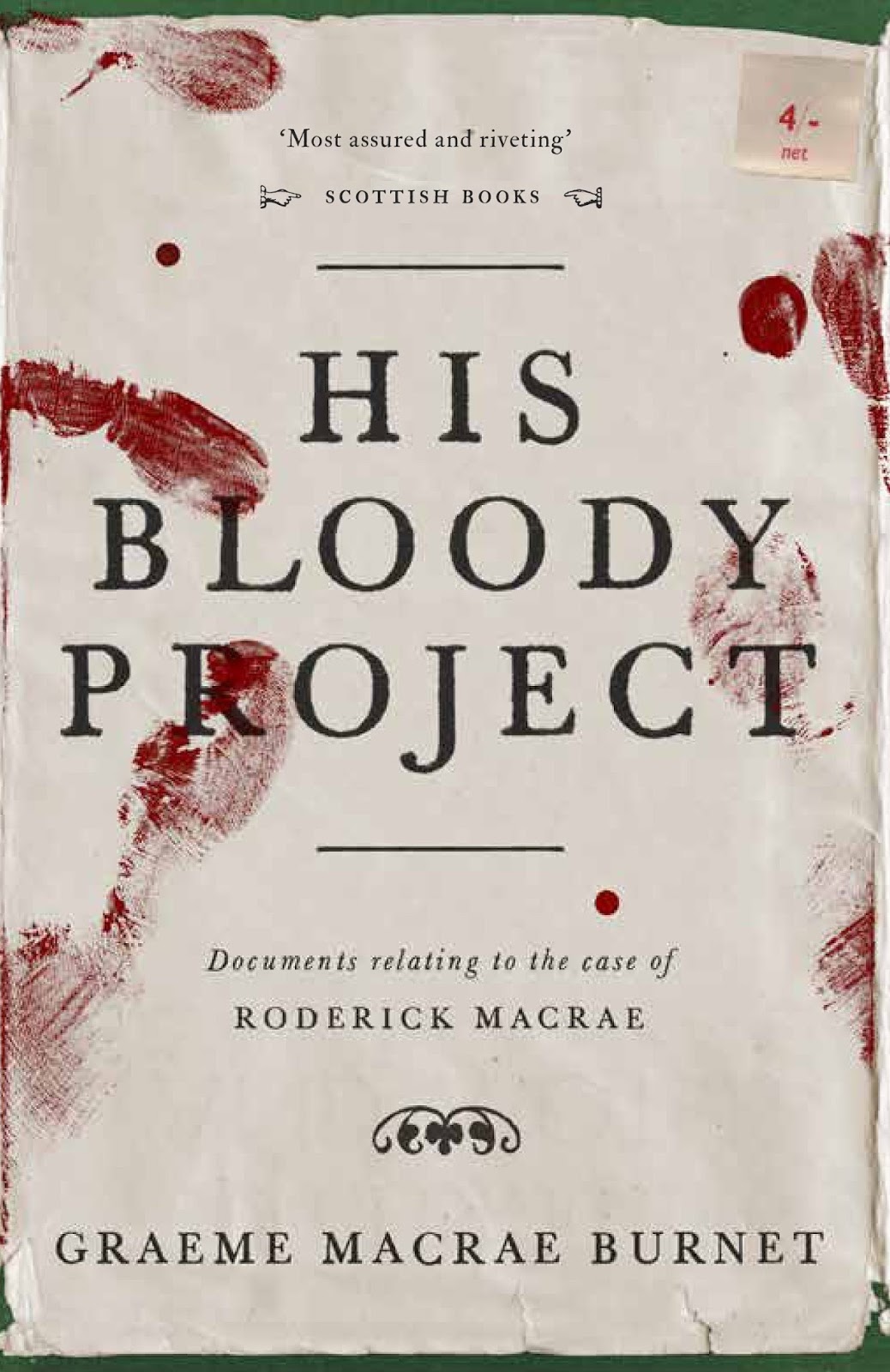
His Bloody Project by Graeme Macrae Burnet

His Bloody Project has been shortlisted for this year's Booker Prize. It was a surprise inclusion to my mind. Historical crime fiction?

But, as it turned out, I loved it.

It's a psychological thriller as opposed to a detective story. The crime - victims and perpetrator - are presented straight up. The unfolding story reveals the how and why of the crime. It's a page-turner - easy to read and thoroughly entertaining.

However it's not a reread.

For me a book is reread if it touches a deep emotional chord that needs more exploring and prodding or if it contains layers of meaning that will take several reads to unpack.

His Bloody Project doesn't fit either of these reread categories for me.

Burnet has set this book up as true story. A part of his own family history that he unearthed during some genealogical research.

He plays around with this idea right from the start with the title page - His Bloody Project: Documents Relating to the Case of Roderick Macrea: A NOVEL, edited and introduced by Graeme Macrae Burnet.

The tension between what's real and what's not continues throughout the reading of Macrae's journal, the medical reports (citing real doctors) and the trial proceedings. Metafiction at it's best!

I normally only read cosy crime, so I thought this story might be outside my comfort zone. But His Bloody Project is really a delicious piece of creative writing decidedly sitting inside the historical fiction genre. Burnet delves into the mind of someone charged with a heinous crime. It's a psychological study about sanity, reason and motivation, set in the Scottish Highlands.

I'm glad this book was shortlisted for the Booker Prize otherwise I would never have read it. The bloody fingerprints on the cover would have been enough to put me off for good!

Maybe the Booker shouldn't have to be about shortlisting the well-known, much loved authors who consistently write interesting books that we will all read regardless. Maybe book prizes, like the Booker can be about bringing to light some unknown, newer writers who deserve a much wider audience.

I've just realised this is the issue that has been bugging me around Bob Dylan winning the the Nobel Prize for Literature.

The Nobel Prize is designed to go to
an author from any country who has, in the words of the will of Alfred Nobel, 'produced in the field of literature the most outstanding work in an ideal direction'. (wikipedia)
I have no problems with another American winning the prize, or a poet/songsmith instead of an author. I can even accept that another privileged white guy wins again - that's the world we live in after all!

But one of the reasons I've enjoyed reading the Nobels over the years (very spasmodically I confess) is the insight into other cultures, the chance to discover new authors that I would never have come across otherwise and for lesser known, but important and culturally significant writers to become more widely known and appreciated.

That kind of diversity is a very good thing any way you look at it.

Bob Dylan is already well known, well regarded and well awarded for his cultural and creative efforts. He will not be forgotten by history.

It feels like this was the easy choice, a nostalgic choice and I will always be left wondering who missed out.

Sunday, 16 October 2016

Brona's Salon

Brona's Salon is a new meme which aims to gather a group of like-minded bookish people 'under the roof of an inspiring host, held partly to amuse one another and partly to refine the taste and increase the knowledge of the participants through conversation.'
(wikipedia)

I will provide a few prompts to inspire our conversation.
However please feel free to discuss your current read or join in the conversation in any way that you see fit.
Amusement, refinement and knowledge will surely follow!

What are you currently reading?

I'm currently reading His Bloody Project by Graeme Macrae Burnet. 

How did you find out about this book?

The Shadow (wo)man Booker group read and reviewed this book.
It was one that was generally enjoyed, with some reservations about it being worthy enough for a literary award. 

Why are you reading it now? 

I'm trying to read half the Booker shortlist before the big announcement next week. 

First impressions? 

Entertaining historical fiction with a metafiction touch - is this a memoir or not? 
What is real? What is fiction?
Is there such a thing as fictional true crime?

Metafiction seems to be a literary device that lots of writers are playing with right now.

I'm thinking of Do Not Say We Have Nothing by Madeleine Thien with her book within the book, Elena Ferrante's ambiguous 'is it memoir is it real' Neapolitan tetraology, Michelle de Kretser's Springtime: A Ghost Story with its discussion mid-story about the nature of ghost stories, Kent Haruf's use of the same fictional town in all his stories and the referencing of his previous books in Our Souls At Night and Alain de Botton's use of footnotes to address issues brought up in his narrative in The Course of Love.

And that's just some of the books I've read this year that can be classified as metafiction!

Wikipedia describes metafiction as -

A story about a writer who creates a story.
A story that features itself as a narrative or as a physical object.
A story containing another work of fiction within itself.
Narrative footnotes which continue the story while commenting on it.
A story that reframes or suggests a radically different reading of another story.
A story addressing the specific conventions of story, such as title, character conventions, paragraphing or plots.
A novel where the narrator intentionally exposes him or herself as the author of the story.
A story in which the authors refers to elements of the story as both fact and fiction.
A book in which the book itself seeks interaction with the reader.
 A story in which the readers of the story itself force the author to change the story.
A story in which the characters are aware that they are in a story.
A story in which the characters make reference to the author or his previous work.

Have you read any metafiction books recently?

Which character do you relate to so far?

I'm not sure if relate is the right word, but I certainly feel empathy for Roddy's sister Jetta.
She has no rights, no protection but all the care and responsibility of looking after her family.

Are you happy to continue?

So far.
I can see Burnet building a case whereby the bullying, mean, officious Mackenzie Broad family got what they deserved (by being murdered), but it seems too neat and too obvious.
Is Roddy a reliable narrator?
The Macrae stoicism and acceptance of fate as being their lot in life feels a trifle overdone.
I'm enjoying the details of Scottish croft life - as bleak and as hard as it was.

Despite the topic, this is a fun psychological thriller read, but I can feel a bit of a drag creeping in.
I hope Burnet doesn't get bogged down or lose his way.

Where do you think the story will go? 

We know that Roddy killed the Mackenzie Broad's from the start. 
He didn't hide or deny what happened.
But is he covering for someone - his father? his sister?

I can see that his advocate is leaning towards an insanity plea - is this a ploy? Or a real concern about Roddy's mental state.
His journal currently presents a logical, thoughtful, intelligent man.


Tuesday, 31 March 2015

11/22/63 by Stephen King

One of the things I enjoy about reading Stephen King is the connections.

King has created three fictional towns based in Maine that reappear regularly in his books - Derry, Jerusalem's Lot & Castle Rock.

Many of the characters from these towns also pop up in unexpected places.

Pennywise the Clown & Randall Flagg are two that cross our paths, one way or another in almost every story.

And it's not just the main characters - neighbours, pharmacists, librarians & even cars tease the Kingophile into trying to remember which books they came from first.

11/22/63 has oodles of these connections to tantalise and tease, beginning with the protagonists name Jake - a name that King uses a lot in his books.

Jake's second time-travelling experience takes him back to Derry 1958 - a few short months after the murderous summer of IT.
He briefly meets young Richie Tozier & Beverly dancing in the park. They allude to the events of the summer and tell Jake that they know he is one of the good guys.

The whole time Jake is in Derry he feels the negative effects of the bad undercurrent that infuses everyone & everything. A visit to the old Kitchener Ironworks leaves Jake with a sense that something evil is lurking in the fallen chimney...all IT readers know exactly what that lurking thing is!

When Jake finally moves on to Dallas, Texas, we leave many of the familiar King haunts only to arrive in a time and place that anyone born before 1970  is intimately familiar with.

King excels at the details. The language, the songs, the cars, the clothes, the books, the shops, the references are all of their time. A nostagla effect kicks in for the time-travelling sections of the story (which is most of it!)

The writing is not beautiful, but it is evocative and it is real. The darker, grittier side of real that is. Bodily functions, dark thoughts, gross behaviours, crude speech....

11/22/63 is a page turner, like the best Stephen King's of old. The battle between good and evil is far more subtle & complex than in some of his earlier books, which makes for a richer reading experience. I can now see why this has become one of Mr Books favourite King's.

There is the impossible, eerie coincidences, the despair of reality & the promise of hope. This one is not a gory horror story. 11/22/63 is more about the suspense.

Thank you to Wensend and Fourth Street Review for hosting King's March. It has been quite an intoxicating experience dropping back into the world of King. I won't stay away so long this time...promise!

Friday, 23 January 2015

The Monkey's Mask by Dorothy Porter

After rereading some of my Porter poems for a recent post, I felt a very strong desire to read one her verse novels.

But I had none to hand.

However I did have a copy of Rebecca Jessen's verse novel Gap on my TBR pile.
I thought, that will do for now.

But for some unknown reason, I googled Jessen before starting the book.

For the record, I never pre-google.

I post-google; I just-out-of-curiosity-even-though-I-will-probably-regret-it-google; I even procrastinate-google. But I never pre-google.

For the record, my pre-google search found an article Jessen wrote for Readings last year, citing the influence of the one and only Dorothy Porter on her writing.

The gods had spoken.

Before I could read Jessen, I simply had to read the source; the beginning of it all; The Monkey's Mask.

Fortunately I work in a small Indy bookshop.
Three days later, the book was in my hand.

24 hrs later, I had devoured it, dreamt it & dropped it in the bath (the water had got cold as I had to finish the book before I got out!)

The Monkey's Mask is part crime thriller (Jill is an ex-cop turned private eye), part sexy romp (Jill is a lonely lesbian), part romance (Jill falls in love), part poetry appreciation 101 (Jill's case is a murdered poetry student).

Jill's voice is ironic, brash and vulnerable "I've got no head for heights/but plenty of stomach/for trouble".

There are times Jill sounds like a poetic Philip Marlowe!

And just like Marlowe's cases you feel the tension rise. You can see the mystery unfold until you want to cry out "look out! behind you!"

But none of this does Porter's story justice.
The Monkey's Mask is gritty, exciting & passionate.
Not one single word is out of place.

Porter's words have captured me - they will haunt me for years to come.
I am not done with her yet!

This post is part of my Australian Women Writers challenge.

Sunday, 7 December 2014

The Watch Tower by Elizabeth Harrower

Oh me, oh my!

What a seductive, chilling, creepy, psychological family drama this is.

Set in Sydney during the 1930's and 40's, The Watch Tower follows the young lives of Laura & Clare.
Orphaned when first their father dies. Then abandoned by their incredibly selfish, self-absorbed, negligent mother who leaves them to go off & do her own thing.
But not before she wrecks havoc on her children's emotional lives.

Laura is left always trying to make amends and be the responsible, reliable one. Clare just wants to disappear within herself and avoid all relationships to keep from getting hurt & being disappointed.

Two such lonely, unloved, isolated young women were almost fated to be taken advantage of again.

Enter stage left - Felix.

Laura's enigmatic, much older boss.
Felix - who promises to marry Laura and look after Clare when their mother takes off.

Nowadays we are all conversant with psychological & emotional abuse; we know about alcoholics, personality disorders and control freaks. It is also quite likely that Felix had frustrated homosexual tendencies.

Whatever the disorder or syndrome or illness, Felix slowly, cruelly wears the two sisters down. His hostility, deceits, self-justifications, denials & irrational caprices are as relentless as they are predictable.

Laura is too embedded into this way of life to see a way out, but Clare finds ways to fight back.

It is Clare that provides the hope in this desperate story.

First published in 1966, Harrower writes an engrossing, enraging story.
Firmly rooted in the quiet, leafy Lower North Shore suburbs of Sydney, Harrower reveals what goes on behind (some) closed doors.

I can't wait to dive into Harrower's other books - Down in the City, The Long Prospect, The Catherine Wheel & In Certain Circles.

Highly recommended for lovers of deftly written character studies.

Friday, 25 October 2013

Picnic At Hanging Rock by Joan Lindsay

I've enjoyed highlighting and remembering all the Australian classics I've read over the years in preparation for November's AusReading Month.

And Flashback Friday has been a great motivator to get me to do one a week at least - thanks Lisa.

This weeks FF needs no introduction...well not in Australia anyway.

Not only is Picnic At Hanging Rock a popular classic book from the 60's it is also an iconic Australian movie from the 70's.

In the 80's a resurgence of interest occurred when the 'secret' final chapter was published for the first time.

Lindsay created a story set at the turn of the previous century with a distinct true crime feel.

The day was Valentine's Day - a hot summer's day - and a group of school girls and their teachers went for a picnic to Hanging Rock in Victoria.
A number of the girls disappeared under mysterious circumstances.

The ending is deliberately ambiguous and has been highly debated over the years.


However in 1987, for those of us who had come of age with the book believing that it might have been based on real events, we were shocked to discover that there had been a chapter cut from the original book at the publishers request.

Lindsay had died in 1984, and the story went around that she refused to allow the final chapter to be published until after her death.

I personally was devastated to find out that the whole story was pure fiction from start to finish.

The final chapter revealed a time warp, supernatural ending that was far less satisfying than the ambiguity of old. The success of both book and movie hinged on the possibilities of truth, mystery & suspense.

The 1975 movie was directed by Peter Weir. It was beautifully shot, the tension and drama were exquisitely crafted and it starred a who's who of Australian tv and theatre at the time. The pan-pipe music is still haunting and evocative even if the acting looks & sounds a little dated.

It is now possible to view the movie each Valentine's Day in the picnic grounds at the base of Hanging Rock. Naturally, it is screened after twilight!


If you'd like see a few pics of the real Hanging Rock click here to go to my other blog, Four Seasons. We had a family holiday there in 2007.

Monday, 22 October 2012

Gone Girl by Gillian Flynn

This book took me a while to get into.

The main reason for this procrastination was my serious dislike of both Amy and Nick Dunne right from the word go. They were selfish, thoughtless and oh so fake.

It took me a while to realise that just because I didn't like them didn't mean I couldn't enjoy watching them self-destruct page after page, chapter after chapter!!

This is a difficult book to review because there are a number of U-turns, OMG moments and red herrings that to review it properly would spoil it completely for anyone wanting to read it.

The basic plot is that Amy goes missing under very suspicious circumstances on their 5th wedding anniversary.

The story is then told in alternating chapters starting with Nick's current day voice detailing the investigation. Followed by chapters from Amy's diary charting the course of their early romance and eventual marriage.

Curiously I found Gillian's male characters more convincing than her female ones. My husband also remarked how well she inhabited the male psyche.

This book could be a good book club book. The two main characters would create a lot of heated discussion and everyone could compete over how soon they worked out some of the twists and turns! It's definitely a book you want to talk to someone about afterwards.

Monday, 17 September 2012

The Dinner by Herman Koch

Please don't hold it against me, but I devoured this book in one weekend. I could barely put it down (except for the times when the horribleness got too much for me and I had to look away.)

For me it was the book equivalent of Pulp Fiction or Reservoir Dogs. It was ugly, provocative and disturbing in the way it attempted to normalise truly ghastly behaviours.

At the same time it made me laugh and it kept me curious despite my best intentions to be shocked. Actually laugh is the wrong word - smug smirking would be a better description or perhaps wry humour. Somehow I felt amused and appalled at the same time.

The Dinner is told through the eyes of Paul.

Initially you feel empathy and affinity with Paul as he describes being outshone all his life by his bigger-than-life politician brother, Serge.
With his wife, Claire, Paul prepares to attend a dinner with Serge and his wife, Babette at a fancy-smancy restaurant.

So far just another happy-unhappy family scenario - sibling rivalry with a little Dutch political commentary and some amusing asides about fine dining.

But then we find out that the 15 year old sons of both couples have got themselves into some kind of trouble and the dinner is an attempt to sort it out.

Okay, 15 year old boys get themselves into trouble all the time. Maybe they cheated on an exam, took a car for a joyride, smoked some pot?

Oh no, no, no!

Here we leave normal far behind. And the farce begins.

Gradually the truth about the boys is revealed and the character flaws of all four parents are laid bare. Any sympathy or affinity for any of the players is left as collapsed as Serge's uneaten dame blanche!

At the end I was left bemused by my willingness to be entralled by this bitter little family fable.

I'm not sure I learnt anything new about human nature as the people in this book seem as far removed from human' understanding as it is possible to get.

My lifelong search to understand man's inhumanity to man was not enlightened by reading this. I already knew that intolerance, amorality and deceit existed but The Dinner gave me no real clues as to how this came about for these particular people and why it became so extreme.
(Except I was curious to know what the un-named psychological condition was that the author gave to Paul and his son. And what was really wrong with Claire during her extended stay in hospital?)

Yet despite all of this, or maybe because of all of this, I would actually recommend this book to those of you who enjoy a dark and twisted tale Tarantino style.


Thursday, 9 February 2012

The Unbecoming of Mara Dyer by Michelle Hodkin

This book came to me with a LOT of hype attached to it and a LOT of high expectations.

So I was bound to be disappointed, I guess.
The ghastly descriptions early on were so annoying I didn't know whether to laugh-out-loud or throw the book across the room! I found it quite slow to begin with and a little confusing about what type of book it wanted to be - thriller? paranormal? romance? issue-based?

But things did improve. Some of the questions and confusions were resolved and the pace picked up until it became a real page-turner. I can see that this could become quite a hit with older teens looking for a light-weight paranormal romantic thrill!

The slutty talk early on in the book was annoying, but then I remembered that teens like to talk a lot about sex and the ones doing the most talking are the ones that usually know the least! That was when I realised that Hodkin actually knows her audience well.

I'm assuming there will be a sequel after re-reading the confusing last chapter. I don't think I care enough to check it out though :-(

Warning this book contains lots of sexual references, teenage angst and romantic cliches.

P.S. I've just been reading some reviews that refer to Mara's brother Daniel...and yes, he sounds amazing!

Saturday, 19 September 2009

The Girl With the Dragon Tattoo by Steig Larsson

This is the perfect holiday read.
I found the first book in the Millenium Trilogy a little slow to start as Larsson set the scene.
I needed time to get my head around the geographical context. I had no idea where I was or who all these characters were.
But all of a sudden - wham!
I was hooked and I devoured the entire story in a couple of days and late nights.
Some of the scenes are not for the faint-hearted and the content is definitely for adults only. Highly recommended crime/thriller.

Wednesday, 2 September 2009

The Girl Who Played With Fire by Steig Larsson


'The Girl Who Played With Fire' is the second part of Stieg Larsson's Millenium Trilogy.
Unlike the first book I had no problems getting into this one and consumed it in a few days whilst on summer holidays. It was hard not to give away plot teasers to my husband who was waiting for his turn to read the book as I gasped my way through to the thrilling, page-turning dramatic end.
And it looks like a movie or 2 could be on the way....
Lisbeth now has her own facebook page too!

Sunday, 9 August 2009

Stolen by Lucy Christopher

A dramatic, beautifully crafted start to this eerie, menacing novel hooks you in and keeps you turning the pages, long after it gets bogged down by the inertia of the 2 main characters.
I kept hoping that the story would live up to the promise of the first half, but in the end just skimmed the last third of the book to see how it resolved.

This book is for those of you that like to wallow in psychological drama & tension.
Mature teen readers 14+
                                           http://www.lucychristopher.com/

Sunday, 5 July 2009

Gone by Michael Grant.

Stephen King's The Stand meets William Golding's Lord of the Flies in Gone.

What would happen if everyone over 15 suddenly disappeared from your world? Could you survive on your own? Who would step up to lead? What if something bad happened? Who would fix it? Police it? Make it better again? And what if some of the people began developing weird powers? Powers that could really hurt you and cause some serious damage!

A thrilling, menacing page-turner for the older teen with a sequel 'Hunger' (& at least 2 more books after that) due out later this year. 

A movie is also being made, but get the book with the original cover - it looks far better than the movie-tie edition!