Showing posts with label Movie. Show all posts

Wednesday, 29 August 2018

Austen on Screen Take 2

Last week I indulged in a little walk down the red carpet with Jane Austen. I quickly realised it was going to take more than one post to adequately explore my love affair with Austen on the screen. The Pride and Prejudice adaptations were so numerous and I found I had so much to say, that I feared I would have to do the same for all of Austen's books! But when I sat down to think about which movies I had actually seen, I realised that I had only seen one or two versions of the other books. So today is all about Jane on screen minus P&P.

After my first reading of Austen's books in my teens, Emma and Mansfield Park were my least favourite books. Emma was too annoying and Fanny was too nondescript. The romance wasn't as obvious as it was in Pride and Prejudice either, and during my teen years, it was all about the romance!

However my view of Emma changed completely when I saw the 1996 movie starring Gwyneth Paltrow and Jeremy Northam for the first time. (Note the strategic use of the word 'first' - I have now watched this movie more times than I can remember!)


Douglas McGrath's lively, endearing take on this rather annoying, manipulative young lady hooked me in, along with his other brilliant casting choices. When I first read Emma at 17, I dismissed Mr Knightly as being 'too old' and therefore not worthy of my romantic considerations. Jeremy Northam's charming, thoughtful, generous portrayal of Knightly changed all that. A reread of Emma not long after my first viewing of this movie, revealed that I had been fooled by Emma's own descriptions and beliefs as she professed them, early on in the book. During a more observant reread Emma's flaws and misconceptions are easier to discern. But don't get me started on the joys and merits of rereading Jane Austen!

Toni Collette played the ingenue Harriet Smith a little self-consciously, but since Harriet is meant to be self-conscious and lacking in self-confidence it worked. Sophie Thompson's Miss Bates was truly inspired. She captured her silly, dithering nature but also the kindness and heart behind this lonely woman. Ewan McGregor's Frank Churchill was played beautifully too. The scene where he and Emma are singing a duet is hilarious every single time, just like the scene where Emma is nasty to Miss Bates hurts every single time. Mr Knightley's "badly done, Emma, badly done!" almost reduces me to tears as my own 'badly done' moments come flooding back to haunt me.

And that is exactly why Jane Austen is still so relevant today. Her characters may be wearing old time clothes and speak in an old fashioned manner to our modern sensibilities, but her characters behave and act in very familiar ways. Her characters have that unmistakable ring of authenticity as we recognise ourselves and those we know between the pages.

I have yet to see the Kate Beckinsale TV version of Emma from the same year, the 1972 or 2009 BBC series either - it's nice to have something to look forward to.

Modern adaptations can be ghastly experiences for those of us who truly adore a book, but sometimes everything conspires for the good. Clueless was one of those times when they got it very right.


Alicia Silverstone's modern day Emma (Cher) makes it obvious what JA was trying to say about youth and privilege and our ability to bend and twist reality to suit our own purposes. The movie highlights Emma/Cher's innocence and her ego. Cher teeters from lovable to loathsome and back to lovable again, and in Clueless we see Emma for the coming of age story that it actually is.

I avoided all Mansfield Park screen versions until this year. Only a few short years ago MP was still my least favourite Austen and the thought of watching sappy Fanny on screen for 2 hours was more than I could bare! But the reread changed everything. I suddenly saw (if you can call the 20 years of life and reading experience that led to this change, sudden) the incredible structure and beauty of Austen's craftsmanship. I had completely failed to see or appreciate the technical brilliance of MP the first time and I had completely failed to see or appreciate Fanny for who she really was.


Sadly Frances O'Connor also failed to appreciate Fanny for who she really was back in 1999 when this movie was made. At the start, the director clearly states that the movie is only 'based on the novel of the same name'. He went on to include a lot more about slavery and plantation life than JA ever would (even though she had very strong opinions about them in real life - but that's another post). All of which is fine, but Fanny is shy and reserved and timid. She is self-conscious and fearful and lacks a sense of belonging. O'Connor plays Fanny with far more energy, confidence and sass than Fanny could ever dream of - perhaps more appealing to a modern audience, but completely changing the story arc for Fanny. Instead of being a journey towards belonging and morality and learning to stand up for herself, we have this particular Fanny doing the same things at the end as she did at the beginning. There can be no story arc for this Fanny who has way too much pluck to belong here!

There is also an earlier BBC TV series of Mansfield Park to watch out for, but everything I've read suggests that MP is still due for a good screen interpretation.

The 1986 Northanger Abbey movie is the only on-screen version I've seen. It has attracted a lot of haters over the years, but I loved it. It captured the silly, romantic, gothic fluff that I believe Austen was aiming for. A lot about this novel is written tongue-in-cheek and this particular screen version embraces the parody with gusto!


Eerie music oozes over every scene, fog and mist cast shadows and mystery everywhere and all the characters a stereotypes, beautifully drawn, from the doe-eyed ingenue, the sexually aware BFF, the hoon brother and the amused romantic hero. It's delicious. Yes, it misses out lots of the details from the book, but all movies have to make that concession. The ones that work for me are the ones that stay true to the characters.

One day I will check out the 2007 version, but it doesn't look as lush and atmospheric as the 1986 one.

The 1995 Persuasion is another favourite. Amanda Roots completely owned her interpretation of Anne Elliot. 


Bath and Lyme feature strongly in this movie too with all the rain, grey skies and chill winds that one would expect. This is one of JA's most socially conscious novels and the movie goes to great lengths to show this off. Beautiful estates, country homes, naval quarters, inns, sumptuous town apartments and run-down rooms in the poor part of town. 

Ciaran Hands played the rugged Captain Wentworth with proper naval aplomb and the scene where our two lovers finally kiss has the added bonus of a noisy, colourful circus passing by with clowns backflipping and jumping for joy in the background. 

I've never bothered to check out the 2007 version, as this one continues to satisfy me every time.

The same goes for Sense and Sensibility. Ang Lee's 1995 movie is such a satisfying version of the story that I've never felt the need to look elsewhere.


Yes, most of the actors are way too old for their parts, but one can forget and forgive this for their faithful interpretation of their characters. I've gone into my feelings about this movie in much greater length before, so I wont go over old ground, except to say that I love the almost final and very emotional scene with Elinor and Edward so very much.

Adaptations and bio-pics are a curious thing. I had such high hopes for Becoming Jane, but was so disappointed to see that apparently all of Jane's good ideas and lines came from a man!!


Lost in Austen was far more successful. It was fun with lots of interesting comment about modern life versus Regency life. I'd happily watch this again one day.


One I have still to see and would really like to, is the recent movie version of Love and Friendship.


Austenland and Miss Austen Regrets are two I have also been recommended...for one day.
Do you have a favourite JA book or movie or TV series?

Monday, 13 August 2018

Austen on Screen

There are so many versions of Jane Austen's books available to watch on the big and little screen, that it would take more viewing time than I currently have to do justice to all of them. But over the years, I've given it my best shot!

Today's post is all about Pride and Prejudice and some of it's screen adaptations.

My love affair with Jane on the screen began during my HSC year when our local ABC TV replayed the 1980 BBC production of Pride and Prejudice starring Elizabeth Garvie and David Rintoul. The screen play was written by Fay Weldon and consisted of five 55 minute episodes.


No Austen production can ever hope to include every single scene or nuance as written by Jane. Some choose to stay as faithful as they can to the original, while others pride themselves on their modern reinterpretation of the story.

The 1980 version of P&P is a faithful retelling with some fabulous characterisations. Perhaps because it was my first P&P, it has remained my favourite despite all attempts by newcomers to convert me to their way of thinking. Elizabeth Garvie will always be my ideal for Lizzy Bennet and Malcolm Rennie, in particular, will always be the odious, smarmy Mr Collins (although now that I've spotted that Matt Smith took a turn in Mr Collin's shoes in the 2016 P&P&Zombies parody, I may have to search out that production next)!


Tom Hollander in 2005 played the role too sly and knowing for my liking, although he did make me laugh. David Bamber (1995) and Rennie captured Collins' obsequiousness far better.

The 1980 version did have one glaring problem though. It obviously lacked the big budgets that other productions enjoyed. There were not many extras or sumptuous costumes and some of the scenes felt like an echoey stage. 
But I loved how my feelings for Mr Darcy grew and changed right along with Elizabeth's. When David Rintoul first walked on screen, I thought, oh no, they've got that VERY WRONG! But by the end, I thought he was the most handsome, dashing young man EVER!

I was prepared to love Colin Firth as Darcy. What's not to love, right? And Matthew Macfadyen - mmmmm! But both failed to replace David Rintoul as my preferred Darcy. 

Firth had the misfortune to be in my most hated version of P&P (controversial I know). I could barely sit through episode one without screaming at the screen! By halfway through the second, I gave up in disgust. I was so disappointed. I had hoped that the extra episode (it had 6) would mean they would include more of the scenes cut from previous versions due to lack of time. 

But no! 

Instead they added scenes that never ever existed in the first place (I'm looking at you Fitzwilliam in your wet t-shirt!). Andrew Davies is a highly regarded screenwriter and I'm sure he thought he was doing the right thing by sexing up Pride and Prejudice, but this particular Jane Austen purist was horrified. 


And don't get me started on how annoying Jennifer Ehle was! She rubbed me the wrong way from the opening sequence. She overdid the playful, lively wit thing. She came across as being self-conscious, rather smug and self-satisfied. Which is better (just) than the giggly girly Elizabeth that Keira Knightley went with in the 2005 movie version.

Oh dear!
What were they thinking?
Deborah Moggach (screenwriter) and Joe Wright (director) turned P&P into a YA rom-com.

Apparently (according to wikipedia) Moggach started off being faithful to the original dialogue, but Wright encouraged her to deviate from the text (because he didn't think that people spoke like that back then!) as well as changing the family dynamics and the time period to an earlier one. I can live with that, but I cannot bare a Lizzy who titters!

Elizabeth Garvie is still the only one who has got the balance right between Lizzy's wit, intelligence and maturity.


I viewed the 1940 movie version starring Greer Garson and Lawrence Olivier after a friend told me that it was her preferred version. (I had lent her my copy of the 1980 P&P and she hated it - Greer Garson was her epitome of Lizzy and she found Garvie too dull). 
However I found the 1940 movie more like a Victorian melodrama than JA's Regency social satire. Greer played a sophisticated, aloof, drawing room Lizzy rather than Garvie's more nature-loving, down to earth, free-spirit.  

A two hour movie can never do full justice to the book. Too many things have to be left out or assumed. I'm hoping that one day, someone will get it all right, because so far, no-one has got Bingley right.


Bingley is meant to be Darcy's foil, not his fool, which is how he often gets played (Simon Woods 2005 was the worst culprit). Certainly none of them have been handsome enough (except for the dashing zombie slayer Douglas Booth, although I'm not really sure that this particular version counts).

It's also hard to get Mrs Bennet's silliness and nerves just right. She has to be silly and nervous, but also pretty and charming enough for us to see how Mr Bennet could have fallen for her in the first place.

I liked the more moderate version of Mrs Bennet that Brenda Blethyn showed us in the 2005 movie, but she was so moderate in the end that it was hard to see the Bennet's as an incompatible couple - which is the whole idea behind their relationship.


Wickham and Lydia are also difficult to capture on the screen.

Wickham has to be dashing and charming enough to attract Lizzy, but there also has to be something insincere and obvious about him that alerts the more suspicious viewer. Our 1980 Wickham was too innocuous and Orlando was too smarmy in 2005. No-one has got Wickham's ability to deceive and manipulate just right. And no production has got the pairing of Wickham and Lydia right either.


The 1980 Lydia was the perfect blend of silly, bitchy and head-strong, but she would have walked all over her innocuous counterpart. Julia Sawalha was annoying enough as Lydia and Jena Malone had lots of exuberance and flirtatious ways, but no-one has mastered Lydia's conniving side. 

The 1980 Mrs Bennet had the best relationship with her Lydia. It was obvious to see why this particular Lydia had grown up the way she did, indulged and petted by her very sympathetic mother.


Lady Catherine de Bourgh's haughty, condescending snobbery was well captured by Judy Parfitt in 1980. Normally I like Judy Dench in anything, but she felt miscast in the 2005 movie. I would have loved to see her tackle Mrs Bennet instead. However, an eye patch wearing ice queen Catherine as played by Lena Headey (of Game of Thrones fame) could easily become my pick of the bunch! Without having actually seen this movie yet, I feel like I can say that it was a truly inspired casting choice! I'm intrigued.


Nobody likes Miss Bingley. I don't believe you're not meant to. She not's very nice. Too brittle, too prickly and too superior. Yet curiously Marsha Fitzalan's version of Caroline created some sympathetic touches. She played her desperation so openly and so vulnerably, that you couldn't but help feel sorry for her. Anna Chancellor was already famous for her 'duckface' turn in Four Weddings and a Funeral by the time she got to Miss Bingley. A perfect, though less compassionate match. The 2005 movie Caroline was completely unmemorable.


As the eldest daughter in a large family of girls, I've always felt an affinity for Jane Bennet. Her ability to hide her feelings (unless you know her well, then you can read her like a book), act the patient peace-maker and trust in the goodness of others can make her seem like a sap. But she has courage, strength of purpose and a sense of responsibility that the Lydia's of this world will never appreciate.

Our 1980 and 2005 Jane's captured her gentleness and determination well. However, the 2005 Jane should never have fallen for that fool of a Took, Bingley and I would have preferred to see the 1995 Jane tackle Lydia instead. There was something about the way her smile suggested something different to her eyes, that made me think she could play Lydia's manipulative ways to a tee.


(I went round and round in circles on pinterest trying to find who I could credit for putting together the P&P character collages, to no avail. If it's you, please let me know so that I can rectify this oversight.)

There was also a 1958 BBC TV series of 6 episodes airing for half an hour each. It starred Jane Downs and Alan Badel. Sadly, it is believed that the entire series has been lost. Another production in 1967 honoured 150 years since the death of JA.

To show that I'm not a complete killjoy about adaptations and modern reinterpretations, let me rave for a minute about my love of Bridget Jones' Diary.


It was hilarious yet poignant and oh so big-hearted from start to finish. Casting Firth as the Darcy character was one of those sublime moments of right person, right time, right everything. Taking our much loved characters into the modern world clearly meant that Mrs Bennet was always going to have an affair with some gross TV presenter, and instead of a tribe of siblings, our modern Lizzy has to have a band of best friends to be her confidants.

I'm not so much a fan of the two sequels though. I watched The Edge of Reason out of curiosity, but failed to get excited about Bridget Jones' Baby at all.

JA has given the modern script writer the bones of such a clever, classic story, that they really have to work hard to stuff it up.

Even a fun musical version out of India in 2004 worked. The themes and characters of P&P are so universal that No Life Without Wife is the only obvious response to a 'truth universally acknowledged'.


I enjoyed the movie version of The Jane Austen Book Club more then the book itself, from memory. Jimmy Smits may have had something to do with that! Emily Blunt was not on my radar back then, so I'd like to re-watch this one day just to see her do her thing. This is not strictly a P&P adaptation either, as Joy Fowler's characters are influenced by all of JA's books over the course of the story.


The IMBd list for Pride and Prejudice adaptations suggests that I am woefully behind with my screen love of P&P - they have 32 possibilities and I've only viewed (or part viewed) ten.

And when I say love, I probably mean hope. No movie, TV series or adaptation has come close to doing Austen's story justice. Some actors have done a magnificent job, some of the sets have been gorgeous but I'm always left a little flat in the end. My hope of seeing Pride and Prejudice alive on the big screen as I've imagined it and felt it all these years has still not been achieved. But like Jane Bennet, I'm always optimistic.

UPDATE
 8th September 2018

Last night I watched Pride & Prejudice Zombies.
It was so much fun and may even become my favourite P&P adaptation!
I'd love to see this cast of characters play their roles in a more traditional P&P - everyone nailed it.
But I particularly loved Mr Collins, Lady Catherine, Mrs Bennett and Bingley.
Darcy's failed proposal scene to Elizabeth was an incredibly sexy ninja battle and I never got tired of seeing the Bennett sister's unsheath their blades for battle with the undead!

As a bonus for those of us who have watched many P&P adaptations, many times, there were parodies of much loved (by some) scenes (such as Darcy diving into the lake), rooms that looked very, very familiar rooms, certain famous lines from other Austen books, a number of scenes paying homage to other well-known screen versions (the wedding scene from Ang Lee's S&S) and a lovely cross-referencing moment when Lady Catherine (aka Cersei from Game of Thrones) arrives to threaten Elizabeth with a body guard as big and as loyal as The Mountain.

Tremendous fun; highly recommended...and much better than the book version by Seth Grahame-Smith, which I got tired of very quickly. It's a concept that works better visually I think.

#AusteninAugust
#AllAboutAusten

Friday, 15 June 2018

The Child in Time by Ian McEwan

The Child in Time was my latest book club read and one of McEwan's earlier works that I had yet to read. For this particular book club gathering we agreed to extend the meeting to include a viewing of the BBC movie starring Benedict Cumberbatch and Kelly Macdonald.

I thought it might be interesting to do a before & after type post to compare the two mediums for telling this story.


I finished the book last weekend. During the week I jotted down these thoughts about McEwan's 1987 Whitbread award winning book:

My previous experiences with McEwan helped me to ride through the consistently inconsistent feelings that his books always seem to evoke in me. I find him to be such a frustrating writer - moments of utter brilliance that leave me breathless and wowed followed by rambling, self-indulgent musings about time, memory and love. Normally I love rambling musings about time, memory and love, but McEwan struggles to find the point, any point, for the reader to catch ahold of (at least this reader anyway).

The car crash in The Child in Time had all the early makings of the infamous ballooning accident in Enduring Love, but somehow the scenes featuring the loss of the child left me cold. The pacing and voice wasn't quite right - I couldn't really engage. I fully expected to feel the panic, the fear and the disbelief but instead I was kept firmly at arms length. Perhaps it was McEwan's way of showing us Stephen's way of grieving. He kept busy, searching and questioning. By trying to fix the problem, bloke-style, he kept his grief at bay, sedating it with alcohol and routines.

Meanwhile Julie allowed herself to succumb to her grief. She embraced the grieving process, chick-style, although it also had the same outcome as Stephen's way, in that they both ended up isolated and alone. The difference being that Julie chose her isolation, it was part of her plan to deal with the pain and loss she was suffering.

Stephen floundered his way towards letting go and acceptance, whereas Julie understood that this was exactly the process she was going to have to work through.

There was some weird shit going on with time that almost made this a ghost story or a time travel story or even a homage to Benjamin Button. A dream-like or perhaps nightmarish quality infused the story. Puzzled by the whole Charles and Thelma storyline though.

The links between the loss of a child with governmental child care policy and the innocence of childhood felt rather clumsy to me. As did the comparison between (bad) city life and (good) country life. In the city we saw the breakdown of transport systems, the rise of poor people wearing beggar's badges to identify them and regulate their movements and invasive technology. Politicians practised disinformation and deception on their constituencies, authoritarian ideals were becoming the norm and the weather seemed to be unpredictable. Meanwhile our characters who returned to the country were searching for an innocence and purity of old. Nature acted to comfort and solace our characters. It worked for Julie, but not, ultimately for Charles.

I have no idea what year the book was set in? It felt slightly futuristic, yet old-fashioned as well. The badges for the poor added to this uncertainty. Beggars badges were phased out of the UK a century or so ago. But they provided another example of an authoritarian government. The kind of government that peddles in disinformation & propaganda & nationalistic policy. Sounds remarkably familiar!

Was the PM gay or was the PM a woman? No name or pronouns used. Was this McEwan's political novel, having a go at Thatcherite England?

I enjoyed the happy-ish ending. I didn't need to know the sex of the baby (but I assumed it was a boy - having another girl would have been too painful. I want Stephen & Julie to be able to enjoy this baby without constantly comparing it to the one they lost).

THE FILM


So first - Cumberbatch - excellent choice for Stephen. He did that British, stiff upper lip, slightly weedy, prone to drinking too much when melancholy character so well. However, in the book, I found it hard to care for him beyond the surface empathy that his loss evoked. In the movie, Cumberbatch was able to convey so much more of Stephen's interior life via his gestures and expressions.

Extra scenes helped to connect the dot that were confusing in the book.

The film had to make some visual leaps of faith - they assumed the PM was male. They also made it clear that the new babe was a boy. The extra bits with the ghost-like boy gave the film a narrative cohesion that the book just missed.

In the film Charles refers his role in the Childcare Book as a joke book which gave me a clearer understanding of what his issues may have been. It didn't even occur to me in the book that his childhood may have been overly authoritarian and harsh, I assumed it was more of a mental illness affecting his behaviour, or perhaps I missed that bit?

The film was softer on the separation and distance between Stephen and Julie. They saw each other a number of times and had regular phone contact. In the book they were far more isolated and alone with their sorrows. The book highlighted how they had to work their own stuff out, on their own, so they could come together again at the end, stronger and more grateful. The film suggested they both just needed some space.

No car accident in the film. Why did they leave it out? Why did McEwan include it?

I felt more emotional throughout the film.

The film helped me to make more sense of the book. But the book explored the layers and themes more than the film. The film was a human drama. The book was more about ideas and politics.

The movie is well worth a watch, but pack a tissue.
The book is not my best McEwan, but it's also not my worst.

4/20 #20booksofsummer (winter)
 11℃ in the Blue Mountains
 18℃ in Northern Ireland

Sunday, 13 August 2017

Lady Susan by Jane Austen

Lady Susan is an epistolary novel written around 1794 when Austen was in her late teens (although it was not published until 1871).


Lady Susan, herself, is an amoral, self-serving coquette, but it's hard not to love her just a little bit. She has a happy knack of twisting the facts to suit herself and an even happier knack of believing her own bullshit. Lady Susan brings to mind the magnificently monstrous Marquise Isabelle de Merteuil from Les liaisons dangereuses (Pierre Choderlos de Laclos). Susan is less vengeful than Isabelle, although it doesn't mean she's any less conniving or duplicitous. Her motivation appears to be one of carefree fun and getting what she wants, rather than meanly and deliberately plotting another's fall from grace.

Les liaisons dangereuses
was first published in 1782 and translated into English two years later, it caused quite a scandal because of its erotic plot and nefarious protagonists. I assume that Austen, who had unfettered access to her neighbours library, would have come across this novel or at least heard about this book by the time she was 19.

Claire Tomalin in her biography of Jane Austen, says -
although Eliza may well have owned a copy of Les Liaisons, it is hard to believe she would have shown it to her unmarried cousin. Its cynicism was one thing; its outspoken sexual element quite another. But she could have talked about the book.

This is not meant to be a critical put down. Early Jane was known to parody or emulate writing styles and in this particular instance, it is easy to say, that imitation was indeed the sincerest form of flattery.

If you're an Austen fan you'll be charmed and delighted by Lady Susan. But like me, you may also wish that she had developed this story further as a mature writer. Perhaps we can take heart from Lady Susan's obvious influence in some of Austen's later characters - Lydia and Wickham, both artless, selfish, flirts in Pride and Prejudice, the self-serving rake Henry Crawford in Mansfield Park and the less than honest, manipulator, John Thorpe, in Northanger Abbey.

Confusingly, Kate Beckinsale starred in a movie last year called Love and Friendship (the title of another Austen short story) that was actually based on Lady Susan. It looks rather delicious, and now that I've (re)read the story, I can't wait to watch the movie.


Speaking of movies, we watched Clueless on the weekend for the first time in 20 yrs or so. I had forgotten how much fun it was. The modern day Elton had us in stitches! I had also forgotten that 'whatever' and 'my bad' dated from this time too.

Whilst researching some of the dates and facts surrounding the writing of Lady Susan, I came across, for the first time, the whole debate surrounding the authenticity of a certain painting claiming to be that of a teenaged Jane Austen.

Is this or isn't it Jane?
Called The Rice Portrait of Jane Austen by Ozias Humphry, the painting is supposedly one done of Jane when she was 13 or 14. The story goes that the painting was commissioned by Jane's great Uncle Francis during a family visit to The Red House at Sevenoaks, Kent in 1788. Various modern provenance tests have been done on the painting in recent years, with no definite answer being given, one way or the other.

Wouldn't it be exciting if the painting was proved to be real?

If you'd like to know more about the history and provenance of the painting click here.

Jane Austen as drawn by her sister Cassandra c. 1810

And a modern colour reproduction of the same.

Wednesday, 7 June 2017

The Ministry of Utmost Happiness by Arundhati Roy

Last week Mr Books and I went to the movies for the first time this year!

I know! How did that happen? How can our life be so busy that we don't make time to go the movies anymore? Surely having adult children living at home means less work and running round? And more to time to ourselves?

We will have to find a way to get better at this sharing a house with other (young) adults stuff.
And, of course, I shouldn't complain. One day they will leave home; one day rents and house prices in Sydney will become reasonable and do-able for the average person again and on that day we will miss them terribly.

But for now, let me get back to being excited about the movie we saw last week.


Viceroy's House stars the wonderful Hugh Bonneville as Lord Mountbatten and Gillian Anderson doing an amazing version of Lady Mountbatten. The story follows their time in India in 1947 in the transition of British India to independence and the eventual Partition of India and Pakistan.

It was a very thought provoking and timely story about the catastrophic and on-going problems that occur when one country meddles in the internal politics of another. Self-interest, the divisive nature of religion, the British policy of divide and conquer and the need for secure oil reserves all played a part in the unravelling of Colonial India. Britain (and India, Pakistan and Bangladesh) are still dealing with the after effects of this time to this day.

Last month I received an advance copy of Arundhati Roy's latest novel, The Ministry of Utmost Happiness. It was 'highly confidential' and strictly embargoed. I resisted the urge to read it straight away, to avoid any temptation to tattle on social media!

After coming home from watching Viceroy's House seemed like the perfect time to begin. That would give me one week to read the book before the embargo lifted on Monday 29th May 9am (EST).


The first thing that struck me was the use of local lingo. I enjoy learning new words and phrases. Sometimes Roy gave us a context for these words and sometimes she didn't. For example:
'You mean I've made a khichdi of their story?' she asked.

I looked up khichdi to discover it is a rice and lentil dish common to South Asian countries. In India it is one of the first solid foods fed to babies.

'I'm a mehfil, I'm a gathering. Of everybody and nobody, of everything and nothing.'

Mehfil is a place where music and dance performances occur.

'Sach Khuda hai. Khuda hi Sach hai.' Truth is God. God is Truth.

After examining Aftab he said he was not, medically speaking , a Hijra - a female trapped in a male body - although for practical purposes that word could be used. 

There were also some lovely turns of phrase early on:

No matter how elaborate its charade, she recognised loneliness when she saw it....And she had learned from experience that Need was a warehouse that could accommodate a considerable amount of cruelty.

However, at page 29 I started to struggle. My initial enthusiasm waned. I began to feel manipulated, the situation felt contrived, then Salmon Rushdie's Midnight's Children jumped into my mind.

I loved and adored Midnight's Children with such intensity that any other simply pales in comparison.

So I put The Ministry of Utmost Happiness aside and quietly dubbed it instead #ministryofutmostdisappointment. The ABC TV Bookclub had announced they were reading it for their 6th of June show. I thought I would wait to see what they all had to say, before deciding to continue or not.

Most of them had something positive to say about the language, one of the characters and the structure, but when asked at the end, if they would recommend the book to anyone, most said not really. They enjoyed reading it, and were glad that they had read it, but found it uneven and as Marieke Hardy said 'I like other books better and I'd recommend them instead'.

To summarise - if you didn't like The God of Small Things then you may or may not like this book too. But if you loved The God of Small Things then you most likely will find this disappointing.

I for one have decided to abandon this book at pg 49.

I have too many other books I really want to read.

But I'm very keen to read your reviews.
Feel free to leave a link to your post in the comments below. You can hyperlink it by using the code <a href="URL">word</a>

Sunday, 18 September 2016

Our Souls At Night by Kent Haruf

Published posthumously in 2015, Our Souls At Night is a beautiful, gentle love story between two elderly neighbours, who bravely decide to seek comfort in the arms of each other every night rather than being sleepless and alone.

I first came across this book thanks to the rave reviews on our ABC's Bookclub program last month. Everyone loved it - a lot - and the next day at work we were swamped by requests for the book.

After waiting for the publishers to reprint the book, we finally got our stock and Our Souls At Night has been sitting on our bestsellers shelf ever since!

It's a slim book, with a simple story, that I read in about four hours. Not a lot happens, but the humanity and tenderness that oozes from every word makes for an enriching, unforgettable experience.

The only discordant note comes from the son who struggles to accept this new arrangement. His meanness of spirit is in such stark contrast to his mother's loving kindness that it almost felt a little contrived.

Jane Fonda and Robert Redford are starring in a Netflix production based on this book, which is fitting, as there were times when the emotions evoked in this story were reminiscent of those I experienced when watching On Golden Pond all those years ago.

Holt, Colorado is a fictional town that Haruf used for all his stories.

He was awarded the Wallace Stegner Award in 2012 for "faithfully and evocatively depicting the spirit of the American West."

Our Souls At Night continues this tradition as it is also firmly rooted in place. Although, Holt is fictional, his descriptions of the local area are very real and very evocative.

Max Liu @Picador wrote this lovely post, with photographs of the area, a couple of years ago when he met Haruf (pronounced to rhyme with sheriff) at home in Salida, Colorado.

I also enjoyed the fun Haruf had in chapter 34 when his characters were talking about going to the theatre.
Did you see they're going to do that last book about Holt County? The one with the old man dying and the preacher.
They did those other two so I guess they might as well do this one too, Louis said.
Did you see those earlier ones?
I saw them. But I cant imagine two old ranchers taking in a pregnant girl.
It might happen, she said. People can do the unexpected....

He could write a book about us. How would you like that?
I don't want to be in any book, Louis said.
But we're no more improbable than the story of the two old cattle ranchers.

The books referenced are Benediction (2013) which really was turned into a play performed at the Denver Centre Theatre in 2015, Plainsong (1999) and Eventide (2004).

Highly recommended for anyone with a heart!

Tuesday, 15 March 2016

Carol by Patricia Highsmith

Usually, I prefer to read the book before I see the movie, but in this case, our long hot summer got the better of my good intentions.

I recently escaped the heat by watching Brooklyn and Carol back to back in our local cinema.

Both movies were fabulous for very different reasons and I came away determined to read both books as soon as possible. I decided to use this experience to test the movie-before-the-book theory.

It has taken me a month to get both books read but I can now confidently say that I preferred the movie of Brooklyn a little more than the book.
Really!

I engaged with the movie characters far more than I did with their book versions and I experienced a wider range of emotions. The book, of course, had more detail and back story which was interesting, but the movie had a heart and soul that won me over in the end.

The movie of Carol was tremendous and very moving, but quite different from the book which made the reading experience almost like discovering the story anew.

Carol was a good title choice for the movie because it really was all about Carol. Carol as observed by Therese (and us). Perhaps this evolved during the filming thanks to Cate Blanchett's portrayal of Carol. Blanchett is such a dominating presence on screen, that like Therese, we're a little in awe of her splendidness.

In the movie we never really feel like we get into or under Therese's skin. There's a vague sense of Carol as the older, experienced cougar-like woman seducing the younger, innocent ingenue. The movie really delved into the devastating impact of Carol's sexual choices. The happy ending came at a very high cost.

The book, originally titled The Price of Salt in 1952 and published under a pseudonym, showed us a much more informed and nuanced Therese. She was clearly very aware of how she was feeling and what she was hoping for with Carol. She gained several personal insights along the way about why she had such a strong fascination for the older, glamorous woman.

The ending of the book, was not only a happy one, but one that allowed the reader to see that the new relationship forged by Carol and Therese would be one based on a more equal footing. It was actually Therese's coming-of-age story.

This theme was reinforced by Highsmith's choice of reading material for Therese when she first visited Carol - James Joyce's Portrait of an Artist as a Young Man.
Goodreads tells us that:

A Portrait of the Artist as a Young Man represents the transitional stage between the realism of Joyce's Dubliners and the symbolism of Ulysses, and is essential to the understanding of the later work.
The novel is a highly autobiographical account of the adolescence and youth of Stephen Dedalus, who reappears in Ulysses, and who comes to realize that before he can become a true artist, he must rid himself of the stultifying effects of the religion, politics and essential bigotry of his background in late 19th century Ireland.


This was obviously an important clue about Therese that Highsmith left for her readers to tease out for themselves.

Carol turned out to be one of those rare cases where the book and movie were both fascinating but for rather different reasons.

Tuesday, 23 February 2016

Brooklyn by Colm Toibin

Usually, I prefer to read the book before I see the movie, but in this case our hot summer weather beat me to the punch.

Last weekend was hot, humid and very unpleasant. My family of boys were absorbed by all things pre-season soccer, so I escaped the heat and the testosterone and sought out the cool, dark comfort of our local cinema.

I watched Brooklyn and Carol back to back. It was heaven on a stick!

Both movies were heart-achingly fabulous for very different reasons and I came away determined to read both books as soon as possible.

I have decided to use this experience to test the pros and cons of seeing the movie before reading the book.

There is no doubt that books offers up much more detail and that most movies have to cut, condense or merge scenes, dialogue and even characters.

Brooklyn is no different.

As I was reading the book, I quickly discovered that Eilis and Rose were not the only siblings - they had three brothers who had moved to England to get to work.
Later, at work in Brooklyn, Eilis talks about the nylon sales and the subtle prejudices at play when black women are encouraged to shop in the store. No such scenes existed in the movie.
There was also an uncomfortable vague lesbian scene with Eilis and Miss Fortini during the bathing suit scene that didn't make it into the movie.

However, the movie provided an emotional depth that I found missing in my reading of the book. I found Toibin's writing to be so subtle and nuanced, that I didn't really enter into Eilis' emotional state in the same way I did as when I was watching the movie.

Perhaps the movie images stole my ability to emotional connect with the written words? I already had Eilis' face, especially her expressive eyes, in my head. Those images were very powerful and Toibin's words alone were not enough to capture all the emotional states I experienced in the cinema.

The movie also taught me how to enunciate Eilis' name correctly. Her lovely Irish name is pronounced Ay-lish.

I've included the movie-tie-in cover because this particular scene in the movie was wonderfully moving & added to the romantic nature of the movie interpretation. It was not one based on the book.

The book ending was more about Eilis and her personal freedom. It was a declaration of independence - rooted in her past but heading forward into her future. It was hopeful and empowering  and practical rather than romantic.

Two further points.

During Eilis' first Christmas in Brooklyn, she helps Father Flood feed the homeless. At the end of the meal one of the men sings a traditional Irish song. It's a poignant scene in both movie and book. The movie scene depicts all the characters feeling homesick and nostalgic.

Whereas the book scene is more about Eilis - each time the singer reaches the chorus he looks at her "managing to suggest even more that he had not merely learned the song but that he meant it."

The chorus ma bhionn tu liom, a stoirin mo chroi can be translated as "if you'll be mine, be mine, oh treasure of my heart". It's easy to imagine that these hard-living, lonely men saw in Eilis the embodiment of all they loved and remembered as being good about Ireland.

Secondly, Nora Webster.

Towards the end of Brooklyn, when Mrs Lacey is telling Eilis about all the people who have visited in the wake of the funeral, she mentions Nora.
I love how authors connect their books and their characters.
After reading Nora Webster I had heard that the story was based loosely on Toibin's own childhood, which now makes me wonder if Eilis' story is also loosely based on someone he knew. Especially since Mrs Lacey reappears in the early chapters of Nora Webster chatting about life in Brooklyn and Eilis and Tony.

At the end of Nora, I declared my desire to read more Toibin. I'm glad I listened!

My review of Nora Webster.

Brooklyn won the 2009 Costa Book Award and was longlisted for the Man Booker.

Saturday, 13 June 2015

Gone With the Wind by Margaret Mitchell (chapter check-in)

Corinne is unable to host the Gone With the Wind discussion for chapters 21-30, so I have put up my hand to help out.

I've been loving my reread of GWTW & enjoying the group discussions immensely, so I was keen to ensure the group had somewhere to touch base until Corinne could regroup on her own blog.

There will be spoiler references in this post, so if you haven't read up to chapter 30, stop right here until you catch up!

***************************************************

At the start of Chapters 21-30 we see the war proper arrive in Atlanta. Soldiers marching by, the sound of cannon and untold numbers of injured overflowing from the hospitals. Half of Atlanta flees ahead of the advancing Yankee troops, but Scarlett and Melanie stay as they wait for the birth of Melanie's baby.

Thanks to the timely reappearance of Rhett, Scarlett and Melanie are helped out of Atlanta as it burns. It is right here that we witness the famous first kiss between Rhett and Scarlett...just before he runs off to join the retreating Confederate army.

Scarlett, Melanie, Prissy and kids undergo a harrowing trip to Tara only to learn the even more distressing news on their arrival that Mrs O'Hara has just died of typhoid fever the day before. Mr O'Hara has lost his mind with grief and the other girls are still recovering from their illnesses. All but three of the slaves have run off, the cotton has been burned by the Yankees and there is very little food for anyone.

Scarlett pulls herself together to save her family from starvation and illness. Everyone now has jobs to do to help out. Scarlett kills a Yankee soldier and Melanie helps her cover up the deed.


The war ends and the Confederate troops slowly walk home. The folk of Tara help feed and shelter many of them in the hope that some other families are caring for Ashley as he walks home to them. One of the returning soldiers is Will Benteen who stops at Tara to help out in thanks for the care given. Scarlett finds herself relying on his gentle strength and sensible advice.

Chapter 30 is also the end of Part Three. Tara is struggling to get back on its feet, Scarlett is a changed woman and Melanie is slowly recovering from her difficult child bearing experience. The last triumphant, stirring paragraph brings Ashley back into the loving arms of his patient wife.

***************************************************

For me the challenge in rereading GWTW is separating out my memories of the movie from the book. It's not always easy as the movie was very faithful to the original. And some of the movie images are so powerful that they will stay with me for the rest of my life, no matter how many times I reread the book.

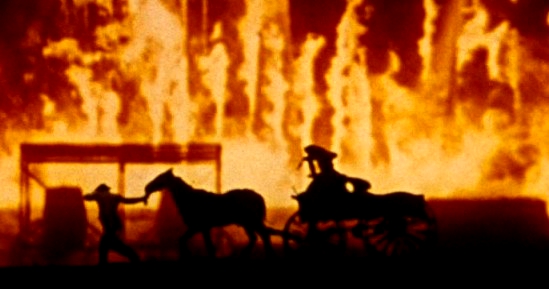
Atlanta burning is one of those images.
Rereading Scarlett's mad dash with Rhett, Melanie, Prissy and kids through the burning warehouses was actually made more dramatic thanks to the movie.
Ahead of them was a tunnel of fire where buildings were blazing on either side of the short, narrow street that led down to the railroad tracks. They plunged into it. A glare brighter than a dozen suns dazzled their eyes, scorching heat seared their skins and the roaring, cackling and crashing beat upon their ears in painful waves.
It was impossible to read those words without the movie images accompanying every sentence.

But one of the big differences between the movie and the book is Will Benteen. As I was reading this section, I actually stopped to exclaim, "who the hell is Will Benteen?" I had forgotten all about him from my first read through of GWTW back in my twenties. And like young Wade, Scarlett's baby to Charles Hamilton, he's cut from the movie completely! It is in fact, Will (& not Mammy) who holds Scarlett back when Melanie rushes down the avenue into Ashley's arms at the end of chapter 30.
Eventually all the family found their way into Will's room to air their troubles - even Mammy, who had at first been distant with him because he was not quality and had owned only two slaves....gradually, unobtrusively, a large part of the burden of Tara shifted from Scarlett's shoulders to the bony shoulders of Will Benteen.
I'm now very, very curious to see what happens with the Benteen storyline in future chapters. Why did Mitchell include him in the story? And why was he ditched in the movie?


During this section, Scarlett undergoes a huge period of personal upheaval and growth. She starts off needing her mother's love and strength to get her through, but Ellen's death rocks Scarlett to her very core. She is on her own, and she feels there is no-one for her to lean on or to ask for help. She pushes her grief to one side and gets stuck into the hard work of repairing Tara and finding food to feed everyone. She comes to challenge Ellen's views:
Nothing her mother had taught her was of any value whatsoever now and Scarlett's heart was sore and puzzled....'Nothing, no, nothing, she taught me is of any help to me! What good will kindness do me now? What value is gentleness?
And even when Grandma Fontaine pulls her aside to tell her thats it's,
'very bad for a woman not to be afraid of something....there's something unnatural about a woman who isn't afraid...Scarlett, always save something to fear - even as you save something to love...'
Scarlett ignores the advice and fails to see how Grandma Fontaine's story might help her. So even though Scarlett has learnt a lot about being strong and independent, she still fails to see any perspective but her own. She belittles Carreen's heartbreak, finds Frank's love for Suellen incomprehensible and feels annoyed at Melly because of her ability to "grasp more of situations than she herself did."

At the same time, several events allow Scarlett to somewhat grudgingly see how strong Melly really is underneath her quiet, gentle nature.

What do you think of Scarlett's choices during this section?


As an aside, did you know that Mitchell got the name for her book from a line in one of her favourite poems? And did you spot Mitchell's use of 'gone with the wind' in this section of the book as well?

Non Sum Qualis Eram Bonae sub Regno Cynarae

    (I am not as I was under the reign of the good Cynara - Horace)

    LAST night, ah, yesternight, betwixt her lips and mine
    There fell thy shadow, Cynara! thy breath was shed
    Upon my soul between the kisses and the wine;
    And I was desolate and sick of an old passion,
    Yea, I was desolate and bowed my head:
    I have been faithful to thee, Cynara! in my fashion. 

    All night upon mine heart I felt her warm heart beat,
    Night-long within mine arms in love and sleep she lay;
    Surely the kisses of her bought red mouth were sweet;
    But I was desolate and sick of an old passion,
    When I awoke and found the dawn was gray:
    I have been faithful to you, Cynara! in my fashion. 

    I have forgot much, Cynara! gone with the wind,
    Flung roses, roses riotously with the throng,
    Dancing, to put thy pale, lost lilies out of mind;
    But I was desolate and sick of an old passion,
    Yea, all the time, because the dance was long;
    I have been faithful to thee, Cynara! in my fashion. 

    I cried for madder music and for stronger wine,
    But when the feast is finished and the lamps expire,
    Then falls thy shadow, Cynara! the night is thine;
    And I am desolate and sick of an old passion,
    Yea, hungry for the lips of my desire:
    I have been faithful to thee, Cynara! in my fashion.
    Ernest Dowson

Just in case Corinne is unable to host the next chapter check-in, TJ from My Book Strings has indicated that she can lead us through chapters 31-40. Until then, please feel free to leave your GWTW related posts in the linky below.
I'm using #gwtwreadalong on Instagram if anyone wants to post pics of where they're reading GWTW.

Schedule:


Friday May 1: first post – just to enthuse about how excited we are to begin. 
Saturday May 16: first check-in on Chapters One through Ten
Saturday May 30:  check-in on Chapters Eleven through Twenty
Saturday June 13:  check-in on Chapters Twenty-One through Thirty
Saturday June 27:  check-in on Chapters Thirty-One through Forty
Saturday July 11:  check-in on Chapters Forty-One through Fifty
Saturday July 25:  check-in on Chapters Fifty-One through Sixty
Saturday August 1:  check-in on Chapters Sixty-One through Sixty-Three (final discussion)

Friday, 13 March 2015

Testament of Youth by Vera Brittain

Reading Vera Brittain's memoir about her years as a VAD nurse during WW1 was a far more intense and bittersweet experience than I first anticipated.

I have tried to write this review several times this week but I've struggled to find the right tone.


Testament of Youth is a sombre book and my attempted reviews so far have reflected this. But unlike Brittain I have been unable to claim the tags, "sad but beautifully written", or "heartbreaking yet eloquent"!

This is a story full of beauty and ugliness. It is deeply personal yet restrained. It is insightful, intellectual writing encased in emotional honesty.
It's a slow, compelling read, with a lot to absorb.

Testament of Youth was also part of my Reading England challenge.

Although Vera's adult years were spent between Oxford and London (as well as nursing overseas), her teenage years were in Buxton. And it was in Buxton that she first met Roland....

Buxton is near Manchester in the spa district of Derbyshire. Built on the River Wye with a geothermal spa nearby, it was made famous by the patronage of the Darwin's & Wedgewood's.

Vera's father worked in a local pottery mill. Her feelings about Buxton were of a love/hate kind.

"but in those years when the beautiful heather-covered hills surrounding Buxton represented for me the walls of a prison." pg 38

"Buxton, which my father used to describe as 'a little box of social strife lying in the bottom of a basin,' must have had a population of about twelve thousand apart from the visitors who came to take the waters." pg 38

Buxton Pump Room 1890-1900
It was in Buxton that Vera and her family sat out the wait to see if the world was going to war or not. 

"Later, on my way home, I found the Pavilion Gardens deserted, and a depressed and very much diminished band playing lugubriously to rows of empty chairs." pg 75

"It was the last Christmas we spent together as a family, and the unspoken but haunting consciousness in all our minds that perhaps it might be, somewhat subdued the pride with which we displayed him to our acquaintances in the Pavilion Gardens." pg 89
Buxton Pavilion 1910


Buxton & surrounds also witnessed the early scenes of Vera & Roland's romance.

"After tea we walked steeply uphill along the wide road which leads over lonely, undulating moors through Whaley Bridge....This was 'the long white road' of Roland's poems, where nearly a year before we had walked between 'the grey hills and the heather', and the plover had cried in the awakening warmth of the spring. There was no plover there that afternoon; heavy snow had fallen, and a rough blizzard drove sleet and rain into our faces." pg 104

Whaley Bridge
From Buxton, Vera watched the young men marching off to war, feeling more & more frustrated at her own lack of activity and purpose.

"...the mobilisation order on the door of the Town Hall; I joined the excited little group round the Post Office to watch a number of local worthies who had suddenly donned their Territorial uniforms..." pg 75


Buxton WW1
"In the early morning we walked to the station beneath a dazzling sun, but the platform from which his train went out was dark and very cold....I watched the train wind out of the station and swing round the curve until there was nothing left but the snowy distance, and the sun shining harshly on the bright, empty rails." pg 106

Brittain describes the constraints and provincialism of small town life to a tee. While she could appreciate the natural beauty of the area, it was never going to be enough to hold someone who was so fiercely determined to live an intellectual, independent, active life.

There is so much more to say about this book as it discusses feminism, academia, the League of Nations & politics. Brittain comments on the values of peace, duty, despair, resilience, remembrance & honour. I could go on & on & on....but the best thing for all of us is for you to simply read this exatrordinary story yourself!

I highly recommend Testament of Youth for lovers of great memoirs. This is one you wont forget in a hurry.