Showing posts with label Graphic Novel. Show all posts

Friday, 4 September 2020

Heartstopper Vol 2 & 3 | Alice Oseman #GraphicNovel


After thoroughly enjoying my time with Charlie, and his new boyfriend Nick in Heartstopper Vol 1, I knew I had to complete the trilogy to see how things turned out for them. 

The being in love part turns out to be pretty easy for these two sweet guys in Heartstopper Vols 2 & 3. The hard part is coming out to everyone at school. 

Last year Charlie was badly bullied when some kids at school found out he was gay. Naturally he's reluctant to be the centre of school gossip once again. For Nick, things are a little more complicated. He likes girls, and now he also realises he likes guys. As the captain of the football team, this is not an easy thing to come to terms with. How does he tell his family that he's bisexual and what if he gets bullied like Charlie did last year?

By the end of Vol 2, Nick has told his mum, and together, they have told a few close friends.

Vol 3 sees the boys very excited, planning a school trip to Paris. There's a lot of cute stuff about them working out how to be good boyfriends to each other, how to talk openly about what's going on for them, how they feel etc.

They tell a few more people, and realise that most people are cool with them being together. The Paris trip goes well until Charlie faints one day at the Louvre, and Nick starts wondering what else is going on for Charlie.

Oseman leaves us with a cliff hanger in Vol 3 as we see Nick google what he suspects is Charlie's problem, which leaves ME to assume that a Vol 4 is in the works! Huzzah!

This is pure teen romance from start to finish.
Sweet, gentle and awkward. 

Thursday, 4 June 2020

Heartstopper Vol 1 | Alice Oseman #GraphicNovel


How can someone so young be so successful already? Alice Oseman has been a YA publishing sensation for 6 years now. She was only 19 when her debut YA novel, Solitaire first appeared. 

Solitaire is narrated by Tori Spring 'a pessimistic...teenage speed skater with a penchant for solving mysteries'. The story is all about her, but Tori's younger brother, Charlie and his doting boyfriend, Nick appear in the background. 

As time went by, Oseman found herself wondering how it was that Charlie and Nick actually got together. Their back story grew out of sketches she drew when she should have been studying for her A-Levels.

A couple of years later, she launched Heartstoppercomic on tumblr.

Heartstopper Vol 1 was first published as a Kickstarter project in 2018. Hodder and Stoughton then published it in 2019.

I give you this much author detail, because all I can really say about this charming, heart-warming graphic novel is how much I loved it. It's sweet and cute and full of gentle, awkward teen romance. Charlie knows he is gay. Nick is still working it out. Meeting Charlie changes everything, for both of them. 

Oseman has created a story that feels authentic and timeless. And there are two more volumes to follow. 

The final pages include some costume (uniform) notes plus character guides that include birth dates, gender, Hogwarts house and Myers-Briggs Type Indicator. Lots of fun and highly recommended for anyone who loves love.


Saturday, 14 December 2019

The Adventures of Alexander von Humboldt by Andrea Wulf & Lillian Melcher

From the New York Times bestselling author of The Invention of Nature, comes a breathtakingly illustrated and brilliantly evocative recounting of Alexander von Humboldt’s five–year expedition in South America. Humboldt (1769-1859) was an intrepid explorer and the most famous scientist of his age. His restless life was packed with adventure and discovery, but his most revolutionary idea was a radical vision of nature as a complex and interconnected global force that does not exist for the use of humankind alone. 
To celebrate Alexander von Humboldt’s 250th birthday in 2019, Andrea Wulf partners with artist Lillian Melcher to bring this daring expedition to life.Inspired by his diaries, plant specimens, engravings, sketches, maps and drawings, Wulf tells this story from a completely new perspective, revealing a man who was not only the most famous scientist of his time, but who also believed that the arts and sciences were intrinsically connected. Melcher’s stunning illustrations bring alive Humboldt’s adventures, from his dangerous river journey along the Orinoco to his spectacular climb of Chimborazo. 
The Adventures of Alexander von Humboldt tells a story of hardship, danger, excitement and discovery, but also of Humboldt’s encounters with the natural world, the indigenous people of South America and his early warnings of harmful human-induced climate change. The result is a lush and thrilling journey of discovery through Humboldt’s years in South America.

I wanted to love this book so much.

I adored Wulf's The Invention of Nature when I read it three years ago. It is still one of my all-time favourite non-fiction books, which is why I hunted down the graphic version when I heard about it a few months ago.

I'm happy to tackle non-fiction graphics thanks to the marvellous Radioactive: Marie and Pierre Curie by Lauren Redniss. It you're not really sure how beautiful and informative a scientific biographic story can be, then Radioactive may just be the one to convert you. This was my benchmark when I started The Adventures of Alexander von Humboldt.

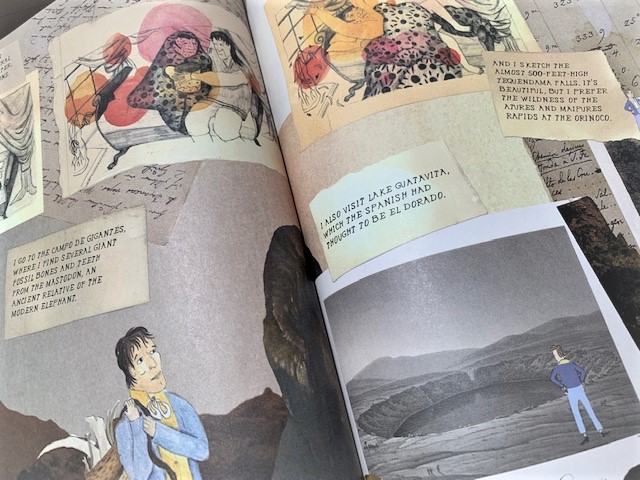
The book is an over-sized hardback, printed on quality paper. It's a joy to hold and Melcher's collages are glorious. She used many of Humboldt's maps, engravings and illustrations to create the backdrops. Letters, diary entries, notes and sketches, herbarium specimens are also superimposed into many of the pages. There's a lot to look at in these details. It was a great way to present some of the information.

But I struggled with the information font that capitalised EVERY SINGLE LETTER AND WORD. It felt like they were shouting at me the whole time. (Yes, I know that most graphic novels use capital letters, it's supposed to make it easier to read...when reading someone else's handwriting. But if you're using a typeprint, then surely there is no need for this standard?)

And I REALLY struggled with the portrait drawings of Humboldt, Bonpland and the other characters as well as the speech bubbles attached to them. They lacked substance. The figures were lifeless and expressionless. The dialogue was dull and failed to add anything to the story. In fact, the dialogue often repeated the information provided in the text. It was also often hard to know which speech bubble to read first. By the end of the book, I still couldn't remember which one was Humboldt and which one was Bonpland; their personalities never came alive.

Melcher's design was often quite striking but sadly, most of her watercolours and sketches left me cold. I preferred the pages with less stuff (i.e. less figures and more collage).


It was a grand idea to turn Humboldt's story into a graphic non-fiction, but sadly the final result was less than grand. Rookie mistakes, I suspect - 'How hard can it be to make a graphic book?' A lot harder than you might think.

The graphic novels I've read and loved over the years are the ones that make you feel something. They make connections; they go on an internal journey as well as the physical one. They make you forget that you're looking at 'cartoon' figures; they take on a life of their own. When they speak, they have something meaningful to say. Even the non-fiction ones.

Beautiful, arty graphics are possible - think Shaun Tan and Neil Gaiman - as well as most of the picture books I've featured on this blog. However it's a lot harder to get the synchronicity between the text/dialogue and the illustrations just right - a lot harder than most people think.

I admire Wulf & Melcher for their intent, but I wish they had taken more time to develop their graphic book technique.

If you really want to know about this amazing scientist who was way ahead of his time, then read Wulf's The Invention of Nature: The Adventures of Alexander von Humboldt, the Lost Hero of Science (2015). You won't be sorry.

Wednesday, 12 December 2018

Australian Junior Fiction Catch Up

The run into Christmas and the silly season, leaves me tired, frazzled and depleted most years. This year I'm attempting a calmer, kinder approach. As a first line of defence I started interspersing junior fiction reads amongst my regular reads several weeks ago. I've been saving all the interesting looking ones for months now, so that I would have something 'just right' for this time.

Great junior fiction is the perfect antidote for the general madness and mayhem of the silly season. It's (usually) light and easy to read, sometimes interspersed with delightful illustrations and (usually) full of wonderful language. And almost all writers for younger people feel duty bound to end with hope. Bad and sad things may happen to their characters along the way, but there is always hope and wonder and love.

The Slightly Alarming Tale of the Whispering Wars by Jaclyn Moriarty is book 2 in her newly named Kingdoms and Empires series. The name of the series didn't make an appearance on the first book, so I was curious to see what this might mean for book 2 and any future books.


I loved Book 1 The Extremely Inconvenient Adventures of Bronte Mettlestone by Jaclyn Moriarty and had very high hopes for this one, so I was a little disconcerted to read the first few chapters with no Bronte in sight.

What was going on?
Where were we?
And who were all these new people?

The first couple of pages of this generously illustrated book show us maps of the various kingdoms within this world. Some of these names were familiar from Book 1, but other than the whispering element, nothing else seemed familiar.

TSATOTWW begins in the little town of Spindrift where we meet two groups of kids - one group from the orphanage, the other from an expensive, exclusive boarding school. A friendly sporting rivalry between the two schools quickly blows up when one of the children suddenly disappears. The Whisperers have kidnapped another child.

A tentative alliance is formed, a plan of rescue is hatched and Bronte makes an unexpected reappearance. Mystery, adventure and a little bit of magic is the name of the game.

I love this series for mature 9+ readers a lot and I hope that Moriarty has many more books planned for the Kingdoms and Empires. Due to the different time frame and setting in this book, it could be read as a stand-alone story, but you'll want to go back to see how Bronte came into the story in the first place. It was a savvy move by Moriarty to expand the horizons and history of this series to include the entire kingdom and I look forward to seeing where and when we end up next.

Inheritance by Carole Wilkinson is for slightly older readers - more 11+ through into the early teen years. It's a fabulous time slip story set in country Victoria.


Nic has been left by her dad at her Grandad's old homestead property while he goes off with his band to play the cruise ship circuit. With no wi-fi, no friends and loads of attitude, Nic starts exploring the big old home one room at a time. Eventually she discovers a locked room with no key in sight.

A fortuitous toe-stub whilst swimming in the dam and an old letter in a copy of Pride and Prejudice changes everything. Nic discovers dark secrets about her family history that have carry-over effects onto today's local history and her own family story.

Wilkinson weaves in indigenous issues, women's rights and early settler history into this engaging yet thought-provoking time travel story.

The Adventures of Catvinkle by Elliot Perlman is now top of my delightful dog story pile. Officially this is a book about a cat - the secret loving, baby shoe dancing, flying cat, Catvinkle, but it is also just as much about her new found friend (shhh! don't tell anyone that a cat and a dog are friends!) Ula the dalmatian.


Set in Amsterdam, Perlman (you may know him from his adult books, especially Seven Types of Ambiguity and The Street Sweeper) has turned the bedtime stories he used to tell his kids into a charming animal story for us all to relish.

There are LOTS of things to adore about this book, but the most endearing are the voices of Catvinkle and Ula. Perlman has got inside the heads of these two animals and they speak and act just as I imagine a cat and dog of these types would speak and act if they could!

The thing these three fabulous books share is complexity. The authors do not talk down to their young readers, they use interesting language, create nuanced, believable characters and they take you on a journey that is utterly compelling.

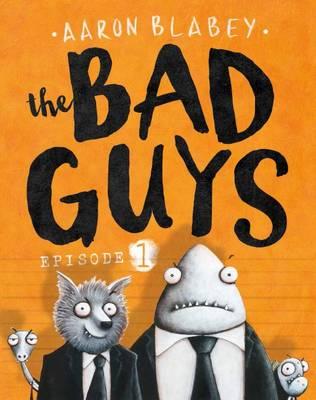
And then there is The Bad Guys Episode 8: Superbad by Aaron Blabey.

Personally, I'm getting pretty tired of their antics by now, but they continue to entertain and get 5-7 yrs old excited about reading, so I'm not going to complain too much.


After an excursion into outer space, then back in time to the dinosaurs, we are firmly back in the present with our world being taken over by the evil Mr Marmalade and his evil alien forces. And it wouldn't be the modern world without a female team of warriors to assist our bumbling bad guys.

In Superbad we learn that Agent Fox is actually part of a much larger, well organised group called The International League of Heroes. Her colleagues include Agent Kitty Kat, Agent Hogwild, Agent Doom, and Agent Shortfuse. They all have special talents and skills and they mean business. They help the Bad Guys learn control of their new super powers...until Marmalade turns up and throws everything into chaos...again!

Six Bad Guys' trading cards are in the back of the book, with 6 more promised to come in book 9. Blabey is onto a good thing, and he knows it!

Episode 1 The Bad Guys
Episode 2 Mission Unpluckable
Episode 3 The Furball Strikes Back
Episode 4 Apocalypse Meow

Sunday, 16 September 2018

The Complete Maus by Art Spiegelman

This is one graphic novel that really packs a punch.

The Complete Maus by Art Spiegelman is one man's journey to understand what happened to his father during WWII. It's obvious from the opening pages that what happened to Vladek during the war had a huge impact on everything that came after. His marriages, his relationship with his son, Art, as well as having deep, abiding influences over Art's life to this day.


Art began his cartoon in 1980. It was serialised in Raw, an avant-garde comic magazine published by Art and his wife, Françoise Mouly, until 1991. The comic reflects conversations that Art began having with his father in 1978 about his war experiences. The story moves between these events and the modern day, where we see Art & Vladek's troubled relationship play our during their meetings.

There is a lot of sadness and unhappiness in this story.
Near the beginning of this story (in a story within the story) we learn that a teenage Art had spent some time in a mental health facility. Art's mother then committed suicide when he was twenty. 
Vladek and Anja were married before the war and had a young son, Richieu, who died during the war. Vladek and Anja survived the Polish ghetto as well as their time in Auschwitz and Birkenau, before eventually moving to Sweden (where Art was born in 1948) and then in 1951 emigrating to the States. 


Spiegelman uses animals as a kind of metaphor throughout.
The Jews are mice, the Germans cats, the Polish are depicted as pigs (which created a controversial reaction when the book was translated into Polish in 2001) and the Americans are dogs. In a humorous meta-fiction moment in the story, Art and his wife are discussing how he should draw her as she is French. Should she be a frog? Françoise suggests a bunny rabbit, until they agree that since she converted to Judaism she should also be a mouse. I suspect there are whole websites, papers and articles dedicated to unpacking the meaning behind all of this, but I'm too tired to search them out right now! However, I did read that Art once said that using animals "allowed me to approach otherwise unsayable things." (MetaMaus: A Look Inside a Modern Classic, Maus)

The Complete Maus contains two parts. 
Part I: My Father Bleeds History was first published in 1986, four years after Vladek's death. This part ended with Art walking away angrily from his father after learning that Vladek had destroyed all Anja's diaries and letters after her death when 'one time I had a very bad day'.
Art finds it hard to forgive his father for this act of destruction. 

Part II: And Here My Troubles Began shows Art struggling to come to terms with his newfound fame thanks to the publication of Part I. He has a young family and is obviously still trying to manage his own depressive episodes. 

Both Art and his father suffered from versions of survivor guilt, with Art not only living with his own memories but the stories of his parent's memories as well. The ghost memory of his brother, Richieu haunts him as well. Part II is dedicated to him, along with Art's own children, Nadja and Dashiell. (I read Nadja's memoir I'm Supposed to Protect You From All This a couple of years ago - it was one of the best memoirs I've read in a long time.)


This Pulitzer Prize winning book is not an easy read or a comfortable one, but if you only ever read one graphic novel in your lifetime, make it this one.
It's emotionally rich and complex.
The simple drawings convey so much emotion by the end, that I defy anyone to be left unmoved by the final page of the book. But it's Vladek's words that are at the heart of this story. Despite their complicated relationship, Art allows his father's words to stand. He bears witness to Vladek's story in an attempt to find meaning in something that is beyond understanding.

Wednesday, 8 August 2018

Smile & Sisters by Raina Telgemeier

Smile and Sisters have been two very popular books at work with 11-14 year old girls. Now I see why. Raina Telgemeier has created two very personal, engaging stories from two significant events in her pre-teen years. Smile details her rather horrific orthodontic work, while Sisters not only features her relationship with her younger sister, but explores a period of time in her early teen years when their parents marriage was on the rocks.


Most of us have a ghastly orthodontist story from our childhood, but not many readers would be able to take on Telgemeier's lengthy, painful and traumatic experiences in the dental chair. Via her and artwork, Telgemeier shows us the ordinariness of teen life as well as the individual self-consciousness that infects most teens anywhere in the world. She explores image, belonging (I was so glad when she finally moved on from that first group of friends - they were awful) and embracing who you are.

It was a surprisingly touching coming of age story with bucket loads of courage and perseverance.

Sisters wasn't quite as success to my mind. Here Telgemeier explores why her relationship with her sister may have been strained throughout their younger years. It felt believable and authentic, but also a little like she was stretching to find another book.

We've all had those challenging relationships with siblings at different times, when two very different personalities constantly rub up against each in daily family life. Sometimes things improve when you're no longer living together under the one roof; sometimes things don't.

But the thing that can bring you together is shared fear and shared adversity - when you think your parents may be about to split up.

In this case, Raina gave her sister a draft of this story several years prior to publication for approval. She also allowed Amara a chance to share insights into her side of the story.

I'm not normally a big fan of graphic novels, but these two books were easy to read and I really liked the colourful artwork. The simple designs were capable of conveying quite a lot of emotion.


Smile was the winner of the Eisner Award for Best Publication for a Teen Audience in 2011 and a finalist for the Children’s Choice Book Award.

Sisters won the Eisner Award for Best Writer/Artist in 2015.

Books 15 & 16 of my #20BooksofSummer (winter) challenge - drop-in titles
25℃ in Sydney
16℃ in Northern Ireland
I read these books during the July #reversereadathon

Sunday, 17 June 2018

What To Do When I'm Gone by Suzy Hopkins & Hallie Bateman

I'm glad this is a book I don't actually need right now. What To Do When I'm Gone: A Mother's Wisdom to Her Daughter is exactly what it says it is. When Hallie had one of those moments during her early twenties when she suddenly realised that one day her mum would die, she felt devastated by this future loss. She discussed it with her mum, who promptly sat down to put together a list of things to do and not do in the event of her death.


Told in diary form with graphic style illustrations, Suzy proceeds to give advice on how to handle the days after she is gone. The first 8 days contain all the stuff Suzy feels a young woman would need to get through that phone call, that first day, the funeral. We then jump days to include things like that first birthday, the first dream as well as all those times when a young woman turns to her mum for support (the break up of a relationship, having kids of her own, changing jobs, growing older, bad days etc).


It's deeply personal, heart-breaking and so, so poignant. But it is also life-affirming, positive and feels very authentic. This book is designed to help younger women cope with loss and grief, but with an end date 20 000 days later, the advice and support within these pages could help anyone who has experienced death and loss. In a nutshell, it's resilience, memories and courage that will keep you going, keep you strong and keep you safe. Nothing unusual in any of that, but having it all together in a lovely book package can help it to feel like the great, big, warm fuzzy it sets out to be.

Even if you haven't lost someone close, reading books like this can prepare you a little for that time. In the middle of your grief, pages from this book may pop back into your mind to help you get through the next bit.

Book 5 of #20BooksofSummer (Winter) Drop-in title
16℃ in Sydney but the wind chill factor made it more like 7℃
15℃ in Northern Ireland

Thursday, 15 December 2016

The Bad Guys Episode 4 Apocalypse Meow by Aaron Blabey

I love this series of early readers so very, very much.

It's clever. It's fun. And it's a little subversive. It also follows the golden rule that a truly great, entertaining children's book is a truly great, entertaining book for adults as well.

Apocalypse Meow is the fourth book in Blabey's Bad Guys series.

We last saw our wannabe good guys facing off against the advancing kitten apocalypse unleashed by the evil genius Dr Marmalade.

In Apocalypse Meow our team of Sort-Of-International-League-Of-Good-Guys-Guys divides to conquer.

Mr Wolf, Legs and Snake venture forth with Agent Fox to find an antidote, while Mr Shark and Piranha head off to find Dr Marmalade's hideout.

As per usual, nothing quite goes to plan. A meeting with an ageing Granny Gumbo almost leads to the untimely end of Mr Snake. Dr Marmalade reveals that the zitten apocalypse was merely phase one of his plans. And his sudden disappearance in a rocket ship, shifts the action to a much higher plane.

Laughter, terror and ridiculous disguises keep the action rolling along nicely. Mr Wolf also finds time to do a little flirting with Agent Fox, as our good guys continue to escape from one crisis only to land in the next!

The promise of interstellar mayhem in Episode 5 might see our favourite Sort-Of-Good-Guys become the Intergalactic-League-Of-Good-Guys-Guys!

The Bad Guys are perfect for early readers who are gaining confidence with form and font or as a fun, fun read aloud with your favourite four year old.


Episode 1 The Bad Guys
Episode 2 Mission Unpluckable
Episode 3 The Furball Strikes Back
Episode 4 Apocalypse Meow

Thursday, 10 November 2016

The Bad Guys Episode 3 The Furball Strikes Back by Aaron Blabey

To my mind, Aaron Blabey can do no wrong!

His series of early readers featuring four of literature's bad guys trying to make good is consistently funny, smart and unexpected.

In Episode 3 The Furball Strikes Back, we find our four +1 bad guys coming face-to-face with the baddest, most evil of all creatures - Dr Rupert Marmalade, the guinea pig!

Mr Wolf, Shark, Piranha and Snake have now been joined by Legs, the Tarantula. There is growing dissension in the ranks about whether or not being good guys is really working for them.

Mr Wolf's constant cry of "It's time to be heroes!" is rubbing some of them the wrong way.

Falling into the evil clutches of the grandiose and rather mad Dr Marmalade only creates more friction amongst our lovable heroes.

In the background, though, there is another dark and mysterious character jumping about - will this illusive figure be a force for good or evil?

And how will our Bad Guys foil the dastardly plans of Dr Marmalade?

Episode 1 The Bad Guys
Episode 2 Mission Unpluckable
Episode 3 The Furball Strikes Back
Episode 4 Apocalypse Meow

Sunday, 14 February 2016

Reluctant Romantic - It's Complicated

Katie @Doing Dewey is hosting a challenge throughout February to encourage us to read a genre we tend to avoid.

This month I am reading graphic novels and discussing what keeps me from reading more books in this genre.

Today's discussion topic is "It's Complicated".

The idea is to discuss what has kept us from reading more of our chosen genre.

However my complications have taken a completely different turn this week. As it turns out, my genre has become complicated in a way that I didn't, or couldn't, predict.

As it turns out, my genre is NOT graphic novels as I originally thought, but some kind of weird hybrid that better fits the #librariansdilemma tag instead!

Is it graphic? Is it art? Is it non-fiction of fiction?

My genre is a booksellers nightmare - of the where on earth do I shelve this book? kind.

It's a story book and it's heavily illustrated or decorated, so much so that the artwork tells at least half of the story. But it's not a children's picture book. Adult themes and concepts are explored. There are no speech bubbles but conversations can take place.

Are you confused yet?

Perhaps if I show you what I mean....

Last week I read Radioactive: A Tale of Love and Fallout by Lauren Redniss. I thought it was a graphic novel, which is why I picked it out of my TBR pile.

But it wasn't; it was this -


- exquisite artwork on every page that told the story of Marie and Pierre Curie along with the text.

Which then reminded me that I had another part-read book somewhat like it by my bed -


- Shaun Tan's incredibly beautiful, haunting, grotesque clay works in The Singing Bones which depict various scenes from the Brothers Grimm fairy tales.

There's not a speech bubble in sight, and the art is the main focus of the story. Tan's creative interpretations challenge the reader/viewer to delve deeper into each of the tales hidden layers.

What is this genre?

Things at Brona's Books are not only complicated, but confused!

Saturday, 6 February 2016

Reluctant Romantic - Graphic Novels

Katie @Doing Dewey is hosting a Reluctant Romantic challenge throughout February. The idea is to embrace a genre that you normally avoid.

Our first post is called Genre Speed Dating - what genre are you getting to know this month? Why do you want to give it a chance?

February is going to be graphic novel month on Brona's Books.

When I was a kid, visiting my Nan and Pop in their wonderful old rambling home in Bellingen was a real treat for several, very childish reasons.

One: the old bikes and scooters that we would ferret out from under the house. My sisters and I then spent the holidays racing each other around the house on these tyre-less, rough as guts, rusty old, leftovers from my mother's childhood.

Two: the giant orange tree in the backyard that seemed to be permanently loaded with fruit. To access the fruit, we had to climb up Pop's old wooden ladder onto the roof of the shed. The roof was a sweet mushy crush of rotten fruit and leaves. Pop had made a hook for us to pull down the fruit from the top of the tree. We always shared some of the fruit with the chooks in the pen below. To this day the smell of overripe oranges instantly takes me back to this place and time.

Three: my uncle's old comic books lived in one of the bedside tables in mum and dad's room. They were a mix of Archie comics and Marvel superman and batman comics. They had the usual musty smell that all books in the tropical north develop over time. They were yellowed with age, but we loved them. We would divvy them up equally, then retreat to one of the daybeds scattered around the huge verandah to read them.

It's the only time I have read (and loved) comic books.

During my early highschool years I discovered the Tintin books - I loved their mix of history and irreverence.
But Asterix bored me. And that was the end of me and graphic books.

As an adult I have tended to look down my book-snobbish nose at all graphic novels as not being proper books and therefore not worthy of my attention.

My plans for February are to reach out to graphic novels to rediscover some of my childhood love.

I will be focusing on my strengths - history, classics, bio's and non-fiction.

Any suggestions are most welcome.

Wednesday, 25 November 2015

The Bad Guys Episode 2 Mission Unpluckable by Aaron Blabey

"Go be a hero"

What a great line.

Sadly for The Bad Guys (Mr Wolf, Snake, Piranha and Shark) their idea to show the world that they are, in fact, good guys hasn't quite gone to plan. News reports of their first event have completely misrepresented what actually happened.

They decide they need to do something more dramatic to show the world that they really are good guys - they decide to release all the caged chickens from the local chicken farm back into the wild. What could possibly go wrong?

The first problem for Mr Shark is the new bad guy turned good guy - I.T. genius Legs, the tarantula. As it turns out Mr Shark is terrified of spiders!

Mr Snake is also struggling to overcome his chicken eating tendencies and Piranha keeps being mistaken for tuna! But what will happen to our loveable bad guys when they finally meet up with a REALLY bad guy?

Full of Blabey's trademark humour, intelligence and quirkiness, Episode 2 is fun from start to finish.

Wednesday, 5 August 2015

The Bad Guys Episode One by Aaron Blabey

Do you have a reluctant reader in your house?

Then I may have found the perfect book for you to tempt them with.

Aaron Blabey has ventured away from picture book territory into early reader land with The Bad Guys: Episode One.

In an attempt to convince us all that the Big Bad Wolf is simply misunderstood, Blabey presents Mr Wolf (with a nod to Tarantino noir) as the narrator of this story about bad guys turned good.

Full of humour, intelligence and lots of fast pacing, the bad guys struggle to come to terms with their new and improved roles.

An unlikely partnership evolves as these traditional baddies get in touch with their kinder, softer sides!

Full of the trademark quirky Blabey style, easy to read format with large exciting fonts, oodles of pictures and quick chapters, The Bad Guys has award winning hit series written all over it.

Guaranteed to amuse children and adults alike.


Tuesday, 3 February 2015

Eat the Sky, Drink the Ocean edited by K Murray, P Dahr & A Roy

"In late 2012, Australia and India were rocked by violent crimes against young women. In Dehli, thousands protested against rape. In Melbourne, thousands stood vigil in memory of a young woamn raped and murdered walking home. The fate of all young women, what they should fear and what they could hope for were hot topics in the media around the world. Out of that storm rose the idea for this anthology."

Eat the Sky, Drink the Ocean is a collection of short stories & graphic novels aimed at the teen/YA market, packaged within one of the best covers I've seen for a long time!

As often happens with such a wide-ranging group of authors & illustrators, some of the pieces work better than others, depending on the type of story you normally find yourself drawn to.

Swallow the Moon by Kate Constable & Priya Kuriyan is a graphic novel that follows a small group embarking on a female initiation ceremony. Set in a future world with glimpses of what happened to the old ways, the feminine spirit is ultimately celebrated by the whole tribe.

Justine Larbalestier's evocative story called Little Red Suit is about a futuristic fairy-tale Sydney, while Anita Roy tantalises us with a time-travelling Masterchef contest in Cooking Time.

Cast Out by Samhita Arni combines banishment, fear & suspicion with magic and a world that is, eventually, safe for all women to live in. Margo Lanagan's Cat Calls reminds us of the power of friendship (between girls and boys) to overcome prejudice and bullying.

And, finally, Nicki Greenberg in Back-Stage Pass reminds us at the end that all women have the power to write, or re-write their own stories.

Published by Allen and Unwin, February 2015.

Wednesday, 4 December 2013

Jane, The Fox and Me by Fanny Britt & Isabelle Arsenault

I'm not a huge graphic novel aficionado, but every now and again, one comes along that grabs my attention.

Maybe it had something to do with the Jane Eyre reference or maybe it was the rave review from the rep that had stuck in my mind, but when I saw this book displayed on our shelves, I knew I just had to read it.

Helené is a recently rejected girl at school. Once popular with friends, she suddenly finds herself on the outer. She is taunted, teased and bullied.

Her loneliness, confusion & sadness are beautifully depicted in the grey wash illustrations by Arsenault. This is a graphic novel that is still also a picture book at heart.

The thing that keeps Helené going, that offers her respite from the taunts, that fills the void of friends, is books.

And one book in particular speaks to her - Jane Eyre.

All of a sudden we turn the page to find a little bit of Jane Eyre's story as seen through Helené's eyes.

The illustrations change - we see colour, lovely old-fashioned fonts & we also see hope.

Helené sees Jane as a kindred spirit - a connection is made through the pages of the book. Through Jane, Helené feels understood. Jane's story not only gives Helené respite, but hope.

During a ghastly school camping excursion, Helené spies a fox in the woods.

She reaches out & makes a connection with the fox.

This encourages her to make a connection with one of the other girls, Géraldine, also on the outer with the popular group.

There is nothing particularly new or earth-shattering about this classic tale of bullying & loneliness.

Or the redemptive power of a good book.

But Jane, The Fox and Me is told so tenderly that I defy anyone to resist its charms.

I certainly couldn't!

Fanny Britt is from Quebec.
The book was translated into English by Christine Morelli & Susan Ouriou.

This book has mature themes but would be suitable for good 10+ readers as well as high school students.